/pic4269471.jpg)





























NEOM Deep Dive
What the Community Thinks About NEOM
NEOM has quietly built a small but enthusiastic following, with multiple hosts admitting most people have not heard of it even as they rank it highly. Rahdo Runs Through placed it at number 80 on a personal top-100 countdown and called it something that stood out even though it never got much buzz, while The Broken Meeple folded it into a filler-focused anthology episode and still gave it a detailed, mechanics-first treatment usually reserved for bigger releases. Getting Games went further across two separate videos, reporting they had been very impressed with NEOM and that everyone they introduced it to had enjoyed it, and later said they wanted to play it more and found it different enough from Keyflower to be worth owning both.
The comparisons to Seven Wonders come up constantly, and not everyone agrees on how big a departure that makes NEOM. The Broken Meeple argued people compare the two left, right, and centre for good reason, since the drafting structure and card-to-tile swap are close enough that knowing one means mostly knowing the other. Rahdo pushed back on that framing somewhat, agreeing there are overlaps in vibe but insisting the solo and two-player draft makes it its own beast rather than a reskin. Board Gaymes James split the difference with a shorthand description of the game as SimCity meeting Seven Wonders, and the city-builder half of that comparison resonated separately with Gaming with Edo and Jessica, both of whom connected it to childhood memories of SimCity 2000.
Core Mechanics That Define NEOM
Drafting Tiles That Cannot Rotate
Rahdo Runs Through described NEOM as a tile-laying game where players build a city of the future on a small grid, and singled out the incredibly harsh restriction that tiles cannot be rotated once drafted. Because every tile carries road segments that must connect back to the city centre, that fixed orientation turns each draft pick into a spatial puzzle rather than a simple resource grab. The Broken Meeple broke down the drafting loop itself: players work through rounds of eight tiles the way Seven Wonders works through rounds of eight cards, building a personal layout and scoring at the end of each round, but tied specifically to road networks that have to reach the centre tile no matter which direction a player builds.
Cornerstones and a Custom Resource Economy
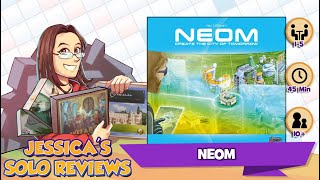
Gaming with Edo and Jessica's solo-mode walkthrough explained that players draft from a set of thirty cornerstone tiles at the start, with most games using only three of them to shape what matters that session. Jessica also highlighted how the resource system avoids pile-up, since producing a good only requires taking a single token as an indicator rather than collecting a growing stash. The Broken Meeple described a similar version of that economy from the competitive game: tiles that generate income or resources work like the trading system in Seven Wonders, except a player simply has to produce a good to use it instead of needing a set quantity of tokens on hand.
The NEOM Experience
Palpable Tension Over Every Placement
Rahdo described the no-rotation rule as the source of a lot of really incredibly palpable tension while grabbing new tiles and figuring out how best to place them, since a single wrong pick can box a player's road network into a corner. The Broken Meeple echoed that same pressure from the other side of the table, explaining that a tile can look perfect for scoring factory points and then turn out impossible to place because the roads will not line up or the tile cannot be rotated into position, which they called frustrating in a good way that adds another layer of decision-making on top of the base drafting.
A Quick, Replayable City Builder
Jessica's solo mode ran through a full city build in roughly twenty minutes, driven by draft piles that can be customized by player count so no two sessions pull from the same stack of tiles. They called the resulting variety and variability huge, with thirty cornerstone tiles ensuring different games emphasize different strategies. Getting Games backed up that replay value from the multiplayer side, describing sessions where players pursued completely different approaches, from stacking resource-producing factories to building an idealized residential skyline, and still ended up in a close race.
What Makes NEOM Stand Out
A Genuine Seven Wonders Alternative
Rahdo pointed to a designer diary in which the creator said they wanted to fix Seven Wonders, and while that is a bold claim, Rahdo agreed the solo and two-player draft bucks the trend of simple hand-passing seen in so many other drafting games and called it very unique and very satisfying. The Broken Meeple arrived at a similar verdict from a more skeptical starting point, admitting the road-network twist makes NEOM meaningfully different rather than a simple reskin and landing on it as a nice little city alternative to Seven Wonders worth keeping on the shelf alongside it.
SimCity Nostalgia in Tile Form
Jessica built their entire pitch around nostalgia, saying NEOM reminds them of SimCity 2000 and that the zones, resources, and growing skyline recreate that feeling far more smoothly than the power lines they could never get working in the original video game. Gaming with Edo and Jessica's second host echoed the same comparison independently on a separate list, and Board Gaymes James reached for the identical touchstone, describing the game as a blend of SimCity and Seven Wonders built around shared resources that create direct interaction between opponents.
Potential Drawbacks
A Rough Introduction to the Rulebook
The Broken Meeple was the most pointed about this, calling out the iconography and the reference guide as genuinely hard to parse, with a wall of color-coded text that is difficult on the eyes even before factoring in the cornerstone tiles, whose unique abilities are harder to understand than the standard set. They suggested printing extra reference sheets for every player just to keep the first few turns moving. Board Gaymes James raised a more physical complaint, describing the components as heavy and somewhat tedious to transport compared to lighter games in the same city-building space.
A Disaster Mechanic That Divides Opinion
The Broken Meeple spent real time on the disaster tiles, tower fire, flood, and crime spree, which sit in the draft pool and force a choice between ignoring them or playing them to punish opponents. They called the crime spree tile in particular a bit too powerful, strong enough on its own to win games, and said the designer has gone on record on BoardGameGeek defending the choice even though a lot of players are not fans and have started building their own variant rules to soften it. Rahdo's own pros and cons list flagged the same default rules as capable of turning cutthroat once those disaster tiles start coming out of the draft.
If You Enjoy NEOM
The Broken Meeple and Rahdo Runs Through both reached directly for Seven Wonders as the closest comparison, pointing to the shared drafting structure even as they argued NEOM's road-network puzzle makes it its own game rather than a clone. Gaming with Edo and Jessica and Board Gaymes James separately landed on SimCity 2000, describing NEOM's zones, resources, and growing skyline as the tabletop version of that same city-building feeling.
What Reviewers Are Saying
"The interesting thing about this game is the designer, he did a a call designer diary years ago talking about how he wanted to quote fix Seven Wonders, which is a bold statement. Now, which means there are things he did very very differently. This has the Seven Wonders style thing of, hey, if I don't have the resources I need, I can borrow from my neighbors to the left or my right. This is a drafting game as well."
— Rahdo Runs Through
"Other than that, the rulebook is relatively easy to follow, although I will argue that there's probably a bit too much text. They could have thrown in a few more pictorial examples, so maybe learning your first game will be a little bit hit and miss, and certainly people are gonna be constantly checking that rulebook for ideas and what the various things do."
— The Broken Meeple
"Huge amount of variety there and variability, tons of choices, and I highly highly recommend Neon as a great kind of either a tile lane game or a city builder, or if you are like me and remember SimCity 2000, Neon is very similar to the board game version of it."
— Gaming with Edo & Jessica