







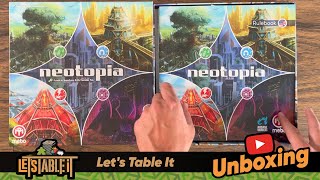

Neotopia Deep Dive
What the Community Thinks About Neotopia
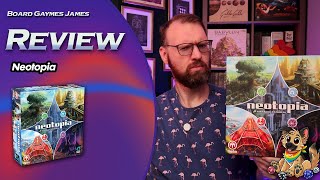
Neotopia has earned respect from reviewers as a well-crafted tile-placement puzzle that rewards both strategic thinking and deliberate spatial planning. Board Gaymes James highlight its clever, interlocking scoring, Allies or Enemies appreciate the way it forces players to spread their attention, and Let's Table It frame it as an intuitive, puzzle-like pattern builder. The game resonates most with newcomers to the hobby and players who enjoy multi-faceted scoring, and while reviewers concede the abstract theme does little for immersion, they consistently praise its mechanical elegance and accessible learning curve.
Core Mechanics That Define Neotopia
Pattern Matching and Tile Placement
At its heart, Neotopia tasks players with building patterns across three districts of the board. On a turn, a player either places a tile from an adjacent factory or drafts a card into hand, and the cards display patterns players try to recreate through placement. Let's Table It describe it cleanly as a puzzle-like pattern-building game using action points, hand management, and tile placement, where each card shows a pattern and you place tiles to complete it. Completing a pattern scores the card immediately without spending an action, and a restriction preventing identical cards in the same district pushes players to build creatively rather than repeat the same trick.
Compound Scoring Across Three Districts
Neotopia's most distinctive mechanic is its compound scoring, where the three districts score independently and a player's lowest-scoring district is multiplied before being added to the total. Board Gaymes James single this out as the source of the game's most interesting balance, since the smallest district scores several times over, forcing players to diversify rather than pour everything into one region. Points come from completing pattern cards during play and from contiguous groups of matching tiles at the end, so every placement carries weight both immediately and at the final tally, rewarding forward thinking over opportunism.
The Neotopia Experience
Fast, Accessible, and Puzzle-Focused
Neotopia plays quickly and intuitively, which makes it accessible to newer gamers, with a two-player session finishing in well under an hour. The turn structure is simple enough to grasp after a few rounds, yet the puzzle of where to place and what to draft feels meaty. Let's Table It note how intuitive the simple actions are and how satisfying it becomes to pull off a strong combo, especially as players discover the bonus tokens. The game encourages spatial reasoning and drafting awareness in equal measure, delivering real cognitive engagement without tipping into analysis paralysis.
Table Presence and Component Quality
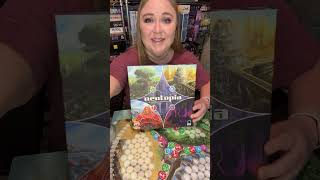
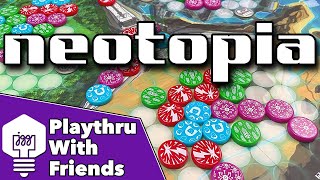
The physical components elevate Neotopia's appeal. Allies or Enemies single out the colorful circular tiles as the standout, terrific to handle and clearly printed so that pattern matching stays unambiguous regardless of orientation. The card stock is sturdy and the patterns are easy to read. That said, the presentation serves the puzzle more than it conveys theme; the table looks bright and inviting, but players will recognize Neotopia as a well-executed mechanical puzzle rather than a narrative experience.
What Makes Neotopia Stand Out
A Diversity Rule That Reshapes Strategy
One rule truly distinguishes Neotopia: the restriction preventing the same card from being played twice in the same district. This is not mere flavor; it acts as a strategic governor, pushing players to build in all three zones rather than chase a single high-scoring path. Reviewers note the restriction lands with more impact than expected, frequently forcing a pivot when an opponent grabs the card they were setting up for. It adds frictional depth without bloating the teach.
Compound Scoring That Demands Balance
The multiplication of the lowest district is the mechanical centerpiece that lifts Neotopia above standard tile-layers. Instead of chasing the biggest numbers, players must constantly assess where they are weakest and decide whether to shore up a deficit or build on a strength. Allies or Enemies call out exactly this, praising how the game makes you split your attention because the lowest district is the most important, which creates meaningful tension on nearly every turn.
Potential Drawbacks
Theme Takes a Backseat to Mechanics
Neotopia's abstract nature is its most consistent criticism. The game nominally involves developing a bright future city, yet little in the tile placement or iconography creates a cohesive sense of building something. The colors are vibrant and the components are well made, but they are tools in a puzzle rather than ambassadors of theme. Reviewers who embrace abstracts will not mind, but the gap means Neotopia is unlikely to win over theme-first players or give younger players a narrative to latch onto.
Variable Engagement Across Player Counts
Neotopia shines brightest at three to four players. At two, the puzzle becomes more predictable, since neutral options can be taken without directly helping an opponent, which reduces the decision tension. Allies or Enemies note that more players means more spanners in the works, with every opponent's turn becoming a potential blocker that forces adaptation. For couples the game still satisfies, but it is undeniably more engaging as a fuller group experience.
If You Enjoy Neotopia
Players drawn to Cascadia will recognize kindred spirits in Neotopia's tile-placement foundation and spatial reasoning. Those who love the tactile, pattern-matching satisfaction of Azul will find Neotopia's circular tiles equally pleasing to manipulate. Calico offers a comparable spatial puzzle where adjacency and pattern completion drive scoring, and for accessible, replayable scoring without heavy rules overhead, Sushi Go! shares the card-drafting awareness woven through Neotopia's tile play.
What Reviewers Are Saying
"The real uniqueness with the scoring is that each district scores separately, and the smallest district that you have is going to score three times, so it's a really interesting balance to make sure you are diversifying."
— Board Gaymes James
"I really like the mechanic of needing to do well in each of the three different zones, because it's your lowest one that's the most important. Any game that makes you split your attention I find really interesting, because you have to diversify. It's a light abstract game for an audience that's perfectly happy with a really abstract theme."
— Allies or Enemies
"Neotopia is a puzzle-like pattern building game using action points, hand management, and tile placement. Each card has a pattern listed on it, and you're trying to place tiles to complete the pattern shown on that card."
— Let's Table It