



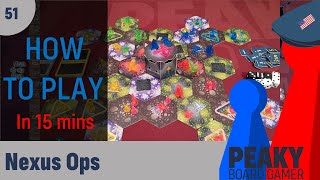















Nexus Ops Deep Dive
What the Community Thinks About Nexus Ops
Reviewers across Meeple University, Watch It Played, Board Game Critique, and The Dice Tower consistently praise Nexus Ops as an accessible, fast-paced alternative to heavier area control games. The Renegade 2024 edition has won particular affection for combining the glow-in-the-dark appeal of earlier versions with refined rules and artwork. The game resonates most with groups seeking dramatic moments and table interaction rather than pure tactical optimization, positioning it as a bridge between party-friendly chaos and genuine strategic play.
Core Mechanics That Define Nexus Ops
Area Control Through Conquest
Nexus Ops structures itself around competing to control the moon's hexagonal landscape and the powerful central monolith. Players establish presence by deploying units, moving across the modular board, and engaging in battles that determine who controls valuable territories. Unlike traditional area control games where positioning is everything, Nexus Ops rewards the player who acts boldly to attack and secure spaces rather than the one who defends cautiously.
The monolith serves as a focal point of power, granting additional card draws to whoever controls it. This creates a feedback loop where aggression is rewarded with resources, encouraging a playstyle of constant engagement rather than safe optimization.
Dice-Based Combat and Variance
Combat in Nexus Ops embraces chaos through a streamlined dice resolution system. Units roll according to their type and strength, with humans requiring a six to hit while dragons need only a two. Both players roll simultaneously, and successful hits force the opponent to choose which unit to lose, creating agonizing decisions in the moment. Combat lasts only one round per battle, meaning contested spaces remain split across multiple turns as players jockey for position.
This one-round-per-turn limitation means a victorious attack does not guarantee permanent territory control. A player might win a battle, seem poised to dominate, and find themselves pushed back on the next opponent's turn. The high variance keeps games tense until the final round and creates the memorable swings that reviewers highlight as Nexus Ops' greatest strength.
The Nexus Ops Experience
High-Variance, High-Chaos Combat
Nexus Ops delivers deliberately unpredictable battle outcomes. Superior forces can still lose to lucky dice rolls, and a carefully planned three-turn strategy can collapse on a single bad roll. Rather than punishing this variance, reviewers celebrate it as liberating. The game makes clear that winning battles matters less than winning the right battles for points, a distinction that makes losses sting less and comebacks feel genuine.
The experience differs sharply from chess-like precision war games. Players describe moments of absolute surprise, watching an opponent's dragon defend the monolith against all odds and succeeding through pure dice luck. These stories stay with players long after the game ends, making Nexus Ops a game remembered for moments rather than calculated play.
Interactive Gameplay With Constant Engagement
Every turn involves movement, exploration, and potential combat with opponents, keeping all players engaged. The secret mission system ensures even the player in last place has hidden paths to victory. With missions drawn privately each turn, opponents cannot fully predict each player's strategy, creating fog of war in a game that appears transparent. A player might appear hopelessly behind but hold three unplayed secret missions that flip the game in a single round.
This interaction extends beyond combat. Controlling the monolith, exploring newly revealed tiles, and watching opponents race toward victory points keeps all players making meaningful choices and adjusting their strategies round to round.
What Makes Nexus Ops Stand Out
Glow-in-the-Dark Miniatures and Table Presence
The vibrant plastic miniatures that glow under ultraviolet light serve as Nexus Ops' most distinctive visual feature. Reviewers note that while the glow novelty fades after the first session, the colorful components create a table presence that immediately signals fun and engagement. The artwork on the hexagonal tiles is praised for avoiding generic textures, instead offering distinct visual environments that make the board feel alive and varied despite the modular setup.
Components alone do not carry a game, but in Nexus Ops' case they reinforce the intended experience. The glow, the colors, the distinct miniature shapes all communicate that this is a game about spectacle and excitement rather than quiet contemplation.
Modular Board Setups and Replayability
The hexagonal board tiles shuffle and randomize before each game, ensuring no two matches follow identical territory patterns. Players cannot memorize ideal opening moves or guaranteed holding positions. A strong position in one game becomes a dead end in another due to the tile configuration. This replayability extends through variant rules and asymmetric unit powers, allowing players to experience different strategic challenges across repeated plays.
The modular approach also shortens setup time compared to fixed-board territory games, making Nexus Ops accessible for casual game nights where lengthy preparation dampens enthusiasm.
Potential Drawbacks
Runaway Leader and Snowballing Advantages
Once a player claims the monolith and begins collecting extra cards, the advantage compounds. The winner of one battle secures victory points for that battle, then draws extra resources, then becomes more powerful for the next engagement. While the secret mission system provides a check on pure runaway leaders by rewarding hidden objectives over board control, the feedback loop is real and can accelerate a leader's path to victory.
Some players find this momentum frustrating, particularly if poor luck in early battles locks them into a losing position with diminishing recovery options. One reviewer noted playing Nexus Ops for the first time with an unlucky starting tile configuration and spending the rest of the game disengaged, unable to recover from that early disadvantage.
Two-Player Imbalance and Player Count Dependency
Reviewers consistently note that Nexus Ops functions well at three to four players but struggles at two. The game's fog of war and constant negotiation shine when multiple opponents compete, but head-to-head matches feel hollow. With just two players, territorial control becomes a simpler mathematical problem, and the hidden missions lose their fog-of-war value.
The game also works better with groups comfortable with moderate randomness and aggressive play. Players seeking deterministic optimization or peaceful area control may find the dice-heavy combat and chaotic momentum frustrating rather than entertaining.
If You Enjoy Nexus Ops
Fans of Nexus Ops often gravitate toward Risk for its similar conquering fantasy but slower pacing, or Battle for Rokugan for deeper hidden information and simultaneous deployment mechanics. Cosmic Encounter captures the same chaotic player interaction and come-from-behind moments. For a quicker, lighter take on area control, King of Tokyo delivers similar momentum and unexpected swings. Players who love the modular board and exploration element might enjoy Carcassonne, while those seeking deeper secret missions and asymmetric factions could explore Cosmic Encounter or Twilight Imperium for longer, more complex experiences.
What Reviewers Are Saying
"It's a light 4X game with an easy starting rule set with many modules and variations you can add to the game later on. Nexus Ops is a great introduction to 4X games if you want simple turns and simple battles."
— Meeple University
"This is like a slightly beefier version of Risk. Winning battles gives you permanent points, but also at the end of every round you draw a secret objective. You're just chasing those points. It's a race to 12 points and people make really dumb decisions throughout because of the secret missions."
— Dice Tower
"If you like the idea of a big epic war on an alien planet but you don't actually want to play that game, you want something easy to tackle, then Nexus Ops is actually the game you're looking for. It's almost a palette cleanser for that kind of game."
— Dice Tower