/pic2683981.jpg)


















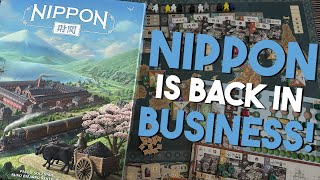













Nippon Deep Dive
What the Community Thinks About Nippon
Nippon stands as a divisive yet respected entry in the economic strategy genre, earning devoted fans and thoughtful critics in equal measure. Reviewers consistently acknowledge its mechanical depth and thematic richness, though some find its area control focus demands more than they bargained for. The game attracts players who relish intricate resource chains and regional competition, while those seeking lighter economic play may find themselves overwhelmed by competing priorities. What remains uncontested is Nippon's position as a well-designed, intellectually challenging experience that rewards mastery across multiple strategic dimensions.
Core Mechanics That Define Nippon
Worker Placement with Bag Building
The central action mechanism draws workers from a cloth bag, creating randomness within structure. Players select from the available workers to activate paired actions, but the color of each worker carries hidden costs during consolidation phases. This system creates a delightful tension: selecting the optimal action sometimes requires accepting an unfavorable worker color that will drain resources later. Over the course of the game, the bag progressively reveals new worker combinations, forcing players to balance immediate needs against consolidation penalties and future board states.
Consolidation and Income Tracks
Rather than accumulating resources freely, players must consolidate regularly, losing all excess coal and money while gaining fresh income based on three distinct tracks: coal production, money income, and knowledge advancement. Each track can be upgraded independently through dedicated actions, creating a puzzle of prioritization. The consolidation phase also awards favor tokens that provide endgame multipliers, incentivizing players to build infrastructure that will pay off during final scoring. This mechanic prevents runaway leaders while rewarding long-term planning over short-term hoarding. Beyond income management, goods produced at factories convert into influence tokens via a tiered system, with players competing for majority control across Japan's four regions. Regional bonuses create localized decision nodes where players must commit resources to contested spaces.
The Nippon Experience
Economic Engine Building
Nippon rewards players who construct efficient production chains. Early turns focus on factory construction and track advancement, gradually unlocking the ability to produce at multiple facilities per consolidation cycle. As the game progresses, well-planned boards generate steady streams of goods that convert directly into regional presence. The satisfaction arrives when a carefully sequenced turn activates two factories with machinery upgrades, producing four goods instead of one. This engine-building arc transforms the game from puzzle-solving into a satisfying demonstration of planning executed.
Crunchy Brain-Burner Depth
Nippon demands constant calculation and forward planning. Every action creates ripple effects: consolidation timing impacts which workers appear next, track placement determines future consolidation income, and regional positioning shapes scoring opportunities across three intermediate rounds and one final scoring. Players must weigh immediate tactical opportunities against strategic positioning, knowing that today's resource spending becomes tomorrow's limitations. The cognitive load remains high throughout, deterring casual play but delighting those who enjoy problem-solving complexity within economic frameworks.
What Makes Nippon Stand Out
Random Worker Availability with Structured Action Pairs
The bag-draw mechanism creates genuine surprises while maintaining strategic depth. Players cannot simply execute a predetermined plan; instead, they adapt their strategies based on which worker colors emerge. Yet the system remains fair: each color appears in balanced quantities, and multiple paths to victory exist regardless of worker draws. This balance between randomness and control creates engagement without frustration, allowing skillful players to overcome unlucky draws through opportunistic decision-making.
Integrated Area Control with Economic Systems
Unlike games where area control exists independently from economic mechanisms, Nippon weaves regional competition directly into production and income generation. Players cannot simply ignore regions; influence placement converts produced goods into victory points and regional bonuses that accelerate future production. The four regions create distinct competitive battlegrounds where different player combinations determine majority at each scoring phase. Ships and trains extend influence without spending goods, adding a secondary layer of area control tools that reward forward planning.
Potential Drawbacks
Area Control Demand May Overshadow Economic Systems
Some players approach Nippon primarily as an economic game, focusing on factory construction and income optimization while neglecting regional competition. This strategy typically fails decisively; without regional presence, economic gains translate to minimal victory points during scoring phases. The game does not gently teach this lesson. Instead, players who ignore area control find themselves positioned far behind after the first intermediate scoring, creating a deceptive experience where the rulebook suggests economic flexibility but optimal play demands regional focus.
Consolidation Timing Creates Moments of Forced Inefficiency
The worker board fills across five action slots, and consolidation becomes mandatory once a player's worker track fills. This creates situations where players are forced to consolidate with unspent resources, wasting coal or money that cannot be saved for future turns. Strategic players minimize this waste through careful action sequencing, but bad timing or worker-color constraints can force suboptimal consolidations. Some sessions feature more efficient board states than others, introducing variability that skilled players can exploit but newer players may experience as frustrating constraints.
If You Enjoy Nippon
Players satisfied by Nippon's economic depth should explore Madeira, the predecessor by the same design duo, which shares similar track-advancement systems and factory-building arcs with a slightly different regional scoring structure. For those drawn to the area control element, investigating Brass or other 18xx-adjacent games offers similar regional competition within economic frameworks. Those seeking heavier economic games without area control emphasis might consider foodchain magnate or campaign trail for pure economic interaction without spatial competition. Nippon sits at the intersection of multiple genre traditions, making it a natural gateway for players transitioning between economic and area-control preferences.
What Reviewers Are Saying
"The game is designed by Paulo Soledade and Nuno Bizarro Santieiro, takes two hours to finish and it's for two to four players. Players are investors of upcoming industries in Japan."
— Peaky BoardGamer
"It starts as an economic game but there's a huge area control element of it on the different islands of Japan that's right and if you're not into the area control part of it you're kind of out of the game."
— Before You Play
"Nippon is an economic strategy game where players manage their Zaibatsu, building and modernizing factories, improving the production and supply of goods, building railroads, and recruiting foreign experts."
— Board Game Sanctuary