/pic1019831.jpg)
(from GMT's website:)
No Retreat: The Russian Front is a new deluxe edition of the two-player Victory Point Games 2008 CSR Award Nominee wargame that retells the story of the titanic struggle between the invading armies of Nazi Germany versus Communist Russia during WW2 at a player-friendly and manageable level of scope and difficulty. This edition combines both the original game and its two extensions (Na Berlin! and No Surrender!) using deluxe components of “Twilight Struggle Deluxe Edition” quality. With only 40 Army/Front sized counters for the Tournament game, and 70 for the whole campaign, and with very low stacking, it’s a quick-playing yet realistic affair that favours the strategic and offensive-minded player.
Each turn is alight with intriguing on-board challenges plus the surprise of card hand Events as players vie to win in one of three different ways.
In a skillfully blended collation of classic hex-based wargaming and modern card-driven simulations, No Retreat: The Russian Front stays truly story-centric, providing the proper feel of sweeping maneuvers, exploitation and encirclements across the vast steppes and forests of Russia. With a simple-yet-innovative economic model, players will also feel the growing might and sophistication of the Russian’s Red Army, and the degradation of the once-invincible German Wehrmacht, over the epic four year sweep of time that this merciless campaign was fought.
Neither side can afford the disgrace of yielding an inch of ground to their hated foe, so your orders are: “No Retreat!”
Components:
One Standard size mounted map
Two Counter Sheets
One deck of 55 Playing Cards
Rule booklet
Scenario booklet
Player Aid Cards
Two 6-sided dice (1 black and 1 white)
TIME SCALE: 2 months per turn
MAP SCALE: 100km / 60 miles per hex
UNIT SCALE: Armies and Fronts
NUMBER OF PLAYERS: 2
DESIGNER: Carl Paradis
DEVELOPER: Alan Emrich & Carl Paradis
COUNTER ART: Mark Simonitch & Carl Paradis
MAP ART: Mark Simonitch


- Considered the strongest game in the No Retreat series by many
- Elegant design
- Simple card play
- Full port to PC
- Faithful reproduction of the board game
- Smooth interface
- Early access with ongoing development
- Currently in early access with ongoing development for another 6 months.
- The Eastern Front of World War II.
- Russian Front, World War II
Mechanics (from transcript analysis)
- AI Opponents — Can play against the AI.
- Card Play — The reviewer likes the "card play and the simplicity of it."
- Multiplayer — Supports multiplayer online (synchronous or asynchronous not specified).
- scenario-based — The game has "six scenarios" and a "full campaign."
Video topics + discussion points
Quotes (from this video)
- Statecraft from Doit Games. Link is down below if you want to go check out the Kickstarter.
- The Kaiser's High Seas Fleet, The Great War at Sea, 1914 to 1918 by Compass Games.
- So, it's really taking War at Sea, reimagining it, modernizing it, and then bringing it to World War I. So, fascinating, clever design idea from Compass Games.
- Congratulations to our winner there. We're not done quite with giveaways yet because we're going to give away a $50 store gift certificate from the Noble Knight sponsorship.
- So, I'm curious how many of you out there that play board war games and watch these videos uh do miniatures combat as well.
References (from this video)
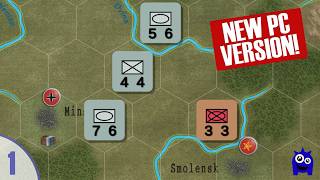
- Faithful digital adaptation of the board game.
- Helpful tutorial system for learning the rules.
- Visually clear movement highlights prevent mistakes.
- Card-assisted gameplay adds strategic depth.
- Functional AI opponent.
- Rewarding feeling when successful advances are made.
- Some 'bumpy edges' due to early access.
- Finicky UI elements in the interface.
- Potential for overextension if not careful.
- AI can be challenging, leading to losses.
- German invasion of Russia
- World War II, German invasion of Russia
- No Retreat: The Russian Front (GMT Games)
Mechanics (from transcript analysis)
- AI Opponent — The game can be played against an AI opponent.
- Card-assisted gameplay — It's a card-assisted gameplay where cards can be used for various purposes and can swing combat.
- Combat odds — Combat is odds based, with attack values and defense values determining outcomes. Ratios like 3:1 are important.
- Counterblows — A mechanism where players can respond to enemy attacks with their own counterattacks.
- Movement — Units with green bars can move. The game highlights possible movement destinations.
- Multiplayer — Online multiplayer is an option.
- scenarios — The game features six scenarios, plus a full campaign.
- Stacking — German stacking is two units in one hex.
- Step loss — Units have steps, and damage can be a step loss, flipping the unit, or elimination.
- Supply tracing — Units need to trace supply. Being out of supply results in penalties and can lead to elimination.
- Tutorial — A text-based tutorial system guides players through mechanics.
- Victory Points — Victory points are gained from cities and oil fields. A target number of victory points is needed to win scenarios.
Video topics + discussion points
Quotes (from this video)
- This is a digital adaptation of that board game, very faithful to the original game.
- One of the nice things I like about the way they've built this game is, say, for example, if we click on this uh second panzer unit 76, it highlights in green where it can move to.
- This is one place where I've noticed it, for whatever reason, it doesn't seem to There we go. It just takes some persistence. That's a little bit finicky. I think in this early access game, it's not quite smooth.
- I feel like based on what I've seen in the first game that I played, the AI is doing a very functional job.
References (from this video)
- Captures the ebb and flow of East Front combat effectively.
- Minimal set of counters and minimal time frame.
- Every counter, every decision matters.
- Forces interesting and meaningful hard decisions on the player.
- Digital version conveys urgency and importance of decisions.
- Shows tons of promise for a game in early access.
- AI can make questionable decisions.
- Player feedback for counterattack/counterblow segments could be better.
- Code may not be working as intended in certain areas (e.g., skipping attacks/counter blows).
- World War II combat between Germany and Russia
- Eastern Front
- Hex Encounters War games
Mechanics (from transcript analysis)
- Area Control — Players capture objective cities to gain victory points.
- combat resolution — Uses dice rolls and cards for combat, with potential for counterblows and advances after combat.
- Hand Management — Players discard and draw cards, some of which have immediate effects or can be used to modify combat.
- reinforcements — Units are placed on the board as reinforcements during the organization phase.
- scenario-based play — The game is played over a set number of turns or until specific victory conditions are met within a scenario.
Video topics + discussion points
Quotes (from this video)
- captures the eb and flow of east front combat with a minimal set of counters in a minimal time frame.
- every counter, every decision matters
- interesting hard decisions that are meaningful
- the digital version of the game I can feel that same sense of eb and flow and the same urgency and the same importance behind the decisions that you're making.
- the combat in no retreat the Russian front is a level more complex and more back and forth than it is in most hex encounters war games that you play on a tabletop.
- I'm struggling to understand what's going on when it goes to counterattack and counter blow.
- the player feedback for those segments of combat could be better.
References (from this video)
- Multiple pathways to victory.
- Engaging combat with strategic choices.
- Challenging supply mechanics.
- Impactful terrain and seasonal effects.
- Some uncertainty about specific rules (e.g., out of supply elimination).
- Potential for bugs in game mechanics (e.g., skipped phases).
- World War II Eastern Front
- Russia
Mechanics (from transcript analysis)
- Area Control — Capturing cities like Odessa and Smolinsk is a key way to gain victory points.
- Card Play — Event cards and special ability cards are used to influence gameplay, like ignoring initiative or providing combat bonuses.
- combat resolution — The game uses dice rolls with modifiers for combat, with a focus on attack odds (e.g., 3:1).
- Supply — Units out of supply are a critical factor, with mechanics for elimination and re-supply.
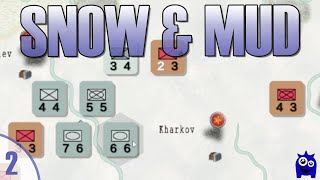
- Terrain effects — Mud and winter conditions affect movement and combat.
- Victory Points — Victory is achieved by accumulating a certain number of victory points, primarily through capturing cities.
Video topics + discussion points
Quotes (from this video)
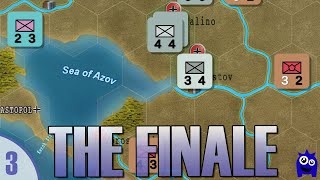
- This is either going to succeed or for this could hinge our whole campaign could hinge on the south here.
- We've demolished that southern front.
- The drive to Stelino.
- It didn't let me get that. It skipped over the counterblow phase which is not what we wanted to.
References (from this video)

- Very playable in its current early access state
- Likely to be a brilliant addition when polished
- AI needs improvement
- Interface is still being worked on
- World War II combat
- The Russian Front
Mechanics (from transcript analysis)
- AI Opponent — The AI needs some help and interface things are still being worked on, typical for early access.
- PC port — A PC format port of the board game available on Steam.
Video topics + discussion points
Quotes (from this video)
- Got it. Off the line. Another man-to-man combat game. Each counter is a single man, just like in combat 3, but uh combat is a solo game. This is uh it's got solo guidance for it, but it's designed as a two-player game, although it's I think it's going to be very solo friendly.
- I feel like that sort of it's easy for me to sit down when I've got 20 minutes and just cruise through my phone and look at social media, but instead I can play a whole game. And so I think these games offer me an opportunity to do something more interesting than Doomcroll
- when talk about companies that have high production values with their stuff, I mean, of course, we've got the big ones, you know, GMT, Compass Games, and things. Worthington Publishing is right up there with Bua Sims in terms of the quality of their content. The boxes are good, the counters are good, materials are good, the cards are all vinyl. I mean, just really they don't they they make good stuff, too, which is always really nice to see some durability.
- It's going to be something different, right? I mean, it's always good to throw different things in the channel. Something a little bit different, but I think there's enough overlap with it with Wargaming that and and I know there's a lot of football fans on the channel as well.
- 49% no, 51% yes. So roughly 50% half of the people watching this video play miniatures wargaming as well as tabletop board gaming or or play and don't play anything else which was I thought it's more than I thought.
- Miniatures games for me represent the extension of a childhood hobby of mine, which was building and painting model airplane kits. Totally can see that. So you're building the miniatures, painting the miniatures, playing the games. These can all go together into one big hobby.
- The other thing would be PC Hex Encounters kind of like we did with the Panzer Core 2. The nice thing about that is that it's very easy to play in a live stream format because the rules are all managed for you in the background.
References (from this video)
- Favorite in the No Retreat series
- Good solid game underneath the simulation
- Fun with interesting historical and card play elements
- Provides variation and tinkering around the edges
- A bear to get into at first
- Germany vs. Russia in World War II
- World War II, Eastern Front
- Nuclear Winter '68
- No Retreat: North Africa
Mechanics (from transcript analysis)
- card-driven — The game is described as a 'car driven sort of resource management game.'
- Hex Encounter — It's described as a 'hex encounter style game' with 'big battalions' and 'regiments of troops.'
- Resource Management — It's described as a 'car driven sort of resource management game.'
- Weather tracking — There's tracking of weather in the days and months, influencing gameplay.
Video topics + discussion points
Quotes (from this video)
- it's just really tight this game is a game that if you invest time in it it's relatively straightforward and simple mechanically
- it's just a fantastic amazing game two player only
- 1989 is almost like the epilogue Twilight struggled
- it is just a majestic piece of ancient design that somehow Reiner canizia dug up from the substrate of the human subconsciousness
- the game feels like it was originally designed during the time that it takes place
- it's like a Euro game with direct conflict
- every time I crack it open and play it I like feel like there's sand coming off of these tiles
References (from this video)
- well-balanced portrayal of history without over-forcing outcomes
- high accessibility within a deep system
- great for teaching strategic trade-offs on a continental scale
- the series can be perceived as similar across titles
- not the easiest for absolute beginners
- historical decision-making with event-driven twists
- Eastern Front in World War II, German advance versus Soviet defenses
- instructive and engaging portrayal of strategic choices under pressure
- Stuka Storm of Steel
- Thunderbolt Apache Leader
Mechanics (from transcript analysis)
- campaign-level decision making — the game rewards long-term planning and recurring consequences.
- event cards and variable spanners — cards introduce twists that alter immediate combat dynamics.
- Events — cards introduce twists that alter immediate combat dynamics.
- low counter density; accessible play — focuses on strategic choices rather than heavy component count.
Video topics + discussion points
Quotes (from this video)
- it's so hard but it's so fun
- the heart of the leader games is the campaign and the choices you make
- the entire thing is drawn out but you could map it exactly as it ended up
- you can play as a team but it's also a solo experience at heart
- the narrative is what makes these war games sing
References (from this video)
- Large-scale operational feel
- Smooth combat and hand management
- Lots of event-driven depth and replayability
- Rule complexity for new players
- Text-heavy cards require careful study
- Big battles with card-driven events and strategic planning
- Eastern Front WWII, large-scale operational warfare
- Epic, sweeping conflict with historical feel
- Twilight Struggle
Mechanics (from transcript analysis)
- Campaign — long-running, large-scale battles
- card-driven events — cards drive events and resources
- Events — special events triggered by cards
- multi-month campaign — long-running, large-scale battles
- opportunity fires — special events triggered by cards
- Resource Management — spend resources and plan operations
Video topics + discussion points
Quotes (from this video)
- the cards can actually become the terrain, you're creating the battlefield as you play
- it's organic, not like rigid and sterile landscape
- Splendor starts with everyone just silent, then the game escalates into intense negotiation
- you can play cards to become the terrain so you're building the battlefield as you go
- you can kind of bluff and read each other with the command and colors system
- it's a pure and accessible civ-like experience that scales well with人数
- the negotiation and hotel-dynamics in Lords of Vegas create a very social table
- Age of Steam-level purity with Steam's maps adds a refreshing clarity