/pic5355459.jpg)
A new era is looming on the horizon. The future of Noria is right in front of you, and you must guide your flourishing trading empire into prosperity. Discover flying islands, buy ships, and build factories. Invest in prestigious projects, and secure their success by passing on secret knowledge to politicians. For even above the clouds, there is still room for improvement...
Noria is the debut title from Sophia Wagner, winner of the Spiel des Jahres fellowship in 2015. The talented, young author created an entirely new steampunk universe specifically for this game, and artists Michael Menzel and Klemens Franz have managed to bring her vision to life. At the center of the game is an innovative mechanism called "wheel building". Each player has an action wheel consisting of three rings, with slots for a number of different action discs. Over the course of the game, players try to obtain new discs and manipulate the rings of the wheel to optimize their action selection. Additionally, to ensure their investments bear fruit, they also need to bribe politicians with knowledge.

- Unique and interesting action selection mechanism with rotating wheels.
- Dynamic victory point scoring that keeps players engaged and requires strategic adaptation.
- High replayability due to the variable nature of the wheels and scoring.
- Beautiful game with good component quality.
- Sparks post-game strategy discussions.
- Can lead to analysis paralysis (AP) due to the complexity of action combinations and optimization.
- The 'screw you' factor in the victory point manipulation can be frustrating for some players.
- Requires multiple plays to fully grasp the strategic depth and nuances.
- A minor rulebook clarity issue regarding initial pawn placement.
- Steampunk
- Flying islands in a steampunk world
Mechanics (from transcript analysis)
- action selection — Features a unique action selection mechanism with three rotating wheels containing action tokens. Players can only claim actions that line up in specific sections of the wheels.
- Engine Building — Players build up their 'engine' by adding tokens to their wheels and acquiring more ships to generate resources and actions more efficiently.
- Set Collection — Players collect resources to build manufactured goods, which are then turned in for victory points.
- variable scoring — Victory points are scored based on positions on tracks, but the value of these tracks can be manipulated by players influencing politicians, creating dynamic and uncertain scoring.
- Worker Placement — Players use pawns to claim spots on the board and advance on victory point tracks.
Video topics + discussion points
Quotes (from this video)
- We're gonna give away $10 gift cards to miniature Market we're giving away five of them count them five so there'll be five $10 gift cards we're gonna do this through the what's that thing called Rafflecopter
- The victory points thing is still a my head still in the clouds over how to generate the victory points
- The mummy which is basically the the board is split up into four segments and you have a d4 that you're going to roll the beginning game determine where the mummy is
References (from this video)
- Fun and clever dexterity game.
- Great for young kids and families.
- Good production quality.
- Quick playtime.
- Can be played competitively or cooperatively.
- The 'why cats' theme is a bit nonsensical.
- Competitive mode can be mean, with opponents dictating difficult placements.
- Not suitable for older individuals with dexterity issues.
- Building an electricity network while avoiding cord contact.
- Island of cats
- Jenga
Mechanics (from transcript analysis)
- Bag building (limited) — Drawing colored cubes from a bag determines which power pole to use.
- Competitive/Cooperative play — Can be played competitively or cooperatively to achieve certain levels.
- dexterity — Players physically place components (power poles with cords) without touching the cords.
- Dice Rolling — Dice determine the colors/segments for placing poles.
Video topics + discussion points
Quotes (from this video)
- We're in the the stage of our life to where it's like it's kind of really got to be really unique and something that's like whoa I just haven't done that before to kind of like Get room on our Shelf to replace something else
- I would never want that to change but I do miss that kind of closeness that we used to have but I've noticed recently in the wall Wally world that the game session has been moved to the back shelf
- that was one of the most vile things I've ever tasted
- if you're not in the Golden Age then it's kind of like who cares what does it matter you know you're in the declining years and I don't think we're there yet
References (from this video)

- beautiful components
- engaging turn flow
Mechanics (from transcript analysis)
- investment tokens / gears — tokens advance on tracks and trigger various actions
- wheel formation / wheel-building — three interlinked wheels drive actions and upgrades
Video topics + discussion points
Quotes (from this video)
- this game is amazing
- it completely blew me away
- Gaia Project... I enjoyed it more than Terra Mystica
- Masters Trials did a good job of combating the number one issue of cooperative games
- it's a really good card game version of a previous game
References (from this video)

Mechanics (from transcript analysis)
Video topics + discussion points
Quotes (from this video)
- it's an ongoing ripple effect of me changing the channel up and not making reviews any more
- I've been thinking about doing this for a while and I finally went about changing my audio setup in here
- thanks for watching
References (from this video)
Mechanics (from transcript analysis)
Video topics + discussion points
Quotes (from this video)
- I am definitely interested in learning more about this.
- I like Roland Wright style games.
References (from this video)
- Appears to offer a thoughtful, thematic economic loop
- Compelling spatial-temporal tension with river-based mechanics
Mechanics (from transcript analysis)
- Resource Management — Players manage limited resources to optimize their river-based economy.
- Tile Placement — Placement decisions influence resource flow and scoring opportunities.
- Tile placement / area control — Placement decisions influence resource flow and scoring opportunities.
Video topics + discussion points
Quotes (from this video)
- Puzzle hunt it is just a lovely 2hour puzzling exercise with a team of four
- I had a fantastic time at working geekon 2023 and I can't wait for next year's
- I walked away with this game
- I can't wait to tell you more about this
- Puzzle hunt and puzzling with the aha moment is really where it's at
References (from this video)
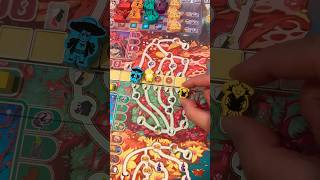
- Deep, multi-layered puzzle that rewards timing
- Innovative track-push mechanism that adds tension
- Shared resource pool increases player interaction
- Bonuses tied to staying on the track and expanding the forest
- Thematic flavor and components evoke a forest spirits theme
- Spirits, nature, resource management, and habitat construction
- A forest inhabited by spirits where players build habitats and collect elemental resources
- Puzzle-focused with light thematic flavor
Mechanics (from transcript analysis)
- Limited Resource Pool — Resources are drawn from a common pool used by all players.
- Resource Management — Unused resources convert to victory points.
- Resource-management scoring — Unused resources convert to victory points.
- shared resource pool — Resources are drawn from a common pool used by all players.
- Tile Placement — Build habitat cards to create scoring and resource opportunities.
- tile/card placement — Build habitat cards to create scoring and resource opportunities.
- Track Advancement — Advancing tracks shifts the center and changes available bonuses.
- Track-push mechanic — Advancing tracks shifts the center and changes available bonuses.
- Worker Placement — Place workers on tracks that resemble a Disneyland ride to advance them and trigger bonuses.
- worker placement on tracks — Place workers on tracks that resemble a Disneyland ride to advance them and trigger bonuses.
Video topics + discussion points
Quotes (from this video)
- this is a euro game that will completely electrify your brain
- a puzzle within a puzzle within a puzzle
- it's a game called aoria and I love it
References (from this video)
Mechanics (from transcript analysis)
Video topics + discussion points
Quotes (from this video)
- As usual, joy is always their goal. They want to bring joy to everyone's tabletops.
- They stood up for publishers and small businesses subject to the illegal tariff taxes forced upon by the US government.
References (from this video)
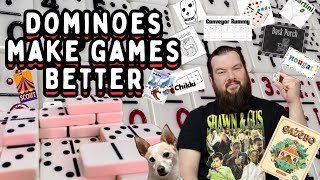
- Extra fun with taking dominoes from the table into your hand
- Constantly builds and manipulates your hand
Mechanics (from transcript analysis)
- Climbing — A type of card/domino game.
- Meld escalation — Melds can only escalate one meld size at a time.
- Runs — Players focus on playing sequences of dominoes.
Video topics + discussion points
Quotes (from this video)
- This iceberg in and of itself is maybe, in fact, the tip of an even bigger iceberg.
- What's great about all of them is you just need some traditional sets of dominoes.
- Because they have two big big things. What are those two things? Well, the aforementioned concept of the numbers, orientation, and all that, but also the physical component, the delectable clicketity clack, that tactile nature.
- I already know that dominoes make games better from a physical standpoint.
- The game is just so satisfying when playing with the dominoes in their true clicketity clacky forms.
- It was so funny to have that revelation, that realization that wait a minute, I like that in games and Domino's are just already bringing that to the table.
- That means dominoes have been hiding in the games you've been playing and you didn't even know it.
- I think dominoes need to be given a little love.
- you can get a Domino set or two anywhere. And for a few dollars, you're opening yourself up to a tremendous world of gaming that is just hidden right there beneath the surface.
- Dominoes really are infectious, and I have put out two domino designs now on Board Gamegeeek.
- Dominoes make games better. Yeah. Yeah.
- I've fallen for it. I've fallen for the delightful sounds of the clicketity clacky.
- I'm buried in bones.
- If you have any questions, comments, or want to discuss any of the games mentioned here, please, please do.
- get yourself some dominoes, fall down the rabbit hole, and don't forget to play board games.
References (from this video)

- Gorgeous artwork.
- Solid gameplay.
- The Boldest
Mechanics (from transcript analysis)
- Worker Placement — It's kind of a typical Euro game.
Video topics + discussion points
Quotes (from this video)
- So, we have a game here called Sequoia. This is from 2022.
- It's It's fine. I'm giving it a six. Uh Beasty Bars is is is a fun style game where you're playing these different type of animals, and I think each additional expansion made it more complex and less fun.
- Trias is an old dinosaur game that originally came with cubes, and eventually they had little dinosaurs in it instead. And it's kind of grow out to different things. This is a very I have this ranked as a seven. Probably now, the next time I go through my rankings, I'll probably rank it as a six because it's fine, but it's showing its age.
- All righty, of all the games we talked about today, my favorite here is clearly David Goliath, although Hooky is a very close second.
- Either way, it's always good to talk to you all.
References (from this video)
- Can be enjoyed with 4-5 players in a specific setting.
- Interesting to experiment with janky factions from the expansion.
- Can be overwhelming with too many players (9+).
- The theme feels weak and pasted on.
- Difficult to determine the value of resources.
- Can be 'hit and miss' depending on the group and player count.
- Alien cube trading
- New Angelus
Mechanics (from transcript analysis)
- Negotiation — Players negotiate cube transactions.
- Trading — The core mechanic is trading cubes for cubes.
- Variable player powers — Different factions can play out "so differently."
Video topics + discussion points
Quotes (from this video)
- This is something I fancy doing for a bit of a change cuz I don't think I've seen this list done by many other creators.
- The ones that improved over time. Occasionally is here, but it's less common.
- Trust me, when I tried to come up with this list, I could only think of 10 games.
- It's just a case that before I either didn't like them or found them kind of meh. And now I'm like, yeah, I'll play them. I'm fine.
- The heart has warmed to them and therefore I'm willing to give them a try.
- It's like, oh, I don't know, I'm going to need this and this well, how do I get that well, I need to get these three things and turn them into this and it's that this whole thing is actually quite cool.
- And so when you throw in all the janky factions and too many players it just becomes ridiculous. I can't do this.
- Honestly, the main time I've warmed up to Race of the Galaxy is playing as a two-player. I think two-player is the best way.
- But the app from Czech Game Editions is just too freaking damn good.
- This is not my day job, remember?
- It's still only a game, so hopefully you enjoyed it at the end.
References (from this video)
- Clear step-by-step setup and rule explanation
- Asymmetric leader cards add strategic options
- Phased structure with exploration, expansion, and return
- End-game scoring via multiple scoring cards and territory control
- territory expansion and control through exploration and development
- Scandinavia and Normandy territories on the map
- asymmetric leader cards guiding special abilities
Mechanics (from transcript analysis)
- Asymmetric leader cards — Each player receives two leader cards with asymmetric abilities; players choose one to keep and gain starting silver and effects.
- End of round scoring and end-game scoring — Scoring cards, exploration cards, territories, and tokens contribute to end-of-round and end-of-game scoring; game ends after the fifth round.
- Exploration phase (simultaneous) — All players reveal exploration cards simultaneously; assign damage icons and place long ships and law speakers on the revealed cards to gain round bonuses.
- Five action choices in expansion phase — Players have five actions per turn: place one yarl, place one long ship, perform a thing action, repair one or more long ships, use the title space; players may pass.
- Loss and repair system — Long ships can be damaged and must be repaired by paying coins; damaged ships stay until repaired.
- Resource and token placement — Resources (coins) and tokens are moved on ladders and territories based on actions; penalties may be incurred and paid.
- Territories, forts, settlements — Players place settlements and forts on territories; territory bonuses go to opponents if you place without your own fort present.
- Turn order influence by Normandy — End of the expansion phase uses leader/territory choices to determine turn order; Normandy can influence bonuses and order.
Video topics + discussion points
Quotes (from this video)
- this game is designed by goblins on board and is published by skele games who helped sponsor this video
- Norman is played over five rounds with three phases in each round
- you'll score the most points by utilizing your long ships and L speakers to expand your reach in various territories using settlements and forts
- this is a prototype and this game is coming to crowdfunding so feel free to check that link out down below to learn more about this wonderful game
- and if you have any questions you know what to do hit us up in the comments down below and we'll be sure to give you an answer
- what crowdfunding project are you excited about that you're following that you're backing tell us about it is it Norman maybe it's arriving soon who knows
References (from this video)
- Clear asymmetric roles with a tight, teachable rule set.
- Strong bluffing and deduction loop supported by multiple game modes.
- Disguises and identity secrecy add depth and replayability.
- Short playtime (~15 minutes) makes it accessible for filler sessions.
- Rules can be dense and require careful reading; players may need a follow-up read-through.
- Certain mechanics (like adjacency including diagonals and wraparound shifts) can be tricky to remember.
- Early setup and board state tracking may create a steeper initial learning curve for new players.
- Murder mystery, secret identities, disguise, deduction, and bluffing within an asymmetric two-player framework.
- A contemporary noir-themed urban environment built around a 5x5 suspect grid and a cat-and-mouse chase between killer and inspector.
- Procedural detective story with shifting information, relying on hidden identities and strategic deception.
Mechanics (from transcript analysis)
- accuse_solve — The inspector can accuse an adjacent card or attempt to solve by naming both the killer’s identity and their disguise; successful calls win the game.
- Blend-In/Hiding — Disguises allow the killer to bluff about identity; players may switch or bluff to mislead the inspector without revealing anything overt.
- canvas_exonerate — The inspector can exonerate a living suspect and canvas around them to reveal whether the killer’s secret identity lies among the surrounding living cards.
- collapse — When allowed, a player collapses the grid by removing one suspect from each row or column and then realigning, shrinking the board toward a rectangle.
- Deduction — The inspector can accuse an adjacent card or attempt to solve by naming both the killer’s identity and their disguise; successful calls win the game.
- disguise_bluff — Disguises allow the killer to bluff about identity; players may switch or bluff to mislead the inspector without revealing anything overt.
- evidence_deck — The inspector draws and holds evidence cards to inform decisions; the killer can view a portion of these to deduce information about the board.
- Grid Building — When allowed, a player collapses the grid by removing one suspect from each row or column and then realigning, shrinking the board toward a rectangle.
- Hidden Roles — Each player (killer or inspector) operates with a concealed identity and may have a disguise; this drives bluffing and deduction.
- kill_action — The killer can kill an adjacent suspect (including diagonals) by flipping their card to the deceased side, narrowing the inspector’s pool of possibilities.
- secret_identity — Each player (killer or inspector) operates with a concealed identity and may have a disguise; this drives bluffing and deduction.
- Shift — Either player can shift an entire row or column; the furthest piece is wrapped around, changing adjacency and board dynamics.
- Tile/Map Shifting — Either player can shift an entire row or column; the furthest piece is wrapped around, changing adjacency and board dynamics.
Video topics + discussion points
Quotes (from this video)
- Noir is a deductive mystery game for two to four players depending on which of the four available game modes you select.
- Killer versus Inspector, you take on your rival in a game of cat and mouse with one of you being the killer, having a secret identity like Lionus.
- The killer will be killing suspects surrounding their current location, trying to either kill 10 suspects to win the game or to kill the secret identity of the inspector.
- The inspector has tricks up their sleeve, too. They can exonerate a suspect and then canvas around asking if their true identity is one of them.
- Disguising is a big part of this game because you could be bluffing and buy some time, or mess with the head of the inspector thinking that they're getting close when they're really not.
References (from this video)
Mechanics (from transcript analysis)
Video topics + discussion points
Quotes (from this video)
- I'm giving away a copy of Dead of Winter: The Long Night with this video
- To be in with a chance of winning, simply like this video, comment below and subscribe to Actualol
- If you're new to Actualol then check out the rest of my videos.
- I'm Actualol on Facebook and Twitter. I'm Jon Purkis, thanks for watching.
References (from this video)
- brief, abstracted game with potential depth
- initial rule friendliness may be generic
- worker placement abstraction
- abstract/modern thematic feel
- neutral/analytical
Mechanics (from transcript analysis)
- Worker Placement — abstracted worker actions on a compact board
Video topics + discussion points
Quotes (from this video)
- newest release from fil that isn't a reprint
- it's a racing style game
- spoiler I did really like this one
- this one intrigued me
- the art style in this game is absolutely gorgeous
- Sandbox prison brawler for up to eight players
- complete reworking of Rum and Pirat
- wind tiles will direct your ships