











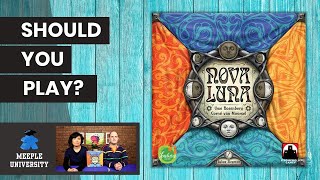






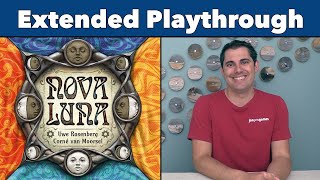



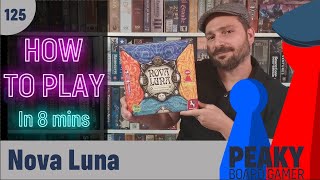
The new moon is a symbol for a new beginning, the perfect time to start something new and to plan your future — and that is what Nova Luna (lat. for new moon) is all about. In each round of this abstract tile-laying game, you have to plan your future anew, developing a new strategy to cope with what the moon wheel has to offer you.
On each turn, you have to decide which new tile from the moon wheel to place in front of you. Every new tile brings a new task you have to fulfill. In order to do so, you need to place tiles of the correct color adjacent to the task you want to complete, but these of course again bring you new tasks. Each time a task is solved, you may place one of your markers on it. So decide wisely and be the first one to place all your markers.
—description from the publisher
- predictable two-player planning
- short and portable
- deep strategic depth for such a compact package
- abstract feel may be less accessible to some players
- patterns and objectives through color/tile matching
- Abstract tile-placement on a circular moon wheel
- sleek, puzzle-driven
- Patchwork
Mechanics (from transcript analysis)
- objective-based placement — Align symbols on tiles to achieve tasks and scoring opportunities.
- tile placement — Take tiles to complete tasks and advance your engine; place tokens on completed tasks.
- Time track — Tiles cost time; the marker advances by the tile's moon value, and the player furthest back goes next.
Video topics + discussion points
Quotes (from this video)
- No patchwork, no Seven Wonders Duel, just genuinely underrated games that deserve a spot on your shelf.
- Buy this if you want something quick, portable, and full of meaningful decisions.
- That swing was massive.
- You can plan ahead because you know what your opponent might take and how it affects the board.
- The app is brilliant. It actually enhances the experience rather than feeling tacked on.
- The brilliance is in the timing and indirect interaction.
- Buy Tether if you want something that teaches in 2 minutes, but reveals depth of a repeated place.
- Buy Lacuna if you want something beautiful and tactile.
References (from this video)
- Strong thematic integration through flavorful card text and flavor
- Engaging dice drafting and card market dynamic
- High replayability due to card variety and track interactions
- Rulebook is concise and quick to learn, enabling smooth onboarding
- Some edge cases and icons not clearly explained in rules or player aids
- Card balance can be uneven in the Express variant
- 3-4 player games can feel lengthy compared to 2-player experience
- Civilization growth, technology advancement, and managing negative events (disasters, unrest) to maximize points
- Civilization-era progression with three eras, involving technology and societal development, across tracks and events
- Card-driven tableau-building with evolving effects and era-based card interactions
- Nations: The Dice Game
- Civilization (various titles)
- Tapestry
- Ancient Knowledge
- Glass Road
- A Feast for Odin
- Agricola
- Terra Mystica
Mechanics (from transcript analysis)
- card drafting — Market of cards is available; players purchase from the bottom row, with future options laid out in front of them.
- Card drafting/market — Market of cards is available; players purchase from the bottom row, with future options laid out in front of them.
- dice drafting — Players draft dice in multiple colors to perform actions, advance tracks, and influence their tableau.
- engine building — Technologies and personality cards enable engines that generate resources and influence scoring.
- Resource/engine synergy — Technologies and personality cards enable engines that generate resources and influence scoring.
- Scoring by color types — Points are earned per scoring round for each color type you accumulate, with bonuses for leading in a color type count.
- tableau building — Cards are organized into four categories on a personal tableau and provide ongoing income or abilities.
- Track advancement — Advancing tracks can trigger negative effects. Excess dice increases unrest; civil war can flip cards and cause penalties.
- Track advancement and disaster/unrest — Advancing tracks can trigger negative effects. Excess dice increases unrest; civil war can flip cards and cause penalties.
Video topics + discussion points
Quotes (from this video)
- This game popped up on the hotness on Board Game Geek.
- Nova era... high uh High Praise from me and from many people who have played this as well.
- It's a civilization themed game that utilizes Dice and cards to advance on a few tracks.
References (from this video)
- Elegant, simple to teach with depth
- Nice abstraction for engine-building basics
- May feel abstract to some players
- Multiplayer solitaire tendencies
- Pattern building and spatial planning
- Tile drafting with lunar-inspired motifs
- Calm, abstract tile-drafting experience
- Cascadia
- Carcassonne
Mechanics (from transcript analysis)
- tile drafting — Draft and place tiles to form a scoring engine
Video topics + discussion points
Quotes (from this video)
- "Bonanza does a great job of putting that negotiation forward and creating more of a social interactive experience that I feel like Katan offers as a Euro game that is somewhat unique amongst Euro games today"
- "Katan by creating that social interaction the fluidity and the kind of non-scripted approach to that"
- "Sleeping Gods is an amazing experience very reminiscent of an open world game"
- "This is definitely a step up in complexity"
References (from this video)
- Clear setup and rule exposition in the video
- Dice-driven action economy creates meaningful decisions
- Three-era progression with explicit scoring phases
- Visual board markers help comprehension during setup and play
- Rules are dense and can be intimidating for new players
- Game length around 90 minutes or longer depending on number of players
- Mechanics like unrest, disasters, and obsolescence may require a few plays to fully grasp
- Civilization development, technology adoption, territorial expansion, and managing societal factors.
- Civilization-building across three eras on a central board with disasters, dark age mechanics, and era transitions.
- Euro-style abstract civilization progression
Mechanics (from transcript analysis)
- dice drafting and action selection — Roll dice into designated zones and spend dice to perform actions; the value of the die determines the magnitude of the action or resources gained.
- Dice rolling — Roll dice into designated zones and spend dice to perform actions; the value of the die determines the magnitude of the action or resources gained.
- disasters and dark age — Disaster markers advance based on unpicked dice; reaching the Dark Age can reset dice and force strategic changes.
- era progression and scoring — Nine rounds spanning three eras with multiple scoring phases to determine the winner.
- obsolescence and past area — Obsolete cards are moved to the Past area; players gain points for eliminating obsolete assets and advancing civilization.
- Resource management — Track welfare, military, economic, and knowledge resources while monitoring unrest to prevent negative consequences.
- resource management and unrest — Track welfare, military, economic, and knowledge resources while monitoring unrest to prevent negative consequences.
- scoring and color-based bonuses — Score points for color diversity and for completed personalities/technologies with medal icons.
- territory and personality enlistment — Spend dice and resources to expand territory and enlist personalities, with unrest adjustments based on color/value.
- unrest and red zone mechanics — If total dice exceed 10, unrest increases; red zone triggers penalties and potential dice reductions.
- upgrades and era transitions — Era transitions use an Evolution/Upgrade deck to add new cards to hand and shape future choices.
Video topics + discussion points
Quotes (from this video)
- Nova Era this is a game for two to four players.
- phase one is roll dice the first player draws three Dice from the bag.
- place the unrest marker on zero of the unrest track.
- phase six is checked for disasters.
- The end of era actions are summarized next to the era track.
- after era 3 scoring you go to the final game scoring.
- I've been Rob AKA just of the Rogue and I'll see you soon.
- Remember to like share and subscribe to Just of the Rogue.
References (from this video)
Mechanics (from transcript analysis)
Video topics + discussion points
Quotes (from this video)
- we own a copy of that and we've never played our copy
- we're a family of collectors
- we could probably play that during the gameon ship
- it's going to be awesome we're going to have so much fun
- return to Dark Tower and we've never played our copy
References (from this video)
- light and approachable
- good variety in scoring options
- perhaps a bit light for heavier gamers
- abstract puzzle
- pattern-building with card drafting
- Uwe Rosenberg titles (in vibe)
- other light card/placement hybrids
Mechanics (from transcript analysis)
- card drafting — draft cards to perform actions and shape scoring
- card_drafting — draft cards to perform actions and shape scoring
- Polyomino — place shapes on a personal board to optimize points
- polyomino_placement — place shapes on a personal board to optimize points
Video topics + discussion points
Quotes (from this video)
- probably my favorite tire placement game of all time
- this one is like a companion game to el grande
- Arc Nova certainly the hotness at the moment
References (from this video)
- Considered a standout Rosenberg design
- Engaging color/pattern interaction
- Not ideal at suboptimal player counts
- Some may find it overly abstract
- Tile placement and color strategy
- Abstract tiling with color palettes
- Tile-placement race with palette constraints
Mechanics (from transcript analysis)
- pattern/area scoring — Complete patterns across the board for points.
- Race to complete palettes — Players race to complete color palettes and scoring opportunities.
- tile placement — Place tiles to fill patterns and start/continue lines of play.
Video topics + discussion points
Quotes (from this video)
- This is a very nasty auction style game.
- I think it's a great design.
- One of my favorite games if not my favorite game.
- It's nice that it plays in about 30 minutes.
- I think it's a wonderful design.
References (from this video)
- Engaging and accessible puzzle with depth
- Clear progression and satisfying visual design
- Online play can be fiddly and may require setup
- Some may find the rule subtleties non-obvious without play
- Pattern-building and tile-placement to satisfy goals
- Abstract puzzle with lunar motif
- Puzzle/strategy emphasis
- Patchwork
- Sagrada
Mechanics (from transcript analysis)
- Goal-oriented placement — Choose tiles to advance toward completing specific colored/dotted goals
- pattern-building — Create configurations to fulfill tile-based objectives
- tile placement — Place moon tiles to build patterns and meet goals
Video topics + discussion points
Quotes (from this video)
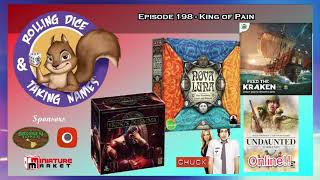
- it's time for another episode of rolling dice and taking names
- Nova Luna I like this a lot more than patchwork
- whoever completed their 20 disks first is the winner
- we had a fabulous time
- Chuck is now on Amazon Prime
- it's not about victory points in Nova Luna
- I love Chuck
- this is a very strategic game
References (from this video)
- Elegant, streamlined flow
- Strong puzzle feel with accessible rules
- May feel repetitive for very long play sessions
- Less variability for some players over time
- Tile-laying and pattern matching
- Abstract color/tile puzzle
- Pure abstract puzzle
- Patchwork
Mechanics (from transcript analysis)
- color matching / pattern planning — Tiles must fit color adjacency and pattern rules
- rondelle time-track — Move on a roundel; turns are tied to tile values
- tile drafting — Draft colored tiles with a time-track twist
Video topics + discussion points
Quotes (from this video)
- it's a very smooth game and very little complication
- it's a lovely example of catering to a wide and versatile audience
- it's a fantastic example of a bidding game and a racing game
- this game is one of the most tense games I've ever played
- I cannot praise this game enough it's amongst my favorite games of all time
References (from this video)
- puzzle-like decisions
- streamlined and accessible
- theme light, some players may want tighter narrative
- tile placement to hit color objectives
- patchwork rondelle with color-tile objectives
- puzzle-focused
- Qwirkle
- Rajas of the Ganges
Mechanics (from transcript analysis)
- patchwork-style rondelle with tile objectives — collect and place tiles to satisfy objective conditions
Video topics + discussion points
Quotes (from this video)
- this one might be the most diverse one
- i thought this game had some really tacked on mechanisms that just did not need to be there
- this is basically a kids game
- it's striking, but not everything lands
- a very solid gateway game
- goa is a great example of classic euro design
References (from this video)
- clever time-track mechanism
- tight, clean design
- family-friendly
- may feel solitaire to some players
- art style and themes may polarize
- color matching and route drawing
- tile-laying puzzle on rondelle
- tight, puzzle-like gameplay
- Patchwork
Mechanics (from transcript analysis)
- tile placement — draft and place tiles to map colors and connect tasks
- time-track rondelle — the time track delays turns until others catch up, creating strategic pacing
Video topics + discussion points
Quotes (from this video)
- it's basically a race to deploy or all your influence markers on the board
- this screen really did blow up this last year or two and rightly so
- it's a classic; it feels like I'll be playing this in five or ten years time
- Hidden Gem
- insanely clever
References (from this video)
Mechanics (from transcript analysis)
Video topics + discussion points
Quotes (from this video)
- it's a beautiful kind of story
- you need to play with the right group
- it's not cute
- it's like comfort food games
- the rules are simple
- oh my god it's so good
- it's a ramp... chaos
- this is an easy one to just flick some discs around
References (from this video)
- innovative and engaging use of dice drafting to drive engine-building
- dynamic disaster mechanic adds tension and decision impact
- high replayability thanks to eras and diverse card pool
- satisfying two-player viability and scalable playtime
- apparent balance and card availability issues due to bottom-row drafting rule
- end-game and obsolescence interactions can be hard to track for new players
- some players may find the complexity and pacing uneven
- space exploration, tech arms race, relics and outposts
- humanity flees across the galaxy to survive after an ancient foe; exploring ruins and building a galactic civilization
- emergent, player-driven engine-building with a sci-fi backdrop
- Forbidden Stars (FFG)
- Gears of War (board game)
- StarCraft tabletop/miniatures adaptations
Mechanics (from transcript analysis)
- area/colony scoring and end-game evaluation — end-of-era scoring includes color-based majority, tech color coverage, and potential bonuses for majorities
- deck/tech tableau and engine building — drafted dice are spent to acquire technology cards and activate production/engine-building effects across eras
- dice drafting — players draft three dice each round, choosing them from a central zone to determine actions, costs, and future options
- disaster tracks and aging — five disaster tracks (color-coded) advance based on undrafted dice, triggering negative effects if not mitigated
- obsolescence and repair — damaged or obsolete cards require repair actions or replacement to maintain engine power
Video topics + discussion points
Quotes (from this video)
- "Nova Era out now from Sean Games."
- "There are eight steps to this game..."
- "The number of pips equal the amount of resources that dice can contribute to whatever you're buying."
- "Obsolescent cards could absolutely destroy you."
- "There’s a flowchart on the back that’s fantastic for teaching this game quickly."
- "Two-player game with tile drafting and placement; easy to teach and quick to play."
References (from this video)
- Clear teaching, short playtime, deep strategic depth for an abstract game
- Elegant interaction via shared moon wheel and color tasks
- Can be fiddly to track color adjacency rules
- some players may prefer more thematic games
- color matching and pattern building
- abstract, grid-based tile placement with lunar imagery
- none
Mechanics (from transcript analysis)
- moon track turn order — turn order determined by markers on a circular moon track
- pattern/color matching — satisfy tasks by connecting colors and backgrounds to form color chains
- tile drafting — each turn you select one of the three next tiles from the moon wheel and move along a track by the tile's value
- tile placement — place tiles orthogonally adjacent to build a personal tableau
- token management — tokens are used to cover completed tasks; end when a player uses their last token
Video topics + discussion points
Quotes (from this video)
- Nova Luna designed by Uwe Rosenberg and Corné van Moorsel
- tiles depict a cost in time as well as tasks that players will try to accomplish
- the game ends immediately after a player uses their last token