
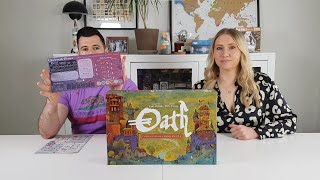
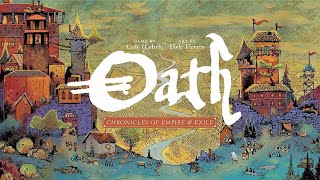
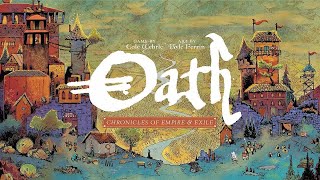





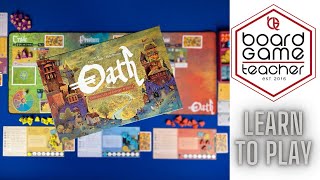






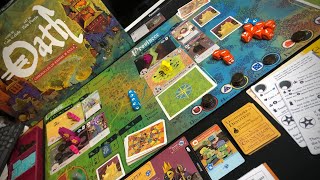

















In Oath, one to six players guide the course of history in an ancient land. Players might take the role of agents bolstering the old order or scheme to bring the kingdom to ruin. The consequences of one game will ripple through those that follow, changing what resources and actions future players may have at their disposal and even altering the game's core victory condition.
If a player seizes control by courting anarchy and distrust, future players will have to contend with a land overrun by thieves and petty warlords. In a later game, a warlord might attempt to found a dynasty, creating a line of rulers that might last generations or be crushed by the rise of a terrible, arcane cult.
In Oath, there are no fancy production tricks, app-assisted mechanisms or production gimmicks. The game can be reset at any time and doesn't require the same play group from one game to the next. A player might use the fully-featured solo mode to play several generations during the week and then use that same copy of the game for Saturday game-night with friends. There are no scripted narratives or predetermined end points. The history embedded in each copy of Oath will grow to be as unique as the players who helped build it.
—description from the publisher
- Quick, lightweight gameplay
- Engaging magnet mechanism
- Accessible for families and kids
- Optional advanced rules add strategic depth
- tile collection and manipulation using magnetic components
- Underwater seafloor exploration featuring a magnetic octopus collecting tiles
- abstract, light-weight filler experience
Mechanics (from transcript analysis)
- advanced mode — Optional rules introduce additional abilities and replacement tiles when stacks are depleted, increasing depth.
- magnet-tile interaction — An octopus figure magnetically attracts tiles to itself, affecting placement and collection on the board.
- rotation/rolling cube — A cube is rotated and rolled around the board to move and pick up tiles, adding a physical dexterity element.
- set collection / scoring via tiles — Points are earned based on the tiles taken and how the set is assembled over the course of a round.
- tile placement — Players place tiles on the board and claim points by collecting them during their turns.
- Tile placement and collection — Players place tiles on the board and claim points by collecting them during their turns.
Video topics + discussion points
Quotes (from this video)
- Overall, I really liked Octo. It's a nice cute little filler game for me, especially with the advanced abilities that you can add in as well.
- This one is really cool and uses one of the new trends of gaming, which is magnets.
- The tiles themselves fit perfectly onto the cubes and you can take them off quite easily.
References (from this video)
- Adorable, appealing art and theme
- Easy to learn with quick rounds
- Strong decision-making and potential for combo plays
- Good table presence despite a small box
- Replayability through different Otter goal cards and potential for expansion
- Some goal cards can be tricky for younger players
- Luck factor from drawing cards
- Downtime can increase with more players
- Not a heavy strategy experience for hard-core gamers
- light, fast-paced card play with hand management and set-collection-like goals
- Otter-themed setting centered around otters and their coastal/river environment
- expository review-focused explanation with emphasis on gameplay decisions
Mechanics (from transcript analysis)
- draw and risk — On your turn you may draw one or more cards from the deck, then you must either flip one of the goal cards or swap two of them.
- goal variability — There are several Otter goal cards, so each game feels different; goals can shift as you flip or swap cards.
- lose a turn — If you miss or can't play, your turn ends.
- otter cards and goals — Play cards from your hand to one of the central otter cards. Each otter has two criteria (head and tail). If your card meets both, you can continue playing on that otter.
- turn-ending rule — If you miss or can't play, your turn ends.
- win condition — The first player to empty their hand twice wins.
Video topics + discussion points
Quotes (from this video)
- Otter is ridiculously cute.
- There's real decision-making here.
- It's simple to learn, but surprisingly thinky.
- The combo potential is super satisfying.
- It's perfect for family nights, warm-ups, or just something light and fun that still makes you think.
References (from this video)
- Cute and charming theme with otters
- Easy to learn and quick to teach
- Portable with small box, deluxe plush edition option
- 1-4 players, including solo mode
- Engaging puzzle-like decisions to maximize cards
- Downtime potential when players cannot move and must draw
- Rule variance in solo mode could confuse newcomers
- hand management and strategic discard to maximize cards in one turn
- Otter-themed card game with otter heads, tails, and lucky stones, set in a playful water-world
- procedural/puzzle-like abstract
Mechanics (from transcript analysis)
- draw and exchange actions — If stuck, players may draw 1-3 cards and flip/exchange otter heads/tails to adjust options.
- hand management — Players try to empty their hand by playing 1-3 cards per turn under constrained conditions.
- pattern/constraint-based play — Cards played must meet constraints (higher, near within two, even numbers, creature type) depending on the otter head shown.
- round reset / re-deal — End of round hands are reshuffled to 10 cards for the next round.
- Score-and-Reset — End of round hands are reshuffled to 10 cards for the next round.
- score/progression via lucky stones — After meeting the required number of empties, players gain lucky stones; accumulating the required total wins.
Video topics + discussion points
Quotes (from this video)
- The game is really cute.
- Otter are cute. They're mean.
- The deluxe edition comes inside of a plushy Otter, which is so fun.
- This is a great option for one to four players. It's portable, doesn't take up a ton of table space, quick to teach, easy to play, great for all ages.
- I am enjoying Otter.
References (from this video)
- Dynamic power politics with many interaction points
- Many win conditions create replayability and ambition
- Strong world deck and narrative flavor driving variety
- Balanced despite high complexity; interesting asymmetry
- Excellent setup/teardown organization and components
- Art style not universally appealing
- Downtime can be lengthy with certain groups
- Iconography not always obvious; need more reference sheets
- Rule changes/errata exist; early play may require clarifications
- Not ideal for two players; best with ≥3 players
- History is written by the victors; politics, power, and narrative control drive outcomes
- A dynamic fantasy-pantheon empire where players shape a living history through politics, relics, and visions.
- emergent, story-driven history generation with a perpetual, changing world
- Root
- Betrayal at House on the Hill
Mechanics (from transcript analysis)
- Area Control — Players vie for control of regions on a shifting map, affecting influence and resources.
- Chancellor mechanic — One player starts as the chancellor with control of the main objective but limited ability to win early.
- Chronicle/Winner influences future decks — Outcomes are written into a chronicle that modifies later games.
- closed economy — Money is generated and spent through a bank-based economy with potential for economic warfare.
- deck manipulation — Card draws from a central deck influence actions, events, and the board state.
- Deck-driven actions (World deck, Vision cards) — Card draws from a central deck influence actions, events, and the board state.
- dynamic player interaction — Diplomacy, deals, and politics shape alliances and contestation.
- Economy and banks — Money is generated and spent through a bank-based economy with potential for economic warfare.
- multiple win conditions — Six or more independent paths to victory (main goal, banners, relics, etc.).
- Positive player interaction — Diplomacy, deals, and politics shape alliances and contestation.
- Relics, banners, scepters — Powerful artifacts and banners grant special actions and strategic leverage.
Video topics + discussion points
Quotes (from this video)
- there's no end you'll never complete oath because it's perpetual history as an experience
- oath is big sandbox of fun effects and different play styles to build crazy stories
- recommend your score 10 out of 10. this is not a joke
- i would play oath with so many people i can't wait to keep playing and changing my world with different friend circles
- oath surprisingly balanced
References (from this video)
- Clear, structured teaching of setup and turn sequence.
- Accessible for families and new players, with intuitive card actions.
- Engaging tension from hidden pearl values and endgame reveal.
- Fast pacing and multiple bluff/deception opportunities.
- Some rule nuances (e.g., exact card exceptions) require careful watching; may confuse new players on first play.
- Negative scoring black pearls can slow early enthusiasm for some players.
- Pearl collection and risk management in a hidden-information, hand-management card game.
- Underwater otter environment with pearls and sea urchins, focused on collecting valued pearls.
- Light, whimsical, puzzle-like.
Mechanics (from transcript analysis)
- Card-driven actions — Cards trigger various actions (gaining, swapping, or negating pearls) that affect players' resources.
- endgame triggering — The game ends when only one player remains, after which pearls are tallied for final scoring.
- hand management — Players manage a hand of cards each turn, discarding or playing cards to optimize pearl collection and avoid penalties.
- Hidden Information — Pearl values can be checked and rearranged by the owner to influence opponent guesses and scoring.
- locking and protection — Specific cards can lock pearls or protect the player from actions until certain conditions are met.
- Re-rolling and Locking — Specific cards can lock pearls or protect the player from actions until certain conditions are met.
- risk management — Urchin cards pose a risk: holding two urchins in hand eliminates a player at the end of their turn.
- set collection — Players collect white and black pearls; pearls are revealed or kept hidden to affect scoring.
- take that — Certain cards directly impact other players’ pearls or hands, introducing interaction and bluffing.
- take-that / interaction — Certain cards directly impact other players’ pearls or hands, introducing interaction and bluffing.
Video topics + discussion points
Quotes (from this video)
- In otter, you'll take turns drawing and playing cards, aiming to collect the most valuable pearls while avoiding the spiky sea urchins.
- The game will end when only one player remains, at which point you'll reveal your pearls and urchins, and the player with the most points wins.
- You'll always play the card face up in front of you and usually discard it at the end of your turn with a few exceptions, but we'll go over the specific card actions in a moment.
- Two sea urchins in your hand at the end of your turn, you're out of the game.
- Now, as Otter are Tyler's favorite animal of all time, uh that is our question of the day.
References (from this video)
- Stunning deluxe production and components, including a neoprene playmat and detailed, high-quality art.
- Innovative chronicle system that tracks game history and subtly reshapes future rounds to reflect player choices.
- Emergent storytelling powered solely by mechanics and system design, not flavor text, creating a sense of horizon-expanding narrative.
- Strong sense of weight and depth; encourages long-term planning and meaningful player interaction across sessions.
- Rich, whimsical yet menacing aesthetics by Kyle Ferrin that contribute to a memorable world.
- High replayability within a consistent group, as the chronicle and role dynamics create different experiences over time.
- High price point and very large production footprint may be a barrier for casual players or smaller game budgets.
- Steep learning curve with dense rules and complex interactions; demands patient teaching and repeated play to fully grasp.
- Downtime can be substantial at higher player counts, potentially slowing pacing and causing fatigue during long sessions.
- No fixed campaign ending; the absence of a traditional conclusion can be unsatisfying for players seeking a conventional win sequence.
- Requires a stable group and commitment to multiple sessions to unlock the system’s deeper layers.
- Power, succession, rebellion, and the fragile legitimacy of leadership in a world without a fixed outcome.
- A mythical, cyclical realm where factions vie for control, exile, and the legacy that binds past rulers to present fate.
- Emergent storytelling that arises from player interaction and a chronicle memory system rather than explicit flavor text.
- Root
Mechanics (from transcript analysis)
- action economy and movement — On a turn, players spend supply to execute actions; choices include moving through the map, expanding influence, or triggering effects that ripple across the board.
- Campaign/Chronicle memory system — A chronicle mechanism remembers the outcomes and choices of prior games, subtly reshaping card distributions and available strategies to reward or punish players based on history.
- Cards and advisor interactions — A large pool of unique cards, including personal advisors, creates a wide variety of synergies and strategic options; cards can be played to influence the board or bolster your position.
- Conflict and stealing — Active competition includes stealing relics or banners and contesting control of lands, creating palpable tension and shifting power dynamics.
- Diplomacy and favors — Interactions with denizens through secrets and favors shape access to powerful cards and scores, incentivizing negotiation and tactical information sharing.
- endgame variability — There is no fixed campaign endpoint; games can shift the winning pathway, challenging players to adapt their plans and seek long-term kingdom improvement.
- negotiation — Interactions with denizens through secrets and favors shape access to powerful cards and scores, incentivizing negotiation and tactical information sharing.
- production emphasis — Deluxe components, a neoprene playmat, and vivid artwork are not merely cosmetic but set a tone that deepens immersion and affects perceived value.
- Resource management — A central resource that players spend to perform actions, move through the world, search for new cards and abilities, and to influence other players. Managing supply tempo is critical to maintaining momentum and preventing stall.
- Role-based play and win conditions — Players assume distinct roles—Chancellor, Citizen, or Exile—each with different goals and victory conditions, which creates dynamic incentives and shifting alliances.
- supply management — A central resource that players spend to perform actions, move through the world, search for new cards and abilities, and to influence other players. Managing supply tempo is critical to maintaining momentum and preventing stall.
- Troop muster and relics — Mustering troops and collecting banners or relics provide defensive power, strategic footholds, and valuable timing opportunities to shape the endgame.
Video topics + discussion points
Quotes (from this video)
- This is oath chronicles of empire and exile—the title feels like a promise and a challenge at once.
- The cycle of power can start anew, and that perpetual renewal is built into the game’s bones.
- The components in oath are stunning with a glorious full-color printed neoprene play mat, with metal coins and chunky wooden bits.
- Kyle Ferrin's artwork is full of whimsical fantasy with a dusting of menace, and it spills into every single element of the game.
- If everyone at the table is too invested in winning then you'll spend several frustrating turns as the win condition bounces from player to player.
- To best enjoy this game you should probably forget about notions of winning and losing; think bigger than that—the future of the kingdom.
References (from this video)
- Array
- Array
- Power struggles, espionage, and the tension between cooperative play and a strong, malevolent AI-like challenger
- Array
- A fantasy realm of provinces, sites, secret politics, and a looming darkness where a queen of shadows seeks to control the realm.
- Array
- Array
- Array
- positive
Mechanics (from transcript analysis)
Video topics + discussion points
Quotes (from this video)
- there's two ways to play the game.
- it's using traditional co-op ideas of how co-op games play.
- randomness is controlled randomness. It's mitigated randomness to some extent.
- Victory is ours.
- This is a thinky game. I'm thinking too much about my turns.
References (from this video)
- Compact, two-player strategic framework with clear goals
- Thematic flavor of tribal warfare and exploration of power dynamics
- Multiple pathways to victory via map control and resource scoring
- Transcript provides limited information on exact rules or balance details
- No publisher/designer/year data provided
- Tribal conflict, conquest, and resource-driven expansion.
- Rival tribes clash across a 5x5 grid map in a structured, turn-based contest.
- Battle-focused, with a clear obstructive/tactical arc spanning 12 rounds.
Mechanics (from transcript analysis)
- 12-round battle structure — A fixed round count guides pacing and strategic planning, creating a narrative arc over the match.
- 5x5 map with area control — Board geometry incentivizes territorial considerations and positioning.
- Crystal powers and scoring — Special powers or resources ('Crystal powers') influence tactics and victory point accumulation.
- tribal leadership and maneuvering — Players lead rival tribes, deploying Warriors to outmaneuver opponents on a defined map.
Video topics + discussion points
Quotes (from this video)
References (from this video)
- deep player interaction and negotiation
- strong thematic flavor and world-building
- emergent gameplay with conspiracies and shifting loyalties
- high complexity and long playtime
- balance can be fragile with expansions and multiple players
- Empire-building, political intrigue, prophecy, betrayal, and shifting loyalties
- The Cradle region with contested sites (Drown City, Salt Flats, Ancient City, cradle relics) within a mythic empire undergoing expansion, conflict, and upheaval.
- Vision-driven prophecy, conspiracies, and dynamic power struggles
- Glory to Rome
Mechanics (from transcript analysis)
- Area Control — Players recruit and maneuver war bands to sites to control regions and influence outcomes of conflicts.
- Campaigning and battle resolution — Campaign actions trigger battles or pseudo-battles with specific costs and dice outcomes.
- Favor economy and banks — Favors and banks provide and drain resources; many actions hinge on managing and leveraging favors.
- Secrets and governance — Darkest Secret and other secrets influence risk, timing, and political maneuvering; trading and discarding can alter influence networks.
- Visions and relics — Vision cards and relics provide powerful, sometimes game-altering effects that shape strategy and endgame.
- War bands and area control — Players recruit and maneuver war bands to sites to control regions and influence outcomes of conflicts.
Video topics + discussion points
Quotes (from this video)
- Winner writes the history, I guess.
- Heavy is the head.
- Calvin Ball.
- How much would you say your time's worth, Edward? I know you know the number.
References (from this video)
- table talk is central
- high variability across games
- heavy to teach
- can be overwhelming to revisit
- table-talk driven strategy and betrayal
- crumbling empire
- saga-like political drama
- Gloomhaven
- Dune War of Arachos
Mechanics (from transcript analysis)
- chain actions and keyword-based rules — complex setup with evolving strategies
Video topics + discussion points
Quotes (from this video)
- This is obviously an S tier game.
- I'm combining a few Clank games here, but they're all A tier.
- I hate Kingdom Death Monster. I hate it.
- This is an easy A tier game.
- This is an S tier game.
- Don't yuck yums.
References (from this video)
- thematic depth and world-building
- gorgeously illustrated artwork by Kyle Farren
- balanced design with predictable elements and mitigatable luck
- novel approach to tuning world state without a full campaign grind
- clear thematic tie-in between mechanics and narrative, with intuitive learning over time
- dense rules and a steep learning curve
- rulebook can be opaque and the solo/clockwork bot implementation is challenging
- early onboarding can be intimidating; the initial tutorial is helpful but not enough for all players
- political leadership, legitimacy, upheaval, and factional power struggles.
- An existing empire in turmoil where charismatic leaders vie for supremacy by securing the fanatical devotion of the population.
- lived-in, evolving world with long-term consequences and shifting power dynamics.
- Root
- Pax Premier
- Pax Pamir
- Root (Clockwork Expansion related mention)
Mechanics (from transcript analysis)
- area_control_and_movement — Movement of pawns across regions dictates interactions, card access, and strategic leverage.
- asymmetric_roles — Players assume one of three roles (chancellor, exile, or citizen), each with distinct victory paths and objectives.
- card drafting — Draw three Deca cards, pick one as an advisor. Visions (face up or down) provide victory conditions.
- card_drafting_and_visions — Draw three Deca cards, pick one as an advisor. Visions (face up or down) provide victory conditions.
- combat_and_war_bands — Combat uses war bands and dice to contest possessions; engaging in battles is a core strategic option.
- oath_and_usurp_mechanics — Fulfill an oath to win; can flip to the usurper side via certain conditions, altering endgame paths.
- Resource management — Actions cost supply; more presence in play increases upkeep and reduces available actions.
- resource_management_and_costs — Actions cost supply; more presence in play increases upkeep and reduces available actions.
- temporal_victory_conditions — Victory can be achieved around endgame rounds or via dice-based resolutions when conditions align.
Video topics + discussion points
Quotes (from this video)
- i love this game it's thematic ambitious strategically empowering probably the most gorgeously illustrated game i've played
- this is not a campaign game you will not have to play the same faction over and over again
- clockwork prince the automated player used for solo or to fill out low player count games
- it's not the actual gameplay that's hard it's the conceptual challenge of learning something so different than anything else out there
- i love that it's here to fill in gaps and present more options
- no victory comes unannounced
References (from this video)
- Rich thematic material and deep design
- worthy of long play sessions
- Complex to teach and learn
- asymmetric powers and narratives with different win conditions
- historical-fantasy intrigue and empire building
- narrative-driven political design
Mechanics (from transcript analysis)
- asymmetric roles — each player has distinct goals and abilities
Video topics + discussion points
Quotes (from this video)
- we're giving away 50 games
- it's worldwide
- remember you can enter in every video
- the box is really heavy
References (from this video)
- Narrative depth and emergent storytelling potential
- Color palette and component design aimed at accessibility (colorblind considerations)
- Large card pool offers broad thematic and strategic variety
- High complexity and potential for analysis paralysis
- Longer play sessions may deter casual players
- World-shaping politics and emergent storytelling through cards and actions
- Mythic, evolving world-state inspired by Chronicles of Pan-era fantasy
- Emergent storytelling; players influence the state of the world over time
Mechanics (from transcript analysis)
- card-driven / card suits — A card-driven system where suits and card text shape actions and interactions.
- world-state evolution — World state changes as cards are played, altering strategies and victory conditions.
Video topics + discussion points
Quotes (from this video)
- "Fantasy by way of like Rich Jim Hensen; everything's a little Muppet"
- "every card should be good"
- "I want somebody to open Leader Games stuff and say this is my favorite game"
- "colorblind friendly with the actual components"
- "you could tell that the people who made this absolutely were fully bought into this concept"
- "the art style is the trust; it's important to visually solve the game's questions"
References (from this video)
- immersive setting
- story-driven conflicts across empires
- multi-faction tension
- high complexity
- rules overhead for new players
- empire-building and conflict between factions
- Historical fantasy empire rise and fall, imperial conquest
- story-driven with world-scale history
Mechanics (from transcript analysis)
- Area Control — competition for influence over regions on the map
- hand management — managing a personal action card pool to shape turns
Video topics + discussion points
Quotes (from this video)
- The Emerald Flame was an amazing experience.
- I love a good cooperative game, but I also love a good competition every once in a while.
- This game has just the right amount of moving parts… to really benefit people that can think a few turns ahead.
- Vantage is like Breath of the Wild, but in board game form.
References (from this video)
- Rich asymmetry and thematic depth
- Solid expansion and component quality
- Clear display and organization within the base game
- Complex setup that rewards organization but can be intimidating
- Some components feel suboptimal compared to the rest
- Box organization can become extensive to maintain
- Empire building, allegiance, and the consequences of power across generations
- A mythic, politically unstable world where rival factions vie for control of the empire
- asymmetric, evolving saga with player-driven outcomes
- Gloomhaven: Jaws of the Lion
Mechanics (from transcript analysis)
- Area Control — Players vie for influence across the map, impacting victory conditions and resources.
- Area/claim control — Players vie for influence across the map, impacting victory conditions and resources.
- Asymmetric gameplay — Each faction has unique abilities and agendas that affect strategy and interaction.
- Deck building — Chronicle/deck system used to influence events and actions, with a mix of event and power cards.
- deck-building — Chronicle/deck system used to influence events and actions, with a mix of event and power cards.
- Modular world map — Board or map segments that adapt per session, affecting setup and approach.
- Unique player powers — Factions start with distinct abilities that shape early and late-game decisions.
- Variable player powers — Factions start with distinct abilities that shape early and late-game decisions.
Video topics + discussion points
Quotes (from this video)
- everything's fitting together so nicely
- get that hugo's amazing tape tip
- it's important to do the dudes are like 75 percent of the work and getting things organized
References (from this video)
- Cute artwork
- Simple gameplay
- Cute animal card game
- Uno
Mechanics (from transcript analysis)
- Ladder climbing — Similar to Uno with different card rules
Video topics + discussion points
Quotes (from this video)
- There's a game for every subject
- We've got a constant barrage of chaos and joy