










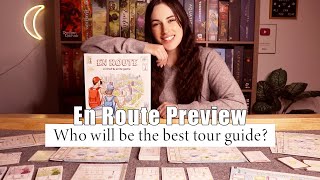
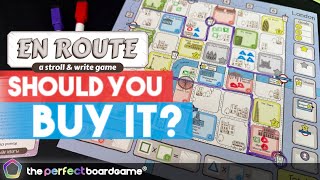

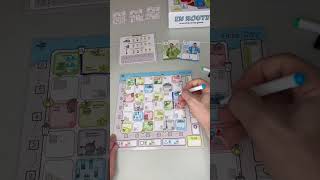


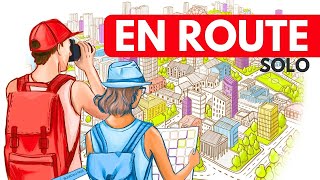





On Tour box art

On Tour

Game ID: GID0233533
Collection Status
Description

You're living the dream. You're in a band and they’re about to go on tour. It's your job to schedule the band's stops over your 100-day tour, visiting as many states as possible.

Each turn in On Tour, two ten-sided dice are rolled to make two two-digit numbers. For example, a roll of 3 and 7 creates the numbers 37 and 73. All players write each of those numbers in a state on their map. The regions they can write in are restricted by three cards turned up in the middle of the table.

At the end of the game, each player draws a route on their map, starting with a low number and visiting adjacent states with higher and higher numbers. Players get a point for every state they visit.

There are also some bonus points available, a way to get wilds, and a variable set-up step that makes every game different.

Note: The second edition supports 8 players out of the box and the map boards are double sided featuring the US map on one side (the one from the first edition) and On Tour: European Expansion of the other side.

—description from the publisher

Year Published
2019
Transcript Analysis
Browse transcript mentions, sentiments, pros/cons, mechanics, topics, quotes, and references.
Total mentions: 8
This page: 8
Sentiment: pos 8 · mix 0 · neu 0 · neg 0
Mentions per page
Top
Showing 1–8 of 8
Video BKRv9Jdqd2c Totally Tabled top_10_list at 14:12 sentiment: positive
video_pk 42882 · mention_pk 130338
Totally Tabled - On Tour video thumbnail
Click to watch at 14:12 · YouTube ↗
Overall sentiment (raw)
positive
Pros
  • Accessible, quick and satisfying roll-and-write
  • Potential for long, satisfying tours
  • App support adds digital play options
Cons
  • High variance; lucky outcomes can dominate
Thematic elements
  • band touring, music, and geography
  • world tour for a band with map regions and evolving sequences
  • light, fast-paced roll-and-write with a musical theme
Comparison games
none
Mechanics (from transcript analysis)
  • Flip/Roll and Write — Roll dice and fill numbers into region cards to build tours.
  • Luck with risk/reward — Great tours require favorable dice; bad luck can derail plans.
  • Region card chaining — Create ascending numerical sequences to connect states/countries on a map.
  • roll-and-write — Roll dice and fill numbers into region cards to build tours.
Video topics + discussion points
No key topics recorded for this video.
Quotes (from this video)
  • it's crazy it sounds downright ridiculous but it's incredibly fun
  • Time Track in order to determine turn order
  • zombies are represented by wooden cubes
  • the solo mode is very well done
  • it's wild and crazy and swingy and really leans into the pirate theme
  • you can screw yourself over you can have just an absolutely horrendous game
  • it's one of my favorite rolling rights
  • cooperative pick up and deliver puzzle that is deceptively crunchy
  • this auction system is brutal but incredibly satisfying
  • the zombies feel scary the system is just incredible
References (from this video)
No references stored for this video.
Video V36ZkMvkxNU Board Game Garden general_discussion at 1:15 sentiment: positive
video_pk 42182 · mention_pk 127987
Board Game Garden - On Tour video thumbnail
Click to watch at 1:15 · YouTube ↗
Overall sentiment (raw)
positive
Pros
  • Engaging flip-and-write mechanic paired with deliberate route-building and spatial planning.
  • Strong thematic integration through city maps, landmarks, and tourist types.
  • Flexible player count (1-4) with a compact 20–40 minute playtime, suitable for families and gaming groups.
  • Solid replayability via multiple city maps and the potential for ongoing campaign/map expansions.
  • Inclusive of a solo mode, broadening accessibility and extending play options.
Cons
  • The product shown is a prototype; components and rules may change before final release.
  • Learning curve may increase with additional maps and variant rules, potentially challenging newer players.
  • Some mechanics rely on multi-player interaction (active neighbor card selection), which could slow play in lower player counts.
Thematic elements
  • Tour guiding and scenic routing: choosing routes to maximize tourist satisfaction and points by visiting landmarks and cafes across curated city boards.
  • A set of city-based maps (starting with a basic city map; later maps include Hong Kong, London, New York, and more campaigns with Rio de Janeiro, Cairo, Paris) where players guide tourists to landmarks and cafes.
  • Flip-and-write with route construction; modular maps that escalate in difficulty and provide thematic flavor through landmarks and color-coded tourists.
Comparison games
none
Mechanics (from transcript analysis)
  • Cafes and Bonuses — Cafe tokens provide bonuses—altering coordinates, granting immediate effects, or offering ongoing benefits—adding strategic layers to route planning.
  • Coordinate System — Coordinates are two numbers from 1 to 6; identical numbers indicate a single location, while different numbers indicate a pair that can be connected horizontally or vertically depending on the choice.
  • Flip and Write — Players flip over cards to reveal coordinates, tourist colors/shapes, and potential landmark cues, which feed into route planning on their personal boards.
  • Flip/Roll and Write — Players flip over cards to reveal coordinates, tourist colors/shapes, and potential landmark cues, which feed into route planning on their personal boards.
  • Map Progression and Variability — Multiple city maps with unique landmarks and optional goal cards introduce varying scoring opportunities and increasing difficulty, supporting replayability.
  • Network/route building — Each round allows players to place two route segments on a 6x6 grid, either as two consecutive steps or as an L-shaped connection, building toward a final route.
  • Round Card Draft and Selection — Each round, the active player and nearby players choose one card from their hands to determine which coordinates and tourist types will be used that round; the discarded neighbor cards are set aside.
  • Route Building — Each round allows players to place two route segments on a 6x6 grid, either as two consecutive steps or as an L-shaped connection, building toward a final route.
  • solo mode — A standalone solo variant exists with dedicated reference cards to enable single-player play and maintain a solvable challenge.
  • Tourists and Landmarks — Tourist tokens come in color-shapes; some cards feature landmarks. Visiting landmark locations yields landmark-based points as they are revealed and marked off.
Video topics + discussion points
No key topics recorded for this video.
Quotes (from this video)
  • This is a prototype so there is like nothing on the back; it is a prototype.
  • The campaign they're going to have even more locations that come in the game.
  • You could erase any of the other streets that you decided to put out throughout the game.
References (from this video)
No references stored for this video.
Video WkUd_PN0fqQ Unknown Channel game_review at 1:02 sentiment: positive
video_pk 41123 · mention_pk 124759
Unknown Channel - On Tour video thumbnail
Click to watch at 1:02 · YouTube ↗
Overall sentiment (raw)
positive
Pros
  • Accessible and relatable walking-tour theme
  • Thematic, meaningful tourists as icons rather than abstract tokens
  • Player ownership and agency via coordinate selection
  • Depth of strategy for flip-and-write genre
  • Subway mechanic that mitigates rule rigidity
  • Short 10-turn length with strong flow
Cons
  • Potentially punishing when key routes are erased due to poor card timing
  • Some players may dislike the learning curve or rule reliance on adjacency/contiguity
  • Not all players may enjoy the hand-management aspect if they prefer more luck-driven play
Thematic elements
  • Tour guiding and sightseeing with thematic destinations.
  • A walking tour through seven cities, including a fictional First City; maps with tourist tokens.
  • Descriptive with witty map references; emphasizes player agency in route creation.
Comparison games
  • Nepone
Mechanics (from transcript analysis)
  • Compound Scoring — Only a single, contiguous route counts toward scoring; broken paths are erased.
  • Contiguity scoring — Only a single, contiguous route counts toward scoring; broken paths are erased.
  • Coordinate pairing — Lead player selects a card; left and right players choose a pair and pair coordinates (x/y) to form a map location, with ambiguity resolved by players.
  • End-game erasure — Any unconnected or broken-off segments are erased at the end of the game.
  • hand management — Managing a hand of three cards per turn introduces strategic decision-making and opponent-aware play.
  • Multi-use cards — A card can copy tourists from another card, enabling flexible planning.
  • Network/route building — Players place two route segments per turn to extend their tour on a grid-based map.
  • Product scoring — Points are the product of the number of tourists along the route and matching destinations.
  • Repeat card — A card can copy tourists from another card, enabling flexible planning.
  • Route construction — Players place two route segments per turn to extend their tour on a grid-based map.
  • Subway mechanic — Some cities allow routing through a subway to connect two sections and ease path creation.
  • Token Pairing — Lead player selects a card; left and right players choose a pair and pair coordinates (x/y) to form a map location, with ambiguity resolved by players.
  • Tourist tokens by type — Tourists are color-coded by interests (e.g., museums, architecture) and influence scoring.
Video topics + discussion points
No key topics recorded for this video.
Quotes (from this video)
  • This is a flip-in right game.
  • I really like this.
  • Definitely one of the most innovative flip and right games both thematically and mechanically that I've maybe ever seen the game on route.
  • Do not think this is a simple game because it is a flipping right.
References (from this video)
No references stored for this video.
Video otUL_BmsFPQ Totally Tabled top_10_list at 0:31 sentiment: positive
video_pk 39401 · mention_pk 118904
Totally Tabled - On Tour video thumbnail
Click to watch at 0:31 · YouTube ↗
Overall sentiment (raw)
positive
Pros
  • easy setup
  • low mental load when sick
  • satisfying to complete a successful route
Cons
  • dice luck can dominate some runs
  • depth may be light for some players
Thematic elements
  • travel routing and ascending-path completion
  • United States state-by-state exploration via region cards
  • light, casual, comfort-focused
Comparison games
none
Mechanics (from transcript analysis)
  • Flip/Roll and Write — Each round you roll two large d10s and assign the numbers to states according to the revealed region cards, building an ascending path across as many states as possible.
  • roll-and-write — Each round you roll two large d10s and assign the numbers to states according to the revealed region cards, building an ascending path across as many states as possible.
Video topics + discussion points
No key topics recorded for this video.
Quotes (from this video)
  • these games tend to fly off the shelf because they just work so well they have few components so setup is super easy
  • I love the coziness of this design and how quickly it can spiral completely out of control
  • The Twist here is that police meeples are being randomly placed in locations as well and at the end of the round your workers need to be able to trace a clear path back to your hideout
  • Cascadia feels super casual and when you're feeling bad a nature theme is exactly what the doctor ordered
  • it's my ultimate comfort food game for so many reasons
  • everything about this game is quirky from its theme to its artwork to the gameplay which is really unlike anything I've played before
References (from this video)
No references stored for this video.
Video wvagXKjJ2_4 Totally Tabled playthrough at 0:03 sentiment: positive
video_pk 28320 · mention_pk 83112
Totally Tabled - On Tour video thumbnail
Click to watch at 0:03 · YouTube ↗
Overall sentiment (raw)
positive
Pros
  • Accessible flip-and-write mechanism that scales well to solo play
  • Multiple city maps with unique tweaks and potential for replayability
  • Engaging scoring system centered on tourists and route-building
  • Dynamic use of special cards to alter draws and coordinate values
  • Clear progression through rounds and defined goals, with hard mode offering a tougher test
  • Transparent disclosure of prototype status and Kickstarter relevance, aiding informed evaluation
Cons
  • Prototype components and rules may change before final production
  • Some maps and features are not yet included in the prototype (e.g., additional cities)
  • Complex scoring with many interacting rules can be intimidating for new players
  • Solo mode requires careful tracking of multiple conditions and round effects
  • Potential analysis paralysis in late game due to numerous strategic options
Thematic elements
  • Tourism, sightseeing, route-building, city exploration
  • Urban sightseeing in a city map learning scenario using a first city map, with expansion potential to other cities
  • Flip-and-write route-building, solo playthrough with deterministic maps and goals
Comparison games
  • London
  • Hong Kong
  • New York City
  • Rio de Janeiro
  • Cairo
  • Paris
Mechanics (from transcript analysis)
  • Compound Scoring — Tourists come in three colors/shapes representing preferences for different location types; color dictates scoring interactions.
  • Edge/border scoring — Some scoring considerations reward routes that travel along the border of the city map.
  • End-game cascade scoring — Multiple scoring categories (by color, yellow stars, gray locations, unused coffee cups) contribute to a final total.
  • flip-and-write — Players flip and select action cards to place tourists and draw route segments, recording choices on a planner-style tableau.
  • Flip/Roll and Write — Players flip and select action cards to place tourists and draw route segments, recording choices on a planner-style tableau.
  • Goal cards — Goal cards set objectives for each round; in hard mode, all three goals must be completed to win.
  • Gray location tokens — Gray locations (e.g., School of Illusion and pottery) provide special bonuses and cross-off effects on a round board.
  • Grid and map interaction — Coordinate numbers map to specific map locations; drawing tourists can restrict or enable future placements.
  • hand management — Players build a hand from current cards and face-up tableau to assemble action pairs each round.
  • Hand management / tableau drafting — Players build a hand from current cards and face-up tableau to assemble action pairs each round.
  • Location adjacency scoring — End-game scoring multiplies tourist counts by the number of adjacent locations of the same color.
  • Multi-use cards — Copy cards double tourist draws; coffee cups modify coordinates or grant extra effects, adding tactical depth.
  • Network/route building — Players draw straight or connected route segments to connect locations on a map, with adjacency and placement rules.
  • Round-based play with fixed rounds — The solo game progresses through a fixed number of rounds (10); rounds are tracked and drive end-game timing.
  • Route construction — Players draw straight or connected route segments to connect locations on a map, with adjacency and placement rules.
  • Special cards — Copy cards double tourist draws; coffee cups modify coordinates or grant extra effects, adding tactical depth.
  • Tourist type scoring — Tourists come in three colors/shapes representing preferences for different location types; color dictates scoring interactions.
Video topics + discussion points
No key topics recorded for this video.
Quotes (from this video)
  • hello everybody Welcome to toally tabled
  • this is a sponsored playthrough
  • which means the crowd games paid me to make this video to show you how on Route is played for their upcoming Kickstarter campaign
  • Everything you see here is a prototype and subject to change, including the rules
  • we're going to be playing with the first city map which is recommended when learning the game
  • we've officially won the game
  • beginner tour guide ranking
  • 125 would be epic
  • there you go that is on Route thank you so much for watching
References (from this video)
No references stored for this video.
Video 9kx-H5GCWvg Wargame Spotlight playthrough at 0:00 sentiment: positive
video_pk 11685 · mention_pk 34286
Wargame Spotlight - On Tour video thumbnail
Click to watch at 0:00 · YouTube ↗
Overall sentiment (raw)
positive
Pros
  • Very easy to teach (one-page rulebook)
  • Fast and light, ideal for a quick game
  • Engaging rolling-right mechanic with strategy via regions and exact circles
  • Expands with new boards and a strong theme (music road trip)
Cons
  • Dice-driven randomness can lead to frustrating rounds
  • Some room for optimization requires multiple plays
  • Scoring can be fiddly for new players
Thematic elements
  • musical band tour
  • US map across states planning a band road trip
  • playful banter with audience interaction
Comparison games
  • Sumo
Mechanics (from transcript analysis)
  • circle vs non-circle placement — Exact matches are circled to gain additional points; non-exact placements remain in the region.
  • Flip/Roll and Write — Roll three dice per round, reveal two cards, and place the resulting numbers into state locations (cities/regions).
  • region and state placement — Numbers must be placed in the region indicated by the cards, with exact-state circles when a match occurs.
  • roll-and-write — Roll three dice per round, reveal two cards, and place the resulting numbers into state locations (cities/regions).
  • route-based scoring — At the end of the game, players score points for each state visited along their route and bonus points for circled numbers.
  • wilds from doubles or matching cards — If all three cards are in the same region or dice show doubles, players gain a wild placement (star) that can be used strategically.
Video topics + discussion points
No key topics recorded for this video.
Quotes (from this video)
  • this is a very straightforward game
  • the rulebook is one page front and back
  • i love a good rolling ring
  • we are band managers and we are trying to map out the ideal summer road trip for the band
  • there's an app for it
  • kickstarter is live right now with expansions for all four of these games
  • i love expansions
References (from this video)
No references stored for this video.
Video x_Uk5XThUW0 Actual Law Anjaan Purchase top_10_list at 12:55 sentiment: positive
video_pk 7735 · mention_pk 22823
Actual Law Anjaan Purchase - On Tour video thumbnail
Click to watch at 12:55 · YouTube ↗
Overall sentiment (raw)
positive
Pros
  • engaging tension
  • shared-board dynamics
Cons
  • dice vs card tension may split tastes
Thematic elements
  • music industry, travel, logistics
  • US tour routing for a band
  • humorous, chaotic
Comparison games
  • Sushi Roll
  • Sushi Go
Mechanics (from transcript analysis)
  • Network/route building — pattern-building and routing decisions across a map
  • opposing styles — two opposing design philosophies shape choices
  • route planning / dice-and-cards — pattern-building and routing decisions across a map
Video topics + discussion points
No key topics recorded for this video.
Quotes (from this video)
  • Sushi Roll is a dice game about eating sushi with such a perfect name that you can't help but feel the makers of 2014's sushi dice should all retire in shame
  • I love gambling on trying to collect the best set because if you do it feels like pulling off a full house in poker
  • it's not going to appeal to gamers who want strategic depth but if you want a light-hearted social game with big moments age of dirt is one-of-a-kind
  • Deep Blue is the year's big family game
  • this is the best storytelling board game I've ever played and it's not even close
References (from this video)
No references stored for this video.
Video aFh9cDoPdxg The Tech Guys general_discussion at 0:15 sentiment: positive
video_pk 4968 · mention_pk 14778
The Tech Guys - On Tour video thumbnail
Click to watch at 0:15 · YouTube ↗
Overall sentiment (raw)
positive
Pros
  • Long, glossy boards for Europe and the USA that create an immersive, map-first experience and contribute to a physical sense of scale.
  • Dice are oversized and highly visible, which supports readability at the table and enhances multiplayer showmanship.
  • Premium components (thick cards, large boards, substantial dice) give a tangible, ‘real game’ feel that elevates the unboxing beyond a typical roll-and-write.
  • The design communicates a clear sense of scope and purpose, making the game appear substantive rather than a simple write-and-erase activity.
  • Strong player-count support up to eight players, enabling larger gatherings and social play.
Cons
  • No explicit solo mode mentioned or observed in the video packaging, leaving solo or solitaire appeal uncertain.
  • Component size and weight imply logistics considerations for shipping, storage, and table space, which could be a downside for casual or space-limited players.
  • Some rule clarifications appear absent from the packaging and in-video discussion (e.g., solo scoring, exact victory conditions, and edge-case interactions), which could require additional rulebook consultation.
Thematic elements
  • Music performance travels and city-by-city touring across multiple continents.
  • A musical tour across Europe and the United States, exploring famous cities and routes in a playful, map-centered format.
  • Light, travelogue-driven with a lightweight, party-leaning design ethos; presented as a tangible, map-forward experience.
Comparison games
none
Mechanics (from transcript analysis)
  • Flip/Roll and Write — Players roll dice and then record the values on their tour map, marking visited locations and achieving progress toward tour goals.
  • Roll and Write — Players roll dice and then record the values on their tour map, marking visited locations and achieving progress toward tour goals.
  • set marking / location tracking — Players populate a large map by marking states, cities, or regions as they are visited, creating a visual record of the tour progression and scoring opportunities.
  • Simultaneous Actions — Gameplay unfolds with multiple players acting in a shared phase or through parallel resolution rather than strict alternating turns, emphasizing social interaction and speed.
  • Simultaneous Play — Gameplay unfolds with multiple players acting in a shared phase or through parallel resolution rather than strict alternating turns, emphasizing social interaction and speed.
Video topics + discussion points
No key topics recorded for this video.
Quotes (from this video)
  • these are huge
  • these boards are really large
  • it feels much more like a full-fledged game
  • eight of those because we can play it with up to eight players
  • the cards feel like they have a nice finish and good thickness; it communicates quality in every component
  • the design makes it feel like a real, complete game rather than just a roll-and-write sketch, which is not always the case with deluxe editions
References (from this video)
No references stored for this video.
Transcript Navigation
Top
Showing 1–8 of 8
View on BoardGameGeek