/pic1494028.jpg)



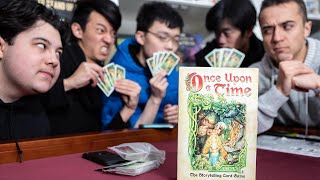

Once Upon a Time: The Storytelling Card Game Deep Dive
What the Community Thinks About Once Upon a Time: The Storytelling Card Game
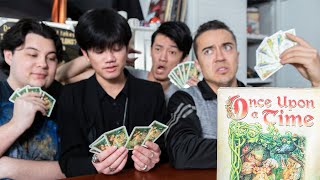
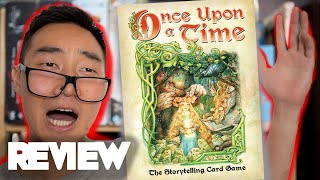
Reviewers who actually play the game as written land somewhere between enthusiastic and cautiously charmed. Shelfside called it "excellent" and settled on an 8 out of 10 in their written score before bumping their personal rating to a 9, saying every session they have played has been "an extremely fun experience." Board Game Sanctuary framed the whole game as a creative tool first and a competitive card game second, praising how it "fosters creativity and imagination" and calling it a genuine resource for aspiring writers. Board to Death TV - Board Game Reviews landed the same way from a lighter angle, rating it an 8 out of 10 and recommending it to families and groups who do not enjoy head-to-head competition.
Where the channels split is on how much the game depends on the people at the table. Shelfside is explicit that the game "is very very speech reliant" and "somewhat falls flat on its face" without a group willing to talk. Board Game Sanctuary goes further, warning that the game needs "like-minded people" who are invested in telling a rich narrative, and that a mismatched group will produce stories that are "very very underwhelming." Gaming with Edo & Jessica takes the game in a different direction entirely, using the card set less as a rules-as-written storytelling game and more as a prompt deck for tabletop role-playing, pulling cards for characters, places, and aspects when they need inspiration at their own table.
Core Mechanics That Define Once Upon a Time: The Storytelling Card Game
Building the Story With Hand Cards
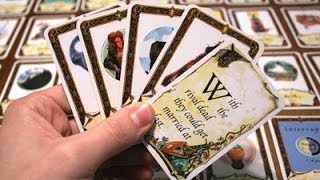
Board Game Sanctuary described the core loop as a competitive storytelling game "where players compete against each other to tell a very rich narrative and try and skew the narrative towards their happy ending." Each player is dealt a hidden ending card and a hand of story cards split across five categories: character, thing, event, place, and aspect. Board to Death TV explained the setup the same way, noting that a player is dealt one ending card and word cards equal to eleven minus the number of players, and that "the point here is to get rid of all your cards to finally play your final ending sentence." Shelfside added that the story and ending have to actually make sense together, so a player cannot simply force a random ending onto an unrelated story just to empty their hand.
The Interrupt System
The mechanic reviewers spent the most time on is the interrupt. Board Game Sanctuary explained that another player can take over as storyteller "if another player has in the interrupt card that matches the story category of the card that was just placed down by the storyteller," or if the active storyteller says a word or phrase similar to a card sitting in someone else's hand. Board to Death TV described the same trigger, noting that "the interrupt must be of the same category as the last played card" and that whoever plays it "becomes the new storyteller, but must follow the story where it left off." Shelfside's own demonstration showed how quickly control can change hands mid-sentence, with one player's witch story getting redirected the moment the other player's card matched.
The Once Upon a Time: The Storytelling Card Game Experience
Improvising Under Light Pressure
Shelfside described the appeal as being able to take the same set of ingredient cards in wildly different directions, walking through two completely different ways the same hand of cards could resolve into a happy ending. Board Game Sanctuary echoed that flexibility, noting the game "provides opportunity for exploring different narrative structures and also exploring character development," to the point where a group could return to the same character across multiple games. Board to Death TV framed it more simply as a game where the players "felt like this is a great tool for people who write," since it keeps pushing the storyteller to find a next sentence rather than stall.
A Game That Leans on Its Table
Because the game has almost no scoring beyond emptying a hand, reviewers agreed the actual experience depends heavily on who is playing. Board Game Sanctuary said a new group can find it "quite daunting to be the storyteller" and recommended starting with two players before scaling up. Shelfside made a similar point about confidence and pacing, adding that their group added a house rule limiting anyone to three story cards per turn so a talkative player could not simply monologue to the ending on their own.
What Makes Once Upon a Time: The Storytelling Card Game Stand Out
Replayable Endings and Flexible Interpretation
Shelfside pointed to the ending cards as the reason the game keeps coming back to the table, saying they give the game "tons of replayability" because there is "so much variety" in how a group can interpret the same combination of cards. Board Game Sanctuary agreed that revisiting the same cards and characters across sessions is part of the appeal, since a story can be picked back up and developed further in a later game.
A Toolkit Beyond the Rulebook
Gaming with Edo & Jessica does not play the game by its printed rules at all and still rates the cards highly, calling the deck "a fantastic tool" for pulling inspiration into tabletop role-playing sessions. They singled out the sheer volume of cards and the artwork on them as a good fit for their own storytelling style. Board Game Sanctuary separately noted the rulebook includes guidance on using the game in an ESL classroom setting to help students practice vocabulary and idioms, calling it "such a valuable resource" for teachers.
Potential Drawbacks
The Interrupt Mechanic Can Overwhelm
The same interrupt system reviewers praised for keeping everyone engaged also drew the sharpest criticism. Shelfside said the interrupt mechanic "makes it too easy for someone who is really competitive to constantly interrupt," and warned players chasing a win above all else to look elsewhere. Board Game Sanctuary raised a related concern about the game's storytelling rules being ambiguous in the moment, noting that what counts as a valid story element "can be a little bit ambiguous," which can lead to disputes over when an interrupt should be allowed.
Artwork and Components Narrow the Story
Board Game Sanctuary was the most direct about the game's limitations, saying the artwork "skewers the storytellers to tell a fairy tale based story" and that the ending cards are "very very generic, very predictable, and also very very skewed heavily to the fairy tale theme." Shelfside had a separate, more practical complaint about the box itself, describing it as "a little too big and clunky" to use at the table and noting the game "could have used some player aids" for newcomers.
If You Enjoy Once Upon a Time: The Storytelling Card Game
Shelfside grouped Once Upon a Time with other games that live or die on how willing a table is to talk, naming Snake Oil and Cash 'n Guns as games in the "same pool" for that reason. Board to Death TV - Board Game Reviews pointed viewers toward it from the opposite direction, recommending it to anyone who already likes Dixit and Fabula and wants a similarly light, non-competitive game night.
What Reviewers Are Saying
"Your mileage may vary, but for me at least, almost every time I played this game has been an extremely fun experience. I love this game."
— Shelfside
"What I really admire about this game is that provides for a very rich storytelling experience. It fosters creativity and imagination in the players that are participating and also is a great opportunity for budding authors and writers and RPG gamers out there who really love the story aspect of gaming."
— Board Game Sanctuary
"This is a great game for families and groups who don't like competitive games and just want to have a good time. We played this many times and our stories were actually getting good, and we felt like this is a great tool for people who write."
— Board to Death TV - Board Game Reviews