You are a Dreamwalker, lost in a mysterious labyrinth, and you must discover the oneiric doors before your dreamtime runs out – or you will remain trapped forever!
You may wander through the chambers of dreams, hoping that chance will reveal the doors, or you can linger in each type of room. In both cases, you will have to deal with the slithering Nightmares, which haunt the hallways of the labyrinth.
Onirim is a solo/cooperative card game. You (and a partner) must work (together) against the game to gather the eight Door cards before the deck runs out; you can obtain those Door cards either by playing cards of the same color three turns in a row, or by discarding (under specific circumstances) one of your powerful Key cards. In both cases you will have to decide the best use of each card in your hand and carefully play around the Nightmares. Those cards are hidden in the deck and will trigger painful dilemmas when drawn...
Basic Deck:
8 Door cards - two each of red, blue, green and brown
10 Nightmare cards
58 Labyrinth cards:
16 red chambers: 3 keys, 4 moons, 9 suns
15 blue chambers: 3 keys, 4 moons, 8 suns
14 green chambers: 3 keys, 4 moons, 7 suns
13 brown chambers: 3 keys, 4 moons, 6 suns
Three mini-expansions, all standalone and compatible with one another, are included with the basic game:
"The Towers" introduces a new type of card that allows more searching and deck manipulation, while also imposing an additional victory condition.
"Happy Dreams and Dark Premonitions" adds evil time bombs that will impede your progress at predictable moments of your quest as well as helpful but unreliable allies.
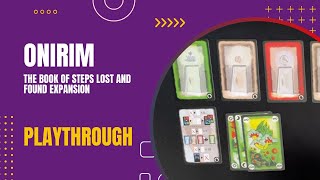
In "The Book of Steps Lost and Found", you must find the eight Door cards in a randomly given order and may remove discarded cards from the game to cast powerful spells that will help you complete this difficult task.
- Spell cards add interesting strategic options (especially the second spell).
- Expansion introduces new goals and novel deck interactions.
- A fun and engaging solo puzzle with puzzle-like mechanics.
- Deck can become tiny and running out before finishing eight doors is a risk.
- Nightmare cards can disrupt the flow and limit options.
- Blue cards can overwhelm early turns, reducing early action options.
- Array
- Dreamlike labyrinth seeking doors
- Solitary, with casual commentary
Mechanics (from transcript analysis)
- Deck building — Players manage a deck by drawing, discarding, and searching for doors or nightmares; expansion spells modify the deck.
- hand management — Starting with a five-card hand, players must discard non-location cards to limbo and redraw; limbo cards reintegrate into the deck later.
- Set Completion / Door Collection — Goal is to unlock all eight doors in a specified order to win; progress is tracked by collecting colors of doors.
Video topics + discussion points
Quotes (from this video)
- I'm doing a solo playthrough of it.
- The Book of steps lost and found is the expansion name.
- I did get five out of the eight doors which I guess is pretty good.
- The Spells were neat I didn't end up using the first spell but man this second spell was really good.
- This is such a fun one.
- I'm excited to just kind of go through them.
- Let me know how you guys like these expansions maybe which ones are your favorites.
References (from this video)
- Loved as a mobile-friendly solitaire title
- Streamlined for quick sessions
- Counterpart physical edition may have variance
- Oni room
- Jaipur
Mechanics (from transcript analysis)
- solitaire play — Primarily a single-player/cooperative solitaire experience.
Video topics + discussion points
Quotes (from this video)
- we have a very round catalogue so we have something for every type of gamer
- it's nice to be able to kind of give something to everybody in every type of gamer
- we look far and wide between our Studios internally and then also external Studios we work with as third parties
References (from this video)
- Highly regarded solo experience
- distinct dream/nightmare theme
- Can be overly luck-driven for some players
- dream exploration and escaping nightmares
- dream labyrinth
- solo-cooperative with dreamlike atmosphere
- The Dreamscape series
- Other solo blackjack-style puzzlers
Mechanics (from transcript analysis)
- card drafting — navigate a dream deck to escape the labyrinth before time runs out
- card drafting / dream exploration — navigate a dream deck to escape the labyrinth before time runs out
- set collection — managing a hand to progress through dream doors
- set collection / hand management — managing a hand to progress through dream doors
- soloable / two-player interaction — designed as a solitaire experience with optional two-player variant
Video topics + discussion points
Quotes (from this video)
- these are games from you know 1990 something all the way up to I think the most recent one is 2013
- I really want to try Agricola because Francis and I have played Caverna we absolutely love Caverna
- the fisherman theme that's why we tried News Fjord as well because we loved that theme
- Onirim ... a solo game where you shuffle through your dreams and open doors
- Robinson Crusoe ... you are trying to survive on an island cooperatively
- Hanamikoji is absolutely beautiful and I would love to try it
- CV is one that I would love to try the art is absolutely adorable
References (from this video)
- engaging solo experience
- unique puzzle dynamics
- can be fiddly to set up
- Lost Cities (card-driven puzzle feel)
Mechanics (from transcript analysis)
- Card-drawn door/keys puzzle — Solo or two-player puzzle about collecting keys to open doors; timing and card timing matters
Video topics + discussion points
Quotes (from this video)
- "it's real time game where everybody's just quickly shoots their kiwis"
- "it's like twister the card game"
- "it's basically king of tokyo for two players"
- "you can play it on a bus or anywhere"
- "it's called alice trolley it's a memory game"
References (from this video)
- clear explanation of solo rules and two-player variant
- replayability supported by seven expansions
- accessible components and straightforward setup
- tension from nightmare cards and timing
- complex interplay of rules can be hard for absolute beginners
- some rules interactions are nuanced and require careful listening
- expansion rules not fully explored in this video
- navigating a dreamscape to unlock doors and escape the dream
- a dreamlike labyrinth world with doors representing color-based challenges
- puzzle-driven, atmospheric solitaire/coop with dream logic
Mechanics (from transcript analysis)
- deck manipulation — key cards can trigger prophecy, reshuffle and order the deck; they have special uses.
- deck-building / draw and discard — draw from the stack to replenish hand; special handling of limbo and discard zones.
- hand management — players manage a hand of cards and strategically place them in the labyrinth or discard pile.
- multi-area play — game state includes labyrinth, door area, limbo, and discard areas; cards move between zones.
- prophecy using key cards — key cards can trigger prophecy, reshuffle and order the deck; they have special uses.
- risk management — nightmare cards impose penalties, forcing discards or reshuffles and potentially losing the game.
- risk management via nightmare cards — nightmare cards impose penalties, forcing discards or reshuffles and potentially losing the game.
- set collection — the objective is to place three cards in a row of the same color to unlock a door.
- set-collection / set-building — the objective is to place three cards in a row of the same color to unlock a door.
Video topics + discussion points
Quotes (from this video)
- Onirim is a funny little card game that plays mainly as a solo but also offers a two-player cooperative mode
- the player's objective is to place three cards in a row of the same color when he does that he finds an oneric door of the corresponding color
- the nightmare cards... the negative effect is that the player loses cards to the discard pile faster
- if the stack runs out you lose time and automatically lose the game
- there are three special uses for the key cards
- the round proceeds to phase 3 where we simply reshuffle any cards that might be in the limbo area back in the stack
References (from this video)
- Evocative artwork and strong theme
- Standalone solo experience with a tight loop
- Can feel repetitive if played too often
- Some players dislike the luck element in card draws
- Door traversal and traversal-based puzzle
- Dreamlike Netherworld / nightmare realm
- Card-driven, atmospheric exploration
- Ouija-like deduction titles
- Other solo door-and-card puzzle games
Mechanics (from transcript analysis)
- Card-based exploration — Players seek to build a path of doors using specific color combos
- deck management — Risk-reward decisions about resolving or delaying cards
- Pattern Building — Players seek to build a path of doors using specific color combos
Video topics + discussion points
Quotes (from this video)
- this is a space where Mage Knight is described as the best solo game you can get your hands on today
- it's a living breathing world inside a box
- it's like being addicted to heroin... every month a new mythos pack is released
References (from this video)
- Compact and clever system
- Good deduction feel in a small box
- Difficult for players who dislike abstract themes
- solitary puzzle exploration
- Dreamlike labyrinth world
- Renegade
Mechanics (from transcript analysis)
- Deck-building / set collection — Card-driven puzzle game with folding pathways.
Video topics + discussion points
Quotes (from this video)
- the solo Gaming Community is the best community in gaming
- this is the forever list for many players, a place where certain games become 'forever' for some people
- the art on Kilforth is the most beautiful art I've ever seen
- it's my number one
- theme hooks me, and if that can hook me, I keep digging into the mechanics
- the audience is changing and that's driving which games end up on the list
- we need fresh voices to keep the list dynamic
References (from this video)
Mechanics (from transcript analysis)
Video topics + discussion points
Quotes (from this video)
- Twilight Struggle is one of my all-time favorite games.
- Tabletop Simulator is one of the best ways to be able to play a whole bunch of board games on your computer.
- Terraforming Mars is my evening unwind game.
- Slay the Spire is a really clever deck-building dungeon-crawler.
References (from this video)
- Good solo experience
- Portable and quick
- Can be repetitive for some players
- Solitaire deck-building with light interaction
- Dream/maze exploration
- Dreamlike, abstract
Mechanics (from transcript analysis)
- deck_building — Build a deck to unlock doors and progress.
Video topics + discussion points
Quotes (from this video)
- Harrow County is a very unique game.
- This is Seven Wonders. ... an excellent card drafting game.
- Ticket to Ride is a classic and a staple at many events.
- Root has fans and they are super fans.
References (from this video)
Mechanics (from transcript analysis)
Video topics + discussion points
Quotes (from this video)
- This is highly subjective in general I award this to games that I find especially entertaining designed especially well or elegantly or view as a great overall package.
- I don't rate games on this channel with a number I don't really like doing that; rating a game is more complex than slapping a number in front of it.
- The definitive rating is how much I would recommend a game, and all games that award the Ace of Games too I would definitely 100% recommend.
- these three seconds is games award if a game is exceptionally good in my opinion and that concludes today's video.
- Wingspan is my most favorite game of all time... it gets the golden Ace of Games Award.