/pic7070031.jpg)














































Oros Deep Dive
What the Community Thinks About Oros
Reviewers keep landing on the same word for Oros: unique. Foster the Meeple called it "this combination of area control and tile movement type game that is pretty freaking unique," and Game Night Picks - Pair Of Dice Paradise picked it as a hidden gem, calling it a game more people ought to be talking about. Allies or Enemies, reviewing a copy supplied by the publisher for the retail edition, and Rolling Dice & Taking Names, who played a copy from Lucky Duck Games, both arrived at a similar place after multiple sessions: the game grew on them once the rules settled in.
The disagreement is over how quickly, and for whom, that settling happens. Within Foster the Meeple's own discussion, one host called the game "very good" while the co-host, Jamie, could not get past how the tile movement worked and did not enjoy it. Game Night Picks was blunter about player count, saying the game is better at three or four than at two, where a dummy player is required. Rolling Dice & Taking Names went further, suggesting based on outside opinion that three players is the sweet spot because a four-player game can leave someone locked out of a mountain space. Across the board, the consensus holds that the tectonic tile-shifting and worker placement combination is genuinely fresh, even as reviewers split on how forgiving the learning curve is.
Core Mechanics That Define Oros
Colliding Tiles and Erupting Volcanoes
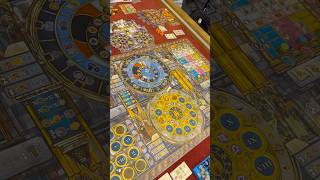
The shared board in Oros is built from land tiles numbered by mass, and players spend actions shifting rows or columns of those tiles to slam them together. Allies or Enemies described the process directly: "when land smashes together it results in higher numbered, aka higher above sea level, land. When two four-size land smash it creates a mountain." Rolling Dice & Taking Names walked through the same idea from the table, explaining that a level one tile and a level two tile colliding becomes a level three, and two level fours merging is what forms a mountain. Volcanoes work on a similar one-to-four scale: erupting one spills lava outward and raises the mass of neighboring tiles, sometimes splitting across more than one edge. Both channels noted that the board wraps around like a globe, so tiles that slide off one edge reappear on the other, which Foster the Meeple flagged as the single hardest idea to visualize without seeing it happen on the table.
Worker Placement and the Wisdom Track
Underneath the shifting map sits a personal player board where each demigod's followers take three actions per turn, moving between spaces that either manipulate the land or send followers to study, journey, or build. Rolling Dice & Taking Names described it as "followers are working for you, they are trying to promote their demigod to god status," and pointed out that every action can be upgraded with wisdom, calling the upgrade paths "almost like a tech tree." Allies or Enemies covered the same system, noting that wisdom gained from sacred sites or study lets a player level up powers, unlock new abilities, free up followers, and push their god up an ascension track that ends the game once someone reaches the top.
The Oros Experience
Begrudging Cooperation
Because mountains and sacred sites depend on shared tiles, players cannot simply retreat to a corner of the board. Allies or Enemies put it plainly: there is "almost a necessary level of begrudging cooperation. You often need to kind of work together to create mountains," since only one level of each temple can be built by a single player and someone else has to build the levels below. Rolling Dice & Taking Names described the same dynamic from the table, saying the group realized they wanted to stay near each other because whoever built first on a new mountain let everyone else benefit from being nearby.
A Slow Climb From Confusion to Confidence
Every reviewer who played more than once described a similar arc: an early scramble through the rulebook followed by things clicking into place. Rolling Dice & Taking Names compared the tile shifting to "the old thumb puzzles where you are trying to shift one piece around... like get them in sequence or build a picture," the sliding-number kind of puzzle, and said the actions themselves are straightforward while the edge cases are what kept sending the group back to the rules. Allies or Enemies reported the same trajectory over a longer stretch of plays, saying their appreciation for the game grows with every session, even as a few small, easy-to-forget rules remain a barrier for new players.
What Makes Oros Stand Out
A Genuinely Unique Puzzle
Reviewers consistently pointed to the combination of area control and physical tile manipulation as something they had not seen elsewhere. Game Night Picks - Pair Of Dice Paradise summed up the appeal of shifting tiles and slamming them together to form mountains, then racing to build temples on the results, as reason enough to call it a hidden gem. Foster the Meeple agreed the mash-up of mechanics was "pretty freaking unique," even while acknowledging how tricky it can be to picture in the abstract.
Clear, Rewarding Scoring
Despite the fiddly middle of the game, reviewers praised how legible the path to victory stays. Rolling Dice & Taking Names highlighted that "you see how points are generated, it's not a head scratcher... it's very clear how in-game scoring happens, and you can work towards those goals to maximize your knowledge points." Allies or Enemies traced the same clarity back to the wisdom system, where leveling up powers and building sacred sites both feed directly into the score a player is chasing.
Potential Drawbacks
A Steep Learning Curve and Rulebook Clunkiness
The most repeated criticism is how much rules-checking the first few plays demand. Allies or Enemies said the rule book "can be clunky at times with some rules in weird places," adding that it took three or four games before the group had their heads around it all. Rolling Dice & Taking Names described hitting edge cases again and again that sent the group back to the rule book, particularly around how volcanoes split lava and how tiles behave when they wrap around the board.
Getting Locked Out at Higher Player Counts
Several reviewers flagged that the game does not scale evenly across player counts. Game Night Picks - Pair Of Dice Paradise said it is "better at three or four than it is at two players," adding that a two-player game forces a dummy player they would rather avoid. Rolling Dice & Taking Names raised the opposite end of the range, explaining that in a four-player game "you could be locked out of a mountain space" once the three available sacred site slots fill up, which is part of why they suspected three players plays best.
If You Enjoy Oros
Allies or Enemies compared the solo and two-player bots directly to another game's approach, describing the bots as fairly simple and likening them to Dune: Imperium, where a flipped card resolves a bot’s turn each round. Game Night Picks - Pair Of Dice Paradise drew a different comparison while discussing their shelf of favorites, noting that after talking about how Oros's tiles move and smash together, City of the Great Machine has tiles that "move around and relocate on the board as this big steampunk city reconfigures itself."
What Reviewers Are Saying
"We enjoy Oros more each time we play it, and after half a dozen or so plays it has built up to being a game that we're probably gonna keep playing. But there are a few barriers to get to that point. There are a lot of small rules that you need to learn and keep in mind, there's also a bit of a tricky flow of play as every action has a few steps and there are three actions a turn."
— Allies or Enemies
"Even though I got beat tremendously here, I did enjoy the game as a whole, and for me, I like worker placement games. I have always liked worker placement games, and I love the idea of upgrading actions."
— Rolling Dice & Taking Names
"For my hidden gem, I am going with the game Oros right here. Oros is a game I wish more people talked about because there are tiles out on the board and you are shifting tiles and making them slam together to form bigger tiles as if they're creating mountains out in the ocean."
— Game Night Picks - Pair Of Dice Paradise