






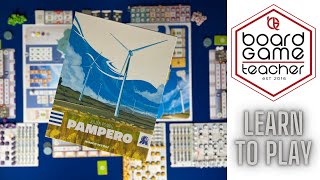



















Pampero Deep Dive
What the Community Thinks About Pampero
Pampero stands as a standout heavy Euro that earns respect from experienced board gamers for its sophisticated mechanical design and thematic integration. Reviewers consistently highlight how the game rewards strategic planning, smart timing, and opportunistic play without locking players into isolated strategies. The win-power theme of Uruguay's energy grid becomes tangible through mechanics that feel earned rather than pasted on. Players encounter a game that respects their intelligence, demanding careful sequencing of card plays and understanding how to leverage shared board resources for advantage.
Core Mechanics That Define Pampero
Hand Management and Card Timing
The foundation of Pampero rests on how players manage their starting eight identical action cards. Cards play to one of two rows on your player board, each row affecting different board zones and costs. The crucial constraint: cards must slide into the leftmost empty slot. Early slots cost more; filling the row rightward makes actions cheaper. This forces genuine decisions about when to play aggressively and when to consolidate. Equally important is the retrieval phase, where you recover cards back to your hand. The game rewards knowing whether to pull all cards at once to refresh your hand or retrieve strategically to maintain cheap action slots. That timing decision shapes your entire turn order position and available actions for upcoming rounds.
Resource Distribution and Energy-to-Money Conversion
Wind farms generate energy; electrical towers distribute it; transformers collect it as contracts for payment. This sequence mirrors actual power infrastructure. Energy sits in a limited supply that you accumulate and strategically spend to activate towers, fulfill contracts, and generate batteries. The battery-generation mechanism particularly rewards player skill. Based on your energy level and which electrical towers you control, you produce a specific number of batteries that can be spent for contract fulfillment or equipment costs. This conversion creates cascading decisions: do you push for energy this turn to unlock batteries next turn, or secure immediate income? The resource flow feels both thematic and tactically engaging.
The Pampero Experience
Satisfying Economic Engine Building
Watching your infrastructure grid develop creates genuine satisfaction. Early actions feel expensive and limited; by mid-game, you unlock multiple towers and contract pathways that feed income streams. Each electrical tower you build unlocks new contract types and income channels. Building your engine inch by inch generates that signature Euro pleasure of small optimizations compounding into tangible advantage. The income tracks that advance with fulfilled contracts provide visual feedback of growing economic power. This is not a game where you crush opponents through single powerful moves, but rather one where steady infrastructure investment and smart sequencing deliver slow-building victory.
Tense Interactive Competition Through Shared Resources
The board features limited spaces for wind farms and towers, with player bulldozers determining placement availability. When you build on someone else's bulldozer, you pay them instead of the bank. Money represents victory points, so you face a constant tension between accessing valuable board spaces and enriching competitors. This creates moments of genuine decision-making: do you pay your opponent to use their prime location, or find another path? Meanwhile, watching opponents position their bulldozers to block your plans or force advantageous payments generates table interaction and memorable moments of tactical maneuvering. No player is ever locked out of strategies; you always have options, but options sometimes cost you significantly.
What Makes Pampero Stand Out
Thematic Mechanics That Teach Without Preaching
Julian Pombo spent over two years researching Uruguay's actual wind-energy transition from imported fossil fuels to renewable infrastructure. That research shaped not just flavor text but core mechanics. Wind turbines generate power that must be transported via towers and transformers, reflecting real grid limitations. Penalties for inefficient connections (requiring specific energy payments) embed the reality that infrastructure problems cost money. The optional environmental expansion further explores how government incentives reward companies that protect local ecosystems. Rather than explain these systems, the game makes players experience them through rules. A heavy Euro usually sacrifices theme for puzzle satisfaction; Pampero delivers both without either feeling forced.
Never-Locked-Out Player Agency
Whether competing for shared bulldozers or accessing contract opportunities, you always retain meaningful choices. Expensive payment options exist for situations where preferred spaces are occupied. Multiple income tracks and contract types ensure blocked paths in one sector don't eliminate progress in another. This design prevents the downward spiral where bad luck or opponent blocking creates a dead position. You stay engaged because you can always pivot toward an alternative strategy, though pivoting may require resource management more careful than you'd planned.
Potential Drawbacks
Substantial Complexity and Teaching Burden
Pampero's depth demands patience during teach. The overlapping systems of card timing, energy management, zone-specific actions, income tracks, and contract placement create a rulebook that requires careful explanation. Players familiar with heavy Euros grasp it eventually, but teaching a critical rule incorrectly cascades through the entire game. The prototype copies featured in community playthroughs show a living rulebook still being refined. First-time players often need several turns before the economy clicks, and games can stretch toward the three-hour ceiling if players agonize over every decision.
Analysis Paralysis and Downtime Potential
The number of legal actions each turn, combined with the cost implications of timing and card placement, invites prolonged decision-making. With six or more potential targets on the board, variable costs based on card slot position, and future-turn sequencing considerations, a player optimizing play can deliberate for minutes. At full player count, downtime between turns multiplies. Casual players enjoy Pampero's theme and visual progression, but players prone to analysis paralysis or tables without time limits may find the economic puzzling exhausting rather than satisfying.
If You Enjoy Pampero
Pampero lands comfortably among games like Mercado de Lisboa, Lisboa, and Weather Machine: heavy economic Euros where infrastructure building and resource conversion drive victory. Fans of Bot Factory appreciate similar "building something that works" satisfaction. If you love the spatial tile-placement and optimization of games like Dominant Species or Agricola, Pampero's grid-building aspect will resonate. Players drawn to games where theme and mechanics reinforce each other rather than conflict should absolutely explore this. The game appeals especially to designers and experienced Euro players who value mechanical elegance and thematic coherence; casual audiences may find it rewarding but demanding.
What Reviewers Are Saying
"The real joy of this game comes down to building up a long series of buildings, then placing that residence and activating them all and getting all their resources."
— The Dice Tower
"The game rewards players when playing the right cards at the right time in the right place and knowing when to retrieve them all as well."
— Let's Table It
"When you're playing the game, you're not just resolving this now and waiting to see what happened. You get to plan your turns two, three turns ahead because that infrastructure investment compounds."
— Beyond Solitaire