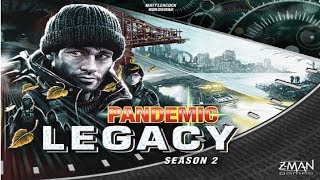
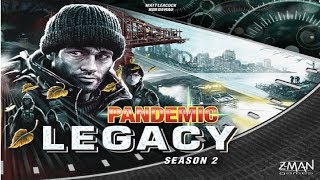
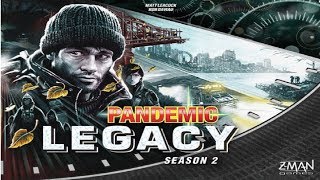
Pandemic Legacy is a co-operative campaign game, with an overarching story arc played through 12-24 sessions, depending on how well your group does at the game. At the beginning, the game starts in a very similar fashion as basic Pandemic, in which your team of disease-fighting specialists races against the clock to travel around the world, treating disease hot spots while researching cures for each of four plagues before they get out of hand.
During a player's turn, they have four actions available, with which they may travel around in the world in various ways (sometimes needing to discard a card), build structures like research stations, treat diseases (removing one cube from the board; if all cubes of a color have been removed, the disease has been eradicated), trade cards with other players, or find a cure for a disease (requiring five cards of the same color to be discarded while at a research station). Each player has a unique role with special abilities to help them at these actions.
After a player has taken their actions, they draw two cards. These cards can include epidemic cards, which will place new disease cubes on the board, and can lead to an outbreak, spreading disease cubes even further. Outbreaks additionally increase the panic level of a city, making that city more expensive to travel to.
Each month in the game, you have two chances to achieve that month's objectives. If you succeed, you win and immediately move on to the next month. If you fail, you have a second chance, with more funding for beneficial event cards.
During the campaign, new rules and components will be introduced. These will sometimes require you to permanently alter the components of the game; this includes writing on cards, ripping up cards, and placing permanent stickers on components. Your characters can gain new skills, or detrimental effects. A character can even be lost entirely, at which point it's no longer available for play.
Part of the Pandemic series
PART 3 : PANDEMIC LEGACY *SPOILERS*
- appreciate the legacy aspect of this game.
- Terrible dev decision.
- horrible and a really long experience.
- There's not enough words.
- Wish replayability was better.
- Destroying my game? Not an option.
- Like Pandemic, but I have to play more games of it. Ugh.
- Gloomhaven
Mechanics (from transcript analysis)
Video topics + discussion points
Quotes (from this video)
- Destroying my game? Not an option.
- Terrible dev decision.
- There's not enough words.
- Wish replayability was better.
- After playing a couple matches, you will appreciate the legacy aspect of this game.
- one just to get Gloomhaven to number
- Like Pandemic, but I have to play more games of it. Ugh.
References (from this video)
- High-impact moments when the mechanics click
- strong storytelling potential
- Misplaying mechanics early can ruin progression
- permanent changes can't be reset easily
- legacy narrative and evolving rules
- global pandemic response with evolving events
- story-driven campaign with permanent changes
Mechanics (from transcript analysis)
- cooperative hand-management — players coordinate to manage outbreaks and cure diseases.
- hand management — players coordinate to manage outbreaks and cure diseases.
- legacy progression — campaign evolves with permanence across sessions.
Video topics + discussion points
Quotes (from this video)
- It's not engagement. It's everyone doing their own puzzle in the same room.
- Gorgeous production quality, but multiple simultaneous subsystems that can feel complex initially for new players.
- Turn order determines a lot in this game's economy.
- One wrong move with how the link network system works, and you've completely invalidated your entire strategy.
- The clue giver walks a razor line between clever and intuitive that new players haven't calibrated.
- Eight-hour day commitment, full group attendance, full mental energy required throughout.
References (from this video)
- Innovative legacy structure
- Integrated story with evolving content
- Time commitment
- Permanent alterations can hinder replayability once finished
- Legacy campaign with evolving components
- Global pandemic response
- Story-driven progress across plays
- Risk
Mechanics (from transcript analysis)
- Campaign progression — Persistent changes across games.
- Card-based actions — Utilizes epidemic rounds with actions
- co-op with evolving rules — Rules can mutate between sessions.
Video topics + discussion points
Quotes (from this video)
- this is our top 10 co-op games
- it's such a chill game
- we are so engaged in this very simple game
References (from this video)
Mechanics (from transcript analysis)
Video topics + discussion points
Quotes (from this video)
- the bones of the game are so simple
- I love bag Builders
- the tracks are so continuously rewarding
- you can see so much of kind of the DNA of Clank
- it's so satisfying to slide those workers into that Mech
- this feels like a Dungeon Crawler but with Euro systems
- I love horror movies
References (from this video)
- Innovative legacy structure with meaningful long-term investment
- Engaging story arcs and memorable moments
- High replay value across campaigns
- Long play sessions and commitment required
- Permanent changes can limit immediate re-playability
- Cooperative play with evolving legacy mechanics
- Global outbreak with evolving game state through a campaign
- Campaign-driven story arc with changing rules and components
Mechanics (from transcript analysis)
- Cooperative Game — Players work together to contain outbreaks and complete objectives.
- cooperative play — Players work together to contain outbreaks and complete objectives.
- Legacy game — Permanent changes to the game world and rules across sessions.
- legacy progression — Permanent changes to the game world and rules across sessions.
- story-driven scenarios — Narrative arcs guide each session and shape future play.
Video topics + discussion points
Quotes (from this video)
- it's so streamlined to like perfection where you can explain the rules in like 15 seconds
- this is the peanut butter and chocolate that we can like totally agree on
- parade is a classic feeling card game that could have been invented in the 1960s
References (from this video)
- cool part about legacy, especially the legacy aspect
- components can get destroyed (as shown in unplayable state)
- box/components damaged leading to unplayable now
- Legacy progression, evolving story and components
- Global pandemic across a multi-session campaign
- Campaign-driven, story-driven with evolving rules
Mechanics (from transcript analysis)
- Cooperative Game — Players work together to contain outbreaks and complete objectives.
- cooperative play — Players work together to contain outbreaks and complete objectives.
- Events — Story events alter how the game is played in future sessions.
- Legacy campaign progression — Permanent changes to the board, components, and rules over many sessions.
- Legacy game — Permanent changes to the board, components, and rules over many sessions.
- pandemic core engine — Managing disease cubes, outbreaks, epidemics as in the base game.
- Story-driven events and rule changes — Story events alter how the game is played in future sessions.
Video topics + discussion points
Quotes (from this video)
- this game is going to get a 6 out of 10 above average
- this is how it looks once you mash up and destroy all the components in saving the world
- the problem but also cool part about pandemic legacy especially on the legacy part
- completely trashed
- this game is just unplayable now
References (from this video)
- Dynamic campaign with meaningful evolution
- High replayability due to evolving state and persistent decisions
- Strong appeal to Johnny archetype through exploration of systems and narratives
- Long play sessions and commitment required across campaigns
- Legacy structure may be intimidating for new players
- Array
- Global pandemic campaign that evolves over time
- Campaign-driven, evolving narrative with persistent consequences
Mechanics (from transcript analysis)
- Cooperative Game — Players work together to cure diseases and prevent outbreaks across a global map.
- cooperative play — Players work together to cure diseases and prevent outbreaks across a global map.
- legacy campaign — The game changes permanently over the course of a campaign, adding or removing components and altering rules.
- Legacy game — The game changes permanently over the course of a campaign, adding or removing components and altering rules.
Video topics + discussion points
Quotes (from this video)
- "Patchwork, right? Very popular two-player game."
- "This game is actually a very spike game."
- "The Timmy is really into it because oh, the concept is oh we get to have a bunch of birds and they all have abilities and they have like Latin text on them."
- "There are a lot of ways you can pilot your faction"
- "negotiation is a big appeal for all three archetypes"
- "What better game to talk about negotiation than Twilight Imperium?"
- "Pandemic Legacy is the quintessential Johnny game"
- "The Crew cooperative trick taking game"
- "one straight line. There's one optimal way to solve it"
References (from this video)
- Engaging narrative arc and memorable campaign structure
- Offers a novel, evolving gameplay experience
- Requires a long-term commitment
- Limited replayability after completing the campaign
- campaign-driven narrative; evolving rules and components
- Global pandemic response with evolving world dynamics
- legacy-style campaign with progressive changes
- Pandemic
Mechanics (from transcript analysis)
- Cooperative Game — Players collaborate to cure diseases and contain outbreaks.
- cooperative play — Players collaborate to cure diseases and contain outbreaks.
- legacy campaign — Permanent changes to components and rules based on decisions.
- Legacy game — Permanent changes to components and rules based on decisions.
- scenario progression — Linked scenarios with evolving goals and twists.
- Unique player powers — Roles and abilities expand or change over the campaign.
- Variable player powers — Roles and abilities expand or change over the campaign.
Video topics + discussion points
Quotes (from this video)
- the two ultimate wind conditions are nice but the rest now pass
- all locks and only a little bit of substance
- pandemic legacy is a game played over 12 months in an involving story that I wrote spoiled base basically pandemic you make to play a lot
- I don't mind pandemic I just don't want to play it again after playing it once
- the clues in the name
- it's a contrived under-produced game
- I love this game the first couple of times I played but I played it as a true gateway game into Euro games
- now no I don't want to try it with the expansion I don't care if it makes the game better I want to play a proper euro I'm all grown up
References (from this video)
- strong campaign-like progression
- immersive cooperative storytelling
- can be long and heavy for some groups
- Pandemic Legacy Season Zero
- Pandemic Legacy Season 2
Mechanics (from transcript analysis)
Video topics + discussion points
Quotes (from this video)
- Number one ranked game is of course Azul.
- Number one is Dead of Winter, a crossroads game. I get 27 points.
- The Crew Mission Deep Sea is the number one trick taking game on board gamegeek.
- Number one is Root.
- Calico.
- Thunderbirds.
References (from this video)
- Compelling narrative progression with meaningful milestones that feel tangible and consequential
- Satisfying sense of discovery through upgrades, mutations, and unlocking new capabilities
- Strong cooperative pacing, especially at two players where shared actions accelerate cures
- High replay potential due to diverse character options, upgrades, and evolving world states
- Delightful physical components (stickers, cards, and upgraded surfaces) that reinforce the legacy feel
- Clear sense of escalation and tension as the world becomes more complicated and the stakes rise
- Story reveals and mission briefings provide clear stakes without overwhelming with exposition
- Well-suited for families or groups who want a narrative-driven, campaign-style experience
- Swingy and occasionally punishing balance that can be frustrating, especially in later months or high-player-count sessions
- Rulebook complexity and occasional misalignment across different sections can slow beginners or returning players
- Sticker scratching and component durability can be finicky, and sleeve-related handling may complicate play
- Two-player dynamics can reduce perceived variety once upgraded paths become obvious or overpowered
- Campaign fatigue risk: a full run requires multiple sessions and long-term commitment, which may not suit casual players
- Legacy elements may feel disruptive or disruptive to the sense of normal Pandemic gameplay for some players
- Late-game surprises and the possibility of difficult-to-resolve missions can create sessions that feel punishing rather than triumphant
- Cooperative disease containment set against a mutable, story-driven world that changes permanently through stickers, scars, and evolving objectives.
- A dynamic global outbreak scenario unfolding over a calendar of months, with cities and worlds evolving as the campaign progresses.
- Episodic mission-based storytelling that reveals a broader global arc across play sessions; heavily player-driven with evolving-world consequences.
- Pandemic (base game)
- Pandemic Legacy Season 2
- Pandemic Legacy Season 0
Mechanics (from transcript analysis)
- Character upgrades and abilities — Characters gain new powers and starting advantages through upgrades, which can dramatically shift play style and strategy.
- City and world state modification — Cities gain negative stickers or upgrades that increase travel difficulty and disease spread, creating a continuously shifting play field.
- Cooperative Game — Players work together to cure diseases and achieve campaign-specific objectives, sharing information and coordinating actions to limit outbreaks.
- cooperative gameplay — Players work together to cure diseases and achieve campaign-specific objectives, sharing information and coordinating actions to limit outbreaks.
- Event/funding system with monthly pressure — The balance of the deck shifts with wins/losses, offering more events or increasing difficulty, and the funding mechanic affects what options are available later.
- Legacy game — Elements on the board, player cards, and even the rule set are permanently altered by stickers, scars, and new components as the campaign progresses.
- Legacy/permanent world changes — Elements on the board, player cards, and even the rule set are permanently altered by stickers, scars, and new components as the campaign progresses.
- Monthly mission briefings and narrative drumbeat — Story briefer updates drive the campaign, with in-between moments hinting at consequences and future revelations, guiding the sense of progression.
- Scenario / Mission / Campaign Game — Story briefer updates drive the campaign, with in-between moments hinting at consequences and future revelations, guiding the sense of progression.
- Unique player powers — Characters gain new powers and starting advantages through upgrades, which can dramatically shift play style and strategy.
Video topics + discussion points
Quotes (from this video)
- We loved the game. It was a great time.
- The swinginess is... more frustrating than base Pandemic, but it’s part of what makes the legacy experience so tense.
- The story really is a big selling point here, especially the first time you play through it.
- Two-player co-workers is insane. Just insane. Sharing city cards with one of us being there was ridiculous and sped up curing dramatically.
- If you’re playing with more players, it would be certainly a tenser and more interesting experience.
References (from this video)
- Long-form, evolving campaign with meaningful player impact
- Strong cooperative depth and narrative integration
- Long sessions can be commitment-intensive
- Campaign longevity may deter casual players
- Cooperative crisis management with narrative progression
- Global pandemic with a year-long campaign that evolves over time
- Campaign legacy with evolving rules and components
- Gloomhaven
- Defenders of the Realm
- Pandemic
Mechanics (from transcript analysis)
- Cooperative Game — Players work together to discover cures and contain outbreaks.
- cooperative_play — Players work together to discover cures and contain outbreaks.
- Legacy game — Game evolves permanently across sessions, changing components and rules.
- legacy_campaign — Game evolves permanently across sessions, changing components and rules.
Video topics + discussion points
Quotes (from this video)
- The number one cooperative game on BG is Pandemic Legacy Season 1.
- Defenders of the Realm because it's a fantastic cooperative game.
- The way I avoid doing that is I follow the advice... Don't Stop the Top.
References (from this video)
- unique evolving story that makes each game feel different
- strong cooperative gameplay
- satisfying sense of progression and consequence
- heavy commitment across multiple sessions
- permanent changes can be intimidating for some players
- pandemics, civic cooperation, persistent world-changing consequences
- Global cities facing evolving disease outbreaks; legacy campaign across playthroughs
- legacy campaign with evolving story and permanent components
- Two Rooms and a Boom
- Great Western Trail
- Kemet
Mechanics (from transcript analysis)
- Cooperative Game — Players work together to treat diseases, discover cures, and manage outbreaks.
- cooperative play — Players work together to treat diseases, discover cures, and manage outbreaks.
- Legacy game — Board and components permanently change over time; stickers, markers, and new characters
- legacy progression — Board and components permanently change over time; stickers, markers, and new characters
- mode change across sessions — Each session presents a different one-month 'episode' with evolving challenges
Video topics + discussion points
Quotes (from this video)
- Two Rooms and a Boom plays that like a spy film with a massive cast
- this is a great couples game because you get to make your own very very ill baby
- historically themed games are hard to write jokes for
- the theme is integral to the game creating the perfect combination of interaction of interest between the players and the frenetic energy of real-time negotiation
References (from this video)
- Innovative campaign structure that drives group bonding
- Engaging narrative twists and evolving components
- High replayable potential across campaigns
- One-and-done in the sense of a single campaign can be long
- Not ideal for players who dislike long, evolving campaigns
- legacy campaign with evolving rules and components
- global pandemic response across evolving seasons
- campaign-driven storytelling with permanent changes
- Pandemic
- Eldritch Horror
Mechanics (from transcript analysis)
- Legacy game — results, components, and story evolve permanently over sessions
- legacy progression — results, components, and story evolve permanently over sessions
- pandemic core mechanics with twists — classic disease curing with evolving twists and player roles
Video topics + discussion points
Quotes (from this video)
- Cooperative games are normally like very thematic.
- you’re not playing against each other you’re trying everybody together to solve the mechanic to solve the problem.
- it's a really friendly game that will everybody try to win or lose together.
- the desert moves around and blows around the desert… the desert is actually trying to kill you.
- it’s brutally punishing.
References (from this video)
- Highly memorable, world-changing play sessions
- Deep sense of progression and impact
- Requires commitment over many sessions
- Spoilers and irreversible changes may limit replay
- Narrative-driven, evolving challenges
- Legacy-style evolution of the Pandemic experience over campaigns
- Long-term commitment with changing rules
- Pandemic
Mechanics (from transcript analysis)
- Cooperative Game — Players confront unfolding outbreaks with evolving mission goals.
- cooperative puzzle-solving — Players confront unfolding outbreaks with evolving mission goals.
- Legacy game — Boards, rules, and components permanently evolve over time.
- Legacy-style campaigns — Boards, rules, and components permanently evolve over time.
Video topics + discussion points
Quotes (from this video)
- Katan almost gives you like this bit of credos because it's like this German game
- Wingspan does that well for me. It makes you want to be a board game ambassador
- Werewolf could create upset or maybe not so much as like diplomacy or something
- Code Names is my favorite game of all time
- Pandemic Legacy that was one of the greatest board game experiences of my life
- If you go to Golden Globes again and played a game after, I think it would be Wingspan
References (from this video)
- one of the greatest experiences in board gaming
- can be long and variable
- legacy progression
- cooperative pandemic investigation across campaigns
- story-driven evolution
Mechanics (from transcript analysis)
- cooperative progression — campaign arcs alter rules and components over time
Video topics + discussion points
Quotes (from this video)
- One of the greatest experiences I've ever had playing a board game ever.
- It's all about board games, but especially the people who play them.
- This is Look Back, a series that I do where I talk about games that I reviewed one year ago, 5 years ago, 10 years ago, and 20 years ago during this time frame.
References (from this video)
- Groundbreaking in its scale and storytelling
- High replay value within a strong arc
- Expensive and time-consuming
- Not ideal for players who dislike long campaigns
- Pandemic with a Hollywood blockbuster storyline
- Global outbreaks and cooperative response
- Season-long arc with ongoing narrative and evolving rules
- Risk Legacy
- Gloomhaven
- Betrayal Legacy
Mechanics (from transcript analysis)
- Legacy game — Base pandemic mechanics are tweaked over time with new components and rules
- legacy progression — Base pandemic mechanics are tweaked over time with new components and rules
- narrative-driven shocks — Boxes and envelopes introduce story beats and new play elements
Video topics + discussion points
Quotes (from this video)
- rip up cards
- story everywhere
- it's a super corrupt auction style of voting
- two things – one legacy games are very ritualistic
- heads into the unknown together
References (from this video)
- story-driven campaign adds lasting memory and investment
- replayability through evolving rules and board state
- expands on core pandemic mechanisms with meaningful consequences
- requires long-term commitment and planning
- some players dislike the permanence of changes or the risk of spoilers
- story-driven, evolving rules with permanent changes
- campaign-driven evolution of a pandemic scenario across months/years
- emerging narrative that unfolds as the campaign progresses; decisions impact future sessions
- Pandemic
- World of Warcraft: Wrath of the Lich King (thematic crossovers via campaign experience)
Mechanics (from transcript analysis)
- Cooperative Game — Players still work together toward cures but with evolving rules and persistent effects.
- cooperative play — Players still work together toward cures but with evolving rules and persistent effects.
- Legacy game — Sticker changes, rite-of-passage consequences, and permanent changes to boards and cards across sessions.
- legacy mechanics — Sticker changes, rite-of-passage consequences, and permanent changes to boards and cards across sessions.
- Persistent state — Changes persist between plays, creating a long-tail narrative and strategic planning.
Video topics + discussion points
Quotes (from this video)
- katan which was the game that got me into board gaming and i played this game a lot with my family
- this is the first game i ever played where players have unique abilities now everybody has the same actions and special actions but the roles make the special actions even better
- the ai is nothing more than a stack of cards called the infector draw pile
- there's a lot of stress when playing this game but that's what made this game so good
- the epidemic card now typically this deck contains the cards you need to find cures move across the map or even special events but when this card is drawn the situation goes from bad to worse
- as the game built upon itself a story started opening up
- this was the og box with the original box art
- i am so pumped for this because i have a long history with warcraft games
- the premise is that you play as one of the iconic wild characters trying to control the scourge in azeroth with the goal of having a final battle against arthas the lich king
References (from this video)
- Has story with plot twists
- Legacy mechanics are engaging
- Not a story game per se
- Stopping diseases with legacy mechanics
- Global disease outbreak
- Campaign co-op
Mechanics (from transcript analysis)
- Cooperative — Players work together to stop diseases
- Cooperative Game — Players work together to stop diseases
- legacy — Game changes from game to game with stickers and torn cards
- Legacy game — Game changes from game to game with stickers and torn cards
Video topics + discussion points
Quotes (from this video)
- Does your wife ever tell you what to do all the time especially what board games to play
- My wife loves games where she beats your ass
- This was the game we took to the hospital when my son was born
- I'm afraid for the calendar its days are numbered
- What does a sprinter eat before a race? Nothing, they fast
References (from this video)
- Masterful design and storytelling
- Keeps players emotionally invested across multiple sessions
- Requires long sessions and commitment
- Not ideal for casual playthroughs
- cooperative play with campaign-driven twists
- Global disease outbreak with evolving game elements
- story-driven with evolving narrative and components
Mechanics (from transcript analysis)
- Board state changes — Innovative changes inserted by each campaign scenario.
- cooperative play — Players work together against the game system to solve outbreaks.
- legacy-style campaign — Campaign components persist and alter future sessions.
Video topics + discussion points
Quotes (from this video)
- these games are phenomenal
- it's a true semi-co-op and not a lot of games do semi-co-op well
- the board in the middle the whole point of terraforming mars is to terra for mars
- this is a foster the meeple favorite
- every deck is unique to that character
References (from this video)
- strong thematic weight
- permanent consequences feel earned
- base game felt sterile without the legacy framing
- campaign with evolving consequences and character attachments
- Too Many Bones
Mechanics (from transcript analysis)
- legacy campaign — campaign sequence with evolving components and permanent state changes
Video topics + discussion points
Quotes (from this video)
- This is obviously an S tier game.
- I'm combining a few Clank games here, but they're all A tier.
- I hate Kingdom Death Monster. I hate it.
- This is an easy A tier game.
- This is an S tier game.
- Don't yuck yums.
References (from this video)
- epic campaign, memorable moments
- difficult to rate solo; evolving rules
- cooperative campaign with evolving story
- pandemic world crisis, legacy campaign
- story-driven, evolving mechanics
Mechanics (from transcript analysis)
- Cooperative Game — players work together to survive
- cooperative play — players work together to survive
- legacy campaign — permanent changes across playthroughs
- Legacy game — permanent changes across playthroughs
Video topics + discussion points
Quotes (from this video)
- Folklore is such a great classic Gothic horror kind of Dungeon Crawl.
- Snowdonia is still on here baby going strong.
- Pavlov's house should be in the top 100 because Pavlov's house is a solo game and it's not really multiplayer.
- it's the joy of It's a Wonderful World... the journey.
- pandemic Legacy season one is above it, I don't know maybe people play it solo
References (from this video)
- bold, accessible entry into legacy format
- highly replayable within the same campaign
- progression permanently alters the game state
- can be emotionally intense for some players
- legacy campaign that evolves over time
- global pandemic response and cooperation
- cooperative, evolving narrative with consequences
- Gloomhaven: Jaws of the Lion
- Descent: Road to Legend
Mechanics (from transcript analysis)
- Cooperative action selection — players plan and execute joint actions to contain outbreaks
- legacy campaign — permanent changes to the game state across sessions
Video topics + discussion points
Quotes (from this video)
- pure cooperative where everybody wins or loses together
- we're in this together it's okay you know i'm not working against you
- macro level adventure
- this is the gloomhaven that should have been the first gloomhaven to come out now
References (from this video)
- Innovative campaign structure
- High replay value within a single campaign
- Requires commitment across multiple sessions
- Story-driven, evolving rules and components
- Global disease outbreak in a shared legacy campaign
- Persistent progression with consequences
- Gloomhaven
- Wingspan
Mechanics (from transcript analysis)
- Legacy campaign with evolving rules — Each session changes components and rules for future play.
Video topics + discussion points
Quotes (from this video)
- Our goal is to make this world a better place one board gamer at a time
- Cards are incredibly versatile tools near Arsenal—they're cheap, you can hold a lot of game data while reinforcing the theme with immersive artwork
- Make it a habit to treat service workers better like be patient when they are providing a service
References (from this video)
- Cinematic, engaging narrative
- High replayability across seasons and outcomes
- Requires long time commitment; heavy coordination
- Cooperative crisis management with episodic consequences
- Global pandemic response with evolving narrative
- Cinematic, unfolding story with twists (traitor revealed) across seasons
- Risk Legacy
- Clank Legacy
- Charterstone
- Deliverance
Mechanics (from transcript analysis)
- Campaign progression with evolving rules — Story evolves with each session; new rules introduced.
- cooperative play — Players work together to stop outbreaks.
- Permanent changes and evolving board state — Stickers, envelopes, and cards permanently change the game.
Video topics + discussion points
Quotes (from this video)
- the paragraph book in Legacy of flame is several hundred paragraphs and we have several envelopes of if you make this choice you open this if you make this other choice you open this
- you could go back and play any of those episodes you wanted with any previous flash point stuff
- Pandemic Legacy season 1 blew my mind
- it's cinematic and a different experience than any games I'd played before
- the difference between Faith issues and religious issues
- the best strategies are ones where you help others at the same time you're helping yourself
References (from this video)
- highly regarded as a transformative experience
- long-term engagement and narrative arc
- requires long-term commitment
- not replayable in the same way after completion
- campaign legacy development
- ongoing global crisis with evolving rules
- story-driven campaign with permanent changes
- base Pandemic
- other legacy campaigns
Mechanics (from transcript analysis)
- legacy campaign / evolving board — the game changes permanently over multiple sessions as narrative unfolds.
Video topics + discussion points
Quotes (from this video)
- Pandemic base game is absolutely amazing; it's one of my top 10 favorite games of all time.
- Dominion ... it's the big box and it's organized by sets; the grand Puba of deck-building.
- Ticket to Ride is a solid gateway game; a must-have for building a collection.
- Steampunk Rally Fusion is amazeballs ... it's that good ... board game coffee seal of approval ten times over.
- This is not an expansion; this is the Cure—the dice game of Pandemic.
- Pandemic Legacy Season 1 — one of my top ten favorite games.
References (from this video)
- highly engaging campaigns with meaningful consequences
- strong integration of story with gameplay
- long commitment required
- can be intimidating for new players
- cooperative survival with evolving narrative
- global pandemic unfolding over multiple sessions
- campaign-based, evolving story across play sessions
- Gloomhaven
Mechanics (from transcript analysis)
- cooperative play — players collaborate to reach a common goal under escalating tension
- Legacy system — permanent changes to components and rules across sessions
- scenario-driven events — each game introduces new rules, components, and narrative beats
Video topics + discussion points
Quotes (from this video)
- Donjon Quest is probably the best example of this, which is an awful game and a great game at the same time.
- it's an awful game and a great game at the same time but we have such a great time seeing the stories that the game tells us
- the curse of the good story... the burden of messy mechanics
- emergent content is what gives a game flavor
- the internet has made gaming culture better and more visible
- replay value is often sacrificed when pursuing strong narrative
References (from this video)
- High-stakes and tense co-op play
- Engaging, evolving legacy narrative
- Strategic depth in planning city cures and movement
- Punishing for mistakes; a quick loss is common early
- Complex rule set, heavy upkeep
- Requires long-term commitment and variable outcomes
- Cooperative public health response in a narratively evolving pandemic
- Global pandemic outbreaks affecting major cities worldwide, with evolving campaigns that permanently alter the game state
- episodic, campaign-driven with persistent changes and player progression
- Pandemic (base game)
- Pandemic Legacy: Season 2 (reference to legacy structure)
Mechanics (from transcript analysis)
- cooperative play — Players work together to treat diseases, share cards, and coordinate actions toward cures.
- Epidemic cards — Epidemic events accelerate the game pace and complicate board state.
- Infection rate and outbreaks — Infection cards and an advancing infection rate drive outbreaks and disease spread.
- Legacy progression and permanent changes — Post-game upgrades, stickers, and rule changes alter future plays.
- Research stations and cure discovery — Establish research stations and collect appropriate city cards to discover cures.
Video topics + discussion points
Quotes (from this video)
- this event reminder about not drawing more cards until end of first game in January
- the Reds are real killers
- Pandemic Legacy can punish you harshly with outbreaks
- we get some upgrades at the end of January regardless of win or loss
- January upgrades and starting stations give us a path forward
- this is how the game punishes you and ends quickly if you mismanage
References (from this video)
- Brought legacy game mechanics into mainstream gaming
- Created rippling effects across the entire hobby
- Changed how gamers think about games as experiences
- Introduced one-time use experiences with persistent narrative
- Generated numerous legacy and legacy-lite games industry-wide
- disease containment
- global crisis
- persistent story
- legacy elements
- Tamara Island
- Rob Daviau's other legacy implementations
Mechanics (from transcript analysis)
- Campaign gameplay
- Cooperative Game
- cooperative gameplay
- fail-forward design
- Legacy game
- Legacy system
- permanent game changes
- Scenario / Mission / Campaign Game
Video topics + discussion points
Quotes (from this video)
- We are coming up at the end of a decade and that's an important thing
- There have been monumental shifts, an absolute monster releases this decade
- The game that has most inspired my imagination and stretched my strategic muscles in the most satisfying way of the 2010s
- It changed the way that gamers thought about games as experiences
- No more was it about a game that I could replay eight bajillion times but one in done experiences or disposable experiences that convey a specific story
- When gaming historians are looking at the most important games that have come out amongst the last 100 years I honestly think that pandemic legacy is going to be one of those milestone games
- Gloomhaven has brought so many new people to the Hobby because the mainstream success of it
- As far as a game that is this in depth and this meticulously put together could appeal to as many as possible gloomhaven has succeeded like no other game has
References (from this video)
- Dynamic, evolving game with lasting impact
- Strong cooperative intrigue
- Long campaign, actions limited by legacy rules
- cooperative disease control with legacy elements
- global pandemic response
- story-driven campaign with evolving rules
Mechanics (from transcript analysis)
- Cooperative Game — players work together to eradicate diseases
- cooperative play — players work together to eradicate diseases
- legacy components — permanent changes to the game state using stickers and alterations
- Legacy game — permanent changes to the game state using stickers and alterations
Video topics + discussion points
Quotes (from this video)
- you take the game of Scrabble and you get rid of all of the letters from the tiles and you replace them with colored symbols
- this is a very tactics heavy game
- from turn-to-turn you are reading hand of cards and planning around options
- the legacy aspect introduces new rules
- it's my number one
References (from this video)
- Compelling storytelling with meaningful permanent changes
- Emotionally engaging and memorable moments
- Complex and long-running; spoilers possible
- Permanence and consequence; unfolding story through permanent changes
- Global pandemic; episodic narrative across seasons with evolving challenges
- Campaign-style with a Netflix-like arc; emotional escalation
- Pandemic Legacy Season Two
Mechanics (from transcript analysis)
- Cooperative Game — Players collaborate to cure diseases and prevent outbreaks.
- cooperative play — Players collaborate to cure diseases and prevent outbreaks.
- episodic progression — Each session adds to the story and reshapes future play.
- Legacy game — Permanent changes to the board, new cards, stickers, and evolving rules.
- Legacy system — Permanent changes to the board, new cards, stickers, and evolving rules.
- Story-driven progression — Narrative beats tie into mechanical shifts and player outcomes.
Video topics + discussion points
Quotes (from this video)
- not alone is a great overall thematic game and that's why it's number 10 on the list
- season one is like 95% identical to the original pandemic
- it's like watching a Netflix show as you are playing these games
- Spirit Island is the most thematic out of all of these
- genuinely I felt like I was in this cramped pressure-filled crazy stressful submarine duking it out to the death
References (from this video)
- cooperative campaign with permanent changes
- Global pandemic with evolving narrative across sessions
- legacy progression across a campaign
Mechanics (from transcript analysis)
- Cooperative Game — players collaborate to prevent outbreaks and save the world.
- cooperative play — players collaborate to prevent outbreaks and save the world.
- legacy campaign — campaign alters rules and components permanently over time.
- Legacy game — campaign alters rules and components permanently over time.
Video topics + discussion points
Quotes (from this video)
- Gloom Haven is a portmanto two emotive words combined to make an intriguing new one
- terraforming Mars is a straightup descriptor literal to the point tells you exactly what you're going to be doing in the game
- Arc Nova translates as new arc employing Latin presumably to give the game an air of sophistication and complexity it's an approach foil land used previously with Terror mystica or mystical land
- the original game was simply called brass and the subtitle Birmingham indicates that this is just one entry in a larger family of games
- the Latin has the advantage of being moderately understandable across the globe
- short it has some pleasing alliteration with both words starting with the letter B
- there's long been a tendency to add an O to the end of the word to make a unique sounding title
References (from this video)
- Innovative legacy format
- Engaging long-term narrative
- Long play sessions
- Requires long-term commitment
- Legacy campaign shaping ongoing story across seasons
- Global pandemic response
- Evolving narrative with player choices
- Season 2
- Season 3
Mechanics (from transcript analysis)
- Cooperative Game — Players work together to eradicate diseases
- cooperative play — Players work together to eradicate diseases
- hand management — Managing player hands and events
- legacy campaign — Boards and components evolve over time
- Legacy game — Boards and components evolve over time
- Variable board — Board and rules evolve as you play
Video topics + discussion points
Quotes (from this video)
- you are now the owner of Christmas mornings Christmas afternoons and birthday parties do you want to mess that up
- it's a constant balance of trying to find that workload
- there's a very limited window where publishers want to work with me before they move on to the next thing
- the legacy is partially legacy games and that kind of in a lot of ways change a little landscape of tabletop gaming
- we're aware of Hero Quest; we want to modernize it while keeping the feel