/pic4503733.png)


























Pax Pamir: Second Edition Deep Dive
What the Community Thinks About Pax Pamir: Second Edition
Pax Pamir: Second Edition stands apart as a bold, intellectually rich experience that challenges how players think about agency, coalition, and political maneuvering. Reviewers consistently highlight its depth and originality. Totally Tabled called it unlike anything else they had played and named it one of their favorite games of all time, while No Pun Included dug into the constant tension of allied players who remain rivals. Yet the same reviewers acknowledge that the game's uncompromising design and dense ruleset make it a commitment. It is a game that reveals itself across plays, rewarding study and mastery.
Core Mechanics That Define Pax Pamir: Second Edition
The Market, Coalition Loyalty, and Shifting Allegiance
Players purchase cards from a central market, each acquisition both an action and a statement of temporary direction. Here lies the central innovation: you do not control armies or influence directly. Instead, you pledge loyalty to one of three factions, the British, Russian, or Afghan blocs. That loyalty is not permanent. A single card can flip your allegiance entirely, reshaping your relationship to the board state in a single turn. Designer Cole Wehrle, publishing through Wehrlegig Games, built the game around these shifting betrayals. A player might spend several turns building a coalition with a neighbor, pooling resources toward dominance, only to realize at the dominance check that switching sides puts them in a winning position while leaving their former ally behind.
The Multi-Use Card Tableau and Bonus Actions
Each card played into your tableau serves multiple purposes. It grants an immediate action when played, can activate bonus abilities tied to cards already in your court, and may carry political weight that shifts dominance checks in your favor. The brilliance lies in this layering: a card depicting a British officer serves as a battle action when played, becomes a source of coins through its tax ability once in your court, and anchors the entire experience in 19th-century Afghan intrigue. Cards are tools with competing priorities. One reviewer noted that every card carries loyalty, meaning an economic action might simultaneously force you to shift your political allegiance, creating tough choices every turn.
The Pax Pamir: Second Edition Experience
Timing and Subtle Positioning Over Direct Power
Unlike many strategy games, victory in Pax Pamir emerges from knowing when to move, not how much power you wield. With limited actions and resources, players spend turns subtly repositioning themselves, sometimes placing armies that belong to their newfound allies, sometimes placing spies that will later allow them to betray those same allies. A reviewer summarized the feel perfectly: you feel kind of powerless, and the moves you make are very subtle. This paradoxical sense of agency despite constraint is what makes the game sing. Timing the dominance check, arriving at a position of maximum influence at precisely the moment the scoring card is triggered, requires not just planning but intuition and adaptability.
Political Dynamism and Table Drama
The game's systems naturally generate moments of betrayal, unlikely alliances, and sudden reversals. Because dominance checks reward only the most influential players loyal to the dominant faction, a player with almost no board presence can reverse their fortunes in an instant by eliminating the high-influence cards of rivals, shifting allegiance to the faction about to be declared dominant, and claiming victory. The confluence of coalition building and coalition breaking creates an environment where no player is ever truly out of the game, and where the player feeling weakest often sees the path to victory most clearly.
What Makes Pax Pamir: Second Edition Stand Out
Designer Intent: Local Perspective Over Colonial Glorification
Pax Pamir: Second Edition was deliberately designed to invert the colonial gaze typical of many wargames. Rather than playing as British or Russian generals imposing order on a fractured land, you play as Afghan leaders navigating, manipulating, and surviving the Great Game. The perspective is local, not invading. This thematic choice deepens the game mechanically: your agency as an Afghan leader is limited because you are not an all-powerful colonial superpower. You influence, negotiate, and pivot, and that constraint is the entire point.
Production and Aesthetic Coherence
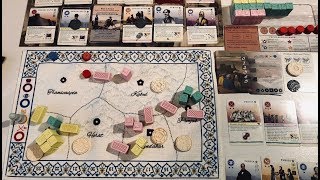
Pax Pamir ships with a cloth map of extraordinary quality, metal coins, and cards printed on stock thick enough to survive dozens of plays. The presentation reinforces the game's serious, scholarly tone. As one reviewer marveled, the production is just amazing, with the cloth mat, the pieces, and the metal coins all coming together. The aesthetic is not flashy; it is respectful. The game looks like what it claims to be: a study of history, politics, and the weight of decisions made when empires collide.
Potential Drawbacks
Rules Density and the Learning Curve
Pax Pamir demands precision in play. The rulebook is comprehensive because the game is intricate. Actions like taxation, betrayal, and dominance checks carry specific conditions and exceptions. While the second edition streamlined the game significantly from its first iteration, the core still requires players to track which cards are political, which are military, and how each interacts with the current dominant suit. A reviewer acknowledged that the problem with Pax Pamir is in the minutiae, praising the streamlining overall but noting that operations like taxation still involve multiple conditional checks. This density is not a flaw to all players, but it demands engagement.
Unpredictability and Player Count Sensitivity
The game's emphasis on simulation over balanced mechanics means outcomes can feel chaotic. A player might invest heavily in a strategy, only to have an opponent trigger a dominance check at an inopportune moment or reshape the board with a single card purchase. One reviewer captured the tension by calling the game so unpredictable that it feels like it runs around and stabs itself in the back, and warned that a five-player game becomes a disaster on stilts. Player count matters enormously. Two-player games become tense cat-and-mouse contests, three-player games work well, and five-player games can devolve into chaos where no one controls enough of the board to matter. Some players revel in this; others find it frustrating.
If You Enjoy Pax Pamir: Second Edition
Players drawn to Pax Pamir often gravitate toward other works by designer Cole Wehrle, including Root and Oath, which share themes of asymmetry, political simulation, and limited agency despite vast historical scope. Fans of heavy interactive games and subtle positioning may also appreciate Twilight Struggle, which rewards tempo and influence over brute-force resource gathering. For those fascinated by the tableau-building and multi-use card play, Innovation offers a similar experience of constant flux and dramatic reversals. If you crave games where timing and subtle moves matter more than raw power, Pax Pamir will reward your patience.
What Reviewers Are Saying
"Pax Pamir is essentially a game of shifting betrayals. If I share an allegiance to the British with another player, technically we have mutual interests: by buying and playing cards that put armies and roads on the map, we're furthering each other's chances of scoring points. But it's still a competition, because that person is not me."
— No Pun Included
"Pax Pamir is unlike any other game I've ever played. It's a tableau builder of sorts. You are drafting cards from a central market, and these cards give you actions like building units in various regions or moving those units around and attacking. You don't own any of those units, you are just allied with one of the superpowers, and you can switch alliances in this game."
— Totally Tabled
"There is so little that you can do. It's all about timing and positioning yourself. There's a lot of coalition building and coalition breaking, there's a lot of intrigue, you feel kind of powerless and the moves you make are very subtle. This is one of my favorite games of all time."
— Totally Tabled