/pic7976026.png)
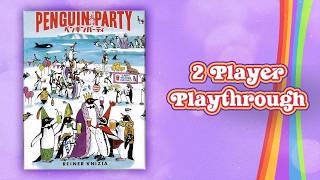
After a long dark winter, the sun is shining and it's party time for the penguins, who celebrate by fishing. To look over the waters more easily, the penguins build high pyramids. The more penguins you can fit in the pyramid, the better — but it's not that easy.
In Penguin Party, players collectively build a pyramid of penguins, trying to empty their hands of cards along the way. The deck consists of 36 penguin cards: 8 green and 7 each of red, blue, yellow, and purple. Deal the deck out as evenly as possible, with the final card in a five-player game starting as the first card in the base of the pyramid.
On a turn, you either play a card to the left or right of the base of the pyramid, which can be at most eight cards wide, or play a card on a higher level of the pyramid so long as it's supported by two penguins, at least one of which is the same color as the card being played. If you cannot play a card, discard your hand face down and take as many penalty markers as the number of cards you didn't play. If you empty your hand, you can return two penalty markers previously collected to the supply.
Play as many rounds as the number of players, with each player starting one of the rounds. Whoever has the fewest penalty markers at the end of the game wins. (With two players, deal each player 14 cards, remove the other cards from play without looking at them, and build a pyramid with a base only seven cards wide.)
Admin note: This game looks very similar to Penguin, but differs not only in components (being a card game while Penguin has 3D penguin tokens), but also in the number of colors and distribution. Penguin has four colors with nine pieces each, while this game has five colors with a distribution of 4x7 + 1x8.

Penguin Party

Penguin Party

Mechanics (from transcript analysis)
Video topics + discussion points
Quotes (from this video)
- Their game choice is fantastic and to me the creative choices are all vibrant and spot on.
- Gosh Bon Trick already was pretty much the pinnacle when it came to set collection and trick taking.
- Plate's version elevates that to the next level by adding actual coins for your spending currency and a slot in the box that adds just the most delightful charm and elevates an an already surprising level of theme for what is a mathy trick taker.
- They really embrace this infusing whimsy into the production.
- I really love the way these games look on the shelf.
- I am so stoked for what's to come from play.
- I am just ecstatic, elated that one of my favorite climbing shedding games, Dickory, is going to be getting a new version, as well as Hellas, Enemy and Enemy, and even more.
- I cannot wait to play some of the new versions of these, and you can be absolutely sure that we are going to be talking about them as soon as we can.
- Really delighted by them, and I am so happy with what amazing stuff that play is bringing to the hobby right now.
References (from this video)
Mechanics (from transcript analysis)
Video topics + discussion points
Quotes (from this video)
- we will link the BGG preview list down below so you can also explore and read about all the different games
- you have to come in with an open mind
- we're excited and do a lot give us that pra to a lot of games
References (from this video)
- Simple to teach and play, good for kids.
- Quick playtime.
- Tactical depth in two-player.
- Not for experienced gamers.
- Not a game to jump for joy for, just okay.
- Penguins having a party and socializing
Mechanics (from transcript analysis)
- Card Play — Players play cards to a shared pyramid, matching colors of adjacent cards on the level below.
- Color Matching — The core mechanic involves matching card colors to the penguins below in the pyramid.
- Hand Management — Players must plan their hand to avoid having dead cards and to create a good foundation for future plays.
- Set Collection — Players aim to avoid being stuck with cards left in hand at the end of the round, which incur negative points.
Video topics + discussion points
Quotes (from this video)
- We are currently in Japan right now.
- All five of these were sent by the respective publishers.
- Penguin Party is a game that was designed by RER Kitia.
- This game is everywhere. It's in board game shops. It's in cafes. So, I think this is a well-known game here in Japan.
- Rainbow is a take on card shedding, right? Hand shedding, which is basically playing combinations from your hand in order to uh shed all of your cards first.
- If Rainbow was a take on hand shedding, this is a take on trick taking. It's truly a trick taking game.
- The twist in Prey is all of the cards are doublesided, meaning you can rotate them.
- Splitto. Share everything but the victory.
- This is a simple drafting game, but it is kind of in the vein of between two cities or uh between two castles of Mat Lwig.
- You need to be you need to work together with both of your neighbors, which is something that I failed at because I don't know what it was. I think I didn't realize that your score is the multiply the you add up the points for your left, add up the points for your right, and you multiply them together.
- Three chapters. Choose, play, and score.
- This game is really cool because of the three different facets.
- This is probably my favorite of all of the games that we brought with us.
References (from this video)
- penguin-themed stacking and color matching, with negative scoring
- pyramid-building penguin game with color matching
- rule-explanation and live playthrough
Mechanics (from transcript analysis)
- card distribution and round structure — 36 cards total; each player is dealt 14; the remaining cards are set aside; bottom row size varies by players (seven for two players, eight for three players)
- color matching adjacency — penguins must touch another penguin that matches the color unless placed on the bottom row
- Cube Tower — build a pyramid with a base; must have a supported base before placing on top
- Hand Management — the number of cards left in your hand determines your negative points; you discard when you can't play
- Hand management and scoring — the number of cards left in your hand determines your negative points; you discard when you can't play
- pyramid building — build a pyramid with a base; must have a supported base before placing on top
- round-based play — play across multiple rounds (three rounds mentioned) with scoring across rounds
Video topics + discussion points
Quotes (from this video)
- Penguin party.
- Cheater.
References (from this video)
- Cute penguin artwork
- Fast to teach
- Flexible with player counts (2-6)
- Good table presence despite small box
- Takes up a lot of table space
- Two-player games feel short; rounds may end quickly
- Color matching and pyramid building with penguin artwork.
- Tabletop card game where players build a color-based penguin pyramid on the table.
- Abstract/strategic puzzle
Mechanics (from transcript analysis)
- Color matching placement — A played card must touch cards of the same color below it.
- Hand management and shedding — Players try to get rid of all their cards; keeping cards leads to negative points.
- Layer Building — Players place cards to form and extend a central pyramid, with the bottom/base completed before moving upward.
- Negative scoring tokens — End-of-round points are negative tokens (-5 snowballs and -1) for remaining cards; -5 can be discarded with a token if used.
- pyramid construction — Players place cards to form and extend a central pyramid, with the bottom/base completed before moving upward.
- Round structure and length control — Rounds equal to the number of players; players may agree to adjust the total number of rounds.
Video topics + discussion points
Quotes (from this video)
- the artwork is so cute cute I love the Penguins I love that it's just colors
- it's quick to teach it's fun to play I have really enjoyed penguin party
- this is a great game that you can play with a variety of Ages
References (from this video)

- Clear promotional hook that leverages penguin theming to attract viewers
- Engages the audience with a tangible giveaway and channel interaction
- Transcript provides no substantive gameplay details or rules
- Promotional framing may overshadow substantive game analysis
- Penguin-themed social interaction and party game vibes
- Contemporary, penguin-themed party setting with light, social gameplay
- Lighthearted, approachable, family-friendly
Mechanics (from transcript analysis)
- Contest/Promotion Entry — The clip promotes a giveaway: viewers subscribe and/or email to enter for a Penguin Party copy.
- Random Draw / Notification — Winner selection is described as random, with outreach by a stated date.
- unknown — Details about core mechanics are not provided in the transcript.
Video topics + discussion points
Quotes (from this video)
- there everybody if you want to win a copy penguin party the new version from 25th Century
- winner will be picked randomly we will reach out a mar 34
- remember to play board games like an animal especially your conia games
- oh absolutely easy as pie
References (from this video)

- Fast to teach and quick to play, making it a good warm-up or party game
- Charming penguin artwork and playful, themed card designs
- Hidden depth through color distribution and placement decisions
- Three short rounds provide predictable session flow
- Can be frustrating when color blocks appear and prevent placement
- The central pyramid can fill quickly, reducing viable moves
- Not every session yields a completed pyramid, which may affect sense of closure
- Penguins organizing a playful party with color-coded suits and whimsical penguin imagery.
- A lightweight penguin-themed card-placement experience where players build a central pyramid of cards and attempt to shed their hand while contending with color-matching constraints.
- Lighthearted, family-friendly, with humorous penguin illustrations and a party vibe.
- Rhinoia
- Rhino Hero
Mechanics (from transcript analysis)
- Card shedding / hand management — The objective each round is to be the first to play all cards from hand; if you cannot play, you are out and incur negative points.
- Color Matching — When building upward, a card must match one of the two colors directly beneath it; horizontal play on the bottom row has looser color constraints.
- Compound Scoring — The game consists of three rounds with rotating starting players and cumulative scoring across rounds.
- Matching — When building upward, a card must match one of the two colors directly beneath it; horizontal play on the bottom row has looser color constraints.
- multi-round structure — The game consists of three rounds with rotating starting players and cumulative scoring across rounds.
- Penalty scoring — Unplayed cards at the end of a round yield negative points; players may reduce negative points by clearing their hand when possible.
- pyramid construction — Players place cards to form a bottom row pyramid and then build upward, with placement governed by color-mmatching below.
- Start-player marker — A non-original coin is used as a start-player marker to track who begins each round.
- Variable Set-Up: Player — A non-original coin is used as a start-player marker to track who begins each round.
Video topics + discussion points
Quotes (from this video)
- This game is a card shedding game.
- First person to get all of their cards out of their hand is going to end the round.
- The bottom level of the pyramid is going to be eight cards and then we will work our way up.
- It's a quick fun game with a little more depth than you would expect.
- There is a lot more strategy in it than you think.
- Even though it seems like quite a simple game, there's still a lot of interesting decisions.
- The artwork is delightful. I noticed a little baby penguin there.
- I would definitely play this again.
- There is a lot more depth than you think; it's a fun quick game with more strategy than expected.
References (from this video)

- Light, approachable for families and newcomers
- Quick rounds, lots of interaction and banter
- Great color/puzzle flavor in a party context
- Can feel mean due to penalties and blocking
- May be too chaotic for serious gamers
- Color-matching, stacking/building, penguin-themed family play
- Penguin colony building a colorful pyramid
- Family party game with light humor and accessibility
- Scout
- Dino Fiesta
- Nana (revisions)
Mechanics (from transcript analysis)
- Color-matching pyramid building — Players place cards to extend a pyramid bottom row, matching color underneath and planning next moves.
- End-of-round elimination and scoring — When a player finishes their cards, or cannot play, rounds conclude and penalties accumulate.
- Flexible placement rules — Bottom row cards can be placed in different columns; top-row placements require valid support beneath.
- Penalty tokens for being unable to play — If you cannot place a card on your turn, you incur penalty points; multiple rounds determine the score.
- Rounds with clear start-player marker — The dealer/marker determines who starts each round; multiple rounds determine the winner.
Video topics + discussion points
Quotes (from this video)
- It's addictive; we could have played that forever.
- Alliance is a variant where you can mix house pods from three decks from the same set.
- This game feels quite mean.
- Jungo. Law of the Jungle.