/pic7723935.jpg)















Perspectives Deep Dive
What the Community Thinks About Perspectives
Board game reviewers have embraced Perspectives as a standout in the deduction genre, praising its elegant design and thematic coherence. Channels like Board Of It and Before You Play compare its visual-first approach to mystery-solving with classics like Sherlock Holmes Consulting Detective, while noting that Perspectives carves its own path with a more streamlined and intuitive experience. The cooperative, communication-focused mechanics have resonated particularly strongly with two-player and small-group audiences, offering a refreshing take on how mystery games can challenge players without dense rulebooks or lengthy narrative passages.
Core Mechanics That Define Perspectives
Image Deciphering and Limited Communication
At the heart of Perspectives lies its central mechanic: players hold image cards they cannot show to teammates but must describe in detail. Each card depicts evidence, footage, documents, or photographs related to a case. The challenge is verbal and interpretive rather than purely deductive. Players must articulate what they see, decide which details matter, and translate visual information into words. This creates a negotiation of perspective, where a detail one player dismisses as trivial might be the crucial link another player needed. The game deliberately withholds complete information from everyone, forcing genuine collaboration and preventing any single player from cracking the case alone.
Logical Case Progression and Satisfying Resolution
Perspectives structures each of its cases across multiple acts, building complexity gradually while keeping the logic tight. Evidence discovered in earlier acts seeds the information needed for the finale, creating a satisfying arc where players feel clever for noticing details they initially overlooked. Reviewers specifically highlight that the game avoids the frustration of unfair solutions, where a designer's reasoning contradicts the players' own. Instead, every answer stems from evidence present in the cards, rewarding observation and discussion. The question-based answer format at each act's conclusion provides immediate feedback, grounding the mystery in concrete facts rather than subjective interpretation.
The Perspectives Experience
A Cooperative Journey Built on Table Talk
Perspectives shines as a cooperative experience that rewards distinct thinking and diverse pattern recognition. During play, moments emerge where one player spots a connection another missed, and the game celebrates this diversity of viewpoint. Unlike some cooperative games plagued by quarterbacking, Perspectives sidesteps that issue by distributing different information to each player, ensuring no one can dominate decision-making. The emphasis on communication turns gameplay into something close to collaborative investigation, where players act as agents piecing together a crime. The pacing supports this immersion, with each act running a manageable length that creates a natural rhythm across a session.
Accessible Yet Engaging Design
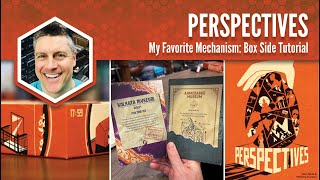
The game's presentation is remarkably efficient. A tutorial built into the box eases players into the mechanics quickly, and the visual art style reinforces the investigative theme without overwhelming the senses. Setup is minimal, the rules are intuitive, and the game moves briskly without sacrificing depth. This accessibility makes Perspectives ideal both for players who might be intimidated by heavier mysteries yet crave genuine puzzle-solving, and for experienced gamers looking for a focused, thematic experience that respects their time. The box contains exactly what you need and nothing more, reflecting a design philosophy of elegant restraint.
What Makes Perspectives Stand Out
Visual Storytelling Over Text-Heavy Narratives
Perspectives replaces long passages and rulebook-driven exposition with image-based evidence, lowering the cognitive load while heightening engagement. Players create their own narrative through dialogue about what they see, turning mystery-solving into something collaborative and interpretive. This approach sidesteps a common pain point in text-heavy mystery games: parsing ambiguous or verbose descriptions. Instead, images present clear, tangible clues that require discussion rather than decryption, making the game more approachable for players who find dense reading or heavy memory demands a barrier.
Strong Difficulty Balance and Scaling
The game calibrates its challenge across its cases and acts, avoiding the wild swings in difficulty that can break engagement. Each act presents a puzzle sized appropriately for the time invested, and difficulty increases naturally as players find the rhythm. The final act of each case serves as an elegant summation, asking players to synthesize clues from earlier acts and rewarding attention without becoming punitive. Acts that stump a team early in the campaign become approachable later, as players internalize the game's visual language of communication and deduction.
Potential Drawbacks
Single-Use Content and Limited Replayability
Like all mystery games, Perspectives is fundamentally consumable. Once the cases are solved, their mystery is gone. Reviewers acknowledge this candidly, noting there is no value in revisiting a case whose solution you already know. The total experience spans only a handful of cases, so the box offers a finite number of evenings. For some players this is a feature, encouraging the game to be passed along to friends or family. Others may find the cost-per-hour calculation less appealing than open-ended games with effectively infinite replayability.
Experience Depends on Player Engagement and Group Dynamics
Perspectives requires genuine dialogue and attention from everyone at the table to shine. If one player disengages or the group lapses into silence, the experience suffers. The quality of play is also somewhat group-dependent and shifts with player count. Three players seems to strike an ideal balance between diverse perspectives and manageable coordination, while the largest counts risk communication overhead. The game also asks players to describe what they see with enough clarity to be useful, a skill some groups have naturally and others must develop. Player count, table culture, and individual communicativeness all noticeably influence how well Perspectives lands.
If You Enjoy Perspectives
Those captivated by Perspectives should explore Sherlock Holmes Consulting Detective, its closest spiritual cousin, for a deeper and more elaborate mystery experience. Where Perspectives uses images to streamline deduction, Consulting Detective embraces lengthy passages and period immersion for players seeking maximum narrative depth. Another natural pairing is Decrypto, which shares Perspectives' emphasis on communication and interpretation, though in a competitive word-guessing context rather than mystery-solving. For groups who loved the focus on collaborative deduction, Exit: The Game offers escape-room-style mysteries in a similarly consumable, one-and-done format, though it leans more on text and physical puzzles than Perspectives' clean visual approach.
What Reviewers Are Saying
"We found it to be a really nice addition to this genre of games, and definitely a standout for us. The evidence is there and the solutions were all very logical. It never felt like you got it wrong because you couldn't follow the designer's thought process."
— Board Of It
"It's a really excellent example of this genre, and it has a real way of making the cases solvable but not too easy, and also not too over-the-top outlandish. It's very, very well done at making you feel clever by laying these connections in there."
— Board Of It
"What makes Perspectives really nice is that it depends on the player. It depends on what you choose to focus on in that image, and that is what the entire game is built off of. There's a sweet spot in terms of player count, and I absolutely loved Perspectives. We both really enjoyed the experience."
— Before You Play