































Point City Deep Dive
What the Community Thinks About Point City
Point City has earned widespread praise from the board game community as a worthy successor to Point Salad. Reviewers consistently highlight how the game delivers greater depth and strategic layers while maintaining accessibility. Rather than a direct sequel, Point City stands as a spiritual successor that takes the card-drafting foundation in a different direction entirely. The consensus is clear: while fans of Point Salad will recognize the DNA, Point City offers its own distinct experience that appeals to both casual players and those seeking something with more strategic weight.
Core Mechanics That Define Point City
Engine Building Through Resource Permanence
At Point City's heart lies an engine-building mechanic that fundamentally sets it apart from its lighter cousin. Unlike Point Salad's simpler approach, Point City introduces permanence through buildings that generate ongoing resources. Once constructed, buildings sit in a player's tableau and provide permanent resources for future turns, a mechanism reminiscent of Splendor. This creates a satisfying sense of progression where early investments in specific building types compound into greater purchasing power. Players who successfully identify synergistic combinations and build coherent resource engines find themselves with significant advantages by mid-game, rewarding both planning and opportunistic adaptation.
Strategic Card Drafting Within Physical Constraints
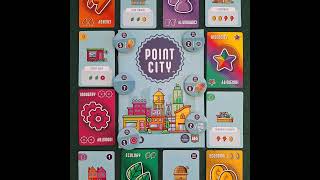
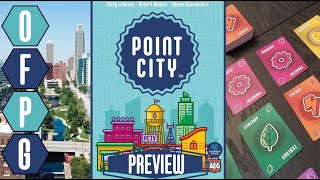
The game's drafting system uses a four-by-four grid where players may only take two orthogonally adjacent cards each turn. This restriction creates meaningful tactical decisions: reaching a desired card often requires manipulation of the board through multiple turns of strategic drafting. The elegant constraint prevents unlimited grabbing, instead creating a satisfying puzzle where players must anticipate future board states while managing their current hand. The double-sided card system, with resources on one side and buildings on the other, means every draft decision shapes what becomes available to opponents, creating tension around who can best predict and exploit emerging board patterns.
The Point City Experience
Breezy, Snappy Gameplay That Feels Crunchy
Games resolve in 15 to 30 minutes, yet the experience never feels rushed. Despite the compact timeframe, Point City packs meaningful decisions into every turn. The game's pacing accelerates naturally as players build out their engines and complete their tableaus. This breezy experience contrasts pleasantly with heavier engine builders, making Point City an excellent option for players who enjoy the satisfaction of compound systems without committing to multi-hour gaming sessions. The snappy play speed makes it ideal for getting to the table multiple times in an evening or introducing the mechanism to groups unfamiliar with engine building.
Rewarding Mastery and Surprising Comebacks
New players and veterans alike experience the pleasure of watching their strategies unfold. The tiered card structure, with easier buildings early and progressively more powerful options later, creates natural pacing that teaches the game through play. Experienced players can identify powerful synergies and position themselves for explosive rounds in the middle and late game. Yet Civic tokens, the endgame bonus cards acquired through building certain structures, introduce a comeback mechanism that keeps games competitive. This balance between rewarding careful planning and allowing strategic pivots maintains engagement from opening tableau to final point calculation.
What Makes Point City Stand Out
Elegant Mechanical Simplicity Housing Strategic Depth
Point City's appeal lies in its paradox: the core mechanism is remarkably easy to explain, yet generates surprisingly complex decision trees. Taking two adjacent cards and paying for buildings with accumulated resources ranks among the simplest core loops in modern design, yet every subsequent game plays differently due to the deck's composition and turn order. Players need only seconds to grasp the turn structure but may spend entire games discovering optimization possibilities. This accessibility at the table combined with strategic richness makes Point City a gateway game for those not yet comfortable with heavier mechanisms while offering substance to experienced hobbyists.
The Civic Token Endgame Scoring System
Where Point City decisively diverges from Point Salad is through Civic tokens, endgame scoring cards acquired by constructing buildings bearing a specific icon. These tokens create fascinating long-term strategic planning opportunities: acquiring a token early can entirely reshape priorities. A player holding a token that scores points for having multiple cards of a single type might pivot their entire strategy toward that color family. Some tokens reward set collection, others reward specific quantities, and still others create negative scoring for absent resources. This layer of variable endgame conditions ensures no two games follow identical strategic paths, and players often must abandon mid-game progress to position for their claimed tokens, creating dramatic reversals.
Potential Drawbacks
The Tracking Tokens Are Essential, Not Optional
Point City includes small tokens designed to mark whether drafted cards were resources or buildings, enabling proper board replenishment. Unlike many games with helper components, these tokens prove genuinely necessary. Early rounds can be managed through memory, but mid-game complexity makes forgetting which card types were taken genuinely problematic for subsequent board state accuracy. Reviewers note that tables unfamiliar with the game's subtle tracking requirement sometimes made errors affecting board flow. The tokens exist for good reason, but players should understand they're not optional flavor pieces.
Limited Player Interaction at Higher Counts
Point City accommodates one to four players, which constrains table size. With four players, each turn in early rounds moves quickly, yet as the game progresses and players build complex engines with more decision points, turns can extend. The game's core interaction comes through the shared drafting grid rather than direct conflict, making Point City lean toward the multiplayer solitaire end of the spectrum. Players seeking direct confrontation or negotiation will find the interaction indirect. Those accustomed to games where opponents' choices dramatically reshape your plans may find Point City's interaction too subtle, though the tight drafting grid does create genuine tension around card availability.
If You Enjoy Point City
Players gravitating toward Point City should consider Splendor, from which the resource-permanence mechanism draws clear inspiration. Those who appreciate the quick-playing card drafting should explore Point Salad for its lighter, more accessible sister game. For deeper engine-building experiences with slightly more complexity, Planet Unknown delivers abstract landscape building with variable scoring opportunities. Three Sisters and Mind Up offer similarly satisfying small-box designs. Fans of set-collection mechanics paired with tactical selection should try Cascadia, which layers beautiful natural aesthetics atop accessible but rewarding gameplay.
What Reviewers Are Saying
"I think Point City replaces Point Salad for me, full stop. This is the game that I'm going to pull out when I want to play that kind of game where cards are one side a resource or the other side a building. It's a great game."
— Tabletop Tolson
"It's a very natural progression. It levels up the complexity a little bit, gets you thinking in different ways. But what's also really wonderful about it is it introduces that engine building mechanic. If you're looking at a small box game that captures engine building in a nutshell, Point City is definitely for you."
— kovray
"I think everything about this game packs the most in a small box. It's an absolutely fantastic game if you're looking for something that feels like a bigger game but is in the smallest box."
— The Board Game Garden