/pic5671087.png)























Praga Caput Regni Deep Dive
What the Community Thinks About Praga Caput Regni
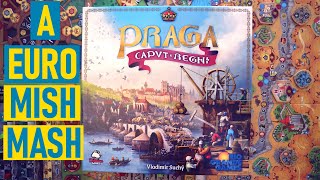
Praga Caput Regni stands as a remarkable achievement in modern Euro design, commanding respect from the board gaming community despite its imposing complexity and thematic restraint. Reviewers consistently highlight the game as one of the strongest releases from recent years, with several rating it among their personal top-ten titles. The medieval city-building theme, grounded in the historical transformation of Prague under King Charles IV, creates an intricate backdrop for what is fundamentally an optimization puzzle. While the theme rarely drives the mechanics, the game's implementation successfully honors the historical setting through careful details like the use of eggs in bridge construction, grounded in genuine architectural history. This marriage of aesthetic ambition with mechanical depth creates a game that appeals primarily to those who derive satisfaction from solving complex systems rather than narrative immersion.
Core Mechanics That Define Praga Caput Regni
The Rondel Action System and Opportunity Cost
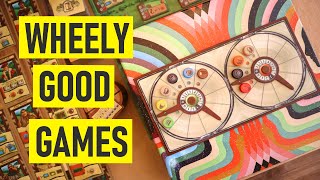
The beating heart of Praga Caput Regni is its rotating rondel mechanism, a six-action selection system that fundamentally shapes every turn. Players choose action tokens from a rotating wheel, and the position of each token determines its cost or reward. Actions recently taken sit in expensive positions, while neglected actions accumulate discounts or bonus points. This creates an elegant tension: every action taken is immediately rotated away, establishing a steady rhythm where players must constantly balance their immediate needs against positioning future actions. The rondel elegantly solves the problem of action scarcity by making the wheel itself a strategic element, forcing players to consider not just what they want to do now, but what they are enabling opponents to do and whether leaving certain actions accessible is worth the cost. With only 16 turns per player, every decision carries significant weight, and the timing of when players access specific actions becomes as important as which actions they access.
Engine Building Through Incremental Advantage
Beneath the surface of action selection lies a sophisticated engine-building system centered on resource production and track advancement. Players develop gold and stone production on personal boards, unlocking bonuses as they advance along mining and quarrying tracks. Technologies unlock at strategic points, providing permanent benefits that can multiply in value throughout the game. The true richness emerges from how these systems interlock: placing buildings triggers majorities that grant bonuses, building walls creates matching opportunities that generate tokens, and advancing on tracks unlocks access to special tiles. The game rewards players who invest early in these systems, as each piece placed or track advanced can trigger cascading benefits. What makes this engine-building particularly satisfying is that it operates on parallel tracks rather than a single dominant path, allowing multiple viable strategies to emerge.
The Praga Caput Regni Experience
Optimization Within Severe Constraints
The defining experience of Praga Caput Regni is one of intense optimization within a tightly bounded system. With only 16 actions per player, every single turn matters, and the game refuses to offer easy answers. Players cannot hyper-focus on one aspect of the game; instead, they must balance resource acquisition, tile placement, track advancement, and bridge construction while adapting to constantly shifting action values on the rondel. The game generates meaningful decisions almost every turn, not through random events but through the interplay of limited options and strategic positioning. A player might spend a turn setting up for a major play two turns later, accepting a weaker action now in exchange for positioning. This creates an intellectually engaging experience where success comes from seeing several moves ahead and understanding which synergies will compound value over the remainder of the game.
The Satisfaction of Triggering Cascades
Reviewers consistently highlight the visceral pleasure of watching their careful plans materialize through cascading triggers. When a player places a building that completes a set of adjacent tiles, earning bonus tokens that increase their scoring multiplier while also advancing on a track that unlocks a new technology, the sense of satisfaction is palpable. The game is filled with these moments where one action detonates multiple effects: spending gold to take a tile placement action, which grants an egg, which can be used for a bridge advancement, which unlocks a new technology. Even unintentional cascades occur, where a player simply going about their business triggers multiple bonuses by fortunate alignment. These chain reactions feel earned rather than random, as they emerge from thoughtful positioning during prior turns.
What Makes Praga Caput Regni Stand Out
Intuitive Complexity and Clear Design
Despite its reputation as a heavyweight Euro, Praga Caput Regni achieves an impressive feat: most of it is intuitively clear once explained. The action wheel is immediately understandable. Each action tile straightforwardly shows two options. The player boards clearly display production and advancement mechanics. The seemingly overwhelming number of systems actually works in the game's favor, as everything connects logically to the central theme of developing Prague's civic infrastructure. Reviewers noted that the game is easier to teach than comparable titles like Underwater Cities, despite having equally deep systems, because everything just makes sense. The icons are consistent throughout, the symbolism is logical, and even edge cases feel intentional rather than arbitrary.
Multiple Viable Strategic Paths
The game generates depth through the staggering number of viable strategic paths rather than through hidden complexity. Unlike some Euro games that reward finding one dominant strategy, Praga Caput Regni supports multiple winning approaches. A player can build an engine around bridge construction and egg accumulation, focusing heavily on advancing along the King's Road and collecting scoring bonuses. Another can pursue plaza majority control, placing buildings strategically to claim valuable endgame bonuses when plazas complete. A third can commit to maximizing production tracks, allowing superior resource generation to fund more tile purchases. Each approach has internal logic and can lead to victory.
Potential Drawbacks
Teaching Burden and Rules Density
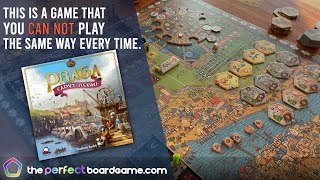
The primary barrier to Praga Caput Regni is its teaching difficulty and rules density. While the game is intuitive in isolation, learning all six actions, multiple track types, tile acquisition rules, plaza majority mechanics, and bonus conditions requires substantial explanation. One reviewer described teaching as difficult and tedious, comparing it unfavorably to cleaner designs. The massive board dominates the table, often requiring sideways orientation to fit properly. Players with limited patience for rules explanation or those seeking a game they can pull off the shelf for casual play may be frustrated.
Thematic Dryness and Modest Innovation
The second meaningful criticism concerns the game's thematic execution. Beyond eggs in the bridge and a detailed Prague map, the mechanics feel largely abstract. Building tiles, walls, and track advancement have tenuous thematic connections to medieval city development. The game is fundamentally about optimization and resource conversion rather than simulating Prague's growth. Players who play for narrative immersion or thematic resonance may find the trappings thin. A reviewer noted that while the design is excellent, it reveals no particularly novel mechanical innovation; it does what prior Euro games accomplished very well but does not pioneer new mechanical territory.
If You Enjoy Praga Caput Regni
Players who find satisfaction in Praga Caput Regni should explore Vladimir Suchy's other designs, particularly Underwater Cities and Pulsar 2849, both of which share the focus on optimization and interconnected systems. Woodcraft offers similar strategic satisfaction with superior thematic integration. For those captivated by the rondel mechanism, Trismegistus rewards similar decision-making. Players who love the plaza-building and majority-control aspects should investigate Ragusa as a lighter alternative. Those drawn to tile-laying with engine-building elements might explore Lost Ruins of Arnak.
What Reviewers Are Saying
"With only 16 actions per player per game, Praga Caput Regni is all about getting the absolute most out of those limited turns, and as a result this is a game for those who love both optimization and understanding lots of systems."
— 3 Minute Board Games
"I prefer Praga because it's such an involved game but I love how simple and easy it is to teach. This is a game that I could probably leave for a year or two, get it back to the table and everything just click into place. It's all so intuitive."
— Chairman of the Board
"This game doesn't do a lot incredibly. It doesn't really have its own identity in terms of doing anything incredibly different than a lot of Euros out there, but what it does it does especially well. It takes all the boxes that I want from a Euro and it was my number one game of 2020 and it still is."
— Chairman of the Board