/pic8413700.jpg)
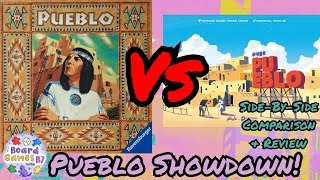
Pueblo - the ultimate building challenge! Work with the other players to create a mighty home for the Chieftain, stone by stone. You are a craftsman, but you cannot let the Chieftain see your trademark stones, or you will be penalized. The longer you play, the more difficult this task becomes! Take on your opponents and become the Chieftain's Master Builder.
The theme setting is the Native American Pueblos of the Southwest tribes of the Zuni and Hopi. The board is a fairly small square. Each player gets a number of building blocks in their own color, and also some neutral colored blocks (1 fewer than the colored). Starting with the odd colored block, the player places it on the board, and then gets to move the "Chieftain" around the outer track surrounding the board. If the Chieftain can look straight across and see any colored blocks, those players gain points -- but points are bad. And when the Chieftain lands on the corners of the track, he looks down on the Pueblo from above, and all visible player's blocks gain them more points. Now, on each subsequent pair of turns, you have a choice of a colored block and a neutral block. Once all players' blocks are played, the Chieftain makes one last trip around the board, players gaining points all along the way. The player who has gained the fewest number of points is the Master Builder and the winner of the game.
There are also some extra components for making the game more challenging by adding an element of bidding for turn order, and from 1 to 4 sacred sites that cannot be built upon.
Original description from box.



- Such a classic game
- placing blocks and trying to have them covered so they can't be seen
Mechanics (from transcript analysis)
- Block Placement — Involves placing little blocks and trying to have your blocks covered so they can't be seen.
Video topics + discussion points
Quotes (from this video)
- Hey everybody, I'm Tom Vassal. Welcome to Look Back, a series where I take a look at games that I reviewed a year ago, 5 years ago, 10 years ago, and 20 years ago.
- And I tell you what I think about these games now, if I think about them at all.
- When you talk about games that are cozy-esque, I think this is pretty close one of those as you build these nice streets.
- Thanks so much for watching. I'm Tom Vasel, and this is Look Back.
References (from this video)

Mechanics (from transcript analysis)
- stacking / tower-building — stacking wooden pieces and hiding them among others
Video topics + discussion points
Quotes (from this video)
- the best time to do it was January 1st 2025 it seemed like a good breakoff point
- the second best time to do something is maybe yesterday the second best time to do something is now
- I’m hoping to do more live stuff ... connecting with people
- I am hoping to do more live I I want to do even just a little bit more live stuff to connect with people
References (from this video)

Mechanics (from transcript analysis)
Video topics + discussion points
Quotes (from this video)
- They ended really strong in book three. It was a good ending of sorts and I really liked it.
- I don't care about it.
- They have multiple multiple uh points of view which I was fine following the one person.
- I just found it to be maybe the last book will bring everything back together, but I doubt it. I just don't care anymore.
- Look, I'm okay with characters dying and things that you need that to progress a story sometimes, but good grief. Does it have to be that bad all the time?
- The mobs are out there and the mobs are going to hunt you down and no matter what you say.
- It has definitely become a witch hunt in many ways where people like as soon as they hear the word the letters AI, they're like, 'I'm out.'
- I think the backlash is and people going and rating games one on BoardGameGeek is kind of ridiculous.
- That has nothing to do with the game. It really doesn't. That's that's just nonsensical.
- I'm kind of mind-boggled with how much people complain about prices of games.
- Yes, games are expensive. They're really expensive to make.
- You don't go yell at your gas station attendant, you shouldn't when gas goes up. That's not them who are doing it.
- It should be a friendly place to go to.
- I always try to put some monkeys in my zoo, period. Just so I can say I have some monkeys.
- I dislike the cat character a lot and I found it to be okay.
- But I will warn you, I noticed that a lot of people when they do this, they also forget about the part where they you should make money.
- Wash it in the shower?
- If I ran BoardGameGeek, if I saw someone rate a one with a comment of 'I hate what they did here.' I would just delete that rating instantly.
- I think are you kidding me? This is so nonsensical.
- I love going to bookstores.
- Any place that has unique interesting thing, a hot sauce store, a a beef jerky store, whatever.
References (from this video)
Mechanics (from transcript analysis)
Video topics + discussion points
Quotes (from this video)
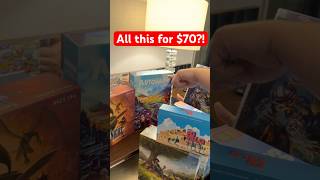
- So we always like to talk about what we got.
- So we spent $70 today.
- So for 70 bucks, looking at this collection, how do you think we did?
References (from this video)
Mechanics (from transcript analysis)
- Word Game — Described as a word game for double the fun.
Video topics + discussion points
Quotes (from this video)
- Hey everybody, I'm Tom Vassal. Welcome to the most boring unboxing on the planet Earth as we take a look at stuff that comes to the Dice Tower and we mess around and see what it is.
- This is the most boring unboxing in the world.
- I know that they're I mean, I bought these before they announced that they're making their own upgrades for Settlers of Catan, but for now, I can use these.
References (from this video)

- Appealing concept and tactile components
- clean, visual design on components
- box history and production variants
- construction/placement with a focus on color visibility
- Block placement and figure placement around a central board
- abstract, spatial puzzle with visual scoring
- original Pueblo variants
- Plate versions
- Mojito Studios version
Mechanics (from transcript analysis)
- block placement with identical components — use blocks to cover areas and influence scoring
- movement/scoring based on visibility — a figure moves around the board applying color-based scoring rules
Video topics + discussion points
Quotes (from this video)
- This is one of the most iconic box covers. I love this game.
- Saddam Hussein is on the cover.
- I learned this before Access Analysis. And I taught Access and Alice.
- This is such a fantastic game.
- Way Out West was ahead of its time.
- Moving water to plants is good.
References (from this video)
- Classic two-player feel with deeply tactile components
- Accessible yet tight decisions/strategy
- Potentially high variability in scoring balance; could be streamlined
- Hidden color balance and color concealment in tower-building
- Desert/island-like environments with stacked blocks
- Euros-style puzzle with healthily competitive edge
- Duel/abstracts with strong color-based scoring
Mechanics (from transcript analysis)
- color concealment and scoring visibility — Points awarded based on what each block arrangement reveals from a bird's-eye view
- stacking/placement — Building a structure with wooden blocks; players place pieces to score
Video topics + discussion points
Quotes (from this video)
- Evergreen is actually I suppose a spiritual successor to the famous photosynthesis board game.
- this one has more focus on the light points and the way you actually take your actions is different as well because it does use this drafting system
- this game was like gold dust for a long long time
- the production of these games is absolutely stellar
- these Magi 7 dice are absolutely gorgeous
References (from this video)
- engaging abstract strategy with clear, accessible rules
- fast-paced play that works well for 2-4 players
- strong component quality and visuals that reinforce the theme
- two editions offer distinct aesthetic experiences while preserving core mechanics
- penalty-based scoring can feel punitive for some players
- artwork and component differences between editions may influence personal preference
- some players may wish for deeper strategic variation beyond base rules
- Pueblo architecture and visibility/penalty-based scoring within an abstract strategy framework.
- An 8x8 grid-based construction scenario where players act as builders crafting a Pueblo for a chieftain in a stylized New Mexico-inspired environment.
- abstract, culturally-inspired theme treatment that emphasizes construction and the tension of visibility.
- Pueblo
Mechanics (from transcript analysis)
- box-transform/production feature — The original and some editions feature a transforming box design that doubles as the game board or playspace in some variants.
- chieftain movement — The chieftain moves 1 to 4 squares per turn, creating varying lines of sight and affecting scoring.
- color and neutral blocks — Players use colored blocks; neutral blocks interact with visibility calculus and scoring dynamics.
- enclosure/visibility — Colored blocks become visible to the chieftain; visibility influences penalty points each turn.
- scoring — Penalty points are tallied based on visibility; lower scores are better, with the game ending after all blocks are placed and a final inspection.
- Tile Placement — Players place blocks on an 8x8 grid to advance their position and shape the evolving board state.
Video topics + discussion points
Quotes (from this video)
- weblo is a highly engaging and strategic game that immerses players in the art of Pueblo construction
- the transforming box is one of the Publishers signature Productions
- overall peblo is a fantastic game that is highly recommended for fans of abstract strategy games
- the game is fast-paced and easy to learn making it suitable for two to four players
References (from this video)
Mechanics (from transcript analysis)
Video topics + discussion points
Quotes (from this video)
- El Grande is my favorite game of all time; it is the original area control game and the cream of the crop.
- Only your best round will count in Coliseum, which is a cool twist on scoring.
- El Grande and the King, with simultaneous selection and Castillo, harmonize to create a rich gameplay experience.
References (from this video)
- distinct and gimmicky style that stands out
- strong visual design
- potential rigidity and deterministic play could reduce variability
- untried mode (bid for player order) adds complexity
- hidden information and line-of-sight
- abstract edge-based puzzle where visibility is constrained by a moving edge
- abstract puzzle
- St Petersburg
- The Lost Code
- Ingenious
- Caper Europe
Mechanics (from transcript analysis)
- hidden information / line-of-sight — players place colored blocks so that their blocks are hidden from a central moving edge that reveals line-of-sight
- scoring with penalties — points are distributed based on what is visible, but points themselves are a negative outcome
Video topics + discussion points
Quotes (from this video)
- this little Tableau building game is where you're building up this little engine of money creating cards as well as Point creating cards
- it is aged very well
- a gimmicky Style game that feels so distinct
- the top row is worth negative points everything after it is worth positive
- fascinating I think it is a wonderful deduction game
- spiritual successor to photosynthesis
- this Japanese game where you are trying to create these routes connect these passengers
- Notre Dame cathedral in the center of the board
- notredam cathedral and the rat threats
References (from this video)

- Interesting 3D puzzle mechanic
- Tactical back and forth gameplay
- Recently got a new beautiful version
- Unique mechanic of negative scoring
- Building and hiding structures from the chieftain
- Village/pueblo setting with grid-based board
- Abstraction based on village mechanics
Mechanics (from transcript analysis)
- 3D puzzle placement — Building up structures in 3D space where higher visibility means more penalty points
- Area visibility/line of sight — Chieftain moves around board edge and can see pieces along a straight line; players want to hide their pieces
- Line of Sight — Chieftain moves around board edge and can see pieces along a straight line; players want to hide their pieces
- Negative scoring — Players do not want to score points; points are awarded when chieftain sees your pieces
- Worker Placement — Taking colored blocks or neutral blocks and placing them strategically on the pueblo
- Worker placement alternative — Taking colored blocks or neutral blocks and placing them strategically on the pueblo
Video topics + discussion points
Quotes (from this video)
- this doesn't feel like any other game... that's kind of what made us think about this
- this is a really interesting 3D puzzle where you are trying to build up stuff so that you can place it out but not score points
- you can strategically kind of change reality, which is just really, really kind of cool and unique
- I fundamentally do not understand how a brain thinks of a game like this. It's just so cool.
- I fundamentally don't understand how it works, but it works really, really well
- what if battleship was real time with a bunch of people and everyone had different roles
- it's fun to kind of cosplay as a collectible card game player, uh, but while keeping it still a board game at the end of the day
- For our money, the most unique game out there is Millennium Blades
- they provide an experience that... there's no other game that does it quite like those games do it