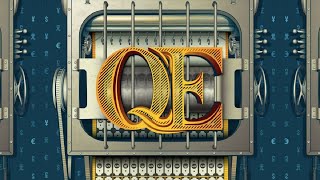






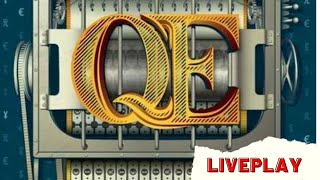






Financial crisis has occurred. Sixteen "too big to fail" companies from four countries need bailing out. The central banks have unlimited financial resources, so lots of money is going to be printed, but the central banks also face disaster — print too much money and the country they represent goes bust.
In Q.E., a term that stands for "quantitative easing", you play the role of a central bank. You bid on different size companies to accumulate various levels of victory points. The amount you bid is unlimited since you are the central bank and you own the printing press! After the initial "open" bid by the lead player, the other players bid in secret. After the sixteen companies have been "bailed out", bonus victory points are awarded for company sets of nationalization, monopolization, and diversification.
Player markers on the scoring track now reveal which player has the most victory points, but this is not the end. Players must now add up the amount of money they printed and the player who printed the most money loses all their victory points!
Previous editions of Q.E. supported up to four players, with a fifth-player expansion being available separately. This new edition of Q.E. is playable with up to five players out of the box.
Spotlight Game Night - QE
- offers a clear, classroom-friendly way to explore finance and risk
- engages students through bidding and budgeting mechanics
- easy to introduce as a teaching tool
- the negative scoring twist (spending the most loses) can be counterintuitive at first
- may require facilitation to ensure all students grasp the penalty dynamic
- economic systems, risk, resource allocation
- modern economic world; central banks auction on company tiles; money can be printed
- Cosmic Encounter
- Evolution
Mechanics (from transcript analysis)
- Auction / Bidding — players bid on company tiles; central banks can print money; the highest spenders incur a penalty, making spenders the losers.
- auction/bidding — players bid on company tiles; central banks can print money; the highest spenders incur a penalty, making spenders the losers.
Video topics + discussion points
Quotes (from this video)
- board games counters these negative effects
- the lesson is teaching the rules and the application is playing the game
- unless you actually test a student on the skills that you want them to learn they will not learn it
- board games are naturally collaborative
References (from this video)
- fast-paced bidding with high tension
- clear, quick rounds that stay engaging
- fun, thematic set collection tied to countries
- replayable with expansions and different tiles
- requires careful tracking of money spent across rounds
- elimination mechanic can penalize aggressive bidders
- may rely on group tolerance for heavy negotiation and bluffing
- National identity, international trade, and set collection
- Global manufacturing and national identity through country tiles
- Procedural strategy with bidding tension and tile-based scoring
Mechanics (from transcript analysis)
- auction/bidding — Players secretly bid on tiles; the auctioneer reveals the top bid and the winner claims the tile.
- economic_penalty_bonus — Total money spent affects elimination; least spent earns bonus points.
- information_tracking — Bids reveal information about opponents; players deduce future bids from previous rounds.
- set_collection — Tiles represent nationalities; players build rows/columns to score points and diversify across marks.
- tile_based_scoring — Rows and columns yield victory points; diversification bonuses provide additional points.
Video topics + discussion points
Quotes (from this video)
- it's an auction bidding game it also has some set collection along the way definitely and it gets wild
- we're gonna secretly bid on how much we're willing to pay
- the first tile is a japan this company this tile is worth two points on its own
- the tension is thick you could cut it with a butter knife
- i'm actually pleasantly surprised that i won with that
- it's so fast i did not think she was gonna get that high
- this is one of my favorite party games because there's so much like just high
References (from this video)
- easy to teach with a party vibe
- hidden depth and strategic twists
- fast rounds with lively interaction
- can risk bankruptcy via bidding too aggressively
- economic bidding and strategic diversification
- industries and national control via auctions
- light, party-game vibes with depth
Mechanics (from transcript analysis)
- Auction / Bidding — players bid on boards to acquire industries
- drafting — collecting industries to maximize bonuses
- drafting / set collection — collecting industries to maximize bonuses
- elimination risk mechanic — highest spender can be eliminated from winning
- player elimination — highest spender can be eliminated from winning
Video topics + discussion points
Quotes (from this video)
- it's breezy and quite relaxing to be honest
- it's so easy to teach
- it's never really let me down with whoever i brought this out
- it's inviting being easy to play but still having the interest there
- it's a hidden gem in terms of being a gateway game
- I really do just sit back and enjoy the process of a game like this
- the best deduction game i've ever played
- it's a 30 to 45 minute game that can be tailor-made to how you want to play it
- it's almost like a step up from a game like Scrabble
- it's a puzzle style game with pirate theme
- the layout of these tiles is extremely interesting
- this game has a unique twist that adds a lot of interest
References (from this video)
- Boss fighting theme is exciting
- Hidden mechanics encourage discovery
- Cooperative gameplay
- Multiple difficulty levels
- Requires tablet for visibility - phone screen too small
- Can be fiddly with QR code scanning
- Boss fighting with hidden mechanics
- Fantasy/Adventure
- Puzzle-based discovery
- Chronicles of Crime
Mechanics (from transcript analysis)
- character customization — Pick one of four heroes and mix with one of four classes for varied combinations and replayability
- Cooperative — Players work together to defeat 10 different bosses with escalating difficulty levels
- Cooperative Game — Players work together to defeat 10 different bosses with escalating difficulty levels
- Hidden Information — Effects of attacks are not disclosed in rulebook - players must discover mechanics through play
- QR Code Integration — Players scan QR codes on cards with a phone or tablet to discover what actions do to bosses
Video topics + discussion points
Quotes (from this video)
- It's a boss fighting game with QR codes. In this game, you're going to get pick one of four heroes and then mix it with one of the four classes
- Every other page in the rule book has this info about how the mechanisms in the game relate to real life
- It's a dice placement game by Stefan Feld. What else do you need to know?
- It's basically trick taking game with a lot of things around it
- If you lose an auction, you also get some rewards
- Let us know which ones are you most excited to try down in the comments
References (from this video)
- interesting use of memory in bidding
- engaging auction dynamic
- complex for newcomers
- remember what others have and bid accordingly
- auction/bidding with memory tracking
- For Sale
Mechanics (from transcript analysis)
- Auction — bidding mechanic to acquire properties or advantages
- memory — remembering opponents' bids and actions to outbid or outsmart
Video topics + discussion points
Quotes (from this video)
- the game is super fast
- I highly recommend that one
- Witness used memory in quite an interesting way
- it's really good family weight game where the actual lack of memory skills can actually make the game better
- Extremely charming and I think um very underrated actually
- This is a cool party game because even if your trivia knowledge isn't very good, you can still get the answers correct based on the previous clues given
References (from this video)
- fun, fast-paced, and engaging with a cool twist
- player-driven market dynamics keep everyone involved
- can feel chaotic if players don't manage risk
- some may find the bidding pressure stressful
- industry bidding and diversification
- shifting global markets / nations
- fast-paced, negotiation-driven economic game
- High Society
Mechanics (from transcript analysis)
- Auction / Bidding — players bid on industries and diversify holdings
- Auction/market-driven bidding — players bid on industries and diversify holdings
- Endgame disqualification mechanic — the player who spends the most money is disqualified, creating tension
- Hidden knowledge / partial information — one player each round sets starting prices with limited knowledge of others' bids
Video topics + discussion points
Quotes (from this video)
- there is this more injected element of player interaction
- it's a genius twist
- the market is completely driven by the players
- money is such a tight resource in this game
- the rules overhead is very low
- a timeless design
- you can bet your funds on other people being right
- loads of things to weigh up, a complete package of the game
References (from this video)
- humorous take on auctions
- highly social and absurd moments
- spending can backfire; risk management is punishing
- stock auctions and economic manipulation
- Financial market bidding
- satirical economics
- Monopoly (implied auction dynamics)
Mechanics (from transcript analysis)
- Auction — players bid to acquire assets; highest bid loses
- Auction / Bidding — players bid to acquire assets; highest bid loses
Video topics + discussion points
Quotes (from this video)
- it's very very simple it's a move attack attack move game
- prepainted Miniatures which is awesome cuz I can't paint
- Hasbro did try and bring this back on two occasions
- Beyond the Sun this has been described as Tech Tree the board game essentially
- the board is very Bland it's sort of like a white and blue aesthetic
- it's skull and roses an insanely simple concept
- the meta game that appears out of blue in this game
- Brass Birmingham has done the unenviable task of converting an already classic game and actually making it better
- Project Elite is like shooting a load of cocaine coming down off of it and then shooting another load of cocaine
- the player that spends the most money automatically loses the game
References (from this video)
- Innovative bidding mechanic
- Surprising and thematic for a bidding game
- Complex and potentially opaque to new players
- high-stakes corporate acquisition
- Financial institutions bidding to acquire companies by theme
- economic, strategic
- Fantasy Realms
- Shifting Stones
Mechanics (from transcript analysis)
- closed bidding — Players bid privately for different companies; largest bid does not guarantee victory if spending too much leaves you ineligible.
- theme-based set collection/tile selection — Bids influence which sets (companies) you can form and score from.
Video topics + discussion points
Quotes (from this video)
- It's a beautiful game. It's not an expensive game.
- This is a mind puzzle in addition to the physical puzzle.
- Number Drop is another puzzly kind of game.
- This is a closed bidding collection game. You can bid as much as you want.
- Fantasy Realms is a card game where you're putting together a hand and there are these symbiotic relationships among the cards.
- One Deck Dungeon was actually a major inspiration for Vantage.
References (from this video)
- hilarious and memorable bidding twist
- strong social interaction and laugh-out-loud moments
- expansion adds more depth
- thematic abstraction can be opaque for newcomers
- auction dynamics can swing dramatically
- economic strategy, market manipulation
- Global stock market manipulation and macroeconomics
- satirical and chaotic economic simulation
Mechanics (from transcript analysis)
- Auction / Bidding — Players bid large sums of money to influence outcomes; the twist is that bidding the most can prevent winning the auction.
- auction_and_bidding — Players bid large sums of money to influence outcomes; the twist is that bidding the most can prevent winning the auction.
- economic_point_scoring — Victory points accrue through market influence and strategic investments.
Video topics + discussion points
Quotes (from this video)
- Don't sit in the bath with your toaster
- If you're new here, consider subscribing to this channel
- pigs in blankets look like the wolf cogs
- this is a frantic time
References (from this video)
- Unlimited bidding creates outrageous, humorous moments
- Hidden information adds strategic depth for the auctioneer and bidders
- Unique elimination twist that prevents cash-bleed from always winning
- Engaging end-game scoring with multiple paths to victory
- Overall fun and addictive bidding tension
- Difficult to source in some regions; imports can be pricey
- Markers' ink rubs off, making tracking scores fiddly
- No built-in rule to prevent scorched-earth finish when players bust
- Requires careful tracking of spending; memory-intensive
- Original rules and support materials may be in French in some versions
- Economic policies, inflation, and corporate auctions
- Global financial markets centering on major economies (US, UK, EU, China, Japan) during the 2008-2009 period
- satirical, humorous
Mechanics (from transcript analysis)
- Auction / Bidding — Players secretly bid money by placing bid tiles; auctioneer reveals winning bid; unlimited bid sizes.
- bidding/auction — Players secretly bid money by placing bid tiles; auctioneer reveals winning bid; unlimited bid sizes.
- Compound Scoring — Score based on counts of industry types, diversification, and monopolization of sectors.
- Elimination by spend — The player who spends the most money in a round or overall can be eliminated from winning.
- End-game scoring with diversification and monopolization — Score based on counts of industry types, diversification, and monopolization of sectors.
- Hidden Information — Auction bid amounts are secret to other players; only the winning bid is written publicly on the tile.
- player elimination — The player who spends the most money in a round or overall can be eliminated from winning.
- Zero-bid incentives — Zero bids can grant points via a specific variant, creating strategic variability.
Video topics + discussion points
Quotes (from this video)
- The player that spends the most can't win the game.
- This is probably the best auction bidding game that we've played in a very very long time.
- It's a fantastic bid in slash auction game with two unique twists.
- You can bid unlimited amount you can spend as much cash as you want but if you spend too much you're gonna go bust.
References (from this video)
- clever pun on actual policy
- fun bridge between economics and play
- concept-heavy for newcomers
- monetary policy as a bidding game
Mechanics (from transcript analysis)
- bidding — players bid monetary action to influence outcomes.
Video topics + discussion points
Quotes (from this video)
- it's amazing you were right it was 34
- now everyone can stop watching and go play a game
- how I Met Your Mother and I knew that Neil Patrick Harris was a really big nerd
- follow me on Siege on games on Twitter and I'm trying to do a lot more Instagram there
References (from this video)
- Extremely unique and engaging mechanic that creates rich negotiation dynamics
- Adds a strong bluffing and information-gathering layer to bidding
- High potential for memorable, laugh-inducing moments with the right players
- Steep learning curve for newcomers due to unusual auction rules
- Can feel chaotic or opaque without careful setup and a patient group
- Auction bidding and market manipulation with abstracted industries and countries.
- A satirical, high-stakes auction environment reflecting the 2008 financial crisis.
- Economy-driven, humorous, and slightly chaotic in tone.
Mechanics (from transcript analysis)
- Auction / Bidding — Each round presents an item up for auction; players secretly bid with any number and any currency value, anchored by an open bid from the auctioneer.
- Endgame scoring based on accumulated assets — Players score based on assets accumulated across rounds, with emphasis on strategic spending and risk management.
- Hidden bidding data — Bids are recorded secretly and only revealed in limited ways, adding strategic uncertainty about opponents’ positions.
- Set collection / value-based drafting — Different industries and countries have varying value, influencing which auctions players prioritize.
Video topics + discussion points
Quotes (from this video)
- it's a game essentially of trying to keep your options open
- you rotate around calling out a resource then everyone has to place that resource somewhere onto their little grid
- the finish to the game is just this like you feel the accomplishment
- there's nothing like it because you're always getting new information trying to decide what's the best way to use it
- three hours... but it is a delight when the right people are at the table
- you end up with a lot of deck boxes and NPCs—there are a lot of different strategies you can pursue
- it's a very dense game in that you're always doing things
- the expansion ads could be huge in helping replayability