/pic4014140.jpg)
/pic2020915.jpg)
/pic4560256.jpg)
/pic2928248.jpg)
The Quartermaster General series goes nuclear!
Quartermaster General: The Cold War depicts the struggle between the aspirations of the Soviet Bloc, the West, and the Non-Aligned nationalist independence movements throughout the developing world.
You will play a Bloc of nations: the Soviet Bloc, the Western Bloc, or the Non-Aligned Bloc. Each Bloc is considered an enemy to each other Bloc, even if players decide to cooperate temporarily to preserve the balance of power. Each of the three Blocs may be played by one or two people, depending on the number of players.
On your turn, you’ll play cards to unfold a narrative of the Cold War, as it might have been. You may decide to use military force when espionage fails – but escalating tensions will reduce the penalty your enemies pay to use their WMDs in retaliation!
—description from the publisher
Part of the Quartermaster family — see Quartermaster General for the combined view.
/pic6824987.jpg)
/pic4014140.jpg)


- excellent component simplicity and clean, fast setup
- very quick to teach and learn, even with asymmetric decks
- strong team play dynamics with six players and clear cooperation
- deep strategic depth driven by card interactions and fronts
- no dice and streamlined mechanics keep gameplay accessible
- card-centric design can be confusing for newcomers
- pacing can be uneven and may feel long if players draw poor hands
- card art not highly varied across categories
- theme flavor can feel occasionally abstract or simplified
- limited explicit comeback mechanics; behind positions can be hard to overcome
- logistics, supply lines, and strategic deployment; card-driven wartime fronts
- World War II across multiple fronts (Europe, Pacific, Africa) with global strategic focus
- historical simulation with streamlined, abstracted mechanics
- Axis & Allies
Mechanics (from transcript analysis)
- Asymmetric nation decks — Six distinct decks provide unique cards and abilities for each faction, driving varied strategies.
- Card-driven turns — Players play one card from their hand each turn to perform actions (build, move, battle, or trigger abilities); no dice are used.
- Combat: Dice — Combat is resolved through card play and relative power; no dice are rolled, reducing luck and increasing planning.
- deck economy — Your nation's deck replenishes and functions as your economy; running out of cards cripples options and can end the game via deck depletion.
- No combat dice — Combat is resolved through card play and relative power; no dice are rolled, reducing luck and increasing planning.
- Status cards and permanent effects — Permanent status cards grant ongoing powers or point bonuses and stack with other effects, influencing long-term strategy.
- Supply lines and river of supply — Units must remain connected to a supply station; if supply is cut and not repaired by end of turn, unsupplied units disappear.
Video topics + discussion points
Quotes (from this video)
- the game is super easy to teach
- one card from your hand, you play it, and that's it
- you pick a card from your hand and you play it and that's it
- quartermaster general does some fun workarounds to make this world war II food edition game
- this is an amazing idea because it first sells that concept that units just can't be found wherever without being connected to some type of resource
References (from this video)
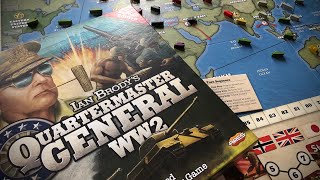
- Simple core rules with deep deck-driven strategy
- Elegant integration of supply lines and territory control
- Strong thematic feel similar to Twilight Struggle and Axis & Allies
- Multi-player team play adds cooperative elements
- Depth relies heavily on card decks; potentially steep learning curve for new players
- Requires several players for best experience; two-player play exists but is more constrained
- Thematic and historical accuracy depends on rules interpretation
- Global strategic competition between Axis and Allies; emphasis on supply lines and alliance coordination.
- World War II era with multiple theaters and cross-theatre military operations.
- Card-driven deck management with semi-cooperative multi-player play and tournament-style victory conditions.
- Axis & Allies
- Twilight Struggle
Mechanics (from transcript analysis)
- Area control / victory points — Occupying spaces with stars yields victory points; track determines winner; round-based scoring.
- card-driven gameplay — Players play cards to perform actions like building units, deploying, and triggering events.
- Deck asymmetry by nation — Different nations have different deck compositions and strengths, reflecting historical roles.
- Elimination rules and tournament victory — If a side leads by 30+ points, they win immediately; final score after 20 rounds determines winner.
- Naval and land battles — Separate rules for sea and land battles; naval units require port adjacency and supply lines.
- Player Elimination — If a side leads by 30+ points, they win immediately; final score after 20 rounds determines winner.
- Resource Management — Status/economic cards affect ongoing play and economies, adding depth beyond simple rules.
- Resource management and economy (status cards) — Status/economic cards affect ongoing play and economies, adding depth beyond simple rules.
- Straits and strategic choke points — Strategic straights affect supply routes and territorial control; control in certain sea routes matters.
- Supply lines and maintenance — Units must be kept in supply via supply spaces; unsupplied units are removed.
- Two-team / semi-cooperative play — Axis vs Allies with teams, where players on same side coordinate but manage separate countries.
Video topics + discussion points
Quotes (from this video)
- it's a card driven global war game but the rules are really simple it's very quick to pick up
- it's a super game
- the depth is in these decks
- this is a card driven global war game
- it's about knowing your deck it really is and that's why it feels like Twilight Struggle