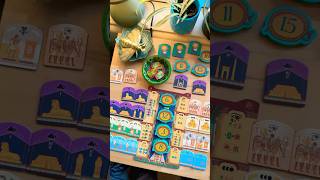
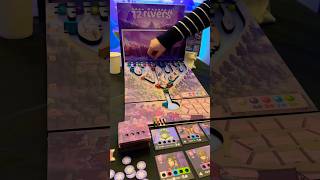
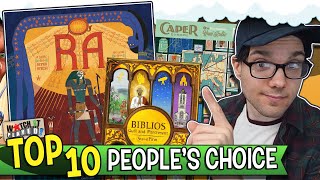
Ra is an auction and set-collection game with an Ancient Egyptian theme. Each turn players are able to purchase lots of tiles with their bidding tiles (suns). Once a player has used up his or her suns, the other players continue until they do likewise, which may set up a situation with a single uncontested player bidding on tiles before the end of the round occurs. Tension builds because the round may end before all players have had a chance to win their three lots for the epoch. The various tiles either give immediate points, prevent negative points for not having certain types at the end of the round (epoch), or give points after the final round. The game lasts for three "epochs" (rounds). The game is easy to learn.
From the Box:
The game spans 1500 years of Egyptian history in less than an hour!
The players seek to expand their power and fame and there are many ways to accomplish this: Influencing Pharaohs, Building monuments, Farming on the Nile, Paying homage to the Gods, Advancing the technology and culture of the people. Ra is an auction and set collecting game where players may choose to take risks for great rewards or... And all this is for the glory of the Sun God Ra!
Ohhhhh I get it: RAtzia
Live Play - Tend
- engaging engine-building feel with evolving decisions
- replayable and satisfying card interactions
- turns can become predictable once you identify a standard engine
Mechanics (from transcript analysis)

Video topics + discussion points
Quotes (from this video)
- it's just such a satisfying game for me to play
- the scoring is so low it makes every point matter so much
- this is a voting game that you are going after you're interested in manipulating tokens on the board
- Mission Deep Sea is the Pinnacle version of the crew
- Ghost Stories is fantastic cooperative game
- Cascadia is such a great game
- Kingdom Builder ... it goes up to five to six players
- KeyForge unlike anything else I've played out there
References (from this video)
Mechanics (from transcript analysis)
Video topics + discussion points
Quotes (from this video)
References (from this video)
- Accessible, quick play (about 30 minutes) with a light, charming feel.
- Solid drafting core without overwhelming decision trees.
- Interesting compost mechanic that adds a layer of depth and trade-offs.
- Objectives provide direction and some variety across playthroughs.
- Good comparison seeds to other lighter drafting games (No Thanks, Tend).
- Drafting tension is not as high as in heavier drafting games; decisions are often obvious.
- Compost interactions can feel underutilized or underdeveloped in many sessions.
- Limited variance; the objectives don’t drastically change the core experience from game to game.
- Hate-drafting can be a feature for some players, but not everyone enjoys that dynamic.
- Replay variety relies more on card distribution than on evolving rules.
- Array
- Fictional trading world
- Abstract/Mechanistic
- Tend
- No Thanks
Mechanics (from transcript analysis)
- Card-exchange when shipping cargo — Reveal a ship cargo card and exchange it for a card from your hand before shipping the cargo.
- Color-based scoring / set collection — Scoring comes from color-specific cards (green, yellow, pink, etc.) and their interactions with the row and objectives.
- Compost mechanic — Cards busted to compost interact with other cards and potential scoring; some cards pull from or reward points for composted cards.
- drafting — Players draft a card from their hand and reveal simultaneously before passing to the next player.
- End-of-round scoring via manifests and objectives — When the deck runs out or cargo is shipped, players score points from objectives and shipped manifests.
- Push Your Luck — Players continue to play cards and advance their cargo manifests while risking busting and discarding cards to the compost.
- set collection — Scoring comes from color-specific cards (green, yellow, pink, etc.) and their interactions with the row and objectives.
Video topics + discussion points
Quotes (from this video)
- Graft is a three to five player drafting push your luck game.
- Overall, this is a light, fun, charming game.
- Once a player ships cargo when the deck has run out, at that point you're going to score up all your points you've gotten for objectives, as well as the points you've gotten for each of your cargo manifests that you've shipped.
- I enjoy Graph. I played it a few times and I'm glad I have because the first time I played it, it had an initial charm to it.
References (from this video)
- easy to teach and learn
- tight balance and replay value
- high production quality
- accessible entry point into auction games
- best with 3-5 players; two-player balance is weaker
- some players may find luck plays a factor
- Auction and set collection
- Abstract auction with tiles drawn from a bag
- abstract, highly tactical
- Modern Art
Mechanics (from transcript analysis)
- Auction / Bidding — Players bid on tiles using value chips; winning an auction requires taking all tiles in the bid and exchanging chips.
- auction with chips — Players bid on tiles using value chips; winning an auction requires taking all tiles in the bid and exchanging chips.
- round-based, finite play — Three rounds total; end conditions and scoring are predictable, aiding strategic planning.
- set collection — Tiles stay in play across rounds; scoring occurs after each round with potential negative points.
- set collection and timing — Tiles stay in play across rounds; scoring occurs after each round with potential negative points.
Video topics + discussion points
Quotes (from this video)
- I would rate a 10 out of 10.
- Through the Desert is incredibly interactive at every player count.
- The production quality of RAW is outstanding.
- Arboritum is very interactive, but in a cutthroat way.
- Botswana is the simplest on the list, but with depth.
References (from this video)
- Less mental math, still satisfying bids
- Visible opponent bids add strategic clarity
- Limited to fixed-value bids
- Some players may prefer pure money bidding
- tactical bidding without mental math
- Auction environment with fixed bidding resources
- Big Shot
- Skyrise
- Modern Art
Mechanics (from transcript analysis)
- Auction / Bidding — Players bid with fixed-value sundisks rather than money; central grid fills with tiles triggering auctions.
- bidding strength represented by disc swaps — Your bid strength is reflected by disc selection; you can swap discs when you win.
- sundisk bidding — Players bid with fixed-value sundisks rather than money; central grid fills with tiles triggering auctions.
Video topics + discussion points
Quotes (from this video)
- Auction and bidding is honestly one of my favorite board game mechanics
- This is such a fun game and can be really cutthroat.
- Modern Art is pure economic knife fighting.
- Keyflower is clever, crunchy, full of tough choices, and is just one of the greatest games ever made.
- it's just such an amazing game.
References (from this video)
- high production quality and components
- deep, interactive bidding and multi-faceted scoring
- varied starting auction tokens create balance and replayability
- scoring opportunities across many categories keep players engaged
- shines at higher player counts
- two-player version can be less engaging; potential boredom noted
- some complexity may be daunting for newcomers
- Auction bidding with set collection and variable scoring
- Ancient Egypt along the Nile with pharaohs, monuments, and Nile flooding
- Thematic flavor with historical Egypt imagery; abstract mechanics
- Razia
Mechanics (from transcript analysis)
- Auction / Bidding — Players bid tokens to gain control of tokens; raw forces bid; last-chance bid; tokens swap from middle and are returned face down.
- auction/bidding — Players bid tokens to gain control of tokens; raw forces bid; last-chance bid; tokens swap from middle and are returned face down.
- bag building — Each turn you draw a tile from the bag and place it on your board.
- board/round progression — Left side persists across rounds; right side resets; boat track determines end of round.
- calamity tiles — Disasters force discarding tiles from your board.
- Compound Scoring — Score categories at the end of each round; Nile, monuments, pharaohs, god tiles.
- End-round scoring — Score categories at the end of each round; Nile, monuments, pharaohs, god tiles.
- endgame scoring and round progression — Three rounds; final scoring includes monuments; tokens convert to points.
- god tiles and swapping — God tiles allow swapping a desired tile from the lineup; otherwise held for end-of-round points.
- set collection — Monuments and other tiles scored by collecting multiple types/numbered sets.
- Tile drafting from bag — Each turn you draw a tile from the bag and place it on your board.
- token management — Use bidding tokens, which are consumed and replaced in subsequent rounds; tokens moved to middle or swapped.
- Track advancement — Left side persists across rounds; right side resets; boat track determines end of round.
- two-player balance — Two-player variant is less engaging but still functional; balance tweaks like seven-point swing.
Video topics + discussion points
Quotes (from this video)
- this is one of the quintessential kind of bidding auction style games
- production quality of this game was amazing
- auction games this is you know about as good as it gets
- it's interactive you're locked in constantly
- I love the kind of the variable starting tiles that you started with
- this shines at higher player counts
- two-player version there's a seven point swing
References (from this video)
- easy to learn
- family-friendly
- engaging family puzzle
- quick turns
- clear scoring
- space for strategic planning
- discovery, scoring through line completion, area control via houses, majority in hidden geography tiles, species collection scoring
- island exploration on a triangular journal grid
- tutorial/overview
Mechanics (from transcript analysis)
- discovery placement on triangular grid — Players place discovery tokens on a triangular grid in their journal, with placement determining scoring opportunities.
- house placement and travel/area control — Completing horizontal lines allows placing a house that speeds travel and establishes board control.
- Line completion scoring — Points are scored immediately when the last token completes a line in any direction (horizontal or diagonal).
- secret geography tiles and majority scoring — End-of-game reveals geography tiles; players with majority benefit with extra points.
- species collection and fluctuating values — Species collected on the journal have values that are set at game start and can fluctuate during play.
Video topics + discussion points
Quotes (from this video)
- This game is super easy to dive into, great for families.
- Make sure to be on the lookout for the upcoming crowdfunding campaign for [music] this game. You're not going to want to miss.
References (from this video)
- exceptional production quality for a prototype
- satisfying tactile components (stamps and scratchers)
- strong variety of strategic paths and multiple routes to victory
- engaging neighbor interaction and subtle player interaction
- fun remote/party play option via the website integration
- thematic cohesion can feel dry or spreadsheet-like at times
- the number of choices can be paralyzing for first-time players
- some components (scratchers) feel fragile in prototype form and may require production adjustments
- lamination of the cargo manifest is not possible with current components
- space-based farming and resource management with interplanetary shipping and colonization dynamics
- Earth has exhausted its resources; humanity operatives work on a distant planet to farm and harvest goods to ship back to Earth as a space-based economy unfolds.
- procedural/resource-management with sandbox elements
- Stardew Valley
- Hadrian's Wall
Mechanics (from transcript analysis)
- Cargo manifest / shipping goods — ship resources back to Earth; goods are scored via a manifest that assigns points based on placement and value.
- Coins, stamps, and markers system — resources converted into markers or stamps; stamps provide a tactile, visual method to track progress and scoring on the manifest.
- Compound Scoring — the game runs over 12 rounds split into three seasons; at the end of each season, players score based on filled criteria and special bonuses.
- Fishing / chopping / mining actions — three core action tracks with upgrading paths; each track yields different resources and endgame bonuses.
- Flip and Write / blank-and-write — players draft and upgrade actions on cards, then mark progress on a sheet; cards cycle and improve over the game.
- Flip/Roll and Write — players draft and upgrade actions on cards, then mark progress on a sheet; cards cycle and improve over the game.
- neighbor interaction — produce resources can be given to left or right neighbors; neighbors gain goods and players gain markers when passing.
- Scratchers / die-cut discovery — scratch-off tokens reveal yields and bonuses; provides a lottery-ticket feel and tangible interaction.
- Seasonal scoring with three scoring bonuses — the game runs over 12 rounds split into three seasons; at the end of each season, players score based on filled criteria and special bonuses.
- tile placement — plant crops and place farm structures on a grid; land size and fences determine what can be built.
- Tile/land placement and plowing — plant crops and place farm structures on a grid; land size and fences determine what can be built.
- Treillis and upgrade pathways — building trellises or upgrades to unlock new crop placements and actions; progression unlocks deeper bonuses.
Video topics + discussion points
Quotes (from this video)
- it's crazy good
- stamps are they necessary probably not are they my favorite thing I've ever gotten in a prototype
- there are so many ways you can go in the game it's really satisfying
- neighbor bonuses... clever
- the damn scratchers... ridiculous
- it's brilliant absolutely brilliant
- it's not particularly thematic but just something that you need to understand as you look past the amazing things that you're getting with the production at the end of the day it is a little bit dry
References (from this video)
- tight, tactical decision-making
- interesting twist with two-sided cards
- integrates well with other Packo titles
- requires careful timing to avoid overshooting zero
- finance/points balance via tricks
- Travel-sized micro-game collection; abstract trick-taking
- cleverly mathematical
Mechanics (from transcript analysis)
- Multi-use cards — Each card has a positive side and a negative side; orientation matters.
- Trick-taking — Players draft and play tricks to maximize positive vs negative points.
- Two-sided cards — Each card has a positive side and a negative side; orientation matters.
Video topics + discussion points
Quotes (from this video)
- eight full board games in this one little pouch
- this set is absolutely brilliant absolutely genius
- we were blown away with how much you can do in such a little package
- the cards are two-sided one is positive one is negative feel upside down
- in Sly you're drafting these cards face down into the hen house
- this is a horse racing game
References (from this video)
- clear color-based feel
- short playtime with strategic depth
- nice interaction via shared pool
- may rely on player cooperation with pool dynamics
- color drafting with set completion
- Travel-sized micro-game collection; color/mactor matching
- light, colorful
Mechanics (from transcript analysis)
- shared-pool drafting — Players draft from a common pile; choices affect others.
- tableau building — Construct a personal display to maximize color sets.
- tableau-building — Construct a personal display to maximize color sets.
Video topics + discussion points
Quotes (from this video)
- eight full board games in this one little pouch
- this set is absolutely brilliant absolutely genius
- we were blown away with how much you can do in such a little package
- the cards are two-sided one is positive one is negative feel upside down
- in Sly you're drafting these cards face down into the hen house
- this is a horse racing game
References (from this video)
- ambitious, high-complexity farming title
- flexible play path with multiple actions per turn
- farming, resource collection, and merchant-style optimization
- Farming world where players build and manage crops and goods
- puzzle-like, high-agency farming experience
Mechanics (from transcript analysis)
- flip-and-write — players flip, roll, write, and track outcomes on a personal pad
- Flip/Roll and Write — players flip, roll, write, and track outcomes on a personal pad
- roll-and-write / scratch-and-stamp — dice outcomes are written and sometimes stamped or scratched for bonuses
Video topics + discussion points
Quotes (from this video)
- The fate of creatures touched by the spark of intelligence hangs in the balance
- This is a flip and roll and scratch and stamp and whatever else you want to do and write
- open world Cooperative Adventure game even for solo
- windmill valley was a big hit for me Solo in 2024
- you start as a child and as such you will have limited sense of interest and skills that will determine your development
References (from this video)
- Engaging simultaneous play that creates tension
- Pattern-driven scoring offers strategic depth
- Interactive decisions and occasional blocking opportunities
- Rulebook is light on rules, leading to confusion
- Scoring conditions and adjacency requirements can be unclear
- Edge-case interpretations require house-rule style discussion
- pattern-based scoring with push-your-luck elements
- tabletop board game session
- live commentary with group interaction
- Time to Panic
- Scales of Fate
- Pillars of Fate
Mechanics (from transcript analysis)
- badge/marker scoring — Conditions allow players to place markers on cards; first claimant earns higher points while others receive lower points.
- bust and compost mechanics — If you bust, you discard or place cards into a compost area; some mechanics allow these to influence future rounds.
- Compound Scoring — Conditions allow players to place markers on cards; first claimant earns higher points while others receive lower points.
- deck manipulation — Players may replace or rearrange cards and draw back up to a hand limit, influencing future choices.
- deck manipulation and replacement — Players may replace or rearrange cards and draw back up to a hand limit, influencing future choices.
- row-based scoring with patterns — Cards form rows that must meet certain patterns or conditions to score, with some conditions requiring adjacency or specific sequences.
- Simultaneous card reveal — Players select and reveal cards at the same time.
- Simultaneous reveal — Players select and reveal cards at the same time.
Video topics + discussion points
Quotes (from this video)
- I love card games.
- These patterns are way harder.
- The rule books are a little too light on rules.
References (from this video)
- Elegant interaction between drafting, restrictions, and goals that rewards careful planning
- Beautiful production values with gold and silver foil on goals and cards
- Strong replayability due to variable card decks and mutually reinforcing objectives
- Bust outcomes can be punishing and may frustrate players who prefer deterministic engines
- Minimum and maximum player counts (3-5) constrain group size and pacing flexibility
- Access is primarily via pre-order, which may slow availability for some buyers
- goal-driven cargo collection and delivery, blocked-card interactions, and push-your-luck decision-making
- Tend universe, corporate space trading with cargo ships, exploration of a connected world shared with Tend
- informational yet enthusiastic overview with emphasis on production values and gameplay twists
- Tend
Mechanics (from transcript analysis)
- board_state_and_marker_scoring — marker placement above or below on the board indicates who hit a goal first and who followed, contributing to end-game scoring.
- card_restrictions_interactions — cards carry color-based restrictions (red borders) that constrain what colors may be played after a given card, creating strategic sequencing.
- Compound Scoring — marker placement above or below on the board indicates who hit a goal first and who followed, contributing to end-game scoring.
- deck_refill_and_compost — after each round, players refill to six cards; if you bust, your accumulated assets are moved to a compost pile, resetting progress for that round.
- drafting — players select a card from their hand and pass the remaining cards to the next player, creating a dynamic flow and potential future options as the deck reshuffles per player count.
- goal_mechanics — two gold and three silver goals exist per game; achieving them places markers and yields points, with order of achievement affecting positioning.
- Push Your Luck — a core element where players may push their luck by drawing and playing additional cards to increase scoring potential, risking busting when forced to pass.
- pusher_luck — a core element where players may push their luck by drawing and playing additional cards to increase scoring potential, risking busting when forced to pass.
- set collection — cargo cards are collected and later shipped; successful shipments score points based on card effects and end-game rules.
- set_collection_and_shipping — cargo cards are collected and later shipped; successful shipments score points based on card effects and end-game rules.
Video topics + discussion points
Quotes (from this video)
- the game Graph from Ivy Studios.
- gold and like look at the gold foil on the cards.
- there will be two gold and three silver goals that you are being worked toward.
- you will put one of your cute little player markers above.
- I really like that pusher luck element.
- this is Graph. I highly recommend it.
- the only way to get it is pre-order through their website.
References (from this video)
- Clever design with deep strategic options
- Engaging and varied when multiple cards are activated in a turn
- Clean layout and clear teaching flow
- Approachable to teach and fun for players of different experience levels
- engine-building/resource management with area-based growth and mask-driven endgame.
- Columns-based mancala board with personal starting cards, a central village area, sun and moon energy tokens, and a market of cards on a top row.
- educational/enthusiastic overview with practical, teach-through-play explanations.
Mechanics (from transcript analysis)
- Card purchasing and council placement — Bought cards grant abilities and are placed in a council area, influencing future turns and strategies.
- Card/Chit Market — A shared village area holds excess tokens and a top-row market of four cards; players can refresh rows by paying to access new cards.
- Central village and card market — A shared village area holds excess tokens and a top-row market of four cards; players can refresh rows by paying to access new cards.
- Column-based activation — Players choose one of their own columns to activate; each column can hold up to four cards, and the column activated determines the effects triggered.
- end game bonuses — Masks provide endgame scoring conditions and can end the game when a certain number of masks are in play or a threshold of cards is reached.
- Endgame scoring — Scoring comes from column height, cards in the council, and mask-based scoring conditions.
- Masks and endgame triggers — Masks provide endgame scoring conditions and can end the game when a certain number of masks are in play or a threshold of cards is reached.
- Row refresh pricing — Players may pay tokens to refresh either row in the village to access different cards.
- Tokens: sun and moon — Two types of energy tokens are used to pay costs and fuel card abilities; tokens are earned and spent during play.
Video topics + discussion points
Quotes (from this video)
- It is really clever, really cool, and has a lot of strategy, but is pretty straightforward and approachable to teach to people.
- I love how cleanly everything is laid out.
- There are some really epic things you can do in one turn when you have multiple cards activated.
References (from this video)
- Concise and well-organized rule book (about 6.5 pages core rules).
- Engaging theme with strong cyberpunk detective atmosphere.
- Strong replayability through multiple cases and varied card encounters.
- Tight interactions between board, cards, and character decks.
- Accessible core mechanics despite depth; intuitive tests and consequences.
- Table space hog: oversized board and numerous components; difficult on small tables.
- Portrait board orientation; landscape mode would be preferable for camera/table setup.
- Over 800 cards with no included card dividers; DIY dividers recommended.
- Long setup time for first game; heavy component management.
- Name of one case, 'the deadly dingus', may be off-putting; naming could be improved.
- cyberpunk detective mystery
- Post-apocalyptic Los Angeles with the surface city Old Angeles, the City of Angels, and the underworld.
- story-driven, case-based gameplay where mysteries have multiple solutions and are experienced through characters rather than players
- Arkham Horror
- Civotas Nihelium
Mechanics (from transcript analysis)
- Bounty hunting and orange clue tokens — During investigation, players can bounty hunt by discarding orange clue tokens to draw more cards.
- Case-based scenarios and expansions — Base game has four cases; expansion adds a fifth; cases are replayable with varied outcomes due to randomized cards.
- Character stats and skill tests — Stats Mind, Mech, Mojo, Moxy, Move, Muscle; tests use cards and Fate/Clue tokens; matching icons can grant extra draws; overshooting adds heat.
- Cooperative Game — Players work together as investigators in Mason Doyle Investigations.
- cooperative play — Players work together as investigators in Mason Doyle Investigations.
- Darkness mythos phase and darkness track — The mythos/darkness phase advances a darkness tracker; spaces can flip between light and dark; events from the mythos deck affect play.
- Deck building — Each character has a starting deck with equipment and stat cards; can upgrade via encounter decks.
- Deck-building starter decks — Each character has a starting deck with equipment and stat cards; can upgrade via encounter decks.
- deduction — During investigation, players can bounty hunt by discarding orange clue tokens to draw more cards.
- Draw and resolve damage and fate cards — Damage cards accumulate; every third drawn flips face up with consequences; fate cards drive test outcomes.
- Heat mechanic — Heat tokens track attention drawn by actions; too much heat triggers negative consequences; can be reduced by laying low.
- Location-based encounter decks and tests — Each space has its own encounter deck; tests rely on specific skills; posters and encounters influence rewards and further draws.
- Move and space mechanics with light/dark sides — Spaces have light and dark sides; moving and testing can trigger different consequences; darkness shifts add tension.
- Simultaneous Actions — Each player gets two actions per investigation phase to move, investigate, rest, etc.
- Tokens as currency — Clue tokens, alibi tokens, executive order tokens, gum shoe tokens, etc. used to perform actions and upgrades; passports and karma tokens add depth.
- Two actions per investigator per phase — Each player gets two actions per investigation phase to move, investigate, rest, etc.
Video topics + discussion points
Quotes (from this video)
- So, yes, this game is awesome. I love this game.
- This board is absolutely massive.
- Richard Lonius is the king of the co-op.
- I would love it if they did come out with a small expansion with more encounter cards.
- I think this game is so much fun.
References (from this video)
- Beautiful production value and cohesive graphic design from a single artistic vision.
- Color-coded components and organized storage that enhance tactile gameplay.
- Integrated trilogy approach with carryover elements across Miru 1 through 3, enabling an overarching campaign.
- High-quality physical components that replace pencil-and-paper fiddliness with tangible tokens and boards.
- Accessible price point for a deluxe hex-kit experience, with bundles that simplify buying all three books.
- Complexity can be a barrier for new players; the hex-kit approach adds layers beyond traditional solo RPGs.
- Requires access to base books 1–3 to play fully, which may complicate setup if PDFs or bundles aren’t obtained.
- Some players may find the hand-management and token systems dense compared to lighter solo experiences.
- The transition from pen-and-paper mechanics to physical components may introduce a steeper learning curve.
- Expands beyond a single standalone game, making it a larger time and budget commitment for a complete run.
- Survival, exploration, artifact gathering, and an epic quest that threads through a trilogy to confront a godly foe.
- A fantastical, perilous world where exploration unfolds across hex-based maps that reveal ruins, deserts, forests, and mysterious locales as the protagonist pursues a god.
- Analog horror/adventure with a cohesive story arc that links Miru, Miru 2, and Miru 3, allowing carryover elements and evolving stakes.
- Dark Venture
- Dungeon Degenerates
Mechanics (from transcript analysis)
- Character progression and gear collection — Acquire weapons, gear, and treasures to improve odds in encounters and overcome challenges.
- hex-grid exploration — Players move a character token across hexes to uncover encounters, resources, and environmental effects.
- hexagon grid — Players move a character token across hexes to uncover encounters, resources, and environmental effects.
- Puzzle-like encounters and cryptic events — Events require deduction and strategy rather than pure randomness, with outcomes shaping the ongoing campaign.
- Turn structure by phases — Each day progresses through a dawn, day, dusk, and dark phase that governs actions, events, and resolutions.
- Variable Phase Order — Each day progresses through a dawn, day, dusk, and dark phase that governs actions, events, and resolutions.
Video topics + discussion points
Quotes (from this video)
- The award-winning series began as a small zen and has grown into an epic story of adventure, horror, and village defense.
- The hex kit alone is $50 and you can get a bundle for $100 that includes the hex kit and all three of the new versions of the book.
- I am very happy with this. What a really really nice production.
- This is going to be pretty dang cool to play Miru's one through three as kind of this three-act epic campaign using these components.
References (from this video)
- Simple, easy to learn and play
- Enjoyable solo experience with satisfying scoring
- The eraser feature makes drawing forgiving
- Pleasant theme and satisfying loop (trees and lakes)
- Drawing quality can feel subjective; the player notes their art could be better
- Some rule interactions (placement near lakes/trees) can be fiddly in the moment
- Array
- Forest
- observational, first-person playthrough narration
Mechanics (from transcript analysis)
- Compound Scoring — Score is determined by the number of different tree types in specific columns.
- Dice rolling — The player rolls two dice to determine which shape to place on the map.
- Eraser / Correction — The player can erase mistakes and adjust their drawings.
- Lakes as Multipliers — Lakes multiply scoring opportunities; more lakes increase the multiplier.
- Pattern/Shape Placement — Players place shapes on a grid to form forests of trees and lakes, guided by the dice results.
- Scoring by Tree Variety in Columns — Score is determined by the number of different tree types in specific columns.
Video topics + discussion points
Quotes (from this video)
- I love rolling dice and I love ones that are very simple to play like this.
- Oh my gosh. Thank goodness this has an eraser.
- I wish my drawing was a little bit better, but this was my forest.
- This was very pleasant. I love rolling dice and I love ones that are very simple to play like this.
- Happy gaming.
References (from this video)
- Highly interactive and tense
- Strong replayability via rotating dice and areas
- Layered decision-making with ongoing pressure
- Punishing at times; mistakes have real consequences
- Can be punishing for new players without guidance
- Power, influence, and cathedral-building under dice-driven pressure
- Medieval France, competing noble houses vying for influence
- Tense, highly interactive, and strategic with constant adaptation
Mechanics (from transcript analysis)
- dice placement — Colored dice represent city factions and are spent to activate buildings and advance influence
- Dice-based worker placement — Colored dice represent city factions and are spent to activate buildings and advance influence
- Hidden objectives with public impact — Players pursue personal goals while reacting to others' moves
Video topics + discussion points
Quotes (from this video)
- Dungeon Fighter is one of the best dexterity games out there, and it is criminal how little it gets discussed.
- This next game was the quintessential subversion of the worker placement genre for its time.
- Millennium Blades isn't trying to be this like perfectly tuned, elegant Euro experience. It's trying to make you feel like a kid again, drafting decks and spending your allowance on singles and getting grounded because the money your parents gave you to buy milk went straight to decks for the new set.
- Lords of Vegas is unapologetically messy and a hilarious blast every single time it hits the table.
- Argent is dreadfully messy. It has an insane amount of table sprawl. It has spells that feel downright broken because this is a game that puts fun and tactical depth above all else.
- Archipelago is messy. It's just not a design anyone on Board Game Geek is going to call eloquent.
References (from this video)
- Array
- Array
- color collection and adjacency-based scoring
- Array
- Casual tabletop card game session
- Array
- Array
- Array
- positive
Mechanics (from transcript analysis)
Video topics + discussion points
Quotes (from this video)
- here's a 2 to six player game that you
- could do a short game for 15 points a
- on your turn all you do is play
- there are three things that can happen next first if one or more cards in the middle match the same number you played you take all those matching numbers
- if I play a zero and there are no zeros in the middle I can take a nine or a one since both of those would be adjacent to zero
- in summary all you do is play a number card from your hand to the middle you take all the matching numbers
- you organize the cards that you take in front of you by color
- how to play Gap hope you all enjoy
References (from this video)
- Multi-faceted decisions that remain approachable with a simple core
- High replayability due to evolving state and player interaction
- Elegant combination of hand management, tableau-building, and location exploration
- Tension from competition for the same locations and colors
- US availability for pre-orders is limited; Essen release anticipated
- Could be dense for very casual players despite being described as simple to learn
- Viking recruitment, exploration, and trade
- Viking Age exploration and expansion
- analytical and enthusiastic reviewer voice
Mechanics (from transcript analysis)
- hand management — Players manage and play cards to trigger effects across their tableau, balancing colors and symbols.
- location_exploration — Locations can be acquired by spending bracelets; they provide resources and slot on the shipboard, enhancing the trade action.
- reputation_engine — A persistent reputation track provides ongoing points each turn, forming the core engine.
- Resource management — Bracelets and other resources are earned through symbols and traded to gain immediate resources and points, enabling powerful actions.
- resource_and_bracelet_trading — Bracelets and other resources are earned through symbols and traded to gain immediate resources and points, enabling powerful actions.
- tableau building — Played cards are placed into color-tied columns; activating a color triggers resources on all cards of that color.
- tableau_building — Played cards are placed into color-tied columns; activating a color triggers resources on all cards of that color.
Video topics + discussion points
Quotes (from this video)
- Nara is combining some really familiar mechanics
- it's hand management Resource Management card play some engine building of sorts
- the gameplay on the outset is actually really simple you play a card and pick up a card or you spin those cards that you've previously played to explore location
- the game state is constantly changing based upon how your opponent is interacting with the cards and locations so replayability
- the replayability on this game is going to be super high
References (from this video)
- fast setup and teach; accessible for non-gamers
- elegant, single mechanic; easy to grasp
- high social interaction; great for mixed groups
- compact playtime with meaningful decisions
- replayable within a lightweight bidding framework
- thematic depth may be light for heavier gamers
- limited variety can lead to repetition over time
- tile bidding can feel brutal or punitive to players with fewer good bids
- production quality varies by edition, which may affect perceived value
- auction/bidding as the core mechanism driving scoring and tile selection
- Ancient Egypt; temple-building era during a ceremonial bidding carnival
- mythic, ceremonial, lightly thematic with abstracted scoring
- Through the Ages
- Power Grid
- Keyflower
- El Grande
- Modern Art
Mechanics (from transcript analysis)
- Auction / Bidding — Players bid with fixed-value tiles to determine who acquires action tiles; each bid tile is discarded after use and replaced by whatever tile is in the middle; end-of-round scoring based on collected tiles and temple/tile placements.
- bidding/auction — Players bid with fixed-value tiles to determine who acquires action tiles; each bid tile is discarded after use and replaced by whatever tile is in the middle; end-of-round scoring based on collected tiles and temple/tile placements.
Video topics + discussion points
Quotes (from this video)
- "it's the bidding game that you need in your collection"
- "I invoke raw"
- "I think the ultimate version of Ra"
- "this is absolutely the bidding game that you need in your collection"
- "it's a great social game"
- "you can learn in 30 seconds and play in 30 seconds"
References (from this video)
- Smaller form factor is more approachable
- Less intimidating than the Pharaoh edition
- Appears to be more travel-friendly and quicker to learn
- Pharaoh edition is cumbersome to travel with
- Abstract card game focused on approachable design and compact form factor.
- Individually played card game; no specific in-universe setting mentioned in the transcript.
- Direct, conversational commentary focusing on product attributes rather than game world storytelling.
- Raw
Mechanics (from transcript analysis)
- abstract_design_explanation — Mentioned in the transcript by implication; the conversation centers on form factor and accessibility rather than procedural gameplay.
- card_play — General discussion identifies RAW as a card game; specific rules and mechanics are not detailed in the transcript.
Video topics + discussion points
Quotes (from this video)
- This is like Raw.
- It's basically Raw the card game.
- This smaller form factor I think has just a more approachable kind of look to it.
- Pharaoh edition of RAW if you have it
References (from this video)
- Interesting scoring twist with pair-based bonuses that rewards pattern recognition
- Negative scoring elements introduce risk management and strategic depth
- Negative scoring can be punishing and may reduce accessibility for casual players
- The theme may feel abstract or confusing to some players if the imagery does not strongly resonate
- crime meets antiquity; strategic card collection with a tilt toward evaluating patterns and penalties rather than simple accumulation
- An abstract, thematically charged setting described through gangster imagery juxtaposed with ancient Egyptian motifs. The speaker references the notion that “gangsters are the equivalent of the pharaohs,” indicating a thematic blend of crime-driven gameplay with archetypal, mythic power dynamics.
- abstract and mechanic-driven; the theme serves as a frame for scoring quirks rather than a linear storytelling arc
Mechanics (from transcript analysis)
- card-type_presence_penalties — The game imposes penalties tied to the presence or absence of card-types, creating strategic tension between collecting for bonuses and avoiding penalties by ensuring card-type coverage.
- Compound Scoring — There is a scoring incentive for collecting certain pairs of cards; the speaker notes that pairing two different gangster pictures yields five points, highlighting a focus on pattern recognition and pairing efficiency.
- negative_scoring — A prominent feature in the discussion is that players can lose points for certain conditions, including not having a required card type or mismanaging card collection. For example, failing to possess a specific card type can cost five points, and having the fewest of a given type costs two points.
- pair_bonus_scoring — There is a scoring incentive for collecting certain pairs of cards; the speaker notes that pairing two different gangster pictures yields five points, highlighting a focus on pattern recognition and pairing efficiency.
- set collection — Players seek to assemble specific sets of cards, in this case involving gangster-card imagery; successful assembly yields point bonuses (notably a five-point bonus for obtaining a particular gangster pair).
- set_collection — Players seek to assemble specific sets of cards, in this case involving gangster-card imagery; successful assembly yields point bonuses (notably a five-point bonus for obtaining a particular gangster pair).
Video topics + discussion points
Quotes (from this video)
- two different pictures of gangsters that if you get the pair of them together, you get five points.
- this is a game in which you lose points. Oh, you don't you don't have this type of card, you lose five points. You have the fewest of these, lose two points.
References (from this video)
- classic Knizia auction design
- tight economy and bidding tension
- can be brutal at higher player counts
- older production quality may feel dated
- ancient civilization asset upscaling through bidding
- ancient Nile valley auction and bid economy
- bluffing and strategic auction with evolving rounds
Mechanics (from transcript analysis)
- Auction / Bidding — players bid for tiles with limited shows of power
- auction/bidding — players bid for tiles with limited shows of power
- dynamic rounds — next rounds introduce new bidding tiles and strategic pressure
- press-your-luck / economy — tile values and end-game scoring hinge on bidding decisions
- Push Your Luck — tile values and end-game scoring hinge on bidding decisions
Video topics + discussion points
Quotes (from this video)
- we're going to give you five amazing games each each so 10 in total
- the maximum play time is 60 minutes
- PanAm is inevitable so it's gonna come and get you
- adrenaline rush of a board game
- Starship Troopers in a box
- it's just a fabulous game
- Ra simple as that
References (from this video)
- Civil rights, protest, immigration enforcement, personal responsibility and joy
- Contemporary United States, Minnesota; real-world sociopolitical context
- monologue, personal confession
Mechanics (from transcript analysis)
- none — No board game mechanics discussed; video is political and personal commentary.
Video topics + discussion points
Quotes (from this video)
- I'm a game designer living in an occupied city in the United States.
- Minnesota is actually the best place I've ever lived.
- This is not the America that I want.
- You can't pretend that even your fun time is not political because you don't get to play games if you've been detained.
- The happiness is very conditional and never guaranteed.
- Sorry for being emotional, but like, you know, we're doing our best out here.
- You should probably call one of your representatives. do something today that makes you feel like you're doing something.
- You can't share space with the hatred that ICE represents.
References (from this video)
- strong atmosphere and gothic vibe
- cohesion with the Ludus Magnus universe
- streamlined rules facilitate quicker onboarding
- narrative density may be intimidating for some players
- game title familiarity may depend on published tie-ins
- adventure-focused; narrative-driven with modular storytelling
- gothic, atmospheric world linked across Ludus Magnus titles
- Choose Your Own Adventure-inspired flow with short, dynamic decisions
- Haunted Land
Mechanics (from transcript analysis)
- Choose Your Own Adventure style — Short narrative snippets guide decisions with branching outcomes.
- Fixed, streamlined rules — Rules are designed to be learned quickly so campaigns progress smoothly.
- Narrative choice — Short narrative snippets guide decisions with branching outcomes.
- Narrative-driven action — Story choices influence quest progression and encounters.
Video topics + discussion points
Quotes (from this video)
- this thing is a beautiful Beast
- production is insanely good
- it's a corker
- dripping with atmosphere dripping with theme
- everything is linked to the theme of the game which is amazing
- the central board is 100% the unique premise of this game
- the setup and gameplay are very fast
References (from this video)
Mechanics (from transcript analysis)
- Area Control — Players vie for influence across positional spaces using allocated actions.
Video topics + discussion points
Quotes (from this video)
- board gaming isn't a particularly environmentally friendly product
- the newest reprint of El Grande is an example of that
- absolutely the best storage solution in a box I ever seen
- it's all positive
References (from this video)
- unique Dutch-water-management theme
- strong interaction and group dynamics
- variability may be limited compared to other Euros
- cooperative/semicooperative civil engineering with farming elements
- dyke-building and flood mitigation in a farming/economy setting
- storytelling through planning and collaboration
- Wingspan
- Tapestry
Mechanics (from transcript analysis)
- Semi-cooperative — players work toward shared goals while competing for individual scoring
- semi-cooperative play — players work toward shared goals while competing for individual scoring
- tile placement — tiles added to the board create evolving challenges
- tile placement / variable tiles — tiles added to the board create evolving challenges
- worker placement — players place workers to influence dyke-building and tile placement
- worker placement on personal tableau — players place workers to influence dyke-building and tile placement
Video topics + discussion points
Quotes (from this video)
- thank you for sticking around and viewing this list once again
- it's easy to try them out there [Board Game Arena]
- these are the most underrated games in my opinion
- this is a tiny Epic type of game where it's really, small and quick
- I think this is a masterpiece of micro game design
References (from this video)
Mechanics (from transcript analysis)
Video topics + discussion points
Quotes (from this video)
- you are somebody's reason to smile
- we are so close to 30,000 Garden members
- thank you all so much for watching and for your support
- I am leaving for Japan and I cannot wait to document it
References (from this video)
- Classic, approachable auction game
- Presents depth through timing and choices
- Ageing design; some find it light by modern standards
- auction and set-building
- Ancient Egyptian-themed auction
- abstract
- Raw
- El Grande
Mechanics (from transcript analysis)
- Auction / Bidding — Players bid to place tiles; higher bids win control.
- auction bidding — Players bid to place tiles; higher bids win control.
- set collection — Construct scoring patterns from collected tiles.
Video topics + discussion points
Quotes (from this video)
- Twilight Imperium is over four (weight) and a lot of people still find it rewarding.
- heavy doesn't mean good, and should never be assumed to be better.
- we should have a graph rather than just a chart for weight, depth, and breadth.
- mom threshold: anything below that is considered very simple.
- it's a messy but fun game—Nemesis is a mess with too many rules.
References (from this video)
- Tight, elegant mechanics
- Good weights of decisions for a card game
- Not deeply thematic; more abstract
- Can be punishing if misplayed
- pure strategic play
- Abstract card-based hand management
- abstract
- Scout
- Ra
Mechanics (from transcript analysis)
- hand management — Players optimize hand of cards to maximize actions.
- set collection / tableau building — Cards form patterns of scoring opportunities.
Video topics + discussion points
Quotes (from this video)
- Twilight Imperium is over four (weight) and a lot of people still find it rewarding.
- heavy doesn't mean good, and should never be assumed to be better.
- we should have a graph rather than just a chart for weight, depth, and breadth.
- mom threshold: anything below that is considered very simple.
- it's a messy but fun game—Nemesis is a mess with too many rules.
References (from this video)
- N/A
- N/A
- expository
Mechanics (from transcript analysis)
Video topics + discussion points
Quotes (from this video)
- that was awesome I really enjoyed being invited over and how much more difficult is it when a game is immensely popular and it seems like everyone likes it except you
- Board Game Geek's top 100 games of all time
- at least half of them don't really land for me
- how do I find a game that I would really like
References (from this video)
- Intuitive value assessment that underpins every decision
- Welcoming to new players while offering depth for series veterans
- Minimal rules overhead that belies rich strategic tension
- Elegant production design and UI in the latest edition
- Earlier printings experienced availability issues and component variation
- Edition-to-edition differences can create confusion or inconsistent experiences
- auction tension, value assessment under time, evolving tile sets
- Abstract auction/set-collection with time pressure and disruption elements
- design-driven and procedural rather than narrative
- Tigris and Euphrates
- Modern Art
- Medici
Mechanics (from transcript analysis)
- Auction — Players bid to win all tiles in the pot each round; bids determine who collects the tiles and how the round ends.
- Auction / Bidding — Players bid to win all tiles in the pot each round; bids determine who collects the tiles and how the round ends.
- bag building — Tokens drawn from a bag are placed on display, shaping available choices and risk.
- Disaster/edge-case effects — Disasters destroy tiles and require adaptive bidding decisions; prior bid tokens circulate for refresh.
- set collection — Winning tiles form sets with varying durations and effects, influencing endgame scoring and strategy.
- Set-collection / tile acquisition — Winning tiles form sets with varying durations and effects, influencing endgame scoring and strategy.
- Time track — Drawing a RAW tile pushes the round timer forward, increasing pressure and potential upside for bids.
- Time-track escalation via RAW tiles — Drawing a RAW tile pushes the round timer forward, increasing pressure and potential upside for bids.
- Token display from bag and display management — Tokens drawn from a bag are placed on display, shaping available choices and risk.
Video topics + discussion points
Quotes (from this video)
- I'm invoking RAW
- There are climactic bids and surprise upsets, all with minimal rules overhead.
- It's extremely welcoming to new players while also being really satisfying to uber dorks who have been slinging cardboard for decades like myself.
- The drama really is driven by the heart being in conflict with itself.
- RAW is the best the game has ever looked, with tight flourishes like some marvelous graphic design and UI.
- The ubiquity of so much output getting repackaged means you got to be really selective.
References (from this video)
- humorous theme
- interactive and smart gameplay
- stock-part can be hard to grasp
- satirical corporate manipulation
- futuristic stock-market-themed game with parody companies
- humorous and interactive
- Stock market games
Mechanics (from transcript analysis)
- dice-influenced events — dice outcomes influence events like stock shifts
- Market Pricing/Manipulation — random stocks, buy/sell decisions, and market effects
- Stock manipulation — random stocks, buy/sell decisions, and market effects
Video topics + discussion points
Quotes (from this video)
- it's a really nice concise little game
- it's like playing a movie to me
- the art style is gorgeous and the mechanism is clever
References (from this video)
- Tense auction with push-your-luck elements that reward sharp timing.
- Tiles and auction set-up provide varied play each round.
- Accessible core mechanics with depth from strategic tile selection.
- Digital and physical versions have proven to translate well.
- Endgame can feel chaotic if players overcommit to auctions.
- Some players may dislike the luck element in late rounds.
- risk and timing in an auction environment; endgame timing is critical.
- Auction-based, push-your-luck game with negotiation-like pressure.
- competitive yet approachable with clear objective focus.
Mechanics (from transcript analysis)
Video topics + discussion points
Quotes (from this video)
- I love Ark Nova.
- Bees in space best theme ever.
- This game is just always buzzing in my ear.
- The actions are distilled down to such a great system.
References (from this video)
- Straightforward ruleset with accessible depth
- Good prototyping of worker/resource planning
- Limited reception in some groups if they want heavier Euros
- Some rule clarifications may be needed for newcomers
- donkeys and orders on a moving map
- rondel-based resource routing
- resource-management with a touch of whimsy
- Federation
- Dune Imperium
Mechanics (from transcript analysis)
- Donkey/resource management — Collect donkeys and use them to fulfill orders on the board.
- Resource management — Collect donkeys and use them to fulfill orders on the board.
- Rondel — Move around a central rondel to gather resources.
- rondel movement — Move around a central rondel to gather resources.
Video topics + discussion points
Quotes (from this video)
- Harvest feels lighter than viticulture, but intriguing for quicker play.
- Castle Combo has quick play and surprising depth for a fast 3x3 card grid game.
- I think this game would play a lot better with more players because that way you would be able to move these highway men a lot faster and they would serve to be more of an impediment.
- Memoir 44 is a classic thanks to its approachable yet tactical WWII battles.
References (from this video)
- fresh take with auction mechanics
- visually appealing edition
- new to presenter, may require learning
Mechanics (from transcript analysis)
- auction / tile placement — draw and auction tiles; place to activate effects
- tile placement — draw and auction tiles; place to activate effects
Video topics + discussion points
Quotes (from this video)
- Castles of Burgundy oh my goodness I love this game so much
- Cascadia is definitely one of the lighter of the bunch
- I would freaking love in the future to compete in this
References (from this video)
- compact box with deep engine-building
- solo mode available
- can be fiddly in physical form
- some players may tire of repetition without variety
- tableau-building and engine-building through colors
- ancient city/empire building with bracelets and landmarks
- Wingspan
Mechanics (from transcript analysis)
- dice drafting — players draft colored dice to trigger effects on a personal tableau
- engine building — recruit tokens and bracelets to unlock more powerful actions
- engine-building — recruit tokens and bracelets to unlock more powerful actions
- tableau building — cards/landmarks are added to a personal tableau to gain power and points
Video topics + discussion points
Quotes (from this video)
- I really want to be able to hop into a live stream and know exactly what I'm doing.
- Less but better quality is something I'm embracing going into 2024.
- Septima is my number one game of the month.
References (from this video)
- Pure bidding experience with clear rules
- Elegant reduction of bidding to essentials
- Classic Knizia design recognized by players
- Some players crave more gadgetry or mechanics beyond bidding
- Can feel dry compared to more thematic games
- auction bidding distilled to its essentials
- Ancient civilization auction bidding
- concise and pure bidding experience
Mechanics (from transcript analysis)
- Auction / Bidding — Players bid for cards/benefits; no mini-games—just bidding pressure.
- auction bidding — Players bid for cards/benefits; no mini-games—just bidding pressure.
- low-friction drafting — Simple card selection with immediate bidding consequences.
- pressure luck elements — Risk and reward interplay during bidding rounds.
Video topics + discussion points
Quotes (from this video)
- This game is so clever. It's so quick to play.
- Rebirth was our game of the year in 2024.
- What a game.
- Ego is a tremendous game by a famous designer called Rhina Cania who we also saw in Rebirth and we may see again in this category.
- Quest for El Dorado is going to introduce you to basically deck building combined with racing.
- Ra, we talked about auction bidding already with Ego, but if you wanted something that takes that idea and distills it down to its bare essentials, you are just bidding.
References (from this video)
- Extremely easy to learn and travel-friendly
- Works well with up to six players
- Very light strategy; casual feel
- Tactically straightforward
- color balance and sequence
- colorful pile management / set-collection
- abstract
- Point Salad
Mechanics (from transcript analysis)
- round-based drafting — Take cards to form two piles and balance scoring across colors.
- set collection / color groups — Score based on balancing colors; end-of-round tally.
Video topics + discussion points
Quotes (from this video)
- Everything Ever is the party game that you've been preparing for your entire life.
- Time Chase is a really interesting take on a trick taking game.
- Gap is easy to play so easy to learn; plays up to six.
References (from this video)
- Very replayable due to drafting and variable starting setups
- Tight, challenging, and rewarding when optimized
- heavy Euro with drafting and worker placement
- Farming/farm-management world
- deep, strategic, satisfying
Mechanics (from transcript analysis)
- card drafting — Draft starting cards to shape your strategy
- engine building — Combine cards and actions to optimize scoring engine
- Engine-building / drafting synergy — Combine cards and actions to optimize scoring engine
- worker placement — Draft and place workers to take actions
Video topics + discussion points
Quotes (from this video)
- The perfect board game collection doesn't exist until now.
- This game's got a ton of replayability as well because every single time you play, you're going to set up a different module and it's going to change how you play.
- And remember, corporai never dies.
- Code Names. You can play this game wherever, whenever, with whoever.
- Spirit Island is the greatest cooperative game ever made.
References (from this video)
- tight economy
- satisfying auction decisions
- depth hidden beneath accessible play
- can be punishing for beginners
- hidden depth takes time to appreciate
- pushing luck and risk management
- infinite-sided economy, tense auction atmosphere
- tight, high-tension bidding with depth
Mechanics (from transcript analysis)
- Auction / Bidding — closed economy bidding with high stakes
- auction/bidding — closed economy bidding with high stakes
- Push Your Luck — press your luck to maximize scoring potential
- push-your-luck — press your luck to maximize scoring potential
Video topics + discussion points
Quotes (from this video)
- This pseudo tileing auction game is an absolute banger.
- Spirit Island is the best cooperative experience you will ever have.
- A Feast for Odin is my number one, but other games in his catalogue are almost as good.
- In a two-player game, this is one of the tightest board games you can play.
- The push your luck aspect in RAW is absolutely wonderful.
References (from this video)
- simple, quick-to-learn rules
- compact footprint, easy to reset and play again
- pleasant wooden production
- very close to other four-in-a-row styles (Yinch) and thus not very novel
- rule about using your own color can feel obtuse
- potentially too light and short for some players
- shepherds guiding sheep to form a line and score
- abstract board with shepherds and sheep moving on a grid
- minimalist, thematic elements largely absent
- Yinch
Mechanics (from transcript analysis)
- abstract movement of pieces — Players move a shepherd or a neighboring sheep in a straight line, as far as desired until blocked by another piece.
- color rule quirk — You must use your own shepherd color for the row; opponent’s color cannot be used in your four-in-a-row.
- line formation of three — Form a straight or diagonal row of three sheep of your color to score a point.
- score-triggered replacement — When you score, you replace one of the sheep with your color; you still move your own colored pieces thereafter.
Video topics + discussion points
Quotes (from this video)
- Gorgeously produced wooden abstract games.
- The boxes don't look like much, but inside they're always very very nicely.
- They hunt down different designers.
- This one feels like almost a tic-tac-toe variant that someone came up with.
- It's basically Chinese checkers.
- I like this a lot. I'm giving this an eight.
References (from this video)
- Classic abstract with strong play across multiple plays
- New edition (25th Century) refreshed experience
- Some may find the pacing a bit slow
- Older design quirks persist in certain editions
- Ancient Egypt
- Kier
- Isle of Sky
Mechanics (from transcript analysis)
- Rondel-style action selection / set collection — Players compete for tiles and actions; strategic timing to maximize points from monuments and categories.
Video topics + discussion points
Quotes (from this video)
- this is where I talk about all of the non new to me games that I have been playing
- thoroughly thoroughly enjoyed this recent play
- it's just a lovely T placement game
- this is one of the best two-play games of all time
- I love this game
- an absolute blast of a game
- the combos are fantastic
References (from this video)
- simple and repeatable
- easy to teach
- very card-driven, could be luck-heavy
- economic card game
- Card-based system about land and rewards
- simple and quick
Mechanics (from transcript analysis)
- Card-driven actions — Play card to use same-color combos for rewards.
Video topics + discussion points
Quotes (from this video)
- This month I played a board game that if I would have played it sooner would have been in my top 20 of all time.
- Welcome to Hot Streak, the wackiest racing game that you've ever played, but in a good way.
- It's simple, it's exciting, and it's very, very different.
- NAR is one of those simple little card games that I want to play again and again and again.
- This game is surprisingly mean.
- I loved every minute of it.
- If this concept sounds fun, it's for you.
- NAR is a giant card game. Everything you do in this game is with cards.
References (from this video)
- Engaging action cadence due to simultaneous choices
- Energy bars allow duplicating actions and enable big plays
- Rich interaction with neighbors and evolving board state (growth, upgrades, geodes)
- Rule complexity and bookkeeping can be fiddly
- Tracking multiple resources and phases may deter casual players
- Resource gathering, neighborly exchange, and seasonal cycles
- A rustic, forested and riverine setting with seasonal resource management.
- Lighthearted, humorous, family-friendly
Mechanics (from transcript analysis)
- action-card progression — After a round, new action cards enter the row, offering different actions and potential bonuses.
- Flip/Roll and Write — Players roll dice or draw from action cards and record outcomes on personal sheets.
- neighbor gifting and scoring — Gifting resources to neighbors yields bonuses and can affect end-of-game scoring.
- roll-and-write — Players roll dice or draw from action cards and record outcomes on personal sheets.
- Simultaneous action selection — Each round, players secretly choose two of five available actions and execute them concurrently.
- Simultaneous Actions — Each round, players secretly choose two of five available actions and execute them concurrently.
- Track advancement — Resources can upgrade equipment and unlock new capabilities (e.g., grotto fishing, geodes).
- upgrades and specialized tracks — Resources can upgrade equipment and unlock new capabilities (e.g., grotto fishing, geodes).
Video topics + discussion points
Quotes (from this video)
- Chop till you drop.
- Energy bars let me duplicate actions.
- This is the name of the game.
- Grotto fishing is rad.
- Two actions per round are key to the loop.
References (from this video)
- Accessible core bidding loop with clear decision points
- Elegant shift from bidding into scoring via tile collection
- Theme may feel generic for some players
- Reliant on tile draw; variability depends on setup
- Set-collection and bidding-driven tile scoring
- Ancient Nile/Egypt-inspired civilization-building
- Economic, strategic tile drafting
Mechanics (from transcript analysis)
- Auction / Bidding — Players bid with tokens to win tiles on a bidding track and swap tokens as the round progresses.
- Bidding with tokens — Players bid with tokens to win tiles on a bidding track and swap tokens as the round progresses.
- set collection — Tiles and God tiles provide point opportunities through set collection and combo scoring.
- tile drafting/placement — Draft and place tiles to optimize scoring potential on your playboard.
- tile placement — Draft and place tiles to optimize scoring potential on your playboard.
Video topics + discussion points
Quotes (from this video)
- I really liked it I love engine builder games and this definitely has a flavor of that
- Production is beautiful just like stunning
- Two player ramped really well
- This is the best bidding game we've ever played
- It's not complicated but there is a lot going on
- Live long and prosper my friends
References (from this video)
- tension in two-player form is great
- timely decisions with bid tokens
- bidding games can be unforgiving if early decisions go wrong
- bidding and resource management
- auction-based ancient Egypt themed
- classic, elegant
Mechanics (from transcript analysis)
- auction/bidding — pre-assigned auction tokens used to bid on tiles, impacting scoring and resources
Video topics + discussion points
Quotes (from this video)
- I think Concordia is one of the best games ever made, full stop
- two players it works extremely well because the downtime is gone
- it's a brain burner game
- the tension in the two-player game is great
- loads of content to explore, tons of replayability
References (from this video)
- cool filler with interesting scoring
- compact and quick to play
- engaging decision space within short playtime
- rules can suggest a longer play length; author sometimes uses a shorter round count
- printing issues noted by the reviewer (misprinted cards/tiles in one playthrough)
- card-based incremental scoring with balancing negatives
Mechanics (from transcript analysis)
- card drafting — players collect cards and attempt to balance piles; the scoring involves positive points for larger piles and negative points for smaller piles.
- Card drafting / set collection — players collect cards and attempt to balance piles; the scoring involves positive points for larger piles and negative points for smaller piles.
- Pattern Building — matching numbers adjacent to other numbers yields benefits; players may shed cards to optimize scoring.
- Patterned scoring via adjacency — matching numbers adjacent to other numbers yields benefits; players may shed cards to optimize scoring.
Video topics + discussion points
Quotes (from this video)
- this is bonfire... kind of one of his more recent ones
- I thoroughly thoroughly enjoyed this two-player game
- it's remarkably fast as well I think I played it in about 75 minutes
- I think it's absolutely fantastic and one of the best two-player games I've played this year
- I love this game because the dice system in Bora Bora is great and the powers help balance outcomes
- expansion Mekka & Bah definitely did make a big change in the gameplay
- Caesar's Empire ... an evergreen feeling game that should be up there with Ticket to Ride
References (from this video)
- Exploration action creates meaningful interaction and shared benefits
- Dynamic cube economy with multiple token types adds strategic depth
- Tension and pacing from tile exploration and bidding mechanics
- Rule density and multiple token interactions may create a steep learning curve
- Some components and tile rules could be confusing without clear reference materials
- mythic dragon appeasement via modular exploration and statue-building with resource management
- Ancient dragon Ryu slumbers for thousands of years; the citizens of Titan build dragon statues to please him on a board composed of nine islands.
- mythic/legendary tone with a race-to-construct objective
Mechanics (from transcript analysis)
- Cube economy and token system — Cubes are spent and converted into various tokens (merchant, smuggler, governor) with strategic value; governors act as wild cubes in paying for dragon-related costs.
- Dragon Bid — A single white cube triggers a dragon bid; players secretly contribute cubes from their hand, and the highest bid determines who flips the next dragon-related tile.
- exploration — Move to an island, pay a yellow cube to flip the island tile, receive a merchant token, and reveal an exploration token that yields a pile of cubes from a bag; players split the cubes and take benefits.
- Movement — Move your dragon 0-2 spaces and optionally take an action, or move 0-4 spaces without taking an action (but with reduced opportunities).
- Smuggler and merchant interactions — Smuggler tokens enable access to board resources; merchant tokens flip or reveal tiles and allow exchanges or flips of tiles.
- Tile flipping and exploration gating — Tiles are flipped to show explored status; non-player tiles flip differently; certain tiles become unavailable until flipped back, introducing a gating mechanic.
- Tile flips via actions and costs sequence — Several tiles require paying a sequence of cube costs (A/B/CDE) to flip; players must manage color-specific cubes to progress.
- Tile/Map Shifting — Tiles are flipped to show explored status; non-player tiles flip differently; certain tiles become unavailable until flipped back, introducing a gating mechanic.
Video topics + discussion points
Quotes (from this video)
- one of the coolest things I think uh that happens in rayu is the explore action
- the artwork's really really cool here
- there are ways to uh exchange uh turn cubes into various different things