/pic533845.jpg)
/pic6746812.png)
/pic8284825.png)
/pic3711759.jpg)
Ra - The Dice Game takes all the major thematic elements of "Ra" and uses them very creatively in a dice game. Pharaohs, The Nile, Civilizations, and Monuments as well as the occasional catastrophe are all here.
Instead of auctions, the core mechanism of Ra, each player rolls 5 dice and can reroll any of them up to two times. The five dice have identical sides, but different colors - the die color matters in some occasions (eg. a player can't claim purple civilization square with a green die). Then, according to the roll, the player claims some squares on the central board (civilizations, monuments, Niles etc.) or moves the Ra figure, which determines the remaining time in Epoch. One die side is a joker and can be used as any other side, as long as one of the other dice actually shows the mentioned other side.
Players need to consider how to utilize their roll for the best personal gain. Scoring takes place in three Epochs (with monuments only scored after the third) and is nearly identical as in the original Ra, but this time the score is kept on a score track on the edge of the board, instead of tokens.
From the box: Remember Ra! Now Reiner has added dice to the game and in such a great way. Players still try to score by collecting Pharaohs, niles and floods, monuments and civilizations, but this time they roll dice and choose which to keep and which to re-roll. True to the original game, players must watch out for disasters and each of the three rounds ends when "Ra" shows up a set number of times, so players need to watch Ra and decide when the round may end and when they have more time. After three rounds, the player with the most points is the winner!
Part of the Ra family — see Ra for the combined view.
/pic533845.jpg)


- Good standalone game
- Doesn't require knowledge of the original Raw game
- Works well on its own
- Looks really good
- Raw
Mechanics (from transcript analysis)
- Dice game — A dice game that can be played as a standalone title.
- Roll and write feel — Feels like a roll and write game, even though it predates the trend.
Video topics + discussion points
Quotes (from this video)
- uh they have Forbidden Legacy, which I'm excited to play.
- Um yeah, so it's a new Sushi Go Party game that has all new cards.
- So it is tons of fun. I gave it, you know, big astounding review.
- My number one is not a specific booth. It is an area. Um that's because I try to find a new one in this area each year and this is Artist Alley as well.
- Uh I just released. It is the new expansion to Marvel Champions is out now.
- And it has Daredevil in it, finally.
- The other character is Echo. It's looks really cool, too.
- And it took me 2 years to make it over to Lucas Oil Stadium. I finally made it last year.
- You know, and that's like a whole 'nother section of Gen Con, you know.
References (from this video)

- Egyptian theme
- Egypt
- ancient Egypt
Mechanics (from transcript analysis)
Video topics + discussion points
Quotes (from this video)
- Um let's see here. Phantom Ink is again, I love that game. All Play is releasing a smaller box version of it.
- Um Star Trek Space Hunt. This is one that at Dice Tower East is Captain Sonar, but it's Star Trek version, right?
- This game is incredible. I'm a huge fan of this game. I'm going to pick up a copy of that.
- 10 Penny Parks has a collector's edition. Sold.
- So, I mean, if you have played Codenames, even if you bounced off of it, if you're like cuz Codenames a lot of people were like very hot and then they're like I won't really play it much. But man, this one is different.
- This is one to definitely definitely check out.
- but we are looking forward to seeing you at Gen Con. Come by our booth, the Dice Tower booth, which is two What did I say? 249? Two 249.
References (from this video)

- clean and fast feel; minimal setup and quick rounds
- moments when dice cooperate feel highly satisfying
- pharaoh track rubber banding provides satisfying tension
- experience can feel solitary, with limited direct interaction
- luck-driven outcomes can undermine some strategic ambitions
- nile and monument systems can occasionally feel underutilized
- dice-driven progression with push-your-luck elements and track-based scoring
- Egyptian-themed dice puzzle where you manage tracks and forward momentum
- concise, fast-paced, reward-driven with sharp turn-by-turn decisions
Mechanics (from transcript analysis)
- dice drafting and track progression — Roll a hand of dice, decide what to keep, and advance on four scoring tracks through dice outcomes.
- luck with structure — The balance between risk and reward depends on roll luck, with moments of clutch synergy when dice align.
- monuments and civilization scoring — Civilization and monuments add layers that reward broader board presence but can penalize neglect.
- progress tracking and endgame trigger — Each symbol moves the corresponding track forward; reaching conditions ends the round and tallies scores.
- the Nile system — A thematic set of tracks (the Nile) influences scoring; flooding the Nile can swing points dramatically.
Video topics + discussion points
Quotes (from this video)
- Rhinelander is way meaner than it looks.
- the rules sound dead simple, but our games kept showing more layers.
- losing isn't always bad.
- it's a thinky partnership trick taker with the six of eight.
- random landmark setup keeps things fresh.
- the aha moment when you realize scoring can come from loss.
References (from this video)
Mechanics (from transcript analysis)
- Area Control — Players place cubes on monument spaces, with points awarded for columns with cubes and for having a certain number of columns.
- Dice Rolling — Players roll five dice and use the symbols rolled to go up on different tracks.
- Set Collection — Players aim to mark spaces on tracks by rolling specific dice combinations.
- Take That — Rolling four or five raw dice allows the player to choose a punishment for all other players, such as removing cubes or moving markers down tracks.
- Track Advancement — Players use rolled symbols to advance on various tracks.
Video topics + discussion points
Quotes (from this video)
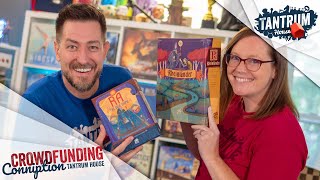
- Tantrum House crowdfunding conipion.
- Raw the Dice game and Rhinelander.
- Now we're going to give you a quick overview of both of these games.
- Just like in the original game, once RAW reaches the end of the track, the epoch ends and the board is scored.
- Disaster strikes, meaning you get to determine the punishment for all the other players.
- Rhinelander is an area influence game for two to five players.
- It was one of Canitia's most elegant designs, except for the fact that they didn't like it at certain player counts.
- The way the deck works in the game is that you'll play cards until you draw up to the joker and then you'll reshuffle the deck immediately.
- And so there's a lot of strategy just in holding on to cards so that other people can't get them.
- There were lots of little strategies like that that I didn't see coming when I sat down to play the game.
- That is the main way to score points in the game.
- Really interesting stuff.
- 25th Century does a really great job of putting together some really nice packaged games.
References (from this video)
- Simple rules that are approachable for families and new players
- High-quality components and chunky dice with clear visuals
- Meaningful strategic choices despite dice-driven randomness
- Good accessibility for kids and casual players
- Dice randomness can limit control and lead to variable outcomes
- Disasters can be punitive and disruptive to other players
- Some scoring areas require time to optimize and can slow pacing
- Civilization development through dice-driven actions and scoring
- Ancient Egypt with tracks for Pharaoh, Nile, Civilization, and monuments
- Instructional and demonstrative
- Raw
- Raw & Wright
Mechanics (from transcript analysis)
- Compound Scoring — Markers placed on monument columns score at endgame based on column occupancy and diversity.
- Dice Rolling — Roll all dice, then may reroll any dice that did not show a raw symbol on each roll, up to a maximum of three rolls.
- Dice rolling with up to three rolls per turn — Roll all dice, then may reroll any dice that did not show a raw symbol on each roll, up to a maximum of three rolls.
- Epic rounds — There are three epics per game; markers and scoring reset (partially) between epics with ongoing progression.
- Icon-Based Actions — Each die result activates a specific action on the board; ank acts as a wild to modify other dice actions.
- Monument grid and column scoring — Markers placed on monument columns score at endgame based on column occupancy and diversity.
- Track-based scoring across multiple tracks — Advance markers on Pharaoh, Nile, Civilization, and Monument tracks; end-of-epic scoring depends on marker positions.
- Wilds and disasters — Ank wilds provide flexibility; disasters can be chosen to affect opponents’ progress on various tracks.
Video topics + discussion points
Quotes (from this video)
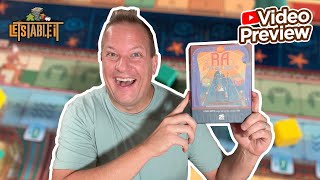
- it's a simple raw game with very simple rules.
- the components, you know, are real nice, real chunky dice.
- the board gives you enough room to place your markers, but not too big that, you know, it's more than what's needed, but not too small that things are too confusing and crowded.
- there's no bidding. there's no auctions, just rolling chunky dice up to three times and getting what you get.
- the Nile track can be used to cash in some big points, but sometimes it takes the entire game for this to happen.
- the civilization area can be interesting.
References (from this video)
- Accessible variant with fewer components than RAW
- Maintains energy and tension of RAW's dice-rolling
- Good introductory bridge for players who want RAW mechanics in a dice format
- Less depth than the original RAW for some players
- Prototype components will change before final release
- Symbol collection and dice-pressured pacing in a ritualistic contest
- Abstract dice-driven session where players vie for glyph-like symbols that appear on the board
- abstract
- Raw (original)
- Raw and Wright
Mechanics (from transcript analysis)
- board scoring and displacement — Careful timing to avoid being displaced by opponents, granting scoring opportunities
- dice-rolling with lock options — Roll multiple dice and choose results to lock for scoring and actions; differentiates from roll-and-write
- set-collection/symbol scoring — Collect symbols from dice faces and use them to trigger scoring on the board
Video topics + discussion points
Quotes (from this video)
- It's a modern classic.
- Rhinelander is phenomenal just in and of itself.
- I'm positive it finally will get the notoriety it deserves.
- Rinlander, it's it's super underrated.
- The Six of 8 is one of the best and delivers clever twists in the genre without losing its sense of traditional allure.