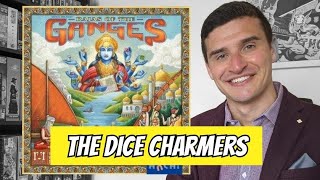
Rajas of the Ganges box art

Rajas of the Ganges

Game ID: GID0259514
Collection Status
Description

Through tactics and karma to wealth and fame...

In 16th century India, the powerful empire of the Great Moguls rises between the Indus and the Ganges rivers. Taking on the role of rajas and ranis – the country's influential nobles – players in Rajas of the Ganges race against each other in support of the empire by developing their estates into wealthy and magnificent provinces. Players must use their dice wisely and carefully plot where to place their workers, while never underestimating the benefits of good karma. Success will bring them great riches and fame in their quest to become legendary rulers.

Year Published
2017
Transcript Analysis
Browse transcript mentions, sentiments, pros/cons, mechanics, topics, quotes, and references.
Total mentions: 11
This page: 11
Sentiment: pos 9 · mix 0 · neu 2 · neg 0
Mentions per page
Top
Showing 1–11 of 11
Video 6FaVPw4FgLc Unknown Channel analysis at 2:05 sentiment: neutral
video_pk 40686 · mention_pk 123349
Unknown Channel - Rajas of the Ganges video thumbnail
Click to watch at 2:05 · YouTube ↗
Overall sentiment (raw)

neutral
Pros
  • Provides a strong economic engine within Euro framework
Cons
  • Not deeply detailed in the transcript; placeholder data used here
Thematic elements
  • Economic development and city planning
  • Historical India with trade and wealth growth
  • Abstract-economic
Comparison games
  • Wingspan
  • Barrage
  • Earth
Mechanics (from transcript analysis)
  • Area Control — Players balance resource generation and income to expand influence
  • Area control / resource optimization — Players balance resource generation and income to expand influence
Video topics + discussion points
No key topics recorded for this video.
Quotes (from this video)
  • there already exists an objective and widely accepted metric for measuring one quality of board games
  • the five elements complexity is one of those elements and probably the most conventional
  • it's an objective way that you can describe how you feel about a game that is agreeable to everyone it's because it doesn't say something about the game it says something about you
  • the driving mechanic of the game is blocking other players by preventing water flow getting to their dams
  • it is so thematically involved that I would rather go outside and actually take photographs of animals than than go through the mechanics of the calipers and the framing of the shot and all of that stuff
  • this is a game about Wildlife Photography
References (from this video)
No references stored for this video.
Video 4IVU0dEH0xk Totally Table top_50_list at 7:34 sentiment: positive
video_pk 37507 · mention_pk 112696
Totally Table - Rajas of the Ganges video thumbnail
Click to watch at 7:34 · YouTube ↗
Overall sentiment (raw)
positive
Pros
  • innovative dual-tracking system
  • varied strategies (money vs. points)
  • replayability via expansions
Cons
  • some may find it punishing to balance both tracks
Thematic elements
  • trade and city-building
Comparison games
none
Mechanics (from transcript analysis)
  • Compound Scoring — money track and victory points track move in opposite directions
  • dice placement — dice serve as resources to perform actions and build on your village
  • dual-track scoring — money track and victory points track move in opposite directions
  • worker/dice placement — dice serve as resources to perform actions and build on your village
Video topics + discussion points
No key topics recorded for this video.
Quotes (from this video)
  • these games still represent like the top five percent of all games I've ever played
  • the theme really comes alive
  • it's incredibly dynamic and fun highs and lows and a ton of agonizing decisions
  • it's a very unique abstract game where the theme actually comes through
  • it's cutthroat brutal game actually
References (from this video)
No references stored for this video.
Video zKj0i3eyzG8 The Board Game Garden top_10_list at 17:05 sentiment: positive
video_pk 28545 · mention_pk 83749
The Board Game Garden - Rajas of the Ganges video thumbnail
Click to watch at 17:05 · YouTube ↗
Overall sentiment (raw)
positive
Pros
  • dual-track endgame pressure creates dynamic player interaction
  • varied action economy with color/dice conversions
Cons
  • solo mode not native; community-driven workarounds exist
  • scaling can be awkward with player count
Thematic elements
  • money and fame across two tracks
  • ancient Indian trading empire
  • competitive economic engine
Comparison games
none
Mechanics (from transcript analysis)
  • dice and resource placement — draft dice and allocate to actions and tracks
  • river and track progression — advance along money and fame tracks, triggering end-game when crossed
  • tile drafting and selling — draft goods tiles and manage production to score
  • Track advancement — advance along money and fame tracks, triggering end-game when crossed
Video topics + discussion points
No key topics recorded for this video.
Quotes (from this video)
  • This has been the hardest one thus far to rank because there are so many games that are like amazing with this kind of mechanism of using dice in cool ways.
  • I love the mechanism video. There are so many good dice games.
  • Wayfarers of the South Tigers is my number one favorite game that uses dice in cool ways.
References (from this video)
No references stored for this video.
Video pK74Huu6Ovs Dice Tower game_review at 1:54 sentiment: neutral
video_pk 8174 · mention_pk 23995
Dice Tower - Rajas of the Ganges video thumbnail
Click to watch at 1:54 · YouTube ↗
Overall sentiment (raw)
neutral
Pros
  • Fine dice game
Cons
  • Couldn't recommend because he prefers the original Rajas of the Ganges
Thematic elements
Comparison games
  • Rajas of the Ganges
Mechanics (from transcript analysis)
Mechanics unknown.
Video topics + discussion points
No key topics recorded for this video.
Quotes (from this video)
  • man, I I I love this game
  • I don't know what happened here. This game has been universally scorned
  • It's a fantastic experiment from Freriedman Freeze, but I don't want to buy a game where a lot of the games aren't that great
  • robots versus ducks. You know, the never-ending war
  • This is fantastic a game, but I think it's fundamentally broken
  • I really want to like this game
  • One of the creepiest covers of all time. The animals are staring into your soul
  • definitely for me one of the best of the Uve Rosenberg tile laying games
  • I hate. I really do hate this game
  • It's a really funny little game
References (from this video)
No references stored for this video.
Video ruScGyu1_5w Before You Play playthrough at 0:00 sentiment: positive
video_pk 8155 · mention_pk 23932
Before You Play - Rajas of the Ganges video thumbnail
Click to watch at 0:00 · YouTube ↗
Overall sentiment (raw)
positive
Pros
  • Engaging dice/resource management with tight tile-based puzzle
  • Strong two-player interaction and competitive tension
  • Beautiful art and thematic backdrop
  • Accessible entry point with a clear standard mode
Cons
  • In the standard mode, some spots can feel overpowered relative to others
  • Can feel repetitive for some players in longer sessions
Thematic elements
  • economic competition between money and fame through tile placement and path-building
  • India, province-building along a river-based economy
  • Euro-style puzzle with historical trading and temple-building flavor
Comparison games
none
Mechanics (from transcript analysis)
  • advanced vs standard modes — standard mode is used in the video; advanced mode introduces different bonuses and yields
  • dice management / currency — dice values act as inputs for actions; dice are a primary resource and can be mitigated via karma
  • karma mitigation — pay karma to flip a die to its opposite side, improving dice results and mitigating bad rolls
  • markets and income optimization — spice, silk, and tea markets provide ongoing income; certain spots allow maximizing income from multiple markets
  • river / harbor bonuses — moving along the river and harbor spots grants bonuses, including dice tokens and karma
  • temple upgrades / over-building — upgrading temples and placing higher-valued tiles; over-building requires paying the difference in dice
  • tile placement — placing and connecting tiles to build a province on your board, aiming to maximize money and fame
  • tile placement / province building — placing and connecting tiles to build a province on your board, aiming to maximize money and fame
  • two scoring tracks — money track and fame track determine end-game conditions via crossing thresholds
Video topics + discussion points
No key topics recorded for this video.
Quotes (from this video)
  • the main currency are dice; you need a steady flow of dice in this game
  • there is no physical money in this game
  • two tracks—money and fame—drive end-game progression
  • karma is a really beautiful way of mitigating your dice
  • this style has a temple on it, so you can't take the bonus there again
References (from this video)
No references stored for this video.
Video G04vdhKLVn0 Broken Meatball game_review at 2:20 sentiment: positive
video_pk 7313 · mention_pk 21606
Broken Meatball - Rajas of the Ganges video thumbnail
Click to watch at 2:20 · YouTube ↗
Overall sentiment (raw)
positive
Pros
  • inserts offer cheap, basic trays; fast to assemble
  • keeps core components reasonably organized
Cons
  • not all components gain significant speed-ups
  • expansion compatibility can be a concern
Thematic elements
  • trade, engine-building, and balancing two tracks
  • early modern India
  • economic strategy with a dash of luck
Comparison games
  • Isle of Cats
Mechanics (from transcript analysis)
  • dice drafting — select dice that drive actions and scoring
  • Resource management — manage money and commodities for points
  • set collection — collect icons/tiles for scoring tracks
Video topics + discussion points
No key topics recorded for this video.
Quotes (from this video)
  • this is a 10 out of 10 insert
  • seal of endorsement
  • it's a beauty you have got here the bag that came with it in the scanner so they just sit on there nice and flush
  • this insert is a solid insert easy to put together
  • I cannot understand why you would want to have baggies or what the base insert was when you've got all the collection together
  • this is why I get behind folded space
References (from this video)
No references stored for this video.
Video r84ib93w8bw Chairman of the Board game_review at 0:02 sentiment: positive
video_pk 6520 · mention_pk 19331
Chairman of the Board - Rajas of the Ganges video thumbnail
Click to watch at 0:02 · YouTube ↗
Overall sentiment (raw)
positive
Pros
  • Beautiful production and board art
  • Engaging dice-based resource economy
  • Smooth flow and pacing with a fulfilling engine-building feel
  • Tight integration of river and tile-placement mechanics
Cons
  • Player interaction can be limited in some configurations
  • Iconography can be initially overwhelming
  • Desire for more variation in building scoring or asymmetry
Thematic elements
  • Economic diversification, trade, and city-building driven by dice-based resources
  • Early modern India along the Ganges river
  • Eurogame-style with layered tile-placing and engine-building
Comparison games
  • Marco Polo
Mechanics (from transcript analysis)
  • Dice-as-resource — Dice act as both workers and currency; values influence actions.
  • Karma/die-pip flipping — Karma tiles allow flipping die pips to different values, altering outcomes.
  • Limited Points — Game ends when money track equals or exceeds points track value.
  • Road/rim bonuses — Connecting roads to rim bonuses yields immediate rewards.
  • Tile drafting and tile placement on personal boards — Acquire and place tiles to upgrade buildings and claim points.
  • tile placement — Acquire and place tiles to upgrade buildings and claim points.
  • Two-track end condition — Game ends when money track equals or exceeds points track value.
  • worker placement — Place workers on board tracks and tiles to activate bonuses.
Video topics + discussion points
No key topics recorded for this video.
Quotes (from this video)
  • The score track is very interesting and it adds a different spin to a worker placement game.
  • The dice are your workers or your resources in the first place and it's not always like the higher valued ones are better.
  • The tile placement part of the game is not tacked on; it's strongly integrated into the engine.
  • It's a race, it's a fair and engaging pace, and you don't feel like you're wasting turns.
  • This is a lovely game, silky smooth, beautiful production, and highly replayable.
References (from this video)
No references stored for this video.
Video 4Z8_t2e4MEY Before You Play top_50_list at 38:31 sentiment: positive
video_pk 4734 · mention_pk 13814
Before You Play - Rajas of the Ganges video thumbnail
Click to watch at 38:31 · YouTube ↗
Overall sentiment (raw)
positive
Pros
  • deep, strategic with constant head-to-head play
  • appealing symmetry and endgame tension
  • layered scoring that invites meta-gaming
Cons
  • can be math-heavy; not ideal for casual players
  • the endgame can drag in some player counts
Thematic elements
  • two-city duel with river and fame vs. money
  • Indian river system; palace and river economy
  • grand strategy with elegant visuals
Comparison games
none
Mechanics (from transcript analysis)
  • End-of-round stalemate/tie-break rules — Ties trigger battles; leads to head-to-head contest for control of kingdoms.
  • Set collection / dice management — Roll dice to activate actions in different kingdoms; currency and scoring diverge by track.
  • Worker/die-driven engine — Assign dice to various actions to shape scoring across fame and money tracks.
Video topics + discussion points
No key topics recorded for this video.
Quotes (from this video)
  • we are embarking on our top 50 journey
  • the games for the most part are going to be shipped directly from the publishers
  • we have excluded games that we've only played one time
  • crossovers obviously because we share a collection a lot
  • please keep in mind we are not here to sway you one way or the other but we do have to disclose
References (from this video)
No references stored for this video.
Video tgduVI9rVsU Zhang Jian's Games playthrough at 0:00 sentiment: positive
video_pk 4477 · mention_pk 13155
Zhang Jian's Games - Rajas of the Ganges video thumbnail
Click to watch at 0:00 · YouTube ↗
Overall sentiment (raw)
positive
Pros
  • deep engine-building through markets and tile placement
  • multiple viable paths to victory via fame or money
  • well-integrated dice economy with karma manipulation
  • dynamic river bonuses creating race tension
Cons
  • advanced variant adds complexity that may overwhelm new players
  • can be tight on action economy in later rounds
  • board layout can be dense and visually busy
Thematic elements
  • trade, empire-building, wealth and fame
  • Indo-Ganges river trade network, India-inspired setting
  • instructional playthrough with in-game teaching and commentary
Comparison games
none
Mechanics (from transcript analysis)
  • adv_variant_tokens_navaratna — advanced variant that adds extra tokens and options beyond base game
  • dice-as-resources — dice rolled to generate resources used for actions and purchases
  • fame_and_money_tracks — two victory tracks with bonuses and end condition based on meeting points
  • karma_and_dice_manipulation — karma tokens flip dice or upgrade scoring, adding strategic depth
  • market_yields_and_connections — markets on tiles generate money when connected to estate roads
  • river_track_bonuses — river journey grants bonuses and unlocks new workers
  • tile_placement — tiles placed on your estate to unlock bonuses and connect roads
  • upgrades_and_buildings — upgrading tracks and spawning built windmills/buildings for fame
  • worker_placement — place dice on action spots to perform actions and advance on tracks
Video topics + discussion points
No key topics recorded for this video.
Quotes (from this video)
  • this is a race game
  • you never lose Fame throughout the game
  • navaratna version of the game which is essentially an advanced version
  • it's a race game and if we keep stalling out trying to be just a little bit more efficient
References (from this video)
No references stored for this video.
Video xe9xtMnBd_o Board Games Countdown top_100_list at 4:29 sentiment: positive
video_pk 4288 · mention_pk 12485
Board Games Countdown - Rajas of the Ganges video thumbnail
Click to watch at 4:29 · YouTube ↗
Overall sentiment (raw)
positive
Pros
  • familiar yet fresh; combines several well-loved mechanisms
  • engaging interplay between river navigation and card-driven actions
  • strong expansion ecosystem
Cons
  • can feel long for some groups
  • balance can vary with different player counts
Thematic elements
  • economic engine building with religious/political overtones
  • historical Indian trade and river influence
  • historical/fable-like with competitive arc
Comparison games
  • The Voyages of Marco Polo
  • Power Grid
Mechanics (from transcript analysis)
  • deck-building elements — Card play shapes future actions and long-term strategy; planning is essential.
  • dice placement — Dice outcomes influence actions and building decisions across the river journey.
  • worker placement — Placement of workers to access resources and actions tied to both river and city tracks.
Video topics + discussion points
No key topics recorded for this video.
Quotes (from this video)
  • QE is an absolutely fantastic game I've had so much fun with this since we picked it up about a year ago.
  • it's absolutely hilarious when somebody just goes absolutely mental with the bids.
  • Arcadia Quest is an absolutely compelling campaign Skirmish game that looks absolutely fantastic and still plays fantastic today.
  • Eric M Lang's Masterpiece in my opinion.
  • The Lost Ruins of Arnak doesn’t feel reinvented, but it feels exceptionally well balanced and clearly designed.
  • Dune Imperium is absolutely outstanding. this is a deck-building worker placement game.
References (from this video)
No references stored for this video.
Video 64H0IRfWfKs The Dice Tower top_20_list at 6:16 sentiment: positive
video_pk 2927 · mention_pk 8561
The Dice Tower - Rajas of the Ganges video thumbnail
Click to watch at 6:16 · YouTube ↗
Overall sentiment (raw)
positive
Pros
  • varied paths to score through money and fame
  • opposite-direction tracks create dynamic endgame pacing
Cons
  • weight can feel inconsistent between scoring tracks
  • some players may prefer more direct interaction
Thematic elements
  • trade, province development, river-based scoring
  • 16th century Mughal India
  • economic empire-building
Comparison games
none
Mechanics (from transcript analysis)
  • dice and worker placement — dice-based actions with color dyes, coins, and tiles
  • dual-scoring tracks (fame and money) — opposing progress creates tension and endgame trigger
  • tile placement and river scoring — build provinces, align rows/columns for bonuses
Video topics + discussion points
No key topics recorded for this video.
Quotes (from this video)
  • Balancing what actions you get on either side of the action space is kind of the whole fun of this.
  • This is one of those weekend night games where this low overhead is quick to play, but it still has an interesting hook that keeps me coming back.
  • There is no randomness in the game. Once the board is set up, all outcomes are on you and your decision.
References (from this video)
No references stored for this video.
Transcript Navigation
Top
Showing 1–11 of 11
View on BoardGameGeek