/pic4161943.jpg)
At the dawn of the SMC age, the people were losing faith in an increasingly amoral society. Mother was developed to emulate human thought and emotion, to simulate human desires and aspirations, to better understand the rapid decline in morality. The citizens of Sapporo became the guinea-pigs for this technological experiment. A series of city-wide neural implant programs, dubbed “the harvests”, enabled the gathering of data directly from a person’s cerebral cortex.
Mother’s neural net became more and more empowered by the collective thoughts of a city of souls. She soon became her own master, not just reading the minds of her citizens, but controlling them. Mother was in charge and the people were now her automatons.
Only a few, the few who from fear, mistrust or in protest, avoided the harvests and remained untouched by Mother’s influence. Like sewer rats they hide in an underground complex in Sapporo's Susukino district. While society at large became free from crime, free from poverty, free from emotion, without free-will or faith, from these few there came the criminals, the bootleggers, and the self-serving; the hungry, the frightened and the “Renegades”.
Renegade is an abstract-euro thematic deck-building game for 1 to 5 players. You are a new breed of Decker - a Renegade. You will hack into a network of five servers, operated by one of four Super-Massive-Computers (SMCs). Each of these four SMCs have their own AI and increasing complexity to defeat. You must survive a series of Countermeasure events before the network becomes overrun by Sparks and Guardians. Once you are jacked into an SMC’s servers, with a profile bringing its own special ability, you will move across its partitions and fight to take control of the network by using informational, destructive, deceptive and cognitive attacks.
Your Decker can seek upgrades (tools, software, apparel and information) by visiting the local bar, the "Hack Shack". Once a fashionable hang-out for attractive young lovers seeking a voyeur's view of the city, it has now gone underground. An intimidating bar full of hit men and debt collectors, fixers and dealers, trading contraband from all across Sapporo, it's not the sort of place to take a date. This is where you will trade for new command cards, enhancing your Command Deck to become a more skillful Renegade.

RENEGADE - Winning & Losing

How to Solo: Renegade (Alpha Moby)

Renegade FIRST LOOK

- Four new bots to work with
- Increases the total number of bots to 19
- Some bots might be complex
- Causing chaos with unpredictable bots
Mechanics (from transcript analysis)
- Bruiser Attacks — Torrent: Strikes can stun guards for three fewer AP. Stunning for a level one, for example, is five AP, so it would only be two AP to stun. Stuns don't advance threat.
- Chip abilities — Unique abilities cannot be used when the associated chip is already in play. The chips don't block movement, are active until flipped, and are regained by moving onto them. Chips left behind on the floor deactivate their ability.
- Fire Starter — As a free action, Packet may place his work die on an unoccupied space in his room or anywhere. While placed, it is treated as a detected bot. Once attacked, it returns to his mat.
- Patrol Die Control — Cathode: Before the patrol step of security activation, Cathode rolls her patrol die and may place it on any guard.
- Power Decrease Alternative — Quick Fix (Lithium): When another bot's power would be decreased for any reason, Lithium may decrease their power instead.
- Repair and Movement — Lithium: Starts every bot with repair, but after a bot is repaired, it may move one space for each power that was routed to it.
- Work Die and Imperatives — Packet: Packet's work die starts at zero and can only be adjusted when on his mat. When Packet completes an imperative, the die increases by one. During the route power step of Packet's turn, he may route one power to increase his work die by one as a free action. Packet may decrease the die by one to draw an imperative.
Video topics + discussion points
Quotes (from this video)
- chip Theory Fanboy
- there's only been one of their games that I didn't really care for and that was hopcus
- in terms of cloud Spire burn cycle and too many bones I think those are all fantastic nine or even 10 out of 10 overall
- if you don't like burn cycle you're not going to like these expansions
- these expansions aren't fixing anything for you it's just more content to a game
- if you love burn cycle you're going to love these expansions
- it's just more greatness
References (from this video)

Mechanics (from transcript analysis)
Video topics + discussion points
Quotes (from this video)
- get X launcher boxes out of my world
- Dark Moon is a dice version of the grander Battlestar Galactica game where things are going wrong on this spooky space station and what you need to do is go and do the go to the different places and everyone needs to give resources up in the form of dice to help solve those things however all your dice are behind a secret screen and they have different values on them and you can say oh I've only got negative values I can't help when you're lying you've got great dice you just want everything to fail because you're a traitor
- betrayal of house on the hill there's also a legacy Edition which I really would love to play I've not actually had a chance to even look at that much what's happening is you're all exploring this house getting stuff trying to get equipment all that type of thing doing things that happen tasks happen and things happen to your characters and all of a sudden there's a haunt one of the characters turns out to be a baddie and then you've all got to kind of get out of the house sometimes the haunt can go very strange sometimes the haunt's over in about six seconds and sometimes it's never over you know but for real wonderful Grand in Halloween night in the trailer house in the hill everyone sat round if you liked some candles get all spooky put some music on that's how I would like to spend my Halloween if I had the chance
- I love dead of winter I love it it's horror themed in my book it's a zombie game and I've it's uh there's also a hidden traitor type of aspect to the game possibly one time I ruined a friend's Night by playing that game because I was a secret Trader at the very end and we'd all won and then I turned my card over and turned out only I had won he didn't speak to me for the rest of the night he's never let me forget it actually that's why I love dead of winter
References (from this video)

- Adds high-energy mechanics and flashy new bots
- Expands replayability via diverse interactions
- Complex to learn and track interactions
- Steep learning curve for new players
- Rebellion, improvisation, and new special abilities through a suite of bots.
- An elevated, chaotic frontier within Burn Cycle where renegade Bots and new mechanics challenge the status quo.
- Array
Mechanics (from transcript analysis)
- Bot chips/adaptables — New bots and chip-based actions expand play styles.
- Stun/attack chains — Combo effects after particular interactions increase aggression.
Video topics + discussion points
Quotes (from this video)
- I am completely 100% biased for chip Theory
- these are some wonderful toys in the brass mags
- I'm excited to jump into volume two
- the base game comes with looks like we have nine Bots with base game
- I have a history with burn cycle
References (from this video)

- The deck-building progression and upgrade path
- Dynamic network setup and modular variability
- Asymmetric SMC AI creates tension and strategic choice
- High replayability due to variable networks and card offers
- Complex setup and learning curve
- Potentially long play sessions
- Some players may dislike opaque AI mechanics
- Cyberpunk resistance, hacking, surveillance, population control
- Futuristic dystopian cyberspace where the SMC harvests thoughts via neural implants; Renegades resist
Mechanics (from transcript analysis)
- advanced command and data management — Purchase of commands and management of contaminants, uplinks, and data nodes provide strategic depth.
- countermeasures and resource management — Copper, silver, and gold countermeasures drive tension and determine costs and effects.
- Deck Building — Players start with a 15-card deck and upgrade it by purchasing from the Hack Shack, discarding/overpaying to upgrade.
- deck-building — Players start with a 15-card deck and upgrade it by purchasing from the Hack Shack, discarding/overpaying to upgrade.
- hack shack/upgrades — Upgrades require removing contaminants and paying costs to gain powerful effects.
- network setup and token placement — The game constructs a network of servers with partitions, avatars, and data nodes, with Sparks and Guardians reinforcing the network.
- Resource Management — Copper, silver, and gold countermeasures drive tension and determine costs and effects.
Video topics + discussion points
Quotes (from this video)
- Renegade we've got one or four character profiles to take
- the government has employed these super massive computers to harvest the thoughts of the population using neural implants
- our objective in the game is to survive a series of copper silver and gold counter measures
References (from this video)
- Cooperative puzzle with escalating tension as the cycle progresses
- Thematic flavor of hacking and network defense is engaging
- Clear objective-driven structure with multiple routes to success
- High rule complexity and heavy bookkeeping can be intimidating
- Punishing failure could frustrate players if not resolved quickly
- Notes and terms (Sparks, Guardians, SMC) may require a reference sheet for new players
- cooperative hacking and countermeasures against a central AI
- Cyberpunk networked setting where hackers attempt to weaken a dominant AI-controlled network.
- procedural, objective-driven with escalating threats
Mechanics (from transcript analysis)
- Countermeasure deployment on an SMC network — Players place countermeasures to achieve objectives while fighting back against the SMC.
- Cycle-based countermeasures — The game progresses through copper, silver, and gold countermeasures, each representing a cycle with increasing difficulty.
- Guardians and firewalls mechanics — Guardians can be created from a flare flipped to its firewall side; firewalls lock down a partition.
- Loss conditions — Losing conditions include running out of Sparks/Guardians or reaching a state that the game deems a failure (e.g., too many countermeasures active).
- Spark explosions and cascading effects — Explosions transfer sparks and can cause additional guardians and changes to partitions.
- Sparks and Guardians resource management — Sparks are placed on partitions; three sparks trigger a spark explosion that can create a Guardian or trigger other effects.
Video topics + discussion points
Quotes (from this video)
- renegade is a cooperative game for one
- minimize spark explosions so you don't run out of Sparks and Guardians
- there are only 5 Guardians in the game and only 25 sparks
- through copper silver and gold succeed
- you need to keep on top of sparks
References (from this video)

- Solid solo-friendly design
- Widely recognized within the hobby
- Availability issues in some regions
- Witchcraft
- Resist
- Earthborne Rangers
Mechanics (from transcript analysis)
- Deck-building/engine-building — Card-based system with upgrades and engine-building elements.
Video topics + discussion points
Quotes (from this video)
- the solo Gaming Community is the best community in gaming
- this is the forever list for many players, a place where certain games become 'forever' for some people
- the art on Kilforth is the most beautiful art I've ever seen
- it's my number one
- theme hooks me, and if that can hook me, I keep digging into the mechanics
- the audience is changing and that's driving which games end up on the list
- we need fresh voices to keep the list dynamic
References (from this video)
- Diverse difficulty levels with multiple SMC opponents
- Flexible network setup creates varied strategic landscapes
- RS20 simulator available for skill-building without real opponents
- Mulligan system allows hand adjustment with strategic risk
- Asymmetric player profiles create varied gameplay experiences
- Complex setup with many individual components to organize
- Multiple rule conditions to remember (orientation matching, partition touching requirements)
- Risk management in mulligan system can penalize players trying to improve hands
- Hacking, Digital warfare
- Cybernetic network
- Strategic gameplay with AI opponents
Mechanics (from transcript analysis)
- AI opponent system — Players compete against an SMC (super massive computer) opponent with difficulty levels ranging from Alpha Mobi (easiest) to Mother (hardest)
- Asymmetric gameplay — Different player profiles (Heti Magnetic, Uro Nora) have unique decks and abilities
- Asymmetric Player Powers — Different player profiles (Heti Magnetic, Uro Nora) have unique decks and abilities
- Command Cards — Players use basic command cards specific to their profile and advanced command cards from the hack shack
- Contaminant placement — Each player places a colored contaminant (virus or replicant) matching their profile on their access point
- Defenses and counters — SMC sets up defenses using sparks and guardians, counter measure cards are organized by copper, silver, and gold colors
- Hand Management — Players draw 5-card starting hands and can mulligan with penalty of placing additional spark on access point
- Network construction — Five server tiles are placed following orientation matching and two-partition touching rules
- Network/Route Building — Five server tiles are placed following orientation matching and two-partition touching rules
- Profile selection — Each player chooses a character profile with unique avatar and associated card deck
- Tile Placement — Players place server tiles with specific orientation and partition connection rules to build a network
Video topics + discussion points
Quotes (from this video)
- in this video we're going to learn how to set up a game of renegade the first thing we do is choose an SMC an super massive computer to play against
- the orientation of this tile must be the same as the orientation of the existing tile
- two partitions each one of these is one of six partitions on a server tile must touch at least two partitions on another server already on the network
- some smc's prefer open networks lots of space around the servers others prefer more compact or closed networks you'll find geometry in the way the server tiles fall
- placing Spark on the same partition is a dangerous occupation you don't want to lose the game before you've even begun
References (from this video)
- Rich, layered decisions with multiple routes to victory
- Strong solo play with meaningful tension and planning
- Flavorful mechanics like neural hubs and replicants that reinforce theme
- Upgradeable deck system adds long-term strategy
- High complexity and learning curve
- Rule text is dense and can be intimidating on first play
- Dice-driven randomness can affect pacing and predictability
- Infection vs containment in a hacked digital ecosystem, using a mix of biology and hacking metaphors.
- A cyber-biological network battle on a server, with partitions, home servers, sparks, and guardians.
- Strategy-first, puzzle-like, deck-building with emergent in-game storytelling
- Renegade
Mechanics (from transcript analysis)
- Countermeasure phase — At the end of turns, a virus battle and delete-contaminant steps resolve the last actions and check for victory.
- Deck Building — Hack Shack shop with cards purchasing upgrades (infiltrate, memory steal, sidekick, etc.) to improve actions.
- Deck-building/shop mechanic — Hack Shack shop with cards purchasing upgrades (infiltrate, memory steal, sidekick, etc.) to improve actions.
- Infection and removal via dice-interactions — Attacking with virus tokens involves rolling a die with modifiers from cards; success removes sparks or infects new areas.
- Installations and Palace mechanics — Installations can be moved or consolidated, and Hacker's Palace triggers objective checks and major effects.
- Neural Hub and teleportation — Neural Hub installations allow avatar teleportation across the network for strategic positioning.
- Partition-based board and sparks — Players place virus and spark tokens on server partitions; sparks trigger infections and cause cascading effects.
- Replicants and contaminant uploads — Replicants generate additional infection actions; uploading contaminants creates new viruses or installs.
Video topics + discussion points
Quotes (from this video)
- I love having a neural hub everywhere I can because it's just useful.
- I love replicants.
- it's awesome
- that was a well played hand
- I think we're going to do this it's cool
References (from this video)
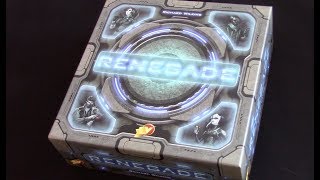
- High-quality production components and refined card/tile art in the production copy
- Significant improvements over press kit previews (larger cards, clearer text, more usable tokens)
- Color-blind friendly labeling using symbols and names in addition to color
- Expansion compatibility and additions
- Replayability and puzzle-like design encourages repeat play
- Potential complexity and a steeper learning curve for new players
- Some players may find the number of Renegade characters and cards initially daunting
- Retail price and availability of expansion content may affect decision to buy
- Cybersecurity, hacking, countermeasures, and network control within a modular mission framework.
- Near-future cyberpunk network defense on a corporate server grid with hackers and security constructs.
- Puzzle-driven, thematic but abstract; asymmetric roles with evolving threat and defense dynamics.
- Pandemic
Mechanics (from transcript analysis)
- Asymmetric Player Powers — Each Renegade character has unique abilities affecting actions and objectives; players can take on different roles.
- card-driven action system — Actions are selected via decks and countermeasures that drive players' planning and responses.
- Countermeasures and contaminants — Swapping or deploying countermeasures, root kits, and contaminants to influence the network.
- Deck upgrades and expansions — Expansion boosters introduce new cards and twists that change the balance and options.
- Heuristic/dice-based risk management — Heat transfer dice and infection dice model procedural risk across partitions.
- Modular Board — Variable map layout with server tiles and uplinks to create varied play spaces.
- Modular board / server tiles — Variable map layout with server tiles and uplinks to create varied play spaces.
- Risk Management — Heat transfer dice and infection dice model procedural risk across partitions.
Video topics + discussion points
Quotes (from this video)
- wow this is very exciting for me because I've not seen it yet
- these look good
- it's pretty neat huh
- Renegade is finally yeah I can't wait till you guys start playing it