/pic5160528.jpg)


/pic5160528.jpg)

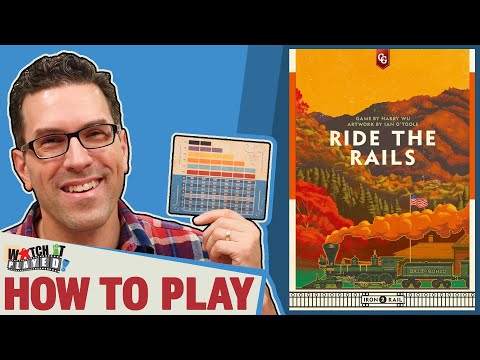













Ride the Rails Deep Dive
What the Community Thinks About Ride the Rails
Ride the Rails occupies an interesting space in the train game landscape. Reviewers appreciate its accessible design and elegant core, though perspectives vary on how it compares to industry stalwarts like Age of Steam. Watch It Played walks through its golden-age railway theme, Getting Games praises its quick teach, and Board Gaymes James positions it within Capstone Games' Iron Rail line. The game succeeds at being approachable while maintaining genuine strategic tension in its stock-building mechanics, with reviewers consistently highlighting the satisfying loop of investing in railways, building track, and profiting as passengers cross the network.
Core Mechanics That Define Ride the Rails
Stock Investment and Track Building Tension
The genius of Ride the Rails lives in a single design choice: stock and building capacity draw from the same limited pool each round. When you acquire a share in a railway company, you take an opportunity away from a player who might have wanted to build. Board Gaymes James captures this elegantly, describing the neat balance between grabbing trains to limit others' construction or passing on stock to focus on your own expansion. This tension threads through every round, forcing players to weigh portfolio growth against network control. Newcomers grasp it immediately because the metaphor is concrete: you must hold stock in a company to build its trains, so every decision reinforces both threads.
Passenger Movement as Distributed Scoring
Unlike traditional pick-up-and-deliver games where one player hauls goods, Ride the Rails lets any player move a passenger, but all shareholders in the railways used get paid. This decouples movement control from earning potential. The active player routes a passenger along connected trains, yet the payout goes to everyone holding stock in each color those passengers traverse. The system creates rich moments of implicit negotiation: moving a passenger helps you if you hold stock, but it might help an opponent more. Each player scores based on the links traveled and their holdings, keeping the math clean and the stakes transparent.
The Ride the Rails Experience
Snappy Pacing and Quick Play Length
Ride the Rails runs a brisk session across its player range, making it accessible for game nights without the time commitment of heavier economic simulations. The rulebook is short, yet the game never feels oversimplified, and Getting Games note that newcomers grasp it within a turn or two. Each round moves through stock acquisition, track building, and passenger movement with little downtime. The combination of simple rules and genuine decisions creates a gateway feel that invites casual players and serious strategists to the same table.
Building Network Routes Across a Living Map
The map serves as both canvas and constraint. Players gradually lay track outward from restricted starting cities determined by railway color. Early rounds force tight branching as limited colors fight for space, while later rounds open up as new colors enter the board. Watch It Played emphasizes the spatial puzzle: you are not just building routes but navigating where colors can begin and how they branch. Terrain features can reduce build capacity for a turn, adding texture. Watching rival railway networks weave across the board provides satisfying visual progression.
What Makes Ride the Rails Stand Out
Stock Mechanics Without the Heavy Economics
Stock games often carry the weight of full economic simulation. Ride the Rails distills the idea to its essentials: you can only build where you hold stock, and you earn when others use your lines. This eliminates complex share trading, dividends, and bankruptcy. The core tension is immediate: invest heavily in one company to dominate its network, or spread holdings to hedge. Because you take at least one stock every round, meaningful choices stack across the game, rewarding long-term positioning without punishing early minority stakes.
Variable Composition Creates Replay Diversity
The variable map and expanding railway options give players genuinely different strategic landscapes each game. Which railways become available in which rounds shifts which regions become contested. Some games see aggressive early build races, others reward patient stock accumulation. Getting Games note that additional map options introduce long-distance bonuses and geographic restrictions that vary the experience further. No two games play identically even at the same count, keeping both casual and repeat players engaged.
Potential Drawbacks
Living in Age of Steam's Shadow
The comparison to Age of Steam is inevitable and sometimes unfavorable. Board Gaymes James positions Ride the Rails as offering the pick-up-and-deliver part of Age of Steam while noting that Age of Steam remains king in their collection. Some players regard Ride the Rails as a lighter, more accessible cousin rather than an equal. Those who crave deeper economic weight or ruthless stock manipulation may find this streamlined approach a touch slight.
Outcome Dependency on Map and Turn Order
The railways available each round are predetermined, and turn order reshuffles based on cash position. Early variance combined with fixed starting positions for certain colors can leave a player well-positioned for one color but short on early stock opportunities. The balancing rule of letting the poorest player go first tries to even out luck, but the variable map can still reward forward-thinking players at the expense of those caught off guard. The effect is subtle rather than crushing, yet players seeking total control may occasionally feel undercut.
If You Enjoy Ride the Rails
If Ride the Rails resonates with you, consider Age of Steam for deeper stock manipulation and harsher economic choices. Irish Gauge, an earlier Iron Rail title, offers a smaller-box alternative with similar stock-holding tension and even tighter share play. Ticket to Ride shares the accessible learning curve and network-building satisfaction without the stock layer. For those wanting the economic complexity cranked to its maximum, 1830: Railways & Robber Barons represents the brutal 18xx tradition that Age of Steam only hints at. The common thread is shared-investment mechanics that reward forward planning while penalizing passive play.
What Reviewers Are Saying
"In the golden age of railway travel, distant cities are connected and passengers can travel from one side of the country to another, and that means there's money to be made for savvy railway investors like you."
— Watch It Played
"When those passengers move along, everyone is going to gain money, which again is victory points, when they have stock in those companies. So a key aspect to this game is figuring out which passenger you want to move and for how far, because in addition to that movement helping you, it's likely helping your opponents out as well."
— Getting Games
"There's this cool, neat little balance between whether or not you want to take trains away from the pool, which then makes it so that less people can build, or maybe you can build less, or if you want to build more but then you also have less stock."
— Board Gaymes James