/pic6460771.jpg)
A dexterity game where players take turning loading wooden "stuff" onto a swaying wooden ship. Bottles, sailors, rats and other cargo are placed on the body of the ship and three yardarms that protrude from the mast.
Each player has the same set of objects and a hand of cards numbered 1-10. Choose one card, then reveal it simultaneously with the other players. On your turn you place any piece you want onto the numbered space you chose. If the cargo is not balanced, the ship will sway to and fro, and one or more items may fall off the ship. If you tip pieces off the ship, you can save them by catching them, but whatever you don't catch is added to the pieces you need to get rid of. The first player to get rid of all his objects wins the game.
Similar to:
Cargo Barjo


- It's a good balance between strategy and dexterity.
- It's unique and not like other games.
- The competitive nature leads to laughter and impressed reactions.
- The physical act of making a dexterous move and pulling it off is satisfying.
- It has a surprising amount of strategy without being overly complex.
- The risk-reward element is engaging.
- It has excellent table presence.
- It can be impossible to win once you start losing significantly.
- It's fiddly and can be too wobbly, leading to big crashes.
- The pieces can feel slippery.
- The game is inherently limited in strategic choices as the game progresses.
- The difficulty of setup to ensure the ship is balanced.
- Catching falling pieces can be part of the game, adding to the chaos.
- It punishes less dexterous players severely.
- Pirates
- Manara
- Men at Work
- Jenga
- Flick 'em Up
- Flip Ships
- Krook
- Viking Seesaw
Mechanics (from transcript analysis)
- dexterity — The core mechanic involves physically balancing pieces on a ship structure, with an added element of catching falling pieces.
- Hand Management — Players play cards numbered 1-10, where the card number dictates the placement on the ship, adding a strategic layer to card play.
- Push Your Luck — Players might take risky moves, such as placing pieces precariously or choosing certain cards to manipulate the game's stability.
- Set Collection — Players aim to get rid of their pieces, and failing can lead to collecting more.
Video topics + discussion points
Quotes (from this video)
- I'm now convinced it's competitive
- this to me is almost kind of the sweet meal ground I have strategy cuz I know what all my cards are I know what all your guys' cards are and you play highest number to lowest which means from top to bottom
- there is just something about making a dexterous move and pulling it off in a competitive game where it's like everyone can't help but be impressed
- it's a surprising amount of strategy without being a strategic game
- why would you ever willingly play a one or a two and it's like oh well because the card number corresponds to where you have to place on the ship it's like oh right that's that makes it way easier
- from a production standard value and and just kind of conceptually from a game it's kind of cool
- this is absolutely one that people would see and be drawn to on what's going on
- once you start losing it's basically impossible to win
- it's just it's a little too wobbly everywhere and so you get the big crashes which again can be exciting but in terms of well someone's probably going to have a bad time
- everything is just like so slippery like can I get some coarse like can someone like unsand the ship quit sanding the deck
References (from this video)

- dramatic table presence; wooden ship and moving parts
- highly social, great for showcasing at a table
- thematic and kinetic excitement
- may rely on luck and dexterity rather than pure strategy
- lighter in depth for some groups
- humor, cargo hand-management
- Pirate cargo on a rocking ship
- lighthearted and chaotic
- Game of Thrones Monopoly
Mechanics (from transcript analysis)
- press-your-luck / dexterous balance — the ship rocks as you try to place cargo; pieces fall if you miss
- top-card reveal & cargo placement — players reveal the top card and place a cargo piece on the matching number on the ship
Video topics + discussion points
Quotes (from this video)
- this is my list and my subjective opinions are objectively correct
- you could fry an airgun
- it's mysterium with a traitor mechanic
- i've never wanted to eat a board game piece
- the rule book has just the nicest texture
- one of the nicest box covers in the hobby
- the whole experience is crafted with such love and care
- be warned playing this game will make you want to take a holiday you can't afford
References (from this video)

- plenty of tense moments and audacious moves
- thematic gimmick is strong but not universally loved
- can hinge on luck and card order
- tactical bluffing and timing
- balanced ship with cargo on a swinging pendulum
- tense, dynamic
- Jenga
Mechanics (from transcript analysis)
- Card-driven hand management — cards influence when and how you offload or balance pieces
- tension / balancing — players place cargo on a swinging ship; if cargo falls, it becomes a target to offload later
Video topics + discussion points
Quotes (from this video)
- This is stupid. It ain't falling over once.
- Growing up can't be that bad if I get to be like you.
- Timmy, you can come out now. It's like scalletwick.
- There's nothing super about being crushed by 10 tons of brick and mortar.
- Are you okay? Did you eat mommy's mango body butter as well?
References (from this video)
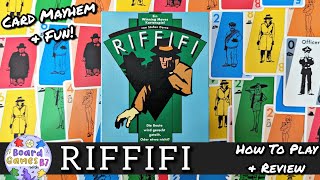
- Engaging and unique card-driven heist experience with dynamic play across sessions
- Appealing theme and cinematic noir vibe reinforced by art direction and components
- Depth in strategy without sacrificing accessibility for new players
- Equality-focused variant provides balanced play and additional strategic layers
- Solid component quality for its era; cards shuffle well and the physical parts are functional
- Iconography could be clearer, particularly with color/value cues for left-handed players
- Sleeved cards can create tight fit in the storage insert and box
- Overall production feels classic; not a flashy modern presentation but faithful to the era
- crime, betrayal, risk and negotiation in pursuit of money
- A heist scenario set among a crew of criminals vying for loot
- cinematic, noir-flavored card-driven intrigue with social dynamics
Mechanics (from transcript analysis)
- Blocking and targeting — Players may target others to deny or seize loot, especially when certain color dominance or chip counts are present.
- Card play with color-based constraints — Players play face-up cards in color order; only one card of each color may be face up at a time; higher-value cards flip lower ones.
- Equal-opportunities variant — A variant where all players use the same set of cards to level the playing field and emphasize strategic memory and timing.
- Hand Management — Players must manage their hand to optimize when to reveal cards to maximize loot on their next turn.
- Officer variant — Optional variant (officer card) alters play by flipping face-up cards and shifting control in four- to five-player games.
- Round-based reshuffling and passing — At round end, hands are passed to the left and new rounds begin with redealt cards; edge cases handled with setup variants.
- Score tracking and color-cross-off rule — Chips are tallied per color; crossing off a color’s chips restricts further scoring from that color but can still block others.
- Set Collection — Loot chips in five colors serve as points; players collect chips when their color card is resolved, creating color-specific scoring tension.
- Set-collection via loot chips — Loot chips in five colors serve as points; players collect chips when their color card is resolved, creating color-specific scoring tension.
- Turn timing and hand management — Players must manage their hand to optimize when to reveal cards to maximize loot on their next turn.
Video topics + discussion points
Quotes (from this video)
- Rifi Rifi is a truly engaging and dynamic card game that offers a unique experience every time you play the game.
- Play is incredible, fun and straightforward yet there's surprising depth in the strategy involved.
- The equal opportunities variant ensures that all players have an equal chance by using the same set of cards.
- I highly recommend it to fans of card games seeking a fresh and entertaining experience.