This description is spoiler free, containing nothing outside the initial rulebook for the game. Details on why this is important in the description.
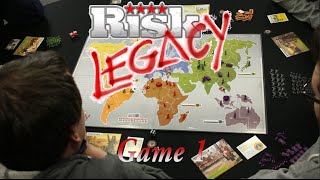
Risk Legacy represents what is if not a new, at least a rare concept to boardgaming: campaigning. At its core, the game, particularly at first, plays much like regular Risk with a few changes. Players control countries or regions on a map of the world, and through simple combat (with players rolling dice to determine who loses units in each battle) they try to eliminate all opponents from the game board or control a certain number of "red stars", otherwise known as victory points (VPs).
What's different is that Risk Legacy' changes over time based on the outcome of each game and the various choices made by players. In each game, players choose one of five factions; each faction has uniquely shaped pieces, and more importantly, different rules. At the start of the first game, each of these factions gains the ability to break one minor rule, such as the ability to move troops at any time during your turn, as opposed to only at the end.
What makes this game unique is that when powers are chosen, players must choose one of their faction's two powers, affix that power's sticker to their faction card, then destroy the card that has the other rule on it – and by destroy, the rules mean what they say: "If a card is DESTROYED, it is removed from the game permanently. Rip it up. Throw it in the trash." This key concept permeates through the game. Some things you do in a game will affect it temporarily, while others will affect it permanently. These changes may include boosting the resources of a country (for recruiting troops in lieu of the older "match three symbols" style of recruiting), adding bonuses or penalties to defending die rolls to countries, or adding permanent continent troop bonuses that may affect all players.
The rule book itself is also designed to change as the game continues, with blocks of blank space on the pages to allow for rules additions or changes. Entire sections of rules will not take effect until later in the game. The game box contains different sealed packages and compartments, each with a written condition for opening. The rule book indicates that these contain the rule additions, additional faction powers, and other things that should not be discussed here for spoiler protection.
The winner of each of the first 15 games receives a "major bonus," such as founding a major city (which only he will be allowed to start on in future games), deleting a permanent modifier from the board, destroying a country card (preventing it from providing any resources towards purchasing troops in future games), changing a continent troop bonus, or naming a continent, which gives that player a troop bonus in future games. Players who did not win but were not eliminated are allowed to make minor changes to the world, such as founding a minor city or adding resources to a country.
It should be noted that although cards are ripped up over the course of the game, there are so many cards added via the sealed packages, that the game does not suffer. Nor is this a "disposable" game, merely a customized one. The game can continue to change beyond the 15 game campaign, and even when it finally does stop changing, you still have a copy of Risk that is completely unique.
Initial games take approximately 30-90 minutes to play, which includes a brief rules explanation and setup.
Risk Legacy - Gameplay & Discussion
- Array
- World Conquest
Mechanics (from transcript analysis)
Video topics + discussion points
Quotes (from this video)
- This is a record crowdfunding week with a ton of I mean, this is the this is the like the most money I've seen in crowdfunding in a single week in a long time.
References (from this video)
- Pioneering legacy format with lasting impact
- Exciting progression through campaigns
- Requires a long time commitment
- Can be intimidating for new players
- Empire-building with lasting changes
- Global conquest with a Risk-style map that permanently evolves
- Season-like campaign spanning multiple sessions
- Risk
- Gloomhaven
- Betrayal Legacy
Mechanics (from transcript analysis)
- legacy campaign — Game evolves across sessions with permanent changes to the board and rules
- Legacy game — Game evolves across sessions with permanent changes to the board and rules
- permanent modifications — Stickers, new rules, and altered decks endure between plays
Video topics + discussion points
Quotes (from this video)
- rip up cards
- story everywhere
- it's a super corrupt auction style of voting
- two things – one legacy games are very ritualistic
- heads into the unknown together
References (from this video)
Mechanics (from transcript analysis)
Video topics + discussion points
Quotes (from this video)
- I'm vocalizing what's going on in my head.
- Gen Con is not a convention that I ever foresee myself going back to.
- This is going to be a very long stream if I'm going to take this much time going through each of these.
- We are going to do a BG auction cuz I imagine everybody that watches this is on BGG.
- The designer is going to send it to you. He's going to pay the shipping and y'all are going to pay us and we get to keep the money.
References (from this video)
- reinvigorates a classic engine with a durable progression hook
- strong core mechanics (area control) backed by evolving story/board
- requires ongoing commitment across campaigns; may not suit casual players
- legacy progression; permanent changes to the game world
- territorial conquest with evolving rules over time
- long-term strategic campaign with evolving story elements
- Pandemic
- Ticket to Ride
- Future legacy titles
Mechanics (from transcript analysis)
- legacy system; permanent alterations — player actions permanently alter the board and available cards for future sessions
Video topics + discussion points
Quotes (from this video)
- the game was twisted
- Cards Against Humanity is not to my taste, but it's the reason that every popular party game now has to have an after Dark Edition
- it's a safe space to indulge some of the darker aspects of human interaction
- one of the best hooks in the history of the industry
- the Ouija board appears to have emerged from American spiritualist camps
- Werewolf also known as Mafia
References (from this video)
- Modern take on classic Risk
- Streamlined gameplay
- Evolving board
- Shorter game length
- Requires consistent player group
- Difficult to complete campaign
- Territorial warfare
- Global conquest
- Legacy campaign
Mechanics (from transcript analysis)
- Area Control — Conquering territories and collecting stars
- Combat: Dice — Rolling dice to resolve battles
- Dice combat — Rolling dice to resolve battles
Video topics + discussion points
Quotes (from this video)
- These games, I feel so close to them that I would invite them to my wedding.
- Deep down, you know, one or two of them you'll never see again.
References (from this video)
- introduces narrative and progression to a classic
- engaging for long-term group campaigns
- requires commitment to continue the campaign
- legacy risk with evolving campaign
Mechanics (from transcript analysis)
- legacy / evolving campaign — game evolves with each session, evolving rules and stories
Video topics + discussion points
Quotes (from this video)
- the production is incredible
- this is a long one there's a few games of my collection
- I'm keeping this one forever
- it's a great family game
- it's basically a social deduction game and it's really clever
References (from this video)
- majestic legacy arc and world evolution
- drives long-term engagement
- can be niche and time-consuming
- early plays may feel unstable due to ongoing changes
- legacy-style progression in a risk-like setting
- risk-based territorial conquest with evolving rules
- campaign-driven, with changes to map and factions over time
- Pandemic Legacy
- Betrayal Legacy
Mechanics (from transcript analysis)
- legacy progression — permanent changes to the board, rules, and components across plays
Video topics + discussion points
Quotes (from this video)
- design a game that lasts and that reveals new secrets after hundreds of plays
- start with the vanilla, make it fun, then expand
- simplicity is sophistication
- design for both the first game and the hundredth game
- create a community around the game to keep it alive
References (from this video)
- groundbreaking introduction of legacy play
- inspired many successors in the genre
- requires a consistent group across sessions
- legacy campaign permanently alters the game state
- world/domination; evolving risk board
- persistent, evolving across plays
- Legacy games genre
Mechanics (from transcript analysis)
- campaign-driven changes — progressive upgrades and technologies across 12 games
- legacy components — ripping up cards, placing stickers, and modifying the board over time
Video topics + discussion points
Quotes (from this video)
- This game is skull and roses.
- This is a game called Forbidden Stars.
- The first action that you put down is going to be the last action that you activate.
- It's a fantastic tease and you get this tragic sinking feeling when you know that you [__] the card that you want to play at the end of your turn.
- This is another hidden trader game called Shadows Over Camelot.
- you can change allegiance when it suits.
- you could make the people on your side think that you are aligned with them and then just basically jump ship and tell them to [__] off.
- If you like being dripfed morphine-like rewards, then Space Base definitely going to be a game for you.
- This broke new ground with the advent of the crossroads cards that have largely been absent since Gen 7 itself.
- Risk Legacy is basically Risk, but you will be changing the way the game plays.
References (from this video)
- Innovative legacy system with lasting impact
- Memorable campaign moments
- Faster, focused campaigns compared to base Risk
- Requires long-term commitment
- Spoilers and potential group drift
- Can be expensive and heavy to maintain across sessions
- World domination with evolving, permanent changes across campaigns
- Global map spanning continents during a modern-era style confrontation
- Campaign-driven with evolving rules, stickers, and permanent deck alterations
- Risk
Mechanics (from transcript analysis)
- Area Control — Players vie for control of territories and bases across a world map.
- area_control — Players vie for control of territories and bases across a world map.
- faction_abilities — Factions with unique abilities that shape strategic options.
- Legacy game — Permanent changes to rules, map, and components from game to game.
- legacy_campaign — Permanent changes to rules, map, and components from game to game.
- permanent_components — Stickers, new rules, and altered decks permanently modify gameplay.
Video topics + discussion points
Quotes (from this video)
- this is the game that actually introduced The Legacy concept
- it's layered on top of what's already a better version of risk
- the primary action selection mechanism on your turns you have this pyramid that has different actions
- two-player only game where you and your opponent are actually playing out the historical event of the Cold War
- it's highly asymmetrical and by that I mean the different factions literally play completely differently
References (from this video)
- Innovative legacy mechanics that permanently alter the map and setup, creating unique experiences per game.
- Core Risk feel with added strategic depth from cards, stickers, and evolving rules.
- High replayability and escalating tension as new packets unlock rules and components.
- Dynamic player interaction and diplomacy enhanced by evolving board state.
- Steep learning curve due to multiple interacting systems and permanents.
- Irreversible changes may deter players who dislike spoilers or unpredictable outcomes.
- First game length can be longer than standard Risk because of additional setup and rules.
- Balance can be delicate early on with new packets and evolving powers.
- Legacy campaign with permanent changes, personal progression, and evolving strategy over multiple sessions.
- Global map with evolving territories; stickers and envelopes permanently alter the board and future plays.
- Campaign-driven, evolving game state where past games affect future ones.
- Risk
- Pandemic Legacy
Mechanics (from transcript analysis)
- Area Control — Players claim territories and continents to gain reinforcement capabilities and points toward victory.
- combat resolution — Dice-based battles with attacker up to three dice and defender up to two; defenses win ties; casualties remove units; no space can be left unoccupied after an attack.
- Combat: Dice — Dice-based battles with attacker up to three dice and defender up to two; defenses win ties; casualties remove units; no space can be left unoccupied after an attack.
- Deployed City/Population Growth — Founding settlements, population advantages, and spawn points influence reinforcements and competitive dynamics.
- Diplomacy and Social Dynamics — Player interactions, negotiation, and diplomacy influence strategic decisions and alliance formation during play.
- hidden victory points — Victory is tracked by stars; four stars win the game, with stars earned from territories, card trades, and starting setup.
- Legacy game — Permanent map changes (stickers, markers) and reshaped components shape each subsequent game; envelopes and packets unlock new rules and components.
- Legacy/Perma-Changes — Permanent map changes (stickers, markers) and reshaped components shape each subsequent game; envelopes and packets unlock new rules and components.
- negotiation — Player interactions, negotiation, and diplomacy influence strategic decisions and alliance formation during play.
- Resource Cards and Money — Resource cards provide money used to recruit troops or trade in for points; some cards offer special values or effects.
- Resource management — Resource cards provide money used to recruit troops or trade in for points; some cards offer special values or effects.
- Scar Cards — Scar cards introduce permanent board changes or bonuses; they are earned early, placed permanently, and can alter balance.
- Stars and Victory Conditions — Victory is tracked by stars; four stars win the game, with stars earned from territories, card trades, and starting setup.
Video topics + discussion points
Quotes (from this video)
- Risk Legacy is a pretty unique game with a legacy style and permanent map changes.
- The core of the game is around those first 15 games.
- Permanent changes to the map, writing names on continents with permanent markers, and tearing up cards.
- You begin the game with 1 star toward victory, and the map changes with every campaign.
- Every copy of Risk Legacy will play differently because of the stickers and envelopes.
References (from this video)
- Innovative approach to replayability with lasting impact.
- Long play sessions; commitment required for full experience.
- Legacy-driven progression where decisions persist across sessions.
- World-conquest in a Risk-like framework with evolving rules and permanent changes.
- Campaign-driven with evolving storylines and evolving boards.
Mechanics (from transcript analysis)
- Area Control — Players vie for global domination across a changing map.
- Legacy game — Permanent changes to the game components and rules based on outcomes.
- legacy mechanics — Permanent changes to the game components and rules based on outcomes.
Video topics + discussion points
Quotes (from this video)
- never socializing outside the hobby
- this isn't about him anymore this is about one day waking up to a world where board gamers are accepted by society
- remember just don't be yourself tell him how fun it is to play as a 17th century farmer in agricola
- let's play star wars rebellion with him
- for Risk Legacy
- remember that guy we invited round to play Game of Thrones after five hours he started crying
- i play a lot of warhammer