




























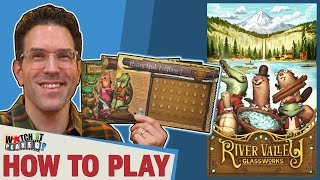




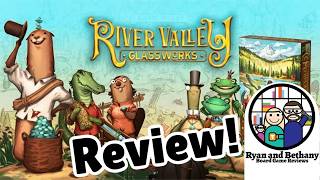



Welcome to River Valley! The beautiful pieces of glass that can be found along the river here have attracted the most entrepreneurial of woodland creatures to set up shop.
In River Valley Glassworks, you play as one of these pioneers, drafting glass from the market of river tiles. To do so, you have to play a piece from your inventory into the river. Each river tile can take only a specific shape, and you must play into a space adjacent to where you want to draft from. After you pick up your glass, the river shifts forward, revealing new pieces and new opportunities.
Store the glass you pick up strategically in your shop. Depending on how the glass pieces are placed, your score will change drastically. Fill in rows and columns to gain bonus points, but don't draft too many of one type to avoid negative points!
-description from publisher
- Unique double-use mechanic where shape governs drafting and color influences placement
- Intuitive drafting and collection loop that clicks quickly
- Balanced rarity system encouraging delayed acquisition of rares
- Dynamic river population adds strategic variety
- Aesthetics and components are appealing, with a nice deluxe mat in the edition
- Art style featuring anthropomorphic animals in hats may not appeal to all players
- Scoring and overflow tracking can feel fiddly for some (especially with multiple components)
- Collecting glass bits with aesthetic value
- A river valley where players pan for glass-like stones to create a colorful collection
- abstract, tile-drafting with artifact collection
Mechanics (from transcript analysis)
- collection grid and scoring — Fill a grid with stones; score the top two rows and the best two columns; overflow points are negative if not accommodated.
- Compound Scoring — Fill a grid with stones; score the top two rows and the best two columns; overflow points are negative if not accommodated.
- double-use drafting — The shape used for drafting and the color used for collection create a dual-use interaction of the same stones.
- draw action — On a turn, restock your pan by drawing up to four items from the river or lake and place them in your pan (pan holds five).
- end condition and river population — Game ends when a player reaches 17 stones in their collection; the river population mechanic drives ongoing choice and pacing.
- expansion content — Riverglen expansion adds modular content that can alter setup, scoring, and interactions.
- place and gather — Take a stone from your pan, place its shape on a River Tile and collect stones from that tile, or spend two matching tiles to place anywhere in the river and then collect.
- rarity and board balance — Stones have common and rare values; rares are better acquired early while commons are easier to fill later.
- river population dynamics — River tiles are populated before removal; items are added from the bag and slide down as you take stones.
Video topics + discussion points
Quotes (from this video)
- the game is fun 100% on its own but you can totally add this as well
- I thought the way the river populated itself was really really cool
- oh my goodness I love this game it was so much fun
- it doesn't take you long to get it... you 100% understand what you're trying to do immediately
- I like that that balance happens where you're trying to avoid them but also get them it makes for a really great balance in game mechanism
References (from this video)
- Dynamic drafting that reacts to all players' actions
- Simple, accessible scoring system that still rewards planning
- Tactile components and satisfying art in prototype phase
- Short playtime (approximately 20-30 minutes) makes it ideal for quick sessions
- High player interaction and meaningful decisions each turn
- Prototype status; final production quality and components may change
- Shifts in the river can create temporary information asymmetry near game end
- For some players, the drafting choices may feel heavy for a lighter title
- Glassmaking as a resource drafting puzzle, balancing aesthetics and practicality, with tangible tactile components.
- River Valley region with a glass workshop along a flowing river, set around a cozy cabin vibe. The river's flow acts as a mechanic that reshapes available options each round.
- Abstract, tactile strategy with a nature-inspired atmosphere; light storytelling rather than a heavy narrative.
- Azul
- Sastro
- Castrol
Mechanics (from transcript analysis)
- Compound Scoring — Score points for complete rows and for your two largest columns; gaps reduce scores and tallied at the end.
- drafting — Players draft shapes by placing a piece onto the corresponding River tile, pulling associated glass pieces into their workshop.
- Overflow Management — Choosing to take a potentially overflow piece can grant immediate points but risk points later if the overflow area is penalized.
- Pattern Building — Tiles come in different geometric shapes; the choice of shape influences drafting options and future scoring.
- pattern/shape matching — Tiles come in different geometric shapes; the choice of shape influences drafting options and future scoring.
- River flow dynamic — After each take, the river shifts and refills, ensuring a continuous flow of available pieces and increasing strategic tension.
- Set collection / scoring by rows and columns — Score points for complete rows and for your two largest columns; gaps reduce scores and tallied at the end.
- tile placement — Placement of shapes onto river tiles determines which adjacent pieces are captured and how the river shifts.
Video topics + discussion points
Quotes (from this video)
- The river flow mechanic is a fantastic centerpiece that drives both drafting and scoring.
- This is a great candidate for a light, brainy 20-30 minute game.
- The prototype version already feels well-balanced and tactile.
- If you like games with evolving decisions and high interaction, River Valley Glassworks could be a hit.
- The dynamic drafting adds a meaningful layer of interaction as the river shifts with every move.
References (from this video)
- Clear setup and rules presentation
- Engaging spatial puzzle with pattern-building decisions
- End-scoring emphasizing rows and tall columns
- Overflow penalty adds tension and risk management
- Prototype notes indicate upcoming inventory track for easier tracking
- Prototype state may differ from final release; some components or rules may change
- Complex scoring concepts (rows/columns/overflow) may be challenging for new players
- glass production and resource optimization
- River Valley region focused on glassmaking
- abstract puzzle/tile-placement with pattern-building
Mechanics (from transcript analysis)
- bag building — draw glass pieces from the lake into your hand; pieces from the river go to your Glass Works board
- bag-draw and lake draw — draw glass pieces from the lake into your hand; pieces from the river go to your Glass Works board
- Compound Scoring — score based on filled rows and tallest columns; overflow area incurs negative points
- end-game trigger and final round — game ends when a player reaches 17 glass tokens; final turn then scoring
- river tile movement — when a river tile is emptied, slide tiles to fill the gap and refill from the bag
- scoring by rows and columns — score based on filled rows and tallest columns; overflow area incurs negative points
- set collection / pattern building — place collected glass onto your Glass Works board forming colored columns; order matters
- tile placement — place glass pieces on river tiles matching their shapes; manage river tiles and lake draws
Video topics + discussion points
Quotes (from this video)
- your goals to score the most points by collecting a variety of River Glass onto your Glass Works board
- balance filling rows and columns on the right side of the track to score the most points
- the two tallest columns score
- if there are ties the leftmost tied column will score
- overflow area will score you negative points at the end of the game
- one player has 17 glass tokens on their board
References (from this video)
- Array
- Array
- glass production, shape and color collection, river-based tile drafting, and compact modular expansions
- Array
- A River Valley environment focused on glass production and collection, with a lake and river tiles forming the core board layout
- Array
- Array
- Array
- positive
Mechanics (from transcript analysis)
Video topics + discussion points
Quotes (from this video)
- not enough thumbs ups for River Valley Glass Works can't wait to play again
- it's beautiful it's a nice impressive compact box
- production quality is here
- the solo game here is dynamite
References (from this video)
- Engaging drafting and pattern-building loop that rewards forward planning
- Vibrant art and components with high visual appeal
- Clear path to varied strategies via color placement and column height
- Solid solo mode and a roadmap for deluxe/founders variants
- Rules and scoring nuance can be complex for new players
- Color management and tracking across rows/columns may feel fiddly at first
- Endgame calculation requires careful bookkeeping toward the end of the game
- glass crafting, color matching, and river dynamics
- River valley community engaged in glass making and river-based production
- preview/primer style presentation
- Motor City
- Three Sisters
Mechanics (from transcript analysis)
- endgame trigger and final scoring — the game ends when a player collects a threshold (17 pieces); final scoring combines rows, tall columns, and overflow penalties
- first player token and player order — the bear token designates the first player and may influence pacing and drafting choices
- inventory management and overflow mechanic — players manage a satchel limit and avoid overflow penalties that subtract points
- Pattern Building — players fill rows and columns with colored glass pieces to form valid patterns and maximize points
- pattern-building — players fill rows and columns with colored glass pieces to form valid patterns and maximize points
- river flow / spawning — the river flows each turn and rocks determine how many pieces respawn on each section
- set collection — colors have rarity and placement affects scoring; color columns score differently depending on position
- set collection / color management — colors have rarity and placement affects scoring; color columns score differently depending on position
- tile-drafting from a bag — players draft glass pieces from a central pool and place them onto the river or their boards
Video topics + discussion points
Quotes (from this video)
- River Valley Glass Works
- the first game that allplay is bringing to crowd funding by itself
- I will be playing the solo mode of this I believe it's going to be on March 24th
References (from this video)
- Engaging engine-building feel with approachable rules
- Beautiful table presence and thematic flavor
- Some players may want deeper strategy or longer play time
- Industrial craft and strategic resource management
- A fantastical workshop in a river valley where artisans craft glassworks
- Story-driven with an engine-building feel
Mechanics (from transcript analysis)
- drafting — Players select from a common pool of options to optimize their build path
- engine building — Players develop a self-improving tableau of actions and abilities over the course of the game
- engine-building — Players develop a self-improving tableau of actions and abilities over the course of the game
- resource allocation — Players allocate limited resources to maximize efficiency and scoring opportunities
Video topics + discussion points
Quotes (from this video)
- Board gamers are just so kind.
- I love this hobby I love this community so so much.
- It was the best birthday weekend.
- I love this hobby I love this community.
- You are somebody's reason to smile.
- Francis joined for the con and it seemed like he really enjoyed it.
- There were so many different restaurants we missed at Reading Terminal Market.
- I just wanted to quickly get this out Ro films so I can get it up for you guys today.
References (from this video)
- beautiful components
- accessible yet thoughtful
- fits fans of Azul and Cascadia
- some players may find it too polite for euro depth
- drafting and building with elegant glass components
- industrial glass fabrication in a river valley with glass pieces
- high-art aesthetic, tactile
- Azul
Mechanics (from transcript analysis)
- drafting / tableau building — Draft glass components to form a tableau with cascading overflow penalties.
- overflows / negative space — Overflows introduce risk/reward tension mirroring other 'elegant' euros.
Video topics + discussion points
Quotes (from this video)
- If you like Carcassonne and you want to go cooperative nicer, you might try Beacon Patrol.
- Kinfire Council gave me a real Lords of Water Deep vibe when I play.
- Katon with nukes. Yes, katon with nukes. That's all you need to know.
- This is like Ticket to Ride but with polyomino drafting—it’s Sunrise Lane for Tickets to Ride.
- Coffee Rush snuck into that category—tower defense vibes without real-time play.
References (from this video)
- solo mode feels varied with different characters
- clear solo design
- components can feel bulky
- Crafting glass shapes to create pattern boards
- Glassmaking and valley workshop culture
- Character-driven with solo-specific opponent boards
Mechanics (from transcript analysis)
- Compound Scoring — Score based on completed lines and patterns
- pattern drafting / placement — Place glass pieces into a grid-based pattern area
- scoring by rows/columns — Score based on completed lines and patterns
- tile drafting from multiple character boards — Each character board in solo mode acts as a different opponent
Video topics + discussion points
Quotes (from this video)
- these are going to be games that I found I was getting to the table quite often in 2024
- harmonies is fantastic I'm sure you've heard a ton about it throughout 2024
- the rules are extremely simple you're just placing in down tiles connecting the different colors
- a gentle rain is my favorite game of 2024
References (from this video)
- Stunning visuals
- Very easy to teach
- family-friendly production and craft
- River valley workshop and glassmaking
- edutainment-lite, accessible teaching
Mechanics (from transcript analysis)
- tile placement — Simple, approachable mechanics suitable for non-gamers
- Tile placement / set-collection — Simple, approachable mechanics suitable for non-gamers
Video topics + discussion points
Quotes (from this video)
- The perfect board game collection doesn't exist until now.
- This game's got a ton of replayability as well because every single time you play, you're going to set up a different module and it's going to change how you play.
- And remember, corporai never dies.
- Code Names. You can play this game wherever, whenever, with whoever.
- Spirit Island is the greatest cooperative game ever made.
References (from this video)
- Beautiful production and art direction
- Solitary play is enjoyable and approachable
- Deluxe components vs retail can be a debated topic
- colorful glass stones and pattern building
- river valley glass artisan workshop
- calm, methodical, pretty aesthetic
Mechanics (from transcript analysis)
- set collection and pattern building — collect colored glass stones to form scoring patterns
- tile/board drafting — select stones to place on your board and maximize scoring
Video topics + discussion points
Quotes (from this video)
- Spicy. So you might be like, Here, Sam. And maybe I'm giving him back some of his bloodline that he gave me back.
- Root's just always going to be here. I play it every day.
- Dice Town. Since we first played Dice Town and every time afterwards, I have had so much fun.
- I love Dune Imperium. I think it's a perfect of a game as you can get.
- Obsession is such a fantastic game and I will pump this game up as much as I can.
- Mountain Goats is incredible. It's a great, quick dice game.
- Red Dust Rebellion is no joke amazing.
- Three Chapters is the newest game from Amigo. And I think it's going to blow up.
- Crafting the Cosmos is so good. The UX is amazing.
References (from this video)
- Strong art direction and theme
- Robust solo mode with five AI variations
- Unclear distribution path beyond Kickstarter Deluxe edition
- crafting glass art with whimsical woodland visuals
- River Valley industrial town with a glassworks motif and forest creatures art
- story-forward with charming visuals
Mechanics (from transcript analysis)
- art-driven engine — strong thematic integration with art by Andrew Bosley
- engine building — strong thematic integration with art by Andrew Bosley
- solo mode and variable player count — supports 1-5 players with a robust solo mode and five AI players
- Variable Set-up: Player — supports 1-5 players with a robust solo mode and five AI players
Video topics + discussion points
Quotes (from this video)
- we are a company that believes in game night
- Kickstarter is the platform there is no pledge management service tied to it
- all play is just going to be a better fit for the company
- we are a small company
- River Valley Glassworks... this is going to be a big product Focus
References (from this video)
- Fast and accessible solo mode
- Thematic and charming components (glass, beaver boutique theme)
- AI provides a solid solo challenge with clear rules
- Tight, quick rounds that promote strategic planning
- Prototype-specific quirks noted (AI satchel size in prototype) which may be refined in final production
- Potential complexity for new players despite quick rounds
- Luck of the draw can influence early momentum
- glassmaking, resource management, color matching
- River Valley, featuring a beaver boutique crafting glass items
- procedural/puzzle-like with AI interaction
- Three Sisters Fleet the Dice Game
- Motor City
- French Quarter
Mechanics (from transcript analysis)
- AI opponent rules — the AI follows fixed placement order and has an hourglass that causes the AI to skip its next turn when covered
- draw action — draw four stones from the lake into your satchel, with a five-slot satchel limit in multiplayer and a three-slot limit in the solo AI variant; excess goes to the AI satchel in solo play otherwise to the opponent in multiplayer
- endgame conditions — the game ends when a player reaches 17 glass pieces or the AI satchel holds 3 pieces
- pattern/column scoring — score is based on the two tallest columns and completed rows; colors and columns influence scoring and endgame conditions
- place and gather — on your turn, place a color tile into the river grid and gather all tiles from an adjacent space into your satchel
- surplus and waste — colors that cannot fit into a column go to a surplus (positive points) or waste (negative points) depending on the actor; overflow adds penalties
Video topics + discussion points
Quotes (from this video)
- River Valley Glassworks a new game from allplay
- this game goes by so quickly even in a multiplayer game you can easily kind of set up and play a bunch of different rounds
- That is River Valley Glass Works I would love to know down below if you've had a chance to try this out
- I demolished him I did so much better
References (from this video)