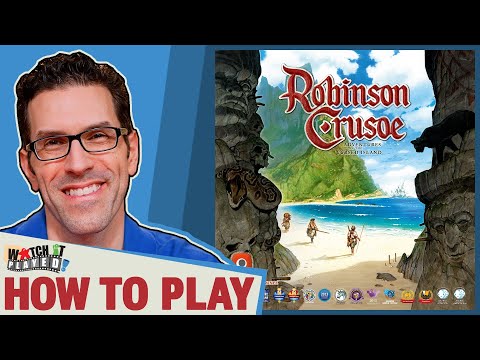


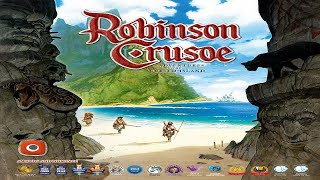
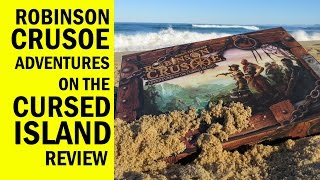
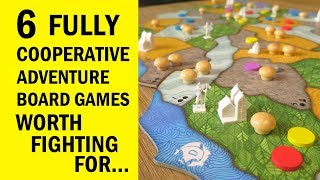

















Robinson Crusoe: Adventures on the Cursed Island is a game created by Ignacy Trzewiczek, the author of Stronghold. This time Trzewiczek takes the players to a deserted island, where they'll play the parts of shipwreck survivors confronted by an extraordinary adventure. They'll be faced with the challenges of building a shelter, finding food, fighting wild beasts, and protecting themselves from weather changes. Building walls around their homes, animal domestication, constructing weapons and tools from what they find, and much more await them on the island. The players decide in which direction the game will unfold and – after several in-game weeks of hard work – how their settlement will look. Will they manage to discover the secret of the island in the meantime? Will they find a pirate treasure, or an abandoned village? Will they discover an underground city or a cursed temple at the bottom of a volcano? Answers to these questions lie in hundreds of event cards and hundreds of object and structure cards that can be used during the game...
Robinson Crusoe: Adventures on the Cursed Island is an epic game from Portal. You will build a shelter, palisade, weapons, you will create tools like axes, knives, sacks, you will do everything you can to… to survive. You will have to find food, fight wild beasts, protect yourself from weather changes…
Take the role of one of four characters from the ship crew (cook, carpenter, explorer, or soldier) and face the adventure. Use your determination skills to help your teammates, discuss with them your plan, and put it into practice. Debate, discuss, and work on the best plan you all can make.
Search for treasures. Discover mysteries. Follow goals of six different, engaging scenarios. Start by building a big pile of wood and setting it on fire to call for help, and then start new adventures. Become an exorcist on cursed Island. Become a treasure hunter on Volcano Island. Become a rescue team for a young lady who’s stuck on rock island…
Let the adventure live!
- Beautiful production and components
- Highly thematic connection between mechanics and theme
- Engaging and often difficult choices
- Game has a memory, making events impactful
- Vast amount of scenarios and replayability
- Great sense of survival and adventure
- Too many exceptions to rules that can hinder flow
- Base game could use an expanded roster of characters
- Can be very punishing and stressful
- Turn limits in many scenarios can feel restrictive
- Potential for alpha gamer issue in multiplayer
- survival as castaways
- an uninhabited island
- Defenders of the Realm
- Nemo's War
- Arkham Horror (second edition)
Mechanics (from transcript analysis)
- encounter deck — Each action (building, gathering, exploring) has its own encounter deck which can lead to difficult choices and consequences.
- event cards — Features two sub-decks of event cards: storybook events tied to scenarios and random encounter events, creating replayability.
- Item Building — Players gather supplies and explore to build various items that improve their survival engine.
- modular expansions — The Treasure Chest expansion offers modular additions that can be mixed and matched.
- Resource management — Involves gathering and managing resources like food, wood, and stone, with mechanics for spoilage and storage.
- scenario play — The game includes multiple scenarios with specific objectives and turn limits, with a new scenario book offering a wide variety.
- Survival — Core mechanics involve building shelter, feeding explorers, hunting, storing food, and dealing with weather elements.
- worker placement — Character tokens are placed on the board to select actions in a typical worker placement fashion, disguised as an adventure game.
Video topics + discussion points
Quotes (from this video)
- I really really enjoy this game quite a bit uh there are a few things I dislike about it
- Robinson Crusoe is a pretty brutal game of survival
- one of the most brilliant things about Robinson Caruso is the game has a memory
- This game creates a lot of stress
- I totally understand now why this game has been so popular for so long
References (from this video)
Mechanics (from transcript analysis)
Video topics + discussion points
Quotes (from this video)
References (from this video)
- Rulebook may need rewriting if the FAQ document is longer than the rulebook itself.
Mechanics (from transcript analysis)
Video topics + discussion points
Quotes (from this video)
- Beyond learning the game a rule book will often be used as a reference and so it should also serve that purpose well
- the rule book not only needs to provide the information but it needs to provide easy ways to find the information inside of it
- you don't want to have to be trying to pick through information on the War of 1812 and George Washington's hair stylist I just want the answer to my question so I can get back to my game
- Blind play test your rulebook
- if the frequently asked questions document is longer than your rule book it's time to rewrite your rule book
- the problem is Publishers are not willing to pay a profession to write their rule book
- Rule books should ensure you that you are contractually going to understand the game and not look like a contract for an insurance
References (from this video)
- Successful hunt yielding food and pelts
- Warming the camp successfully negates frost
- Exploration revealed grassland, candles, and healing herbs
- Roof level increased by one
- Gained two determination tokens
- Building a hatchet and shortcut completed
- Discovered two goats
- Generated two wood and gained food from shortcut
- Gained wood resource for the camp
- Not enough pineapples for food
- Need more wood
- Cold front moving in
- No weapon level for hunting
- Snow requires discarding wood, which they don't have
- Perishable food discarded
- Tree fell into shelter, causing wounds
- Morale dropped
- Need to assign one worker and have a weapon level of at least two for predator tracking
- Haven't focused on building the wood pile
- Hunger damage potential
- Friday doesn't share food
- Suffered a wound while building rope, crossing morale drop level
- Forgot to cover the bottom of an event card
- Lost two health due to lack of food and wood from snow
- Morale dropped again
- Gangrene requires three wounds or one wound with medicine, resulting in losing a leg
- Morale dropped further
- Friday gained a determination token which is not great for his abilities
- island
Mechanics (from transcript analysis)
- building — The hosts work on building structures like the roof and hatchet, and discuss abilities that reduce the cost of building.
- Combat — The hosts discuss hunting a fox, using a pistol, and the combat level required for certain encounters.
- Event resolution — The hosts draw and resolve event cards that impact their progress, such as cold fronts, falling trees, and predators.
- exploration — The hosts use a map to explore new locations, revealing tiles with resources and potential dangers.
- Morale — The hosts track their morale level, which can drop due to wounds and negative events, and can be improved using determination tokens.
- Resource management — The hosts discuss managing wood for warmth, food for survival, and determination tokens for abilities and morale.
- weather — The hosts roll a weather die that can result in snow or rain, impacting their resource levels and requiring shelter.
- worker placement — The hosts assign workers to tasks such as warming the camp, exploring, hunting, and working on the roof.
Video topics + discussion points
Quotes (from this video)
- well we know a cold front is moving in and that's why this token is sitting here so I'm going to spend one of my actions warming up the camp and to do this I'll have to use a piece of wood
- well this is a fox bang jeez I think I nearly died there
- well that's going to cause us a little bit of a problem here yeah you're right Pat because when it snows you need to discard a wood which represents you you know warming up during the cold we actually don't have any more wood here
- well now we have to draw a new card this one tells us there's a predator in the vicinity P another Predator where's Arnold when we need him
- please clearly please help us in the comments below let us know what you want us to do and whichever one gets the most votes that's what we'll come back and do in the next episode
References (from this video)
- Cooperative nature provides teamwork and shared experience.
- Exploration of the island uncovers new areas and resources.
- Building structures like shelters improves survival odds.
- Thematic elements like preparing for winter add to the immersion.
- Mistakes in gameplay can lead to negative consequences like wounds.
- Resource scarcity, particularly food, can be a significant challenge.
- Weather effects like frost and snow can add difficulty and resource drain.
- stranded on an island
Mechanics (from transcript analysis)
- building — Players can construct various items and structures, such as a shovel, cellar, shelter, roof, and palisades, which aid in survival and progression.
- cooperative play — The game is played with two people, emphasizing teamwork and shared success or failure, with specific rules for a non-player character (Friday) supporting the main players.
- Event resolution — At the start of rounds, event cards are drawn and resolved, introducing challenges, dangers, or opportunities that affect gameplay.
- exploration — Players uncover new tiles representing different areas of the island, which provide resources or present new challenges.
- Resource management — Players gather and manage resources like wood and food, which are crucial for survival, building structures, and achieving objectives.
- Scenario Objectives — The game has specific objectives, such as preparing for winter and building a wood pile by a certain round, which guide the players' actions.
- worker placement — Players assign tokens to perform actions, with the number of tokens and their placement determining the success or failure of an action, as seen with placing two people for food crates or one for exploring.
Video topics + discussion points
Quotes (from this video)
- we do have a video teaching you how to do that and I'll put a link to it in the description of this one
- if I die you lose just be aware of that
- we'll do our best to correct them as we go along but let's see how long we can go before we make our first mistake
- the primary objective of the game is to build this wood pile here over the course of several rounds
- the catch about building this wood is that you can only complete one stage of it per round
- we have to start by first putting one wood onto this section here
- I'll reclaim my token here and then move the shovel to the future resources area
- I encountered a wild dog first it looks at me then it bites me then it runs away this is a dr. Seuss book
- it's about making mistakes learning from and forming a bond with the baby we never we can escape we never should have got washed ashore in the first place that was the first mistake and I apparently made a series of them since then
- we have different definitions of what is a mistake and a near mistake
- we've been too busy to introduce ourselves I mean I named the goat all right let's get these introductions out of the way
- all right I'm Joel the names Noel nice to meet you under these unfortunate circumstances that we find ourselves in
- all these mistakes are making the game because that's what this game is about it's about making mistakes learning from and forming a bond with the baby
References (from this video)
- Wonderful cooperative game
- Offers diverse scenarios
- survival and escape from a deserted island after a shipwreck
- a deserted island
Mechanics (from transcript analysis)
- cooperative play — Players work together towards a common goal.
- Dice rolling — Dice are used to determine success or failure for certain actions and to resolve events.
- Modular board — Island tiles are explored and added to the board, creating a variable play area.
- Resource management — Players collect and spend resources such as food and wood.
- scenario play — The game is played through a series of distinct scenarios, each with its own setup and objectives.
- set collection — Players collect various items like inventions and treasures.
- worker placement — Players assign pawns to various action spaces on the board to perform tasks.
Video topics + discussion points
Quotes (from this video)
- hi welcome to watch it played my name is Rodney Smith and in this video we're going to learn the wonderful four player game Robinson cruso Adventures on the cursed Island
- Did you make it to the end of this video If you did congratulate yourself in the comments below because you deserve it Well done there was a lot here to absorb but hopefully you'll find it pretty easy to follow once you sit down and start playing your own games
References (from this video)
- Rich, immersive survival theme with high tension
- Deep cooperative design encouraging team communication
- Multiple scenarios provide strong replayability
- Varied artifacts and shelter-building options add strategic depth
- Encourages careful risk management and planning
- Very challenging; punishing failure states can frustrate players
- Dice-driven randomness can override strategy in some turns
- Rulebook complexity makes onboarding lengthy
- Cooperative fatigue in long sessions
- Survival, cooperation under pressure, improvisation
- Isolated, deserted island survival with dangers and exploration
- immersive, scenario-driven, escalating threats
Mechanics (from transcript analysis)
- camp management and morale — Morale and camp status influence actions and survival odds.
- Cooperative Game — Players must work together to survive the island's hazards.
- cooperative play — Players must work together to survive the island's hazards.
- dice risk and event resolution — Rolling dice triggers damage, event cards, and potential victory conditions.
- Dice rolling — Rolling dice triggers damage, event cards, and potential victory conditions.
- Environmental exploration — Exploration of terrain types enables access to resources and narratives.
- hunting and combat — Hunt beasts, defend against threats, and manage weaponry.
- Resource gathering and crafting — Collect resources to build shelters, tools, and other essential items.
- Scenario / Mission / Campaign Game — Base game features six distinct scenarios that drive different win/lose conditions.
- scenario-based objectives — Base game features six distinct scenarios that drive different win/lose conditions.
Video topics + discussion points
Quotes (from this video)
- It's Robinson Crusoe's Adventure on the Coast Island, and I love it.
- This is probably one of the toughest cooperative games I've ever played.
- every choice feels tense
- gaining a victory in what you're trying to do, which is a rare occurrence.
References (from this video)
- Fast-paced playthrough with strong thematic immersion
- Highly visual, thematic minis and painter work improve recording and play experience
- Rich, branching scenarios via the newspaper-based tokens create high replayability
- Morale-centric design provides meaningful tension and decision points across rounds
- Redolent of survival storytelling with a satisfying progression (roofing, diary, drums, pot, cure)
- Rule complexity can be challenging and invites occasional errors during play
- Weather/die mechanics can be punishing without proper shelter or planning
- Heavy reliance on luck for exploration outcomes may feel unfair in some runs
- Survival under harsh conditions, exploration-driven narrative, and the discovery of relics, cures, and dangers.
- Isolated tropical island during the late 19th century exploration era (1871 context with references to Henry Stanley and David Livingstone).
- Array
Mechanics (from transcript analysis)
Video topics + discussion points
Quotes (from this video)
- I absolutely love this game.
- This scenario is fast and fun.
- Watch the morale track that first round to the second round.
- This game is fast and fun — I absolutely love this game.
- You're down low on morale and you start taking wounds from that, then you start taking wounds from actions.
References (from this video)
- Array
- Array
- survival, exploration, cooperative storytelling, and resource management under duress
- Array
- remote island survival with pirate/colonial flavor, exploration, and episodic campaigns
- Array
- Array
- Array
- positive
Mechanics (from transcript analysis)
Video topics + discussion points
Quotes (from this video)
- I paid for this 20 years ago so I've forgotten a lot about it
- this big box is I think Robinson Crusoe
- we did it we put it together look at that a little volcano dice tower
- I'm going to read the instructions though Wingspan and Everdell told us how to put it together
- this is not sponsored this is not I paid for everything
References (from this video)
- Rich thematic survival experience with strong cooperative play
- High-quality production, especially miniatures and components
- Thoughtful storage design with multi-layer player boards and trays
- Introductory campaign guide and tutorial deck to teach the game
- Wide variety of scenarios and modular components included
- Production delays and earlier rulebook language/edits
- Complex rules and learning curve for newcomers
- Large, heavy storage-heavy box requiring significant space
- Cooperative survival against environmental hazards, with team-based decision making
- Deserted island survival with exploration and rescue themes
- campaign/scenario-based progression with a tutorial introduction
- Gloomhaven: Jaws of the Lion
- Robinson Crusoe: Adventures on the Cursed Island (original)
Mechanics (from transcript analysis)
- Campaign/tutorial deck — Introductory deck that teaches rules progressively
- Cooperative Game — Players work together to survive the island's hazards
- cooperative gameplay — Players work together to survive the island's hazards
- Dice-based resolution — Dice determine outcomes for actions and events
- Scenario-based progression — A sequence of connected scenarios with varying goals
- worker placement — Assigning actions and gathering resources to advance scenarios
- worker placement/resource management — Assigning actions and gathering resources to advance scenarios
Video topics + discussion points
Quotes (from this video)
- this game is a cooperative Survival game set on the cursed Island that you are going to be stranded on and you are going to be playing one of four different roles
- this game is legendarily difficult yep it's very punishing
- the original version on BGG it's got like great ratings 7.8 something
- Portal Games worked with awaken Realms on this addition
- it's a very big box
- I back this back in 21 I'm a different man now it's been two and a half years
- we're very excited to get this to the table
- Introductory campaign guide is included and signed by Yan
References (from this video)
- strong thematic immersion and survival tension
- clear path to evolution through missions and crafting
- deep strategic options via dice placement and resource tradeoffs
- scales in difficulty for ongoing solo play
- food indicator can be hard to read during setup
- rulebook lookups can slow down initial plays, especially solo
- dice management and tracking can be fiddly for newcomers
- Survival, exploration, risk management, and tactical decision-making under scarcity
- Desert island survival scenario with exploration, resource management, and threatening environmental hazards
- Campaign-like, mission-driven progression with variable difficulty and optional character abilities
Mechanics (from transcript analysis)
- dice placement — Roll three dice and place them into action spaces that resolve across day phases (morning, afternoon, evening) to gain resources, move, or perform crafting and exploration.
- quest/mission progression — Complete quests with increasing difficulty; quests determine success or failure and drive the game toward victory conditions.
- raid and hazard system — Random or region-based raids threaten Food and Health; weather and regional dangers add strategic risk to planning.
- Resource management — Gather and spend Wood, Skins, Food, and other resources to craft items and fulfill quest requirements, with progression unlocking more powerful options.
- Resource management and crafting — Gather and spend Wood, Skins, Food, and other resources to craft items and fulfill quest requirements, with progression unlocking more powerful options.
Video topics + discussion points
Quotes (from this video)
- thoroughly enjoyed this
- I will consider backing a late pledge
- there's a lot of strategy in how you pick your actions
- I love this case
- I'm not here to pressure you or to hype you because I'm not good at that
- I love you all I'll see you next time
References (from this video)
- strong thematic weight
- presents real pressure and difficult choices
- extremely punishing; learning curve is steep
- hard, unforgiving survival
- island survival; stranded castaways
- grim, challenging
- Mansion of Madness
- Arkham Horror
Mechanics (from transcript analysis)
- Cooperative Game — Players work together to manage resources and complete objectives while facing environmental hazards.
- cooperative survival — Players work together to manage resources and complete objectives while facing environmental hazards.
Video topics + discussion points
Quotes (from this video)
- What you're saying is Arkham Horror the card game gets a pass and these two are out.
- Frost Punk is nasty.
- Daybreak gives you that feeling of like walking in and being like I just cleaned up in here.
- Ghost Stories is tricky.
References (from this video)
- Strong thematic integration with the Robinson Crusoe setting
- Book of Adventures significantly expands content with numerous scenarios
- Deluxe collector's edition components add tactile and visual appeal
- Introductory campaign booklet and app-based decks offer flexible learning and play
- Some deluxe components are fiddly or arguably unnecessary for gameplay
- Dice tower is criticized as a weak or unhelpful accessory
- Collector's edition upgrades can be expensive and may not fit every table setup
- Some upgrades may not integrate perfectly with all boards or scenarios
- Cooperative wilderness survival against the elements, wilderness hazards, and narrative-driven challenges
- Deserted island survival with thematic crisis management and exploration
- Scenario-driven storytelling with evolving objectives and episodic events
- Castaways
Mechanics (from transcript analysis)
- card driven events and adventure cards — Adventure and event cards drive challenges, discoveries, and narrative twists.
- Cooperative Game — Players collaborate to survive on a harsh island, sharing roles and coordinating actions.
- cooperative play — Players collaborate to survive on a harsh island, sharing roles and coordinating actions.
- Events — Adventure and event cards drive challenges, discoveries, and narrative twists.
- Modular board — Collector edition components include layered boards and minis to represent progress and characters.
- modular board and figure minis — Collector edition components include layered boards and minis to represent progress and characters.
- Resource management — Players gather food, tools, and shelter components and craft items to progress.
- Resource management and crafting — Players gather food, tools, and shelter components and craft items to progress.
- risk assessment and morale dynamics — Outcomes hinge on managing threats, health, morale, and the ticking clock of the island.
- Scenario / Mission / Campaign Game — Each Book of Adventures presents a distinct scenario with its own win conditions and rules tweaks.
- scenario driven objectives — Each Book of Adventures presents a distinct scenario with its own win conditions and rules tweaks.
Video topics + discussion points
Quotes (from this video)
- Robinson Crusoe is my favorite solo game and my favorite cooperative game and it's been that way for over a decade
- I've finally have the Robinson Crusoe collector's edition here in my house on my table it's been I don't know many years in the waiting this thing was crazily delayed but so I wanted to do something for the channel like an unboxing
- an incredible neoprene mat
- this book is massive there are so many scenarios in here
- Jenny needs help is also one of my favorite of the scenarios it's the one I recommend as your first play even though the manual always recommended Castaways
- Reality Island this is just straight up Survivor the TV show
- I can't wait to try some of these Straight to Hell and just see how long you can survive
- this game is just too good it's just too good I can't help myself
References (from this video)
- excellent solo and cooperative experience
- emergent narrative from mechanics
- tactically flavorful"
- learning curve
- heavy setup and maintenance
- cooperative exploration and survival with emergent storytelling
- Survival on a remote cursed island
- story emerges from gameplay rather than a fixed book
Mechanics (from transcript analysis)
- Campaign — scenarios and character progression carry across sessions.
- campaign/persistence — scenarios and character progression carry across sessions.
- Cooperative Game — players work together to survive threats and complete goals.
- cooperative play — players work together to survive threats and complete goals.
- simulation of survival stresses — events and hazards simulate challenging conditions on the island.
Video topics + discussion points
Quotes (from this video)
- "no other civilization game that I've played comes close to capturing the feeling that I get when playing this one"
- "this game does something that I think no other game can do it can tell a compelling Adventure Survival Story without the need of a storybook here the story emerges out of the gameplay"
- "Gloomhaven is one of the most popular board games of all time"
References (from this video)
- Strong emergent storytelling
- Excellent solo and coop play
- Punishing difficulty
- emergent survival narrative without a fixed storybook
- Isolated island survival to escape or endure
- story emerges from gameplay and event cards
Mechanics (from transcript analysis)
- Co-op survival with scenario-based play — Players cooperate to survive across various scenarios
- Event-card driven narrative — Top/bottom events shape the story, with lasting consequences
- Events — Top/bottom events shape the story, with lasting consequences
- Resource management — Gather resources and explore to progress objectives
- Resource management and exploration — Gather resources and explore to progress objectives
Video topics + discussion points
Quotes (from this video)
- for me this game is the culmination of all of UV rosenberg's prior games
- it's a big game it takes a while to set it all up but it is so worth it
- the theme is just so amazing
- it's not abstract at all you walk into a bar your character has a gun they confront some other character they have a shootout
- this is such a special design
- no board game that has made me laugh as much as this game
References (from this video)
- Engaging narrative with episode-based goals
- Clear, satisfying solo play progression
- Strong thematic integration of reality show premise
- Interesting risk-reward decisions under pressure
- High randomness can derail plans
- Complex setup and rule density may intimidate newcomers
- Management of multiple tracks (morale, popularity) can be mentally taxing
- Survival, exploration, resource management
- Desert island survival with a reality-TV premise
- Reality-TV framing with scripted events and audience feedback
Mechanics (from transcript analysis)
- action selection with dice influence — Players perform actions using action spaces and dice; success/failure affects resources and morale.
- construction and sheltering — Building shelters/palisades provides protection against weather and hazards; involves resource management and risk.
- Events — Weather effects and scripted events drive tension and require adaptive planning.
- morale and popularity tracks — Morale tracks viewer sentiment; popularity tracks show audience reception and influence end-of-day scoring.
- scenario-based objectives — Each round presents two objectives; completing at least one avoids losing; dual completion affects popularity.
- weather and event deck — Weather effects and scripted events drive tension and require adaptive planning.
Video topics + discussion points
Quotes (from this video)
- this scenario has a difficulty level of no chance
- we are contestants on The Ultimate Survival reality TV show
- this is a fantastic scenario I highly recommend trying this one out
- wow in all honesty that was a pretty wildly successful reality TV show
- I think this is a fantastic scenario I highly recommend trying this one out
- it's a reality show premise and the audience feedback
- the end it was fantastic
References (from this video)
- Huge variety of scenarios and theme-rich storytelling
- One of the author's favorite, with lasting replayability
- High complexity may be daunting for casual players
- Setup and rule overhead can be extensive
- cooperative survival with narrative-driven scenarios
- A deserted island where survivors must endure and escape
- scenario-driven, highly thematic
- Frostpunk
- Halls of Hegra
- Lords of the Fly (conceptual reference in the discussion)
Mechanics (from transcript analysis)
- cooperative action-selection — Players choose actions to balance needs and threats while advancing the story.
- cooperative actions — Players choose actions to balance needs and threats while advancing the story.
- Scenario / Mission / Campaign Game — A large variety of scenarios with distinct goals and obstacles.
- scenario-based play — A large variety of scenarios with distinct goals and obstacles.
Video topics + discussion points
Quotes (from this video)
- there's definitely nothing else like this in board gaming
- I like to call this game The Pinnacle of the take that card game
- this is the most thematic and cinematic card game I've ever played
- the added tension is just terrific
- it's almost like every game is a completely new experience
References (from this video)
- rich storytelling and replayability
- strong solo and cooperative modes
- puzzle-heavy and can be punishing
- long play sessions
- Survival storytelling and resource management under pressure
- Survival on a deserted island with dangers and decisions
- Scenario-based with emergent survival narratives
Mechanics (from transcript analysis)
- Cooperative Game — Players work together to survive and complete goals.
- cooperative play — Players work together to survive and complete goals.
- Event deck with consequences — Events trigger immediate and delayed consequences drawn from a deck.
- Events — Events trigger immediate and delayed consequences drawn from a deck.
- Resource gathering and crafting — Explore, gather, craft tools and supplies to endure scenarios.
Video topics + discussion points
Quotes (from this video)
- it's a perfect fit for this list that's Cosmic Encounter
- I had to have a card game
- this is a collectible SL living card game so you're going to be building your own deck
- this is the absolute definition of a minute to teach a lifetime to master
- it's Star Wars in a box
References (from this video)
- Strong thematic alignment with survival and adventure; high tension and narrative payoff.
- Depth from Book of Adventures content and scenario variety; good replay value for solo players with multiple characters.
- Clear identification of end-game objectives (DNA samples, electric fence, survival across ten rounds).
- Dynamic decision points—starting items, weapon progression, and resource allocation create meaningful choices.
- Rules and setup can feel opaque or ambiguous at times (e.g., starting tile placement, river spaces, and deck interactions).
- High difficulty and maintenance cost; even with good play, the scenario can easily swing toward punishing outcomes.
- Requires careful tracking of many moving parts (tokens, damage, wounds, morale, and weather effects) which can be onerous.
- Some players may dislike the heavy randomness and the escalation curve that makes late rounds very punishing if not prepared.
- Cooperative survival under duress, resource management, exploration vs. danger, and makeshift engineering to survive the island's threats.
- Deserted tropical island during a storm, with dinosaurs, ruins, and survival pressures driving the narrative.
- Story-driven, mission-based scenarios with discovery tokens, totems, and event-driven twists that shift how players meet victory conditions.
- Dinosaur Island
- Jurassic Park (metaphor in-game thematic context)
- Robinson Crusoe: Adventures on the Cursed Island (base game is the platform for the expansion content)
Mechanics (from transcript analysis)
- Combat and weapon progression — Beasts vary in strength by round; weapon levels and defensive plans influence outcomes; frenzy and other cards can alter combat odds.
- Cooperative survival & role-based teamwork — Three characters (or more in team play) collaborate to manage fatigue, hunger, injuries, and threats across rounds.
- DNA samples and research — DNA collection via totems leads to different victory thresholds; DNA-related actions drive a narrative of scientific exploration on the island.
- Electric fence and fortifications — Building the electric fence uses fuel and is a key endgame requirement; fortifications like palisades influence morale and survivability.
- Event deck and book events — Dynamic events and book events inject escalating risk, changing beast strength, terrain hazards, and consequences for players.
- Events — Dynamic events and book events inject escalating risk, changing beast strength, terrain hazards, and consequences for players.
- Exploration, discovery, and totem mechanics — Discovery tokens, DNA sample goals, and totems create optional high-reward paths that carry risk via beasts and terrain effects.
- Resource management — Track wood, food, fuel, and special resources (e.g., palisades) to build defenses and sustain the crew.
- Terrain and exploration costs — Dark spaces and terrain features increase action costs; riverbeds and other terrain shifts require planning and potentially new tools.
- Variable Phase Order — Weather dice introduce ongoing hazard or relief, affecting health, food needs, and night-phase outcomes.
- Vehicles, fuel, and mobility — ATV actions modify how many players can act and where; fuel management drives exploration and risk mitigation.
- Weather phase — Weather dice introduce ongoing hazard or relief, affecting health, food needs, and night-phase outcomes.
- Worker actions per round — Actions like Explore, Gather, Build, Hunt, and Rest are selected to advance survival and progress toward victory.
Video topics + discussion points
Quotes (from this video)
- that's right this is Jurassic Park in Robson cruso and I can't think of a much better match
- we need to First survive all 10 rounds
- this is another no chance difficulty scenario for expert players
- Jurassic Park in Robinson Crusoe—the comparison feels almost perfect for this setup
- we're going to have to deal with the biscuits and the rum
- the Beast strength increases as the rounds go on, so preparation is everything
References (from this video)
- survival adventure masterpiece
- strong solo and co-op experiences
- broad scenario library (Book of Adventures)
- heavy and complex
- solitaire replay can be quite long
- cooperative survival, exploration, scenario-based play
- isolated island survival
- emergent storytelling, cinematic feel
Mechanics (from transcript analysis)
- Cooperative Game — players work together to survive scenarios
- cooperative play — players work together to survive scenarios
- Scenario / Mission / Campaign Game — structured challenges with varying goals
- scenario-based design — structured challenges with varying goals
- solo and cooperative modes — built-in formats for solo and co-op play
Video topics + discussion points
Quotes (from this video)
- these are the games that have stood the test of time for me each one I've played every year for a decade or more
- Robinson Crusoe for me it came out in 2012 I got it immediately
- it's the ultimate forever game
References (from this video)
- Rich cooperative experience with thematic depth
- Highly replayable through multiple scenarios
- Heavy/long play sessions
- learning curve to grasp all mechanics
- cooperative survival with narrative scenarios
- island survival and exploration
- epic, mission-driven
- Sub Terra
- Subnautica-inspired co-ops
Mechanics (from transcript analysis)
- action cue / area movement — angular set of actions and turn order impact progression
- Campaign — campaign-like progression through linked scenarios
- Cooperative Game — players work together to survive environmental hazards
- cooperative play — players work together to survive environmental hazards
- Dice rolling — random events test the group's resources and choices
- dice rolling / event resolution — random events test the group's resources and choices
- scenario-based campaigns — campaign-like progression through linked scenarios
- tile placement — setup and exploration mechanics drive resource flow
- tile placement / worker placement analog — setup and exploration mechanics drive resource flow
Video topics + discussion points
Quotes (from this video)
- these are games from you know 1990 something all the way up to I think the most recent one is 2013
- I really want to try Agricola because Francis and I have played Caverna we absolutely love Caverna
- the fisherman theme that's why we tried News Fjord as well because we loved that theme
- Onirim ... a solo game where you shuffle through your dreams and open doors
- Robinson Crusoe ... you are trying to survive on an island cooperatively
- Hanamikoji is absolutely beautiful and I would love to try it
- CV is one that I would love to try the art is absolutely adorable
References (from this video)
- Rich emergent narrative through events and consequences
- Strong thematic immersion and cooperative tension
- High replayability via variable setups
- Complex rules and long play time
- Steep learning curve for new players
- Can feel punishing when failures accumulate
- Survival, resilience, cooperation under harsh conditions
- Isolated island survival with exploration and resource management
- Emergent narrative driven by events and player choices
- Empires of the Void II
- Above and Below
- Near and Far
- Charterstone
- Fallout: The Board Game
- Arkwright
Mechanics (from transcript analysis)
- Cooperative Game — Players work together to survive on a cursed island
- cooperative play — Players work together to survive on a cursed island
- Deck integration of events — Used event cards are shuffled back into the deck, affecting future draws
- deck manipulation — Used event cards are shuffled back into the deck, affecting future draws
- Event deck — Deck draws introduce new challenges and consequences
- Modular board — Island board with various locations to explore
- Modular board / exploration — Island board with various locations to explore
- Worker/action placement — Players allocate actions to build resources and progress
Video topics + discussion points
Quotes (from this video)
- when I'm in the game I want to feel like the game itself has a mind of its own and it is operating like its own organism
- experience is one of the most important things to me about any game no matter what it is
- these event cards don't poke you with a stick directly but what they do is they create some sort of event that is going on in the universe based on that planet
- the game feel alive
References (from this video)
- Comparative fit against Robinson Crusoe as a thematic benchmark
- Strong designer pedigree mentioned (David Turchie)
- Survival and cooperative decision-making
- Deserted island survival
- Story-driven survival with challenging choices
- Edge of Darkness
Mechanics (from transcript analysis)
Video topics + discussion points
Quotes (from this video)
- Emerson's greatest work
- this game has an awesome table presence
- it's an expensive game
- i'm a sucker for metal coins
- print and play options ... are awesome
References (from this video)
- Strong theme and survival storytelling
- Research-informed design process
- Very heavy and lengthy play sessions
- Complex for new players
- Survival, exploration, resource management
- Isolated island survival scenario
- Story-driven campaigns with event-driven storytelling
- First Martians
- Detective: A Modern Crime Board Game
Mechanics (from transcript analysis)
- cooperative play — Players work together to survive and complete objectives.
- Dice-driven actions — Element of randomness drives outcomes during events.
- Story/event cards — Narrative events shape the session.
- worker placement — Actions require placing workers to gather resources, build shelter, explore.
Video topics + discussion points
Quotes (from this video)
- ideas are execution is everything
- play testing is a job
- the best time to plant a tree was 20 years ago, the second best time is now
- execution matters more than the idea
References (from this video)
- strong thematic integration and tension
- cooperative depth with meaningful decisions
- high replayability due to modular setup and events
- heavy ruleset and long setup
- steep learning curve for new players
- can be unforgiving in difficult scenarios
- survival, exploration, resource management, cooperative play
- Deserted tropical island, survival scenario with escalating hazards
- story-driven, episodic encounters with evolving threats
- Robinson Crusoe: Adventures on the Cursed Island
Mechanics (from transcript analysis)
- Cooperative Game — Players join forces to survive hazards, craft, and complete objectives.
- cooperative play — Players join forces to survive hazards, craft, and complete objectives.
- Dice-based resolution — Outcomes of actions and encounters are determined via dice mechanics.
- Events — Encounter cards drive narrative progression and randomization.
- Modular board — Exploration unfolds on a modular board built from variable tiles.
- Resource management — Management of food, tools, shelter, and other resources to survive.
- story cards / events — Encounter cards drive narrative progression and randomization.
- tiles and modular board — Exploration unfolds on a modular board built from variable tiles.
- worker placement — Characters allocate actions to explore, gather, build, and endure hazards.
Video topics + discussion points
Quotes (from this video)
- here that is from the game robinson crusoe adventures on the cursed island
- it is one of the food tokens
- this is week six and here is this week's component
- what game is this from
- it's like a green question mark made from plastic
- resolve this mystery next monday as usual
- have fun guessing
References (from this video)
- Immersive survival theme
- Strong cooperative play
- Rules can be heavy
- Complex setup and learning curve
- Cooperative exploration
- Deserted island survival
- Campaign-driven coop
- Arkham Horror: The Card Game
- Descent: Journeys in the Dark
Mechanics (from transcript analysis)
- Cooperative Game — Players work together to survive hazards and complete objectives.
- cooperative survival — Players work together to survive hazards and complete objectives.
- worker placement — Assign workers to gather resources and perform actions.
Video topics + discussion points
Quotes (from this video)
- What does Colin know or Time to educate Colin? Whichever way you want to think about it.
- I'm going to learn so much today.
- I'm 0 for three right now.
- The over under is five.
- I ain't got time to bleed.
- I'm at 10.5 points, going into December.
- This is Fight Club.
- Galaxy Quest the best Star Trek movie.
- What does Colin know or Time to educate Colin?
- I'm not on zero.
References (from this video)
- Brutal, rewarding cooperative experience
- High narrative heft and replayability through different scenarios
- Encourages creative problem-solving under constraints
- Painfully punishing at times
- Learning curve can be steep for new players
- Hard-tought survival with escalating threats
- Isolated island survival with cooperative play
- Story-driven, scenario-based challenges
- Arkham Horror
- Descent: Journeys in the Dark
- Stronghold (Portal)
Mechanics (from transcript analysis)
- cooperative optimization — Players collaboratively plan actions to survive a harsh environment
- Scenario-based variability — Each scenario provides unique objectives and threats
Video topics + discussion points
Quotes (from this video)
- number five tides of time two player game
- number four on my list and this was very tough for me because i was torn between these two
- number two we actually combine two games together, nirōshima hex and monolith arena
- number one stronghold, what else could there be right
- it's a game you can pull off the shelf and play without a heavy rulebook in hand
- the art is amazing and the components are gorgeous, it makes you want to play again just to look at them
References (from this video)
- Innovative risk-reward timing for events
- Challenging but rewarding with meaningful tension
- Difficult to master; can be punishing
- Rulebook complexity and setup time
- Survival, exploration, and cooperative decision-making
- Desert island survival with perilous conditions
- Event-driven narrative with delayed consequences
- The Lord of the Rings: Journeys in Middle-earth
- Cast Away-style co-ops
Mechanics (from transcript analysis)
- cooperative survival — Players manage resources to survive weather, beasts, and hazards
- Event deck with delayed outcomes — Resolve advent cards immediately for small benefit or delay for bigger later reward
Video topics + discussion points
Quotes (from this video)
- this is a space where Mage Knight is described as the best solo game you can get your hands on today
- it's a living breathing world inside a box
- it's like being addicted to heroin... every month a new mythos pack is released
References (from this video)
- cooperative exploration and survival against the elements
- island survival narrative
- story-forward survival campaign
Mechanics (from transcript analysis)
- Cooperative Game — players work together to survive island challenges
- cooperative play — players work together to survive island challenges
- Scenario-based progression — campaign progression with varying outcomes
- worker placement — execute actions to gather resources and progress
- worker placement / action resolution — execute actions to gather resources and progress
Video topics + discussion points
Quotes (from this video)
- we're going to bask in the world's negativity today
- the world's negativity cuz that's really what we need more of
- we want to be a beacon of negativity in this world
- the special cards are pictorially meaningless
- randomness disguising itself as difficulty
- it's an evil game
- sandbox experience
- I feel like a boy that has cheated on the test because that was one of the comments
- three faces on the cover
- three big faces one of them is wearing a cowboy hat
- this game is clearly inferior
- the rule book was great but everything else was weak
References (from this video)
- Deep, thematic experience
- Strong co-op tension and storytelling
- High replayability
- Steep learning curve
- Long playtime
- cooperative survival with story-driven exploration
- Isolated island survival
- picaresque survival journey with modular storytelling
- Descent: Journeys in the Dark
- This War of Mine - The Board Game
Mechanics (from transcript analysis)
- cooperative play — players work together to survive events
- deck-building / event-driven exploration — cards drive events and terrain exploration
- worker placement — placing workers to perform tasks
Video topics + discussion points
Quotes (from this video)
- I'm going to do a Q&A for everyone
- the patreon is going well thank you for asking
- Seventh Continent is definitely I'm excited to get back to that
- we want to plan a proper Halloween night with candles and stuff
- top ten travel games I wanted to talk about
- plan is for it to be patreon backers actual heroes
- lighting is really important
- collaboration with Shut Up and Sit Down soon
- the artwork on Dinosaur Island was garish on Kickstarter
References (from this video)
- rich narrative and high replayability
- immersive cooperative experience
- heavy and long sessions
- learning curve can be steep
- cooperative exploration and survival against the elements
- island survival
- Array
- Lost Ruins of Arnok
- Skyrim: The Board Game
Mechanics (from transcript analysis)
Video topics + discussion points
Quotes (from this video)
- it's a two-player game even though it's abstract
- the art is great i loved it
- we love sharing it with you guys
- stay safe keep wearing a mask
References (from this video)
- tough, satisfying challenge
- great table presence and theme
- solid when played cooperatively with the right group
- high difficulty can be punishing
- setup and time requirements are substantial
- survival, exploration, and cooperative problem solving
- stranded on a cursed island with limited resources
- story-like campaigns with escalating difficulty
- Kingdom Death: Monster
- Arkham Horror
Mechanics (from transcript analysis)
- cooperative worker-placement/lockstep actions — players manage actions to gather resources and overcome events
- peril management — constant threats from weather, hunger, and hazards challenge players
- risk management — constant threats from weather, hunger, and hazards challenge players
Video topics + discussion points
Quotes (from this video)
- probably the greatest party game of all time
- it's a betting racing game
- this is basically one huge massive rondell of a game
- I hate painted miniatures
References (from this video)
- strong emergent storytelling through events and choices
- memorable moments of tension and discovery
- deep thematic immersion and atmosphere
- rules can be dense and heavy for some players
- solo or full party sessions can be lengthy
- Survival, exploration, and resilience with emergent storytelling.
- Desperate survival on a deserted island with environmental challenges and hazards.
- emergent storytelling through events and player choices
Mechanics (from transcript analysis)
- cooperative_play — Players work together to survive island threats and manage resources.
- event_deck — Deck-driven events create unpredictable narrative beats.
- story_integration — Player decisions influence the arc of survival and outcomes.
Video topics + discussion points
Quotes (from this video)
- there's an emergent story that comes from the characters
- the emergent storytelling that you can see in Z is amazing because it's so sandbox
- we make decisions based on what our character would do rather than what's the best choice
- it's fun to make up stories as you're spending lots of money
References (from this video)
- Deep, thematic co-op experience
- Tough but rewarding scenarios with strong atmosphere
- Supports a range of expansion content and scenarios
- Can be punishing and very challenging
- Rules and setup can be lengthy for newcomers
- cooperative survival, exploration, resource management
- Uninhabited island survival in a Robinson Crusoe-like setting
- scenario-based with challenging branches and thematic moments
- Detective: A Modern Crime Board Game
- First Martians
- Imperial Settlers
Mechanics (from transcript analysis)
- Cooperative — Players cooperate to survive and complete scenarios
- resource_management — Careful allocation of limited resources to survive
- scenario_based — Narrative-driven campaigns with evolving threats
Video topics + discussion points
Quotes (from this video)
- Detective is a fantastic co-op deduction game, heavy but with strong stories and campaigns.
- This compendium book of scenarios on Kickstarter could revive Detective with tons of replay value.
- Rise of Empires brings a larger, open-world feel to Imperial Settlers with more cards and factions.
References (from this video)
- Deep, thematic cooperative experience
- Rich scenarios with meaningful challenges
- Very long play sessions and steep learning curve
- Rule complexity can be finicky
- cooperative survival against the environment
- deserted island survival and exploration
- scenario-driven, story-anchored
Mechanics (from transcript analysis)
- cooperative play — Players collaborate to survive and complete scenarios with a heavy emphasis on planning and resource management.
- dice-driven outcomes and event chains — Actions and events unfold via dice, with long play sessions and meaningful consequences.
Video topics + discussion points
Quotes (from this video)
- one of the biggest things you know as being a good game designer you want to give players interesting choices
- Gamers or people in general they want to feel rich they want to feel powerful they want to feel smart
- there's value in playing terrible games
- you can create a system that can be re-themed to different things to make more money
- it's like watching film... you break it down to see how they do it
- this is a monumental feat of game design
References (from this video)
- One of most involved solo games
- Genuine sense of achievement when winning
- Multiple scenarios with varying difficulty
- Complex with many moving parts
- Brutally merciless and rewarding
- Very complex game
- High time commitment to learn
- Will lose many times before winning
- Not a pick-up-and-play game
- Survive on island with challenges
- Tropical cursed island
- Survival saga
- First Martians
Mechanics (from transcript analysis)
- Risk Mitigation — Too many things to do with insufficient resources
- Story Problems — Ongoing story scenarios to solve
- Survival — Build shelter, find supplies, survive
Video topics + discussion points
Quotes (from this video)
- I've played about 300 solo games so this represents the top of all the solo games I've played
- These are entirely my opinions based on my personal play experience
- I think this is one of the cleverest solo modes on the market
- When you win a game of Robinson Crusoe there are very few things in solo board gaming more satisfying
- The closest experience in board gaming to being the captain on a bridge in a sci-fi movie where everything is going to shit
- I'm probably a solo board gaming masochist
- I just love Thunderbirds as a solo game
- It feels like Legendary Encounters was built for the Alien theme and was built as an upgrade to the original Legendary system
- Probably the best AI opponent in all of board gaming
- Few games have that genuine sense of exploration
References (from this video)
- Tense, thematic experience
- Excellent solo and coop modes
- Steep learning curve
- Can be punishing
- Survival with exploration and resource management
- Desperate survival on a deserted island
- Nemo's War
- Feast for Odin
Mechanics (from transcript analysis)
- Cooperative Game — Players collaborate to survive hazards and complete goals.
- cooperative survival — Players collaborate to survive hazards and complete goals.
Video topics + discussion points
Quotes (from this video)
- Spirit Island is just so engaging and interesting.
- Words cannot express how dominant this is.
- My true love is still Mage Knight… but Spirit Island ate and left no crumbs.
- The solo gaming community is the best gaming community.
- Thank you so much to the solo Community; you guys do a great job.
References (from this video)
- Engaging narrative choices
- Decisions have meaningful consequences
- Strong thematic cohesion
- narrative choices driving outcomes
- island survival with cooperative play
- branching decisions with consequences
- Pandemic
- Mysterium
- Forbidden Island
Mechanics (from transcript analysis)
- Cooperative Game — players work together to survive and complete objectives.
- cooperative play — players work together to survive and complete objectives.
- Event deck — selected events re-emerge later in the game to create consequences.
- Events — selected events re-emerge later in the game to create consequences.
- Narrative choice — cards present decisions with immediate rewards and future consequences.
- narrative choice cards — cards present decisions with immediate rewards and future consequences.
Video topics + discussion points
Quotes (from this video)
- one of the key stages in a product design process is defining the problem
- nobody genuinely needs a board game
- Dominion was the result and it saw huge success
- despite players having no idea that this was something that was missing in their lives
- the events in the game feel connected to the decisions taken by the players
- publishers have relationships with their players but also with their retailers
References (from this video)
- high tension
- engaging scenarios
- player elimination risk
- complex
- cooperative challenge with environmental hazards
- island survival
- procedural storytelling
- Pax Pamir
- Gloomhaven
Mechanics (from transcript analysis)
- co-op puzzle solving — Overcome island threats
- cooperative play — Players work together to survive
Video topics + discussion points
Quotes (from this video)
- it's fun I played it it's really fun
- I love it I love it
- it's a racing game
- the island tries to kill you
- it's a competitive Legacy game that does toweling and and uh you know dice crafting
References (from this video)
- strong narrative and replayability
- interesting crossroad mechanics
- can be punishing and slow
- rules heavy for newcomers
- peril, crew management, and consequences
- island survival and decision-driven narrative
- choice-driven, consequence-focused
- Arkham Horror
- Tikal
Mechanics (from transcript analysis)
- decision consequences — Early choices influence later events and outcomes
- scenario-based objectives — Each scenario presents a new goal with unique challenges
Video topics + discussion points
Quotes (from this video)
- I'm a board game sommelier right
- it's not a zombie game it's a survival game that has zombies
- Dead of Winter is a brilliant game and I really like the first time I played it at a convention
- Mansions of Madness second edition is a cooperative game where you play investigators and you choose a mystery and you're trying to solve it
- Nyctophobia is all experience I think for sure
- Pandemic Legacy Season One it's like playing a movie and all these twists and turns in the narrative were really really great
- Tales of Arabian Nights is a board game experience
- Dominion was really the one that made that genre super popular
- Too Many Bones is a game and it it's about playing these weird gnome type people and it felt like a chore
- Summoner Wars which on a map and these cards represent different units so it's sort of like you're moving them a few steps at time
- Tales of Arabian Nights is a board game experience is a cool game that evokes different experiences
References (from this video)
- First edition: brown pirate aesthetic
- Nice shipwreck imagery
- Good font on title
- Avatars look like they're exploring
- Ragged clothing conveys survival theme
- Second edition: dark and hard to see details
- Panther hidden in background
- Survival
- Tropical island
- Adventure
Mechanics (from transcript analysis)
- Cooperative adventure — Shipwrecked survival game
Video topics + discussion points
Quotes (from this video)
- The box cover makes a promise to the customer
- Every box cover tells me what I'm going to be doing and how I'm going to be feeling
- This artist is one of the best board game artists working in the industry right now
- This is how you do it
- This cover is a mess
- Striking iconic design
- The box cover is not selling the game