/pic4120596.png)
Ruthless is a pirate themed game in which players will gather their crew and fight with their opponents.
The primary mechanic of Ruthless is deck building. Every turn a player must play a card or set of cards from their hand after which they may buy new cards to their deck. The deck consists of pirate cards, which allow to attack opponent, draw more cards and perform many more profitable actions, and treasure cards which allow to buy more and better pirates. Treasures can be discarded immediately to acquire gold when needed or added to the deck to benefit repeatedly from their bonus. New crew members are laid out in front of the players and their effects are used at the moment of acquisition.
At the end of each round the players will form poker combinations with the cards in front of them and compare the strength of their crew in play. The player with the strongest crew wins the battle and gains most points.
After five or six rounds (depending on player count) the game is over and the player with most points wins.
–description from the publisher
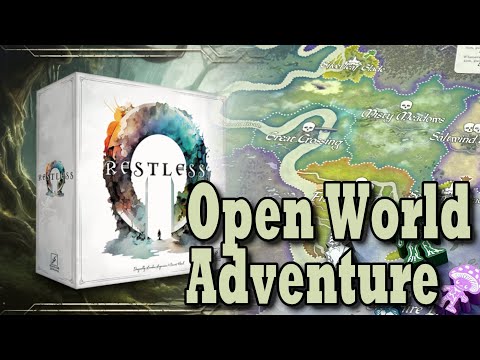


- Amazing art.
- Narrative-driven campaign.
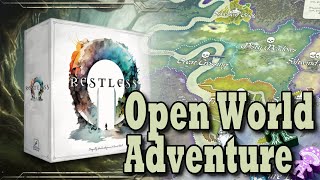
- Open world exploration.
- Fast tactical dice combat.
- Deep character customization.
- Affordable.
- Screen printed meeples.
- Daniel from Dungeon Dive loves it.
- Potentially unique boss fights based on narrative decisions.
- Uncertainty about the depth of character customization.
- Concern about replayability if narrative decisions don't significantly alter gameplay.
- The claim of 'unlimited replay-ability' is a bold one.
- Adventure exploration
- Fantasy
- Storytelling
- Madara
- Oswort
- Leviathan Wilds
Mechanics (from transcript analysis)
- Campaign play — Described as a narrative driven campaign game.
- character customization — Highlights deep character customization as a key feature.
- Dice combat — Uses fast tactical dice combat.
- Modular Board — The use of screen printed meeples over miniatures gives a unique feel, and the game uses tiles or a modular board.
- Open world exploration — Features open world exploration.
Video topics + discussion points
Quotes (from this video)
- So, like every year, we go over the games that we are most excited for in next year, whether or not we know if they're going to be good.
- 2026 is shaping up to be an awesome year.
- From my understanding, one engaging narrative with impactful choices leading to multiple paths throughout various missions and p personal journeys.
- So, it's like that could be either really really cool or incredibly cringey.
- Throughout the journey, the decision you make will permanently shape your character's personality and the relationship with other individuals, opening and closing possible paths along the way.
- That alone differentiates this from a bunch of like other games of this type because no other game really has like a a relationship meter or a whatever.
- So I think this could be really cool.
- It's a fairly simplistic game.
- Um, and you're going through and you know, you build your convoy and you're just doing it's it's it's one of those it's kind of hard to explain like you're like I said, you're trying to race.
- But you know, this is a fun one and it's it's I'm excited to see how streamlined they make it, you know, uh, and see how much faster it makes the games go.
References (from this video)
- Great little adventure game
- Very easy to play and set up
- Quick campaign structure
- Game of random encounters
- Cool character building
- Effortlessly easy and fun
- The campaign is somewhat similar in structure to Warhammer Quest Darkwater
- Adventure game with a quick campaign structure
- Overland map leading to different areas
- Random encounters and boss fights
- Warhammer Quest Darkwater
Mechanics (from transcript analysis)
- Campaign play — A structured campaign that progresses through random encounters and boss fights.
- Character progression — Players build up their stats and gear, including skills associated with gear.
- Overland movement — Players move on a small overland map from one area to the next.
- random encounters — The game is 'just a game of random encounters' triggered when entering areas.
Video topics + discussion points
Quotes (from this video)
- And in this video, I'll be discussing the best games that I played in 2025.
- And the golden torch award I am giving out to games that uh are just shining examples in the hobby. They are the golden torches and I think the game that I am awarding that to this year really really does deserve it.
- But my most disappointing was the uh the expansion for Talisman fifth edition, the co-op expansion. Man, what a disappointment.
- Those house rules created by Dragon Phoenix Games, which are the designers and publisher for Gathering Gloom, are great. they make the game how it should have been from the beginning.
- Wandering Galaxy was going to be my game of the year. It's a fantastic game.
- Conversely, my game of the year and the winner of the very very first Dungeon Dive Golden Torch award is shockingly just shocked me to like I couldn't believe that I am giving my game of the year to a Stonemer Games game uh from from uh from Jamie Stagmire and that is Vantage.
- It is so effortlessly easy to set up, to learn, to play. I mean, it literally takes about 5 minutes to set the game up and start playing.
- What I care about is having an experience of having a fun experience of exploration of discovery of mystery of of that kind of illusion of infinite possibility.
- And I can't think of another game that gives me that illusion better than Vantage does. It is absolutely truly the modern adventure game perfected.
- So, all right. Well, hey, let me know some of the best games you played.
References (from this video)
- Ends in an epic boss fight
- Small footprint
- Tight gameplay focused on positioning
- Variable game length options
- Deep character customization
- Unique theme and potential for unique mechanics
- Does not explicitly call itself a boss battler
- Might be considered a stretch for the list by some
- Publisher is unproven, this is their first game
- Uncertainty about the depth and quality of the boss fights
- Adventure game with boss fights
- Nordic Seas
Mechanics (from transcript analysis)
- Boss Battler — While not explicitly called a boss battler, it culminates in an epic boss fight and is discussed in the context of boss battlers.
- character customization — Offers deep character customization, including finding weapons, equipment, companions, skills, and professions.
- Cooperative — The game is a co-op adventure.
- Open world exploration — Features open world exploration.
- Scenario-based progression — Each playthrough is split into three acts, each culminating in a boss fight.
- Tactical dice combat — Employs fast, tactical dice combat.
Video topics + discussion points
Quotes (from this video)
- So, these are ranked in an order of how excited I am of for them to come out, but that is that obviously all remains to be seen.
- You have to primarily be fighting the boss, not a boss that shows up.
- So, this one just looks very quaint. I like the small footprint it has.
- It just feels like it's going to be a very small form kind of boss battler, which for all these other games I've been talking about have been big grandiose games.
- But the JRPG boss battler system is something I'm very excited for and it being a oneshot.
- So, this is the number two because it's into the unknown and my favorite game of all time is uh I was say Attack on Titan is Aon Trespass Odyssey.
- Is what's this one going to end up being like? Is it going to be more epic like atto or is it going to fall flat a little bit like Kingdoms 4 or is it going to land a little bit in the middle?
- So, like I literally just said, Aon Trespass Odyssey is my favorite board game. So when they announced 12 cents of Heracles, it is I just it's more of that
- The boss battler genre is popping off right now. I absolutely love it.
- So, if you know of any boss battlers that were not on this list, let me know in the comments below because I definitely want to check them out because I this is like I mentioned, if it says narrative driven campaign or boss battler, I'm I'm all in.
References (from this video)
- Easy and quick setup.
- Great solo experience.
- Engaging narrative and world-building.
- Fun dice placement puzzles tied to classes.
- Satisfying character progression through experience and leveling.
- The reputation system adds variety and replayability.
- The player board is well-designed.
- Lots of replayability due to numerous stories, bosses, and items.
- Players need to be comfortable with randomness.
- Limited direct player-to-player cooperation in co-op mode.
- Adventure, exploration, and combat against corruption and impending doom.
- Avarion, a world of endless woods, cities, and wilderness where corruption is spreading and monsters are appearing.
- The game uses an adventure book with numbered encounters tied to locations and specific adventure codes.
Mechanics (from transcript analysis)
- action selection — Players choose from various actions each turn, including travel, resting, engaging with adventures, and trading.
- Adventure Book — A large book contains numerous numbered encounters tied to specific locations or codes, driving the narrative.
- Character progression — Characters gain experience by exploring and can level up, increasing attributes and gaining new professions.
- Combat — Players engage in combat against monsters using dice rolls and character abilities, with distinct phases.
- Dice Placement — Dice results are used to trigger class abilities and manipulate outcomes, creating a puzzle element.
- Dice Rolling — Dice are rolled to determine random events, combat outcomes, and progress on the doom tracker.
- exploration — Players move across a map, exploring new locations which can trigger events, grant experience, and cause damage.
- Reputation system — Reputation with different cities can be gained or lost, providing discounts and unlocking benefits.
- Set Collection — Players can acquire various items, weapons, armor, and profession cards that enhance their character.
Video topics + discussion points
Quotes (from this video)
- This game to me just screams solo player. So if you're a solo player, this is definitely for you.
- The game is so easy to set up and play, right? It'll take you literally 5 minutes to set it down, have an adventure.
- This is one of the better adventure systems, especially for solo mode, because it plays quick.
- The writing, I feel like, is quite solid in here.
- The player board is also awesome. So dang cool.
References (from this video)
- Absolutely love this game.
- Does so many things that I love in adventure board gaming.
- Perfect solo game.
- Effortlessly easy to learn and play.
- Excellent at the character level with many ways to build out your character.
- Lots of build variety.
- The game plays very quickly, especially solo.
- Super super cool.
- The turn sequence is very simple.
- Combat is pretty fast and fun due to dice manipulation.
- Love exploring this world.
- The writing is pretty good.
- A whole heck of a lot to love about Restless.
- It's in a really good place as a prototype.
- The box size is normal and will fit on a shelf nicely.
- There are some errors in the adventure book, and they are going through corrections.
- The reviewer found two mistakes in the adventure book so far.
- The red and purple D10s are pretty close in color in the prototype.
- The design of the D20 timer mechanism has some randomness.
- Adventure
- Runebound
- Talisman
- Lands of Galier
Mechanics (from transcript analysis)
- Campaign play — The game is played over a short campaign consisting of three chapters.
- Character progression — Characters gain experience, unlock abilities, and can improve attributes like intellect, strength, agility, and fortune.
- Class system — Character classes are based on the weapon equipped and are represented by double-sided cards.
- cooperative play — The game can be played cooperatively with up to four players.
- Deck Building — Players can equip gear cards, including weapons, armor, and magic potions, from a large deck of numbered cards.
- dice manipulation — Players can manipulate dice rolls in combat to achieve desired outcomes or trigger special effects.
- Dice Rolling — The game uses D10s for combat (strength, quick, magic attacks) and a D20 for the doom track, along with a D100 for random adventures.
- exploration — Players explore different regions on the map, shading them in as they are visited and gaining experience.
- questing — Characters can undertake quests that may involve multiple steps, often initiated by random encounters or events.
- random encounters — The game features random encounters keyed to specific regions, utilizing a large book of adventures.
- Reputation system — Players can gain or lose reputation with different factions, which can unlock benefits or lead to becoming outlawed.
- Resource Management — Players collect resources like plants, fur, bones, and gold to buy items or trade.
- World Events — World event cards introduce ongoing effects that can complicate the game and change various aspects of gameplay.
Video topics + discussion points
Quotes (from this video)
- The goal of this rulebook is to be read only once. Ideally, you could use it to kindle the flames in your fireplace before the first session.
- The giant book of adventures is really just a huge book of random encounters.
- The combat in this game is fun. There's lots of dice manipulation and as your character grows, you can do some really neat things by manipulating dice, rolling extra dice. You can manipulate the dice that the monsters have rolled, all kinds of cool things. It's really neat.
- There is so much build variety in this game and I can't wait to kind of just play it again to see what kind of a new build I can make.
- Restless. This game ticks off a lot of boxes of games that I look for and it is a lot of fun.
References (from this video)
- Engaging tactical dice combat with a clever slotting system
- Clear, tactile production elements (dual-layer boards, slotting, visible progression)
- Accessible for newcomers while offering meaningful decisions
- Strong variation in player loadouts and playstyles across acts
- Overwhelming randomness can crush strategic control over longer campaigns
- Limited and often solo-leaning cooperative interaction outside boss fights
- Expansion content and base game contents are not clearly delineated in campaigns
- Production risk and delivery timing warnings due to a first-time publisher
- cooperative fantasy exploration with dice-driven combat
- Everion, a three-act cooperative fantasy world
- choose-your-own-adventure influenced by D100-driven events
- Gloomhaven: Jaws of the Lion
- Descent: Legends of the Dark
- Merchants Cove
Mechanics (from transcript analysis)
- D100 adventure book events — Exploration and events are driven by a D100-based adventure book, with territory lookups and quest codes guiding multi-step objectives.
- dice slotting — Roll colored d10s and assign them to slots on a character board; minimum values activate abilities; middling rolls can be combined with gear to achieve effects.
- doom tracker and boss encounters — Global doom progression pushes toward boss fights; escalating pressure creates tension across chapters and acts.
- dual-layer character boards — Character progression is shown on layered boards with dedicated spaces for weapons, armor, spells, and items, providing clear loadouts.
- simultaneous combat resolution — Damage and outcomes resolve simultaneously; killing a monster doesn’t prevent its attack that round.
Video topics + discussion points
Quotes (from this video)
- The dice combat system is genuinely the most fun part.
- Dying is super forgiving.
- Overwhelming randomness crushes strategic control.
- Combat is a tactical puzzle, but broader game structure lacks meaningful player control.
- Dual-layer boards with visible progression are brilliant design.
- Campaigns feel like choose-your-own-adventure with rules that you keep needing to reference.
References (from this video)
- Easy entry with low rule overhead while maintaining agency and depth
- Core combat system is intuitive and puzzle-like, with satisfying depth
- Excellent production quality for a prototype, with thoughtful components
- Dual-layer gear boards enable varied, reusable loadouts without constant rule-checking
- Strong exploration loops and region-based incentives drive replayability
- Book-based navigation can be fiddly and region-first lookup may slow play in practice
- Quest tracking relies on memory of encounter numbers, which can be easy to forget
- Prototype may need dice balance or UI refinements before final release
- Narrative through-line is lighter; some players may want a stronger overarching story
- Exploration, cooperation, and light-hearted fantasy adventure with boss battles
- A three-act, world-spanning fantasy world with regions to explore
- episodic, vignette-based encounters with a lightweight overarching arc
- Lands of Galer
- Lands of Gala
Mechanics (from transcript analysis)
- combat manipulation and healing — Abilities allow re-rolling or modifying dice; healing occurs at end of turn or in cities.
- Combat: Dice — Dice of various colors allocated to cards to trigger effects; monsters also roll and are manipulated by abilities.
- Dice-based combat — Dice of various colors allocated to cards to trigger effects; monsters also roll and are manipulated by abilities.
- doom track timer — A doom track advances each round via a dice roll, pushing toward boss encounters and signaling the session's end.
- dual-layer player boards — Character-specific boards that load out gear via slots; enables varied builds without rule references.
- no-die death rule (hospitaling) — If you lose combat, you are sent to a hospital and skip a turn to recover rather than dying.
- quest system via region name and number — Quests are identified by a region and a number; players can request a specific quest during play.
- region-based exploration with random encounters — Move on a world map, roll for encounters in each region, and resolve via an adventure book reading by another player.
- three-act campaign with boss structure — Boss encounters scale through the acts; finishing the third act resets the campaign can start again.
Video topics + discussion points
Quotes (from this video)
- Restless has a lot going for it because it manages to hit that right spot over and over again.
- Two players is a sweet spot for us.
- The combat system is a particular highlight. It's a real satisfying puzzle to try and flesh out what you're going to do with the dice that you've rolled.
- The dual layer player board is really a revelation in the way that it acts as a gear loadout.
- It's a nice time with low complexity chill time as you go about and have adventures.
References (from this video)
- Whimsical mushroom-themed setting with lighthearted humor
- Open-world exploration and modular boss structure
- Beautiful watercolor/art style and accessible prototype feel
- Flexible progression paths (professions, attributes, cards) that enable varied playstyles
- Prototype rules can feel incomplete or unstable during live play
- High randomness and chaotic moments can overwhelm strategy
- Player interaction is limited, which may reduce cooperative satisfaction for some groups
- Exploration, alliance-building, and boss encounters across three chapters; mushroom-themed character concepts and whimsical fantasy lore.
- Open-world fantasy with mushroom folk exploring a multiregional map, encountering regions like Silver Leaf Glade, Misty Meadows, Blighted Woods, Echoing Hills, and Hammerfall-esque locales.
- Chapter-based progression with three distinct bosses per game cycle; open-world exploration with player-driven choices and event-driven storytelling.
- Asylum
Mechanics (from transcript analysis)
- Character progression — Attributes, weapons, armor, professions, and class cards evolve as players gain XP and level up.
- cooperation with individual goals — Game encourages a semi-cooperative, multiplayer-solitary feel where players mostly act independently but share a boss encounter and can aid each other indirectly.
- Dice-based combat — Combat uses colored dice (green, red, etc.), with modifiers from class cards and weapons; can upgrade dice via abilities.
- exploration and events — Exploring new regions triggers adventure/event checks (D100-like tables in the prototype); travel costs and damage are tracked.
- resource and reputation management — Players manage herbs, gold, and reputation with four cities, influencing trade costs and certain actions.
Video topics + discussion points
Quotes (from this video)
- This game is about shrooms. All about shrooms.
- Restless is going to be uh very different from Asylum.
- You start with impending doom. If you're the profit of doom, you roll this die and move up the track.
- This is multiplayer solitary game because we cannot interact with each other very well.
References (from this video)

- strong artwork by the designer
- custom pirate flavor
- rules can be dense for new players
- piracy and plundering
- pirate-themed deck-building combat
- bold, high-energy micro-encounters
Mechanics (from transcript analysis)
- Deck Building — build a pirate-themed deck to battle opponents
- deck-building — build a pirate-themed deck to battle opponents
Video topics + discussion points
Quotes (from this video)
- we're doing a fundraiser to raise money for Black Lives Matter
- we support the protesters that are fighting for racial equality and justice
- we've put together this fundraiser so tonight all the donations will go to Black Lives Matter
- we'd appreciate you to donate
- look out Eric Lang on Twitter; he talks about his experiences suffering racism
References (from this video)
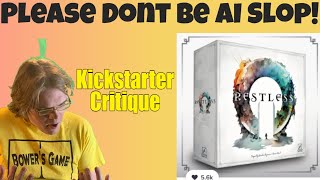
- High production value with dual-layer boards and spiralbound book
- Open world exploration with many cards and flavor
- Reasonable base price and deluxe upgrade value
- Strong potential for replayability and expansions
- Weak main image; visuals do not sell the game well
- No stretch goals listed; concerns about deluxe upgrades and pre-stretch claims
- Expansion presentation lacks clarity and value
- Unclear details about deluxe components and timing; shipping costs high
- adventure, treasure hunting, exploration, factions
- open-world fantasy sea exploration across a vast continent
- lore-rich, branching adventures with multiple sessions
- Terramystica
- World of Evasion
Mechanics (from transcript analysis)
- co-op/competitive options — Factions and guild interactions; co-op exploration with potential competition.
- deep character customization — Many options to customize character abilities and progression.
- fast tactical dice combat — Dice-based combat system with quick engagements.
- Open-world exploration — Players explore a large, map-based setting with diverse regions.
- solo mode — Supports solo play with rules integrated.
- story-driven adventures — Campaign-style sessions with events and bosses.
Video topics + discussion points
Quotes (from this video)
- I want to play that game right now solo.
- That game looks like a banger.
- This is a fast pacing experience with simple rules to shine.