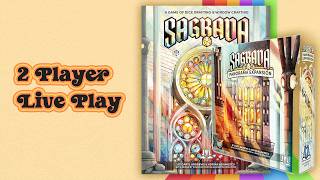
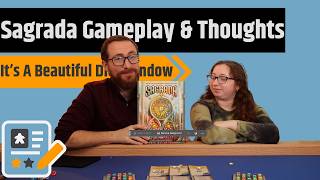
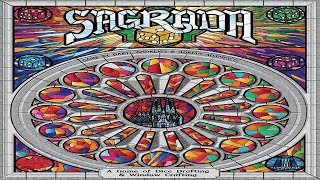
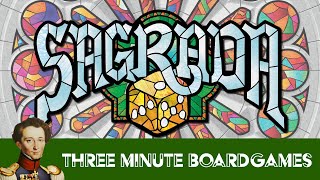
Draft dice and use the tools-of-the-trade in Sagrada to carefully construct your stained glass window masterpiece.
In more detail, each player builds a stained glass window by building up a grid of dice on their player board. Each board has some restrictions on which color or shade (value) of die can be placed there. Dice of the same shade or color may never be placed next to each other. Dice are drafted in player order, with the start player rotating each round, snaking back around after the last player drafts two dice. Scoring is variable per game based on achieving various patterns and varieties of placement...as well as bonus points for dark shades of a particular hidden goal color.

Special tools can be used to help you break the rules by spending skill tokens; once a tool is used, it then requires more skill tokens for the other players to use them.
The highest scoring window artisan wins!
Sagrada Challenge - 2/5
- Strong player interaction and board awareness
- Adds depth with mini expansion and special creatures
- Accessible entry with clever constraints
- Replayability may be limited for some players
- May not have long-term variety compared to heavier games
- Array
- Coral reef
- Abstract
- Arribada
- Maya
Mechanics (from transcript analysis)
- Area Control — expand reefs to touch more of your animals and fewer of opponents and score when reef is surrounded
- Area Control / Surrounding Reef — expand reefs to touch more of your animals and fewer of opponents and score when reef is surrounded
- hand management — draw new tiles after expanding a reef to maintain hand size
- special abilities — special animal tiles grant one-use rule-bending effects
- tile placement — play animal tiles or reef tiles onto the board
Video topics + discussion points
Quotes (from this video)
- Oh my god, look how adorable this case is. It's a turtle, but also a board game.
- Arribada is a math-based competitive puzzle.
- If you are looking for a game in that genre, I highly recommend checking it out, and especially if you want a board game with a turtle as the box, I think it's worth taking a look at.
- I really like how this game encourages you to be aware of what's going on around the table instead of just looking down at your pieces.
- I haven't gotten bored of Seagrass yet, but I feel in my stomach that if you are looking for a game with a lot of replayability, Seagrass might not be able to deliver.
References (from this video)
- gorgeous dice and presentation
- puzzle is quick to grasp
- variety from different window patterns
- can be punishing if you make mistakes
- stained glass puzzle
- cathedral windows
- abstract puzzle
Mechanics (from transcript analysis)
- dice drafting — draft colorful dice to place in patterns
- Pattern Building — fill a grid with constraints for scoring
- pattern-building / tiling — fill a grid with constraints for scoring
Video topics + discussion points
Quotes (from this video)
- it's like a double puzzle absolutely wonderful absolutely amazing
- the dice in this game are gorgeous
- it's quick it's beautiful it has a puzzle element
- it's basically a dice placement slash worker placement game
- I will forever love it
- Andrew Bosley is just the MVP
- Clank is just so great
- please God let it happen at some point
References (from this video)
- Accessible and easy to teach
- Turns are brisk and pacing is solid
- Good scalability for 2–5 players
- Beautiful components and cohesive theme
- Relaxing, contemplative puzzle
- Tool cards are underused or underpowered in many plays
- Limited direct player interaction in the base game
- Expansion required to support 5–6 players (though pacing generally remains solid)
- crafting beautiful stained-glass windows with color and pip constraints
- Medieval to early modern workshop crafting stained glass windows
- abstract puzzle with minimal or no narrative
Mechanics (from transcript analysis)
- Compound Scoring — scoring combines public objectives and a private goal for each player
- dice drafting — draft colored dice from a central pool to place on a personal window pattern
- Objective-based scoring — scoring combines public objectives and a private goal for each player
- Pattern Building — build your window by placing dice to match color and pip-number constraints on your pattern
- pattern building / window drafting — build your window by placing dice to match color and pip-number constraints on your pattern
- placement restrictions — cannot place adjacent orthogonally with the same color or the same pip value; wild spaces can be used strategically
Video topics + discussion points
Quotes (from this video)
- I really really enjoy Sagrada
- it's a very accessible puzzle like game
- Sagrada is the saltine cracker of dice drafting modern board games
- I can sit down and I can teach someone the entire rules - Sagrada in ten minutes, five minutes if I don't use the funny British chimney gremlin voice
- it's not like the best game ever but I think Sagrada has a place on my current list of favorite games
- I found it to be a very, very enjoyable filler game
- the rules are dirt simple
- Sagrada is serene non-combative
- it's a game that I'm gonna be keeping in my game library for a long long time
References (from this video)
- Engaging puzzle with tight placement decisions
- Reroll tokens add strategic options
- Beautiful thematic integration of stained glass
- Can be punishing if draft is unfriendly to color/number distribution
- Rules can be slightly fiddly for new players
- Artistic glass window construction using dice
- Stained-glass window workshop in a cathedral
- Competitive puzzle solving with drafting and placement of dice
Mechanics (from transcript analysis)
- dice drafting — Draft dice from a pool each round to place on your window grid.
- dice placement — Place dice on a grid, following adjacency and color/number restrictions.
- dice_drafting — Draft dice from a pool each round to place on your window grid.
- favor_tokens_reroll — Use favor tokens to reroll dice from the draft pool.
- grid_placement — Place dice on a grid, following adjacency and color/number restrictions.
- Pattern Building — Place dice to satisfy a window pattern and color/number constraints.
- pattern_building — Place dice to satisfy a window pattern and color/number constraints.
Video topics + discussion points
Quotes (from this video)
- I am out. I cannot place any of those dice
- This is going pretty good
- I didn't even need to spend that one
- This last one here is my round counter.
- Oh no. I can't put it here or there because there's purples.
- I'm done. I'm good.
References (from this video)
- Improved component quality (cards, dice, scoring sheets) in remastered edition
- Clearer card art and color differentiation, improving accessibility
- Backward compatibility with original expansions and cards
- Brighter, more cheery aesthetic in remastered edition
- Personal objective cards add variety and strategic goals
- Differences between editions are minor; upgrade not essential for existing owners
- Upgrade cost may not be worthwhile for those satisfied with the original
- Stained glass window construction and color/pattern optimization
- Cathedral workshop focused on stained glass and light interaction
- Array
- Sagrada
Mechanics (from transcript analysis)
- Compound Scoring — Common scoring goals revealed during the game that all players can aim to meet.
- dice drafting — Players draft colored dice each round to place on their personal boards.
- dice placement — Dice must be placed on the grid following pattern and placement constraints on the board.
- hidden victory points — Each player has a private objective that scores points based on color distribution or patterns on their board.
- Pattern Building — Each player uses a pattern card that defines the shape and placement possibilities on their board.
- pattern-card constraints — Each player uses a pattern card that defines the shape and placement possibilities on their board.
- Private objective cards — Each player has a private objective that scores points based on color distribution or patterns on their board.
- public objective cards — Common scoring goals revealed during the game that all players can aim to meet.
- tool cards (expansions) — Expansions may introduce tool cards that alter placement or scoring mechanics.
Video topics + discussion points
Quotes (from this video)
- There are differences, but they're minor.
- If you own Cigrada, there's no reason to run out and buy the new one.
- I personally prefer the new one a little bit more because I like this brightness.
- This is definitely one to check out.
- The good news is if you have an expansion or those cards, extra cards, whatever, they all fit from one to the other.
References (from this video)
- Beautiful components and improved accessibility in newer printings (textures on color patterns, larger tarot-sized public cards, dual-layer boards).
- Balanced scoring via private objectives and public goals, with fewer random mismatches due to more even color distribution by player count.
- Engaging drafting mechanics (snake draft) and clear placement rules that create meaningful decisions.
- High replayability due to multiple window patterns, objective cards, and randomized tool cards each game.
- Placement restrictions can be punishing for weaker draws, potentially slowing down early rounds.
- Luck of initial dice can influence early strategy before players settle into private/public objective alignment.
- End-game penalties for empty spaces may lead to rental-like optimizations that reduce flexibility for some players.
- dice drafting and window construction; aesthetic and spatial puzzle
- Stained-glass window crafting in a cathedral workshop inspired by the Sagrada Familia
- procedural, objective-driven with public and private scoring
Mechanics (from transcript analysis)
- dice drafting — Players draft colored dice from a pool each round to place on their window boards.
- favor tokens (currency) — Favor tokens serve as currency to break rules or modify outcomes, with end-game scoring bonuses for unused tokens.
- pattern/board placement — Drafted dice must fit on a given pattern and follow color/number restrictions; placement rules constrain adjacency.
- Private objective cards — Each player has a private objective that rewards a specific color, influencing drafting choices.
- public objective cards — Three public scoring cards are revealed to guide scoring in addition to private goals.
- snake drafting — Turns draft in a snake order: first player picks first, then last, then reverse, etc., toward a dynamic drafting sequence.
Video topics + discussion points
Quotes (from this video)
- Now, Sagrada is a game of dice, drafting, and window crafting.
- The boards are even more beautiful because there's lots of cutouts just in the way it looks.
- It's a little more balanced where you'll get three points for every die of that color on your board.
- This balances out quite a bit.
- Sigrada will be on the top half of that list, putting it in the top 2 and a half% of the thousands of games that I've played as a reviewer over the last 13 years.
- If you'd like to see my full review on Sagrada, I've placed that link below.
References (from this video)
- Adds modular, scalable expansions within the Great Facades line
- Increases player count support to 5-6 players with the right expansions
- Introduces new scoring opportunities and variability through symmetry and rare glass components
- Private objectives in rare-glass configurations create fresh scoring opportunities
- Increases complexity and setup time with multiple modules
- Full experience requires multiple expansion purchases to access all features
- The art and math of constructing beautiful glass windows using down-to-the-pixel patterns and color coordination
- A cathedral workshop where artisans craft intricate stained glass windows for a grand, light-filled interior
- Array
Mechanics (from transcript analysis)
- color/number restrictions — Dice placement must respect the pattern’s color and value constraints; some patterns enforce strict mixes.
- dice drafting — Players draft dice from a central pool to place into a personal window grid, shaping their scoring potential.
- expansion-enabled tools — Base game interacts with expansion modules that modify tools, favors, and scoring dynamics.
- Pattern Building — Players follow pattern cards on their window boards, placing dice to satisfy color and number constraints.
- pattern-based window building — Players follow pattern cards on their window boards, placing dice to satisfy color and number constraints.
- private/public objectives — Score derives from private objectives and public objectives, with strategic emphasis on symmetry and color distribution.
Video topics + discussion points
Quotes (from this video)
- I loved this game so much it made my top 10 games of the year and I gave it my dice game of the Year award
- these expansions will be part of what's called the great facades and they'll be called passion Life & Glory
- each of these three expansions will be modular where you can add in some or all the different modules within each one
- I'm gonna show you a preview of the first of the upcoming three modular expansions in the great facade series called passion
- the essence feel fair is in Germany and it's about to start
References (from this video)
- Tight, high-constraint design creates meaningful decision space and strategic depth.
- Clear, rule-driven flow with a satisfying sense of progression across rounds.
- The flux brush rerolls add a controlled element of luck without breaking tension.
- Visually clean and tactile puzzle feel that rewards careful planning.
- Early placement can feel punishing if the edge or adjacency constraints trap options.
- Certain color/number interactions can lead to dead-ends or repetitive moves.
- Pacing can slow down on harder variations as players chase legal placements.
- color-number placement with adjacency and edge-based entry
- abstract puzzle board with color and numeric constraints
- non-narrative abstract puzzle solving, emphasis on spatial logic
Mechanics (from transcript analysis)
- Board fill objective — The explicit objective is to fill the entire board while adhering to all placement rules, turning the session into a test of foresight, spatial reasoning, and constraint management.
- Color/number matching restrictions — If a number or a color is printed on a given cell, the die placed there must match that attribute, introducing a rule layer that can disrupt otherwise obvious placements and require re-evaluation of the board’s markings.
- dice drafting — The game pool contains five dice of each color, introducing a fixed distribution that players must work with as rounds progress and rows fill.
- dice placement — Roll five dice of each color and place four per round onto a board; each placed die must be adjacent (orthogonally or diagonally) to an existing die. This creates a growing, connected pattern where the trajectory of placement constrains future options and visualizes the evolving layout.
- Dice placement with spatial adjacency — Roll five dice of each color and place four per round onto a board; each placed die must be adjacent (orthogonally or diagonally) to an existing die. This creates a growing, connected pattern where the trajectory of placement constrains future options and visualizes the evolving layout.
- Edge-entry constraint — The first die you place must be along the edge of the board, establishing a boundary condition that influences subsequent placements and the available shaping of the board.
- Five-die pool per color — The game pool contains five dice of each color, introducing a fixed distribution that players must work with as rounds progress and rows fill.
- Matching — If a number or a color is printed on a given cell, the die placed there must match that attribute, introducing a rule layer that can disrupt otherwise obvious placements and require re-evaluation of the board’s markings.
- Rerolls and flux brush — A flux brush provides up to three rerolls during the game, injecting a controlled element of luck that can correct misreads or bad rolls but cannot fully override structural constraints.
Video topics + discussion points
Quotes (from this video)
- The first dice you place has to be along the edge of the board.
- Every other die has to be adjacent to one already placed, either orthogonally or diagonally.
- If a number or a color is printed on your board, the die you place there has to match it.
- Round three. Oh boy, those purples are tough.
- We could put the red two there anyway because there's already a two next to that spot.
- I need a one. Yes.
References (from this video)
- easy to learn
- great solo puzzle
- expansions add variety
- satisfying sudoku-like challenge
- solo rules can feel different from multiplayer norms
- design and puzzle of glass windows
- Stained glass windows in a cathedral
- puzzle-forward with spatial layout
- Floriferous
- Viticulture
Mechanics (from transcript analysis)
- dice drafting — draft dice to place on a grid following pattern cards
- Pattern Building — fill a grid to meet pattern requirements with color/number constraints
- pattern/slot optimization — fill a grid to meet pattern requirements with color/number constraints
- tool cards — use cards that modify dice or placements with color constraints
Video topics + discussion points
Quotes (from this video)
- this solo variant is very much like that where Becky or Becca whatever the heck her name is you are just doing a few things back and forth with her
- the three different tracks you're going up and you're trying to bring all of these different rides into your park
- it's a really good like set collection game you're collecting different flowers and different bugs in order to gain some points
- i scored 50. so i don't know if i just scored it wrong but i was very proud of myself
- it's so easy at the table it's such a good puzzle
- i'm very excited to get cartographers and cartographers heroes to the table more
- this is one of my favorite solo games and i did play it in august
References (from this video)
- puzzle-like depth
- tight spatial placement
- appealing art and theme
- remastered edition adds polish
- die color distribution can be frustrating
- short game length may limit strategic planning for some players
- requires careful tracking of rules for new players
- Array
- Array
- Crafting colored dice into a window under pattern constraints
- Array
- Stained-glass window-building puzzle, abstract fantasy setting
- Array
- Array
- Array
- positive
- Sagrada
Mechanics (from transcript analysis)
- color-adjacency-restriction — No two adjacent dice may share the same color
- dice drafting — Draft dice from a pool to place on your personal window grid
- dice placement — Place dice on a window grid following restrictions and adjacency rules
- dice-drafting — Draft dice from a pool to place on your personal window grid
- dice-placement — Place dice on a window grid following restrictions and adjacency rules
- Pattern Building — Fill a predetermined window pattern with dice
- pattern-building — Fill a predetermined window pattern with dice
Video topics + discussion points
Quotes (from this video)
- Sigrada is pretty dang close.
- Sigraa challenge, which is sort of a shorter version of the game where I have to place a die, place all four of the five die that I have each round and then get rid of one of them.
- no like dye next to like dye or like color next to like color.
- I've completed the Sigraa challenge.
References (from this video)
- Engaging dice drafting and placement puzzle
- Clear, beginner-friendly tutorial with updated visuals
- Multiple strategies via window patterns and objectives
- Solid demonstration of both two-player dynamics and core mechanics
- Rule complexity can be challenging for absolute beginners
- Edge cases (like solo play) are only briefly touched or left for players to explore on their own
- A few terms/phrasing may be misread or misheard in a tutorial setting
- Design and placement of stained glass windows to score points
- Stained glass workshop during the construction of the Sagrada Família in Barcelona
- Abstract, puzzle-driven with a light thematic framing
- Cigara
Mechanics (from transcript analysis)
- card crafting — Earn favor tokens based on window difficulty and use tool cards to modify placements.
- dice drafting — Roll dice into a central pool and draft them into your window frame according to placement rules.
- dice drafting / dice pool — Roll dice into a central pool and draft them into your window frame according to placement rules.
- favor tokens and tool cards — Earn favor tokens based on window difficulty and use tool cards to modify placements.
- hidden victory points — Score points via private objective dice colors and public objectives related to rows and color variety.
- one-tool-per-turn — On a turn, a player may take a die and/or use a tool card, with usage costs and restrictions.
- pattern drafting — Choose window patterns with secret objectives and decide which sides to use.
- placement restrictions — Spaces constrain placement by color, value, and adjacency; diagonal placement is allowed while sides cannot share color or value.
- placement rule correction — If a window breaks a rule, the player must correct by moving dice from their window back to the pool until compliant.
- private and public objectives — Score points via private objective dice colors and public objectives related to rows and color variety.
- round track / end-of-round mechanics — Track rounds and manage dice leftovers; end of round scoring and round progression.
- tile placement — Place dice on a personal window grid with color/value constraints and adjacency rules.
- tile/board placement — Place dice on a personal window grid with color/value constraints and adjacency rules.
- tool card costs and reuse — Using a tool that already has favor tokens costs more; first use costs one favor, subsequent uses cost two.
Video topics + discussion points
Quotes (from this video)
- The game is played over a total of 10 rounds.
- There are 90 dice included in the game with 18 in each of these five colors.
- The first dye you add to your window must be put into one of the spaces that go around its outside edge.
References (from this video)
- Easy to learn
- Beautiful, colorful components and artwork
- Strong entry point for new players as a gateway puzzle game
- Dice color/number luck can impact strategic options
- May feel repetitive after multiple plays for some groups
- Depth may be limited for experienced players seeking heavy strategy
- Pattern-building through stained glass design
- Stained-glass workshop in a cathedral-inspired setting
- Abstract puzzle with visual and design emphasis
Mechanics (from transcript analysis)
- Compound Scoring — Score via public and private objective cards; strategic placement affects points.
- dice drafting — Players draft colored dice from a common pool each turn.
- dice placement — Place dice onto a window grid with color and number restrictions plus window-specific requirements.
- Objective scoring — Score via public and private objective cards; strategic placement affects points.
- Pattern Building — Use window pattern cards to guide placement and scoring.
- pattern-building — Use window pattern cards to guide placement and scoring.
Video topics + discussion points
Quotes (from this video)
- If you're looking for the perfect board game to add to your collection that's easy to learn and easy on the eyes, too, then might I suggest Sigrada from Floodgate Games.
- It's a nice puzzling game for ages 10 plus, and I can tell you all about it in less than a minute.
- Hi, I'm Alex. I'm a board game sa, which means I play a bunch of board games so I can tell you which one's the best.
- If you want to find that perfect board game for you, then follow me.
- Sagrada is a colorful dice placement game where you'll be placing your multiolored die into your player board to try to make the most beautiful and the highest scoring stained glass windows.
- Sagrada is a beautiful game. It's easy to learn but difficult to master.
- The perfect board game to add to your collection that's easy to learn and easy on the eyes.
- And now, as of today, you can find this on the shelf at your friendly local game store.
- greatest artisan ever and win the game.
References (from this video)
- clever, counterintuitive abstract mechanics
- satisfying misdirection and control via line-of-sight
- tactically rich and visually classic
- setup can feel random and unbalanced
- steep learning curve for line-of-sight rules
- theme is minimal or ambiguous
- line-of-sight blocking with mircat and termite mound interaction
- termite mounds and a mircat on the board; light thematic cueing
- thematic veneer is light; concept drives the puzzle
- Yinch
- GI series
Mechanics (from transcript analysis)
- Line of sight — Termite mounds and a mircat constrain where you can place pieces; mircat blocks view unless obstructed by mounds.
- line-of-sight blocking — Termite mounds and a mircat constrain where you can place pieces; mircat blocks view unless obstructed by mounds.
- move-and-block dynamic — The mircat is moved to alter line-of-sight; players aim to force opponent to create a three-in-a-row or block all legal moves.
- placement and restricted visibility — On your turn you place a colored piece anywhere not in the mircat’s line of sight.
- Two win conditions — Win by forcing three-in-a-row for your opponent or leaving them with no legal moves.
Video topics + discussion points
Quotes (from this video)
- Gorgeously produced wooden abstract games.
- The boxes don't look like much, but inside they're always very very nicely.
- They hunt down different designers.
- This one feels like almost a tic-tac-toe variant that someone came up with.
- It's basically Chinese checkers.
- I like this a lot. I'm giving this an eight.
References (from this video)
- Beautiful aesthetics
- Solid solo mode
- Accessible for new players
- Though accessible, some rules nuances require attention
- Art, patterning, color and light
- Stained glass window drafting in a cathedral workshop
- Abstract, colorful, visually driven
- Welcome To... (pattern-building with dice variants)
Mechanics (from transcript analysis)
- dice drafting — Draft colored dice to place on stained-glass patterns
- Pattern Building — Complete windows while adhering to placement constraints
Video topics + discussion points
Quotes (from this video)
- the future is mestizo
- good trouble
- we're not trying to get rid of nobody we're just trying to make space for everyone to be involved
- if you could change your mind i could change the world
- inclusion and diversity in gaming is very important
References (from this video)
- beautiful production
- great for quick two-player sessions
- pattern constraints can be fiddly for some players
- artistic window creation with color/foil patterns
- stained-glass window-building with dice drafting
- puzzle-like, puzzle-box
Mechanics (from transcript analysis)
- dice drafting — players draft colored dice to place on a personal window pattern abiding color/pattern constraints
Video topics + discussion points
Quotes (from this video)
- I think Concordia is one of the best games ever made, full stop
- two players it works extremely well because the downtime is gone
- it's a brain burner game
- the tension in the two-player game is great
- loads of content to explore, tons of replayability
References (from this video)
- Great Sudoku variant
- Beautiful and gorgeous
- Fun to play
- Stained glass creation
- Sagrada Familia cathedral
- Beautiful Sudoku variant
Mechanics (from transcript analysis)
- dice placement — Roll dice and place by color and number
- puzzle constraints — Can't have same colors or numbers beside each other
- Sudoku-like puzzle — Place dice on board following Sudoku rules
Video topics + discussion points
Quotes (from this video)
- Agricola is one of those games that you just got to have in your collection if you like euro style games
- Porta is one of my favorite underrated games
- Broom service I absolutely love food service one of the coolest mechanics in board games 100 percent recommend this game it is a hoot
- Barron Park is my favorite polyomino Tetris in a board game game
- Orleans is a top 5 game for me period just one of my favorite games to play ever
- Power grid this was the game that got me into board gaming y'all
- Seven wonders this is a modern-day classic
- Betrayal at house on the hill every game is different
- King of Tokyo one of those games that you have to have in your collection
- If you like board games one or percent recommend this game
References (from this video)
- beautiful components
- accessible yet deep
- great gateway to heavier abstract games
- rule clarity in some expansions
- pattern cards can be subtle to master
- pattern-building with dice
- stained-glass cathedral window production
- puzzle-forward
- Sagrada Legacy
- Pattern-building cousins
Mechanics (from transcript analysis)
- dice drafting — roll dice and draft for pattern cards to fill a stained-glass window
- pattern-building — achieve specific color/shape patterns for scoring
Video topics + discussion points
Quotes (from this video)
- it's a fight and we're fighting
- analysis paralysis is here to stay
- it's a brain burner
- it's not that heavy there's a lot to do
References (from this video)
- Haven't played it
- Traded it away and regretted it
- Dice drafting
- Abstract
- Abstract
- Role Player
Mechanics (from transcript analysis)
- dice drafting — Selecting dice from a pool and placing them on board
Video topics + discussion points
Quotes (from this video)
- It wasn't just the hundred sort of best designed games this was the hundred games that I feel that I'm particularly sort of connected to
- The games that have a place in my heart really games that I've got a lot of nostalgia for
- It felt a bit like doing a roll and write game but without all of the sort of convenience
- I wish I still had castles of burgundy and notre dame
- The main thing that got in the way for me was all the iconography
- I do use board games as an escape from screens and technology
- I really like the production of cockroach poker
- I found it was a game where I could see the ending coming and then someone would just go and there we go we've got another 20 minutes now
- It feels like something other than a board game
- The decisions you make in the game are very very slight
- Right up my alley
- I do really like push your luck
- That's my favorite game
- Abyss is my second favorite game
- I love pekka pig
- I just think it's ugly
References (from this video)
- Beautiful art and design
- Accessible yet puzzle-like
- Great for teaching and family play
- Can feel unforgiving at higher player counts
- Die luck can influence outcomes
- Crafting colorful stained glass windows
- Stained glass workshop inspired by the Sagrada Família
- abstract puzzle
- Cascadia
- Blazon
Mechanics (from transcript analysis)
- dice placement — Draft and place rolled dice on a grid to meet objectives and shaping the window.
- drafting — Select dice from a pool each turn to fill your grid.
- Public/private objectives — Score from shared objectives and your own private goals.
- Restriction-based placement — Placement rules based on color and pattern restrictions.
Video topics + discussion points
Quotes (from this video)
- Sagrada is a really cool dice placement puzzle
- beautiful art and design of the game
- a really cool bounty hunting pick up and deliver game
References (from this video)
- beautiful components
- accessible and family-friendly
- roll randomness can be limiting for some players
- pattern-building with dice drafting
- stained glass window design
- abstract aesthetics
- King of Tokyo: Dice Edition
- Canvas
Mechanics (from transcript analysis)
- dice drafting — Draft dice with specific colors/shades to complete patterns on a grid.
Video topics + discussion points
Quotes (from this video)
- King's Dilemma is a beast.
- I would never get rid of that one, that is perfect.
- There is a real appeal to negotiation games; they're so interactive and social.
- This is absolutely one of my favorite party games.
- Two Rooms and a Boom is completely unique.
- New Angeles is such a cool example of negotiation in a modern setting.
References (from this video)
- beautiful components
- solving abstract grid patterns with dice
- can be challenging for newcomers
- pattern building and dice placement
- stained glass window design
- puzzle-like, abstract
- Star Realms
- Azul
Mechanics (from transcript analysis)
- dice drafting — draft dice to fill a grid with constraints
- Pattern Building — fulfilling patterns on a grid with color/shade constraints
Video topics + discussion points
Quotes (from this video)
- we celebrate women's history month by looking at some of the women in board game design
- gatekeeping and systemic racism in board gaming that we all need to overcome
- we need less games that are about cis white maleness we need more feminism we need more racial diversity
- acceptance and being a good human is saying that you're adequate and you're welcomed
References (from this video)
- exploration of political power themes
- prototype; not yet fully developed or publicly released
- dynastic politics and power maintenance
- ancient political power dynamics involving Nero's lineage
- prototype exploration
Mechanics (from transcript analysis)
- political power management — navigating power structures while managing familial dynamics
Video topics + discussion points
Quotes (from this video)
- we are going to see what other goodies we can fit in there.
- Queen of Spies is a solo game that I did with David Thompson, uh, about running a spy ring in World War I.
- Night Witches is in print at the factory. And I've been waiting to share it with the world for a long time.
- The game is literally about traveling around the country and trying to see as many bird species as possible.
- I want to recommit to my YouTube channel and we'll kind of see what that looks like.
References (from this video)
- Aesthetically stunning and visually striking with vibrant, color-rich dice; the stained-glass mosaic motif is immediately appealing on the table.
- Accessible and easy to teach; well-suited as a gateway game that remains engaging for a wide audience.
- Simple core mechanics that scale into thoughtful, strategic decisions as players delve deeper into placement and tool usage.
- Strong component quality and variability through public/private objectives and tool cards, offering replayability.
- Dice-drafting luck can influence early rounds and may frustrate players who crave tighter control.
- Placement rules, while simple, can feel fiddly or punishing to some players as the window becomes more constrained.
- Setup and component organization can be a bit involved, potentially slowing first-time players down.
- Colorful mosaic window-building with a religious/architectural motif; abstract puzzle aesthetics.
- A fictional church in which players craft stained-glass windows by placing dice to form patterns and mosaics, guided by color and shape constraints.
- Abstract/puzzle-driven theme rather than a strongly narrative experience.
Mechanics (from transcript analysis)
- Compound Scoring — The game runs across ten rounds, with a final tally using tokens to determine final scores and potential 50-point tallies if flipped.
- dice drafting — Players roll a pool of dice each round and take turns selecting dice in a predetermined order, shaping the evolving window.
- hidden victory points — End-of-game scoring is driven by private color targets and published pattern objectives, adding strategic visibility into others' progress.
- pattern-building window placement — Placed dice must follow adjacency rules and respect color and number restrictions while filling a personal window grid.
- private and public objectives — End-of-game scoring is driven by private color targets and published pattern objectives, adding strategic visibility into others' progress.
- round-based progression with scoring total — The game runs across ten rounds, with a final tally using tokens to determine final scores and potential 50-point tallies if flipped.
- tool cards and influence tokens — Tools modify placement rules or grant special actions; influence tokens power tool usage and can mitigate placement constraints.
Video topics + discussion points
Quotes (from this video)
- It's super aesthetically pleasing.
- I love games that are aesthetically pleasing to the players and to those who might be walking by and look down at the table and go, 'Ooh, wow that looks really cool.'
- Not an overly heavy game as far as that's concerned; the mechanisms are super simple.
- It's an easy game to teach and everybody had such a great time at the game.
- The tools give you mitigation that you wouldn't normally have and I really enjoy that a lot.
- I'm really excited for that new version to hit.
References (from this video)
- therapeutic and relaxing
- beautiful production, translucent dice
- smooth flow and accessible to new players
- dice drafting can feel cutthroat when a coveted die is claimed just before you
- crafting stained glass windows
- stained glass workshop, cathedral windows
- abstract puzzle with decorative art
Mechanics (from transcript analysis)
- dice drafting — draft colored dice and place them on a personal grid to form patterns
- Pattern Building — placement rules prevent duplicates in rows/columns and color constraints
Video topics + discussion points
Quotes (from this video)
- it's a really therapeutic game
- the production is gorgeous
- I just enjoy looking at all the arts
- extremely relaxing to play
- I don't care about winning, I just enjoy the process
- lose myself in this one
References (from this video)
- Beautiful components and visuals
- Engaging puzzle-like decisions
- Can be intimidating for newcomers
- convincing colored glass patterns
- stained glass window workshop
Mechanics (from transcript analysis)
- dice drafting — draft dice to fill a stained-glass window grid
- pattern-building — fit dice into patterns with color/number constraints
Video topics + discussion points
Quotes (from this video)
- it's a beautiful game
- dice are mean
- you gotta feed your birds
- travel with it
- it's a quintessential dice rolling game
References (from this video)
- beautiful art and components
- great for light strategic play with family
- some expansions can complicate setup
- luck in dice draw can influence outcomes
- artful, decorative glass panels
- stained-glass cathedral design
- abstract, puzzle-like
- Istanbul: The Deck-building Edition
Mechanics (from transcript analysis)
- dice drafting — draft colored dice to fill a stained-glass window pattern
- Pattern Building — achieve patterns and fulfill public/private objectives
Video topics + discussion points
Quotes (from this video)
- Spirit Island not Spirit Away mind you it's a great movie if we were giving away Badges of approval for movies Spirited Away a batch of approval but Spirit Island also and this is greater than games
- Spirit Island is a fabulous game... it's fantastic
- Terraforming Mars yes it's our favorite ugly game terrifying Mars is amazing
- I would play that anytime you brought it out
- it's so freaking cool
- we're giving away four copies of Sagrada to four different people
References (from this video)
- Elegant, fast solo mode with clear decisions
- Scoring mechanic that integrates draft choices with end-game score
- Quick gameplay — around 20 minutes per session
- Solo can feel stingier with RNG and fewer rounds
- Two-player dynamics can expose some trade-offs more sharply than solo
- dice drafting into a stained-glass tableau
- Cathedral glass-window workshop; dice are the raw material
- abstract puzzle with spatial placement
Mechanics (from transcript analysis)
- dice drafting — Draft and place colored dice into your personal tableau to meet constraints.
- end-of-game scoring via track — Unused dice and placement influence end-score through a track-based mechanism.
- Limited Points — Unused dice and placement influence end-score through a track-based mechanism.
- tableau building — Place dice on a grid with color and value constraints to maximize score.
Video topics + discussion points
Quotes (from this video)
- interpretive solo games ... simulate the experience of playing the multiplayer version without having to fully go through the painstaking conduct of an automated opponent
- scythe and root are great examples of games that have good solo modes at this point with a better bot project
- i want to see more of those types of games
- i want to see more solo games for kids
- points don't matter
References (from this video)
- beautiful production and tactile dice
- clever spatial and pattern constraints lead to meaningful decisions
- can be punishing on first plays for color/positioning rules
- table presence is high but setup time is moderate
- dice drafting and pattern-building
- stained glass window workshop
- abstract yet visually thematic
Mechanics (from transcript analysis)
- dice drafting — Draft colorful translucent dice to fill a window pattern and score based on pattern and color rules.
- pattern-building — Rules constrain where dice can be placed to form aesthetically pleasing ‘windows.’
Video topics + discussion points
Quotes (from this video)
- one of the biggest things you know as being a good game designer you want to give players interesting choices
- Gamers or people in general they want to feel rich they want to feel powerful they want to feel smart
- there's value in playing terrible games
- you can create a system that can be re-themed to different things to make more money
- it's like watching film... you break it down to see how they do it
- this is a monumental feat of game design
References (from this video)
- Unique window-building theme
- Variety through different pattern cards and dice colors
- Tight placement constraints can be fiddly
- Casual players may find rules interactions confusing
- Glasswork / stained-glass window creation
- Cathedral window design with dice drafting
- Abstract puzzle with visual pattern constraints
Mechanics (from transcript analysis)
- dice drafting — players draft dice to place on their window plans
- dice placement — dice must fit on a grid with pattern-card constraints
- Pattern Building — each player uses unique patterns that constrain placement
- pattern-building — each player uses unique patterns that constrain placement
Video topics + discussion points
Quotes (from this video)
- I'm Mark Maya and this is Board Game Coffee
- Have fun, keep gaming, be social
- I hate public speaking
- I'm a gamer first and then I also get to work in the industry and make games as well
- I started content creation the original intent not the intent now
- From hobby to creating board game media
References (from this video)
- beautiful art and components
- accessible to families and hobbyists alike
- puzzle-like placement with moderate depth
- some players may dislike luck of die color/number draw
- scoring can feel rigid without tools
- cathedral artistry and color-rich glasswork
- Stained glass window design studio within a cathedral environment
- puzzle-driven, aesthetically focused
- Azul
Mechanics (from transcript analysis)
- dice drafting — Players draft dice from a common pool to place into a stained glass window pattern.
- pattern-building / placement restrictions — Dice cannot be placed adjacent to same color or same number; tool cards provide mitigation.
Video topics + discussion points
Quotes (from this video)
- gaming is not simply a hobby but a home let's make it both inclusive and diverse
- please remember to be kind and welcoming to everyone it's so important now more than ever
- it's more than just fun and games when you sit down at the table... there's more there's a science there's an academic to it
- one board game at a time
- be nice because it doesn't hurt to be nice
References (from this video)
- Stunning aesthetic and tactile dice placement
- Easy to learn with approachable rules
- Mitigates luck with tools and strategic choices
- Some harder designs can be punishing or tricky near the end game
- Can be fiddly for first-time players when teaching patterns
- Crafting a stained glass window with color and pattern constraints
- A stained glass window design workshop in a cathedral or studio
- Abstract puzzle with luck and strategic placement
Mechanics (from transcript analysis)
- dice drafting — Players draft colored dice from a common pool to place on their window grid.
- grid placement with constraints — Dice must be placed on a grid respecting color/number restrictions and adjacency rules.
- luck/randomness — Dice rolling introduces luck into available options each round.
- private/public objectives — Scores are based on matching private objectives and public patterns.
- tool cards — Players can pay to use tools that modify dice or actions during the round.
Video topics + discussion points
Quotes (from this video)
- Sagrada is a stunning abstract dice drafting game.
- The tactile experience of completing a stained glass window by placing dice is enjoyable for all.
References (from this video)
Mechanics (from transcript analysis)
Video topics + discussion points
Quotes (from this video)
- It's quirky and it's different.
- It's the best one that's out there.
- In 20 years there will be so many better board games with virtual reality, but right now it's the best one that's out there.
- One map and you're racing to finish.
- This is a romantic comedy in a board game.
- Magic Maze is my number one game of 2017.
References (from this video)
- Solid dice-drafting experience
- High variability with expansions
- Setup and constraint tracking can be fiddly for new players
- artistic construction and paneling
- stained-glass window-theme with dice drafting
- puzzle-centric with variable setup
Mechanics (from transcript analysis)
- dice drafting — players draft dice to place on a stained-glass grid with constraints
- pattern-building — placing dice to match grid constraints and maximize points
Video topics + discussion points
Quotes (from this video)
- I'm just blown away by whoever came up with the Punch Cards that can be used with millions of puzzles because there's an app online that has a bunch of different puzzles that you can play but you use the same cards over and over again
- these three cards together and there's only one square showing once you line up on those cards it's either going to be a check or an X
- it's one of those they just keep asking for to come back to the table because it's a really fun Co-op game
- the story in this one has got to be one of my favorites
- this is one of the most clever games I've seen in quite a while
- everything's in one box with the previous campaigns they released; it makes it easy to jump in
References (from this video)
- Accessible, satisfying puzzle design
- Solid family-weight game
- New edition may introduce minor tweaks; rule changes uncertain
- glittering cathedral windows
- Stained glass window design puzzle
- charming, approachable, simple-yet-deep
Mechanics (from transcript analysis)
- dice drafting — Draft dice to place on grid patterns under constraints.
- Puzzle placement — Meet color/number constraints while building a window.
Video topics + discussion points
Quotes (from this video)
- The Crew is back.
- it's mostly Astronauts. Like, it's basically Astronauts with a rethe.
- 2026 has just begun, which means there's plenty of times for things to get better.
- Zenith is absolutely amazing.
- I will burn Mountain Ghost Legacy down to hold on to this one.
References (from this video)
- beautiful art
- strong digital and physical implementations
- dice drafting and placement
- stained-glass window design
Mechanics (from transcript analysis)
- Dice drafting and placement — draft dice and place to meet window patterns with color/number constraints
Video topics + discussion points
Quotes (from this video)
- Our world needs more good humans.
- Be kind to one another.
- Imagine that everyone I'm dealing with is having the worst day of their lives.
- This is July — Bipoc mental health awareness month.