














Salton Sea Deep Dive
What the Community Thinks About Salton Sea
Reviewers treat Salton Sea as a demanding heavy euro that rewards careful sequencing, and the praise centers on how tightly its systems depend on one another. Board of It describes the game as a place where everything is neatly intertwined, and the channel says the tough decisions are so fraught that it cannot express how much it enjoys them. The Dice Tower describes it as a very tight economic game in which drilling, extraction, warehouse space, contracts, shares, and upgrades all compete for the same limited turns, and the channel places it on its ranked list of favorite games. Tabletop Tolson is enthusiastic about the design even though the theme never fully landed personally, calling the game itself dynamite. Board Stupid, filming at a preview event, frames the game as punitive and very well balanced, a design that forces players to do things they would rather not do.
Enthusiasm is not universal, and the criticism tends to focus on the parts of the game that feel less polished. Board of It says the design is not perfect and singles out the stock market and the objective cards as areas that feel looser than the rest. Tabletop Tolson admits the drilling and energy terminology did not stick, which made the game a harder fit personally despite its quality. Meeple University found the first session demanding and says the strategy only comes into focus over repeated plays.
Core Mechanics That Define Salton Sea
Multi-Use Cards
The system reviewers return to repeatedly is the dual-purpose card. Every dollar in a player's hand is also an action that is a stronger version of one of the basic actions on the player board. Spending a card as money means giving up that action, so the same card can anchor a turn one moment and pay for the next turn the following moment. Board of It notes that money only comes in denominations of one, three, and five, and that overpaying gives no change, which pushes players toward the high-value cards whose actions are strong enough to form a core of their strategy. Tabletop Tolson explains that a card used as an action stays in front of the player until the end of the round and then returns to hand, so the cost of using it is temporary. Board Stupid frames the same choice as a constant trade between better actions and the cash needed to pay for them.
Resource Management
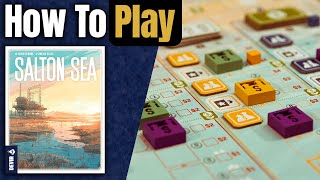
The second mechanic is a tight resource chain that runs from claim to cash. A player pays for a drilling license, drills down to reach brine, extracts it, and then pays again to convert it into lithium or geothermal energy before any real profit appears. Board of It observes that selling at this stage often yields only a sliver of profit and that filling a contract can even lose money, which makes each purchase feel weighty. Drilling and processing also wear down the machinery, and the shortcuts are tempting but expensive. Cheaper claims often carry more rock, which damages the drill and costs victory points, and converting brine can yield double output at the price of severe damage that is not cheap to repair. Tabletop Tolson describes mining as taxing both machinery and workers, forcing regular repairs to avoid losing points at the end of the game. kovray frames the difficulty as coming from very tight resource management and the question of how to reach the desired position, rather than from the sheer number of actions on the board.
The Salton Sea Experience
A Brutal Economy That Never Lets Up
The feel of the game is repeatedly described as brutal. Board of It notes that resources cannot even be stored until a player upgrades the warehouse, and that the early game makes sales thin and contracts risky. The result is less about building an engine calmly and more about surviving the early rounds long enough for a well-timed card to change the trajectory. Board Stupid compares the rhythm to a roller coaster, with a player riding high after a fistful of new action cards, only for the cash to be pulled straight back into the machinery of the company. Board of It sums the effect up as a non-stop white knuckle experience in which no decision feels cheap.
Snappy Turns and Heads-Down Play
Despite its weight, the game moves at a brisk pace. Board of It appreciates that each action resolves quickly and that the turns are so snappy that a player is sometimes not ready when the next turn arrives. Tabletop Tolson says every turn is straightforward: place a worker, take the action, and pass play to the next player. kovray describes the game as very introspective, because much of the work happens on the player's own board and in front of them, with little blocking of spaces and little direct competition for the same action. Meeple University, playing through a live session, found the game could be finished in well under the 120 minutes printed on the box once the rules were familiar.
What Makes Salton Sea Stand Out
Research Cards That Turn Routine Actions Into Turning Points
Research cards are singled out as the feature that keeps the middle game interesting. Board of It explains that each one is either a one-time, very powerful action or a permanent addition that alters one of the basic actions on the board. A research card that arrives at the right moment can be a genuine turning point, and the channel says these cards let ordinary actions feel fresh while helping each player carve out a niche. Tabletop Tolson makes a complementary observation, noting that the basic actions on the starting board have no discounts, advancements, or bonuses of their own, so the growth comes from the cards and upgrades a player adds over time.
Big Game, Small Box
Reviewers remark on how much weight fits in such a compact package. Board of It calls the tiny box a massive space saver and says the package makes the game easy to imagine carrying along, though the running time keeps it from being a truly portable heavy game. Tabletop Tolson describes the box as slim and small for a heavyweight title, and points out that the game is comparatively affordable at roughly forty dollars for the amount of play it offers. kovray also highlights the very small box.
Potential Drawbacks
A Stock Market That Feels Loose
The stock market draws the sharpest criticism. Board of It finds it looser than the rest of the game: buying shares requires cash the player rarely has to spare, and shares only pay off if multiple players sell into the same company repeatedly. The bonuses along the share track are rare and random, and the channel argues they are not worth the money needed to reach them. kovray reaches a similar conclusion, calling the stock track the weakest part of the game for them and noting that it can feel like a lot of work for nothing when other players are not selling into the same companies. Board of It adds that the stock track is especially sensitive to player count, since more players selling means more movement and more value.
Objectives, Contracts, and a Steep Start
Objective cards and contracts draw criticism for feeling like chores. Board of It finds the objectives difficult to complete naturally, a little dull, and not generous enough in points for the effort involved, and says that pursuing some of them can actively hurt because they consume valuable resources without fitting a coherent strategy. The channel also suggests contracts could have been fulfilled automatically on completion rather than requiring a separate action. Learning the game is another hurdle. Tabletop Tolson says the game is likely to challenge a player for the first play or two as they learn the actions and iconography. Meeple University observes that it takes a few plays to realize that a player who ignores better action cards is likely to struggle.
If You Enjoy Salton Sea
- Barrage: Board of It compares the brutal decisions and the constant feeling of never having much control over resources to Barrage, making it a natural next step for players who enjoy the feel of this game.
- Pipeline: Board of It groups Salton Sea with Pipeline as a heavy euro with a very brutal feel, so players who enjoy Pipeline may find a similar appeal here.
What Reviewers Are Saying
"We're particularly enamored with how brutal the economy is. I mean, for a start, at the beginning of the game, even if you could manage to get a bunch of resources together, you can't even store them until you begin upgrading your warehouse. Then, just to get brine, the most basic resource you want, you're going to have to pay for a drilling license, you're going to have to drill, and then you're going to have to pay again to convert it to a better resource."
— Board of It
"Things are tight, money is tight, all your actions are just really, you know, you know, built on one another. And I find those kinds of games incredibly appealing."
— Tabletop Tolson
"What sets this game apart for me is actually the multi-use cards. I'll say it with me. I love this mechanism."
— The Dice Tower