/pic3136431.jpg)
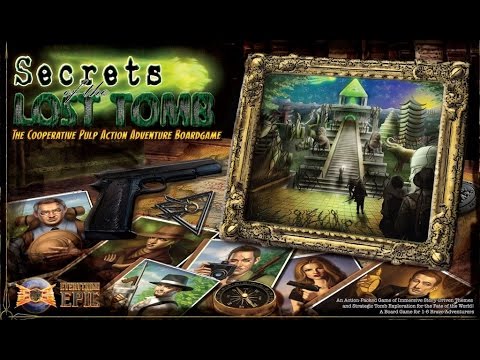
Secrets of the Lost Tomb is a cooperative game of thrilling action-adventure and discovery. Players assume the roles of stalwart expedition members working together to investigate ancient mysteries, while surviving dangers and shielding humanity from the supernatural powers of The Tomb—an ancient vault filled with primeval powers perpetually struggling to be set free upon the world. Powers that mankind should never behold…
Secrets is a tile laying game that allows players to build the tomb tile by tile, creating a new game board and adventure every time. The game is designed for one to six people, each of whom plays one of six possible Adventurers, each with unique powers, abilities, starting items, and attributes.
With the main Cooperative Story Mode and 2 Competitive Modes of Play, many unique Adventurers to choose from, over 50 unique and detailed room tiles, over two hundred tokens, and over three hundred cards, Secrets of the Lost Tomb offers an Ever-Evolving, EPIC, Tomb-Crawling adventure every time you play.

- Exploring for treasures and assembling the Staff of Ra to disrupt a ritual.
- Exploring a pyramid/lost tomb
Mechanics (from transcript analysis)
Video topics + discussion points
Quotes (from this video)
- I would love this game a lot more if it was if if the all the sets were in boxes the size of like Eldrich Horror or or Arkham Horror.
- It always feels like you're coming into the final act of a exciting, thrilling story or movie.
- As they take more sanity they become stronger. They get more enraged and they give into their more base instincts and they become deadlier. But if they push it too far and you level up too much you die.
- It just kind of devolves into this big dice fest where you're trying to kill the old one and they have a ton of health, you know.
- Shelf space is one of the first things that I think about.
References (from this video)
- New art and improved components
- Will be absolutely blown away
Mechanics (from transcript analysis)
Video topics + discussion points
Quotes (from this video)
- And we're going to start with Plaid Hat Games.
- go to their booth. And I'm going to give you a game that completely shocked me.
- It is one of the best games I I've played this year, and we are just having fun.
- Shadowborne Games is killing it.
- It's Avalon. And Avalon looks fantastic.
- And the game that I'm really enjoying, and my grandkids and I are enjoying, is Wingspan Pocket.
- Bandai, um my wife and I went to the Florida Mall.
- The Gundam miniature game looks fantastic.
- The Gundam card game is absolutely fantastic.
- Secrets of the Lost Tomb 10th anniversary edition is coming out very very soon.
- you're going to be absolutely blown away.
- Now, on the negative side, one company that you should stop off and see is Academy Games.
- And it seems there is zero coming from their camp, from their website, or anything else.
- But, the radio silence is disturbing.
- go check out Dragon Dice, which is alive and kicking.
- It's a game that you will fall in love with and have a great, great time.
- So, those are some of the underrated companies and and games that you're going to want to check out at the fantastic Gen Con 2026.
References (from this video)

Mechanics (from transcript analysis)
Video topics + discussion points
Quotes (from this video)
- It's one of those games that's greater than the sum of its parts.
- The way you explore the dungeon is so unique.
- It's focused on strong female characters, which most games aren't.
- The only huge downside right now is it's nearly impossible to get in the United States because of uh trade wars and shipping is insane...
- Make sure whatever you're doing, make sure you're having fun.
- We are so blessed with variety.
References (from this video)
- Immersive thematic storytelling with a strong narrative arc
- Clear structure with distinct adventure and tomb phases
- Modular scenarios offer varied setups and replayability
- Rich equipment and resource management with Soul Shards and artifacts
- Rule complexity and dense components can be daunting
- Setup and organization may be lengthy for new players
- Dice-driven randomness can lead to abrupt outcomes
- Cooperative exploration and survival within a mythic tomb, driven by modular scenarios and narrative events.
- Ancient tomb expedition where players explore rooms, encounter monsters, and progress through a scenario-driven storyline.
- Story-driven, scenario-based with misadventure cards, quest goals, and evolving threats.
Mechanics (from transcript analysis)
- Adventure phase and tomb phase — Gameplay alternates between an action-filled adventure phase and a resolution-focused tomb phase with monster movement and event resolution.
- Audacity/health/courage management — Stats track audacity, health, and courage; these influence dice results and survivability, with potential permanent bonuses.
- Combat and area-of-effect — Combat uses dice, armor, and weapon stats; area weapons can affect multiple creatures but impose courage costs.
- Combat: Damage Based — Combat uses dice, armor, and weapon stats; area weapons can affect multiple creatures but impose courage costs.
- Cooperative Game — Players work together to explore rooms, defeat creatures, and complete scenario objectives.
- cooperative play — Players work together to explore rooms, defeat creatures, and complete scenario objectives.
- Dice Rolling — Characters roll multiple 12-sided dice for checks (e.g., strength, dexterity). Outcomes include regular successes, critical successes, and fails.
- dice-based skill checks — Characters roll multiple 12-sided dice for checks (e.g., strength, dexterity). Outcomes include regular successes, critical successes, and fails.
- Narrative-driven scenario scaling — Different scenarios scale in depth, with customized setups and scenario-triggered effects.
- Resource Management — Items, artifacts, companions, and soul shards drive equipment and upgrade options.
- Resource tokens and Soul Shards — Items, artifacts, companions, and soul shards drive equipment and upgrade options.
- Rest/heal actions — Rest actions allow healing of health and courage under certain conditions.
- Search and treasure — In rooms without monsters, players can search to obtain treasures with varying risk and reward.
- Soulmonger market (barter/trade) — Soul shards are used to buy/sell items and artifacts via a market mechanic, enabling strategic resource management.
- Story cards and misadventures — Story and misadventure cards trigger events and narrative consequences that affect all players.
- tile-based exploration — Room tiles form the tomb; exploration reveals new rooms and often triggers events.
- Tile/Map Shifting — Room tiles form the tomb; exploration reveals new rooms and often triggers events.
- Traps and die checks — Exploring tiles can trigger traps requiring checks; failures impose penalties like status effects.
Video topics + discussion points
Quotes (from this video)
- Secrets of the Lost Tomb I hope those rules you can refer back to them and Dive Right In and get right into enjoying this immersive thematic story driven scenario-based Cooperative game
- This game's played in two phases the adventure phase and the tomb phase
- There you have Secrets of the Lost Tomb I hope those rules you can refer back to them and Dive Right In and get right into enjoying this immersive thematic story driven scenario-based Cooperative game
- We're going to dive into the rules in detail show you how it's played
References (from this video)
- Story-driven, campaign-like feel with a clear objective (recover the staff of Ra and related talismans).
- Cooperative two-player setup with room for two companions per player, enabling interesting partner dynamics.
- Rich exploration with many triggers, status effects, and artifacts that influence strategy and replayability.
- Dramatic narrative cues and scenario-driven pacing, encouraging decision trade-offs (e.g., whether to risk Zeus's bolt).
- Tangible sense of progression via unlocking effects (Fearless) and tiered dungeon depth (levels 1–3).
- Production quirk noted in the video: printed covers were misaligned and required manual adjustment, signaling potential setup friction in some releases.
- Rule complexity is high, with numerous checks, effects, and token interactions that may overwhelm new players and slow early plays.
- Tile and dungeon management demands careful setup and organization to avoid misreads or misplays during flow.
- Narrative cards and scenario book can lengthen games for beginners who are learning the interaction rules and timing.
- Adventure, exploration, artifact collection, curses and destiny, teamwork against a narrative-driven threat.
- An undisclosed island tomb where Pharaoh Razul Ahamed is interred; adventurers explore a multi-level tomb to recover talismans to prevent a resurrected catastrophe.
- Story-driven, scenario-based progression with trigger events and evolving discoveries as you traverse levels.
Mechanics (from transcript analysis)
- Audacity check — A 12-sided dice pool where the number of dice equals the current audacity value; successes (primarily 5-6) yield rewards, with boosts possible by spending audacity; rerolls available via audacity expenditure.
- Combat and weapon loadout — Characters carry weapons and combat effects; trades between players can occur, affecting the group’s tactical options.
- Companions and items — Each character provides starting stats and can have companions; items and artifacts alter combat and exploration capabilities (e.g., Zeus's Bolt, grappling hook).
- Exploration effects — Entering a room can trigger immediate effects (e.g., a curse, a reward, or a scenario cue) that shape the next steps.
- Movement and exploration — Tiles form a dungeon; players move up to a set number of tiles per turn, with level progression (level 1 to 3) and stairs used to descend.
- Mythos and knowledge checks — Non-audacity checks for lore/mystical effects; success thresholds drive narrative outcomes and potential misadventures.
- Scenario effects and misadventures — The scenario book provides a structured sequence of events, including adventure and misadventure cards that impact the room state and narrative.
- Status effects and upkeep — Rewards grant ongoing effects (e.g., Fearless) that modify future checks; upkeep phases refresh items or affect possessions and companions.
- Tomb phase and monster spawning — During the tomb phase, spawn rules create monsters (base and elite) in red-bordered rooms, with placement affecting threat level and tempo.
- Trap tokens and room hazards — Certain rooms accumulate trap tokens that trigger with movement, requiring checks to avoid penalties like being slowed.
Video topics + discussion points
Quotes (from this video)
- we're going to demonstrate the introductory scenario for you and we're going to do that with two players
- this is the scenario book to get read out
- story driven Dungeon Explorer which is the thing that attracted me to it really
- Fearless... that's a pretty good effect
- Zeus's bolt