/pic2037825.jpg)
/pic2037826.jpg)
/pic4089302.jpg)
/pic2037825.jpg)


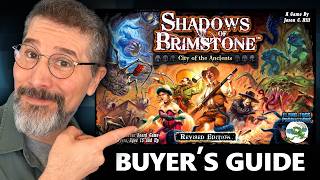














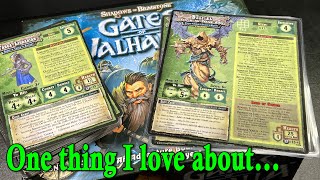











Shadows of Brimstone: City of the Ancients Deep Dive
What the Community Thinks About Shadows of Brimstone: City of the Ancients
Shadows of Brimstone stands as a gateway to something larger than the sum of its components. Community players consistently discover that the core dungeon crawl experience becomes a foundation for personal storytelling, whether played with house rules, hex crawl campaigns, or purely narrative-driven interpretations. Reviewers emphasize the game's thematic coherence and modular nature, noting that its Western horror setting creates a uniquely flexible playground for solo and cooperative adventuring.
Core Mechanics That Define Shadows of Brimstone: City of the Ancients
Exploration Through Revelation and Choice
The exploration system drives meaningful decision-making without punishing curiosity. As heroes move through mines and encounters, they draw exploration tokens that determine what they discover: clues, monsters, treasures, or story beats. Reviewers highlight that this token-based discovery creates genuine exploration because paths split and branch; players must choose which direction to pursue, with some routes leading deeper into danger while others close off prematurely. The holding-back-the-darkness mechanic mirrors time pressure, ensuring that extended exploration carries real consequence. Each drawn token feels revelatory rather than arbitrary, and the combination of procedural discovery with card-based encounters creates variety that justifies replaying the same mines.
Character Progression Through Earned Spoils
Combat and exploration yield loot that directly shapes character capability. Gear cards offer specific bonuses: a Gravedigger shotgun that crits on high rolls, a Hellfire Ring enabling area attacks, weathered ponchos that add resilience. The Dungeon Dive's reviewer noted that these items tell stories of their own; finding a particular gun feels earned and memorable. The skill-check system (testing agility, cunning, spirit, strength, lore, luck) means that character specialization naturally emerges through both leveling and equipment discovery. Over a campaign, heroes develop distinct personalities not through stat increases alone but through the cumulative weight of their discovered artifacts and survived encounters.
The Shadows of Brimstone: City of the Ancients Experience
Western Horror Atmosphere That Invites Imagination
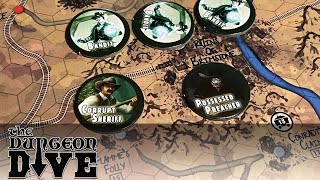
The Western setting grafted onto cosmic horror creates an uncommon emotional tone. Reviewers describe playing in desolate mining towns, stumbling upon lost cities of gold, discovering corrupted sheriffs and possessed preachers; scenarios that feel pulpy and mythic rather than mechanically prescribed. The game's thematic components (artwork, flavor text, enemy names like "void swarms" and "ancient horrors") consistently drive narrative impulse. Even random wilderness encounters, such as a burning man summoning fire or a zombie drawn to an ancient standing stone, become story beats because the setting and mechanics align. The experience feels less like solving a puzzle and more like living through a serialized Western adventure.
Cooperative Storytelling in Persistent Worlds
Heroes develop relationships with recurring locations and NPCs through hex crawl mechanics. Reviewers who played Shadows of Brimstone as a campaign game with persistent towns discovered that visiting the same settlement multiple times, rolling random location events, and discovering how one town's troubles connect to another creates emergent narrative. A mutant-enslaved mining town connects thematically to a mutant settlement in the next region; helping one population feeds into a larger quest arc. This hex crawl integration means that Shadows of Brimstone becomes not merely a sequence of dungeon delves but a living world where characters earn allies, make enemies, and uncover overarching mysteries across multiple sessions.
What Makes Shadows of Brimstone: City of the Ancients Stand Out
Modular Encounter and Loot Systems Built for Customization
The game arrives with dozens of pre-built encounters, loot cards, and scenario hooks that support radical customization without requiring external materials. Reviewers emphasize that the included encounter decks, location tokens, and threat tables provide enough modular pieces to invent entirely new missions or adapt exploration rules. The token-based system (junctions, clues, encounters, special effects) allows solo players to split exploration paths, backtrack with ambush risk, or introduce thematic quest tokens that replace standard encounters. This architecture means that house rules and personal campaigns feel seamless rather than bolted-on; the game's bones support extensive modification while remaining recognizably Shadows of Brimstone.
Solo-Friendly Design That Requires Minimal Arbitration
Unlike many dungeon crawls, Shadows of Brimstone's core mechanics accommodate solo play through deterministic skill checks and random-but-fair encounter tables. The Dungeon Dive's reviewer consistently praised the ability to play without a game master or complex oracle systems. The skill-check framework (rolling dice pools against fixed difficulties) resolves narrative questions without ambiguity. The daily event decks and random encounter tables feed story without requiring players to make constant adjudication calls. This design means that solo players spend time experiencing the game rather than managing complexity, and the hex crawl integration amplifies this by letting the dice and cards generate plot naturally.
Potential Drawbacks
Combat Can Drag When Enemies Have High Defense
Reviewers who played combat by the rules noted that certain enemy combinations, particularly creatures with high defense values relative to available damage output, turn individual combats into grueling dice-rolling marathons. A void swarm with 5 defense but only 1 health exemplifies the problem: you must roll high damage just to overcome defense, turning what should be a quick kill into multiple rounds. When darkness-enhanced enemies compound this across a single delve, combat can occupy significantly more time than exploration. Most reviewers who identified this issue adopted house rules (simplified ranges, removal of darkness rolls during combat, abstracted area effects) that accelerate resolution, suggesting that vanilla combat pacing represents the game's primary mechanical friction point.
Component Storage and Setup Burden
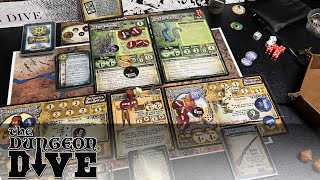
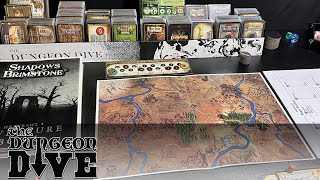
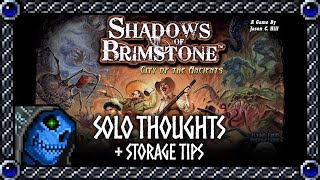
Reviewers with limited table space emphasized that the tile piles, miniature sprues, and numerous decks require substantial organization and setup time. The game comes with so many optional expansions and modular components that storing everything together becomes impractical; players reported boxing tiles separately, removing minis from sprues into dedicated containers, and tracking dozens of card decks. For solo players or those with small gaming tables, this physical footprint can become prohibitive enough to discourage regular play. Community solutions include removing minis and tiles entirely (playing via token-based exploration and theater-of-the-mind combat) or boxing up expansions in attic storage.
If You Enjoy Shadows of Brimstone: City of the Ancients
Consider Warhammer Quest or HeroQuest for a mechanics-first alternative with more streamlined dungeon crawling. Folklore: The Affliction offers similar solo RPG mechanics with a different horror setting and smaller footprint. For pure hex crawl integration, Runebound (Second Edition) delivers open-world sandbox exploration while maintaining familiar skill-check resolution. Gloomhaven provides a more modern cooperative crawl with legacy campaign structure. Descent shares the dungeon crawl DNA with tighter scenario design. Arkham Horror (Second Edition) scratches a similar cosmic horror investigation itch with cooperative mystery-solving.
What Reviewers Are Saying
"Flying Frog's games are so thematic that it's easy to connect the dots and turn them into really interesting stories. There's just something about Shadows of Brimstone that makes it perfect for solo RPG play because you already have all the pieces: skill checks, NPCs, random encounters, a bestiary, loot."
— The Dungeon Dive
"Once I stripped away the tiles and minis and ran exploration using token splitting at junctions, combat became theater of the mind with three ranges, and towns became persistent story anchors. Shadows of Brimstone became the most fun I've had with the game."
— The Dungeon Dive
"Shadows of Brimstone is one of those games that keeps pulling you back in. Every time you think you've seen everything, you discover a new combination of encounters and story beats that makes the next session feel completely fresh."
— The Dungeon Dive