
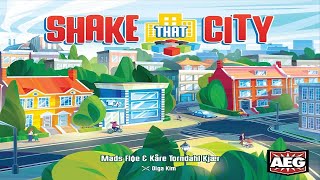
Welcome, city planners! Design the best city block using patterns from the new and exciting "Cube Shaker". You'll place a mix of tiles to help grow the thriving city. The best design wins the game!
Shake That City is a family puzzly tile-laying game for 1-4 players, that plays under an hour! The game is played over a series of rounds. The active player shakes the Cube Shaker and presses its slider to reveal a 3x3 pattern, based on which they need to place the corresponding building tiles of a single color of their choice on their board. The building tiles correspond to roads, factories, shops, parks and of course, homes. The other players then pick any building color other than the one the active player picked, then place matching colored tiles in the matching pattern on their board. Players earn points for tile-placement combinations and for the completed bonus point tiles around the edge of their board.
• Roads wants to connect to an edge of the board.
• Factories wants to be next to other factories and roads.
• Homes want to be placed in clusters that are as small as possible — the smallest being a single tile — so long as they're not next to a factory.
• Parks wants to be next to homes and factories.
• Shops score increasingly more the closer they are placed to the city center, but if they're not placed on an edge, they need to be adjacent to a road connected to the board's edge in order to score. Without road access, you'll have no products to sell!
At game's end, players earn points for tile-placement combinations and for the completed bonus point tiles around the edge of their board.


Images



- Really unique
- Really cool
- Really simple
- Entry level plus
- Kind of brain burning but most people can pick it up
- Great solo puzzle game
- Not that expensive
- citybuilding
- King Domino
- Suburbia
- Castles of Mad King Ludwig
Mechanics (from transcript analysis)
- Dice Rolling — A box with cubes is shaken, and then a 3x3 grid of cubes is revealed, dictating building options.
- Set Collection — Players aim to have certain city parts next to each other based on scoring conditions.
- Tile Placement — Players build out a 6x6 grid using tiles representing different city parts.
Video topics + discussion points
Quotes (from this video)
- So Castell is very much a Euro game, but in a very unique way.
- It's really really thinky. It's really hard to build these pyramids. Uh which is what I love about the game. That puzzle of building these pyramids and collecting the right people to recruit into your into your group to build these pyramids is so thinky. It's so hard, but it's so much fun.
- One is setups kind of long. Um, and putting away is even longer with the insert that they have.
- This game is a quarter century old at this point.
- The game that got me into the hobby, the modern hobby, and that is Carcassone.
- What blew my mind is, and we take it for granted now, but think about your first time ever hearing about a board game that starts with one tile and it builds out.
- It's a very simple game. It's truly an OG style Euro game and uh it's it's wonderful.
- Still one of the most popular games to this day. One of the most played games on BGG to this day, 25 years later.
References (from this video)
- The shaker gimmick is genius, neat, and compelling.
- It's a simple, straightforward puzzler.
- It's a good filler game that's quick and easy to learn.
- The game has enough variety with different board sides and an expansion.
- It offers a fun frustration with planning ahead and dealing with random outcomes.
- The end scoring is not very impactful and difficult to manage.
- The box for the expansion is too small to fit everything.
- The expansion didn't add significant new thought processes or strategic depth.
- Rules explanation for scoring could be clearer, with scoring details in the back of the book.
- There's a possibility of not being able to place a tile, though statistically rare.
- Tiny Towns
- Between Two Cities
- Boggle
- Cartographers
- Tenpenny Parks
Mechanics (from transcript analysis)
- Dice Rolling/Shaking — The core mechanic involves shaking a contained device to randomly generate cubes that form a grid.
- Set Collection — Players aim to create specific combinations of terrains and complete rows or columns for scoring.
- Simultaneous Play — Players can theoretically play at the same time, with one person shaking and revealing the tiles.
- Tile Placement — Players place tiles representing different terrains onto a personal grid.
Video topics + discussion points
Quotes (from this video)
- this little Shaker is so neat it's compelling
- Simple straightforward Puzzler trying to create the right combinations while planning ahead
- this isn't like the most grandiose game the one thing I don't really care for uh and it feels like they were just trying to kind of come up with some gamery thing is I actually don't really like the Ed scoring
- the box is so [__] small that with this expansion it's kind of a pain in the ass to try and fit both of them
- it's a good like Gateway into like the game day kind of thing
References (from this video)

- Very approachable
- Decent little family game
- Felt gimmicky
- Not up reviewer's alley
- Abstract polyomino placement
- City building
Mechanics (from transcript analysis)
- Cube Drafting — Drafting cubes and placing them in patterns onto a grid.
- Pattern Building — Organizing drafted cubes into specific patterns.
- Scoring objectives — Scoring points based on city layout and objectives.
- Tile Placement — Placing tiles onto a personal grid to form a city.
Video topics + discussion points
Quotes (from this video)
- we have officially played all of the games that we have brought back from Gen Con
- this is going to be a hot and heavy video we're going to go through every game we brought home why we brought them home and what our initial impressions of them
- 10 Penny Parks should be on your on your radar like it's one that you might want to consider it does something different it's Unique it's got a cool theme
- this is four science from gray fox games this is a real time uh stacking and building game trying to solve a science experiment
- three ring circus by games you know I forgot about it still think trick draw T it for me I this would be number two though is okay that it can take number two for you
- it is a tableau you have your three rows of cards and you have to sequence your numbers and the colors in the order that you want them to
- we finished playing all of my city played through the entire campaign
- we started the Legacy version of sagr and as any of you know this is a legacy game so we don't want to start another Legacy game while we're in the middle of a few other titles a few other campaigns
References (from this video)

Mechanics (from transcript analysis)
Video topics + discussion points
Quotes (from this video)
- Duck & Cover is a fantastic filler family game.
- Pentago is one of the best abstract games of all time.
- What is this in the middle of all the board games on BoardGameGeek?
- This game truly is mid.
References (from this video)

Mechanics (from transcript analysis)
Video topics + discussion points
Quotes (from this video)
- "Shake That City this is a city building tile placement game"
- "this is how you enter yes so uh to enter for a chance to win a pledge of this game to be received when the game is fulfilled head to mapleuniversity.com giveaway and enter the password which is quake"
- "it's a quick game"
- "15 placements"
- "the first 12 rounds follow those rules with the last three it's open slather"
- "roads score one point each as long as you can connect them to the edge"
- "shops score"
- "Factories can score up to two points each"
- "parks score two points unless adjacent to a factory"
- "clusters of houses no matter how large they are will score two points"
- "you flip this one in the corner"
- "it's not even an hour"
References (from this video)
- short, quick gameplay with 15 placements
- distinct tactile shaker component
- varied scoring options across building types
- two-sided board offering replay variety
- late-game space constraints can make placement difficult
- ruleset includes many scoring options that can be complex to track
- edge/cluster placements may limit player choices later in the game
- urban development, zoning, edge connectivity
- city-building
- cap EDM
Mechanics (from transcript analysis)
- color drafting with fixed orientation — lead player chooses one color and places all tiles of that color in the unrotated orientation; other players pick remaining colors and place similarly.
- Dice Placement — nine color cubes are deposited; subsequent rounds rotate lead color choice; total of 15 placements with last three rounds open to any color.
- End Game Bonuses — achieving certain patterns (row/column requirements, ensuring multiple building types) can flip corner scoring tiles for extra points.
- end-game variety bonuses — achieving certain patterns (row/column requirements, ensuring multiple building types) can flip corner scoring tiles for extra points.
- lead-turn color assignment and progression — lead player determines the color pool for that round, influencing placement options for all players.
- round-based placement with a shaker-drafted pool — nine color cubes are deposited; subsequent rounds rotate lead color choice; total of 15 placements with last three rounds open to any color.
- scoring by building types and edge connectivity — roads, shops, factories, parks, and houses score based on edge connections, adjacency rules, and row/column bonuses.
- two-sided board variant — board has two sides with different scoring mechanics (beach front vs inland) affecting scoring and placement decisions.
Video topics + discussion points
Quotes (from this video)
- "Shake That City this is a city building tile placement game"
- "this is how you enter yes so uh to enter for a chance to win a pledge of this game to be received when the game is fulfilled head to mapleuniversity.com giveaway and enter the password which is quake"
- "it's a quick game"
- "15 placements"
- "the first 12 rounds follow those rules with the last three it's open slather"
- "roads score one point each as long as you can connect them to the edge"
- "shops score"
- "Factories can score up to two points each"
- "parks score two points unless adjacent to a factory"
- "clusters of houses no matter how large they are will score two points"
- "you flip this one in the corner"
- "it's not even an hour"
References (from this video)
Mechanics (from transcript analysis)
Video topics + discussion points
Quotes (from this video)
- the cube Shaker is an amazing component
- it's self-assembly as well
- it's easy to teach uh it's quick to play
- the pace of this game and that's because it's essentially simultaneously
- this is the perfect game to introduce to people it's a great family game
- the Shaker elevates the game significantly
- it's a relatively simple game
- I haven't played this game without the Shaker so I don't know what that would look like
References (from this video)
- Cube Shaker is an amazing component and elevates the game.
- Pace is fast due to simultaneous play, keeping everyone engaged.
- Easy to teach and quick to play, with replayability due to pattern randomness.
- Perfect game to introduce to people; great for families.
- Visually appealing production and strong table presence.
- Spatial orientation can be confusing due to seating position and board orientation.
- Some players may want more complexity; one speaker would prefer a heavier game.
- If you’re hoping for planning long-term strategies, the game may not always satisfy that desire.
- Some may wonder how the game would feel without the Shaker; the Shaker clearly adds value, but it’s not clear how it would stand alone.
- urban planning and development
- city-building
- instructional/procedural
- Miyabi
- Tiny Towns
Mechanics (from transcript analysis)
- Board variant (beachfront) — Back side of the board presents a beachfront variant with different features.
- Color drafting from pattern — Active player picks one building color from the pattern; other players pick from the same pattern.
- Cube Shaker usage — Active player shakes the cube shaker to reveal a 3x3 pattern of nine cubes.
- Edge goals scoring — Goals around the edge can be fulfilled for additional points.
- End Game Bonuses — After placement, players may flip bonus tiles to score points based on fulfilled conditions.
- end-of-game scoring — Total points come from bonus tiles plus per-type scoring (roads, parks, factories, shops, homes).
- End-of-round bonus tile scoring — After placement, players may flip bonus tiles to score points based on fulfilled conditions.
- Pattern Building — Active player picks one building color from the pattern; other players pick from the same pattern.
- round progression — Game lasts 15 rounds; round tracker advances; center cubes return to the shaker; turn passes clockwise.
- Simultaneous color selection (Rounds 1-12) — Active player selects a color first; other players simultaneously choose any other color from the same pattern.
- Tile Placement — Players place tiles on their boards matching color and the same 3x3 pattern orientation; no rotation allowed.
- Tile placement with pattern alignment — Players place tiles on their boards matching color and the same 3x3 pattern orientation; no rotation allowed.
Video topics + discussion points
Quotes (from this video)
- the cube Shaker is an amazing component
- it's self-assembly as well
- it's easy to teach uh it's quick to play
- the pace of this game and that's because it's essentially simultaneously
- this is the perfect game to introduce to people it's a great family game
- the Shaker elevates the game significantly
- it's a relatively simple game
- I haven't played this game without the Shaker so I don't know what that would look like
References (from this video)

Mechanics (from transcript analysis)
Video topics + discussion points
Quotes (from this video)
- shake that CD
- shake shake shake shake
References (from this video)

Mechanics (from transcript analysis)
Video topics + discussion points
Quotes (from this video)
References (from this video)
- The game is light and approachable with easy learning curve.
- Drafting and tile placement offer strategic choices.
- Diverse tile types create varied scoring opportunities.
- Non-active players get more color choice later, adding flexibility.
- Family variant provides accessibility for lighter play.
- There is a bit of luck on what tiles appear at the start.
- Tight spaces can prevent placement late in the game.
- Some components are prototype in the video; rules described may differ in final version.
- city design and development
- urban city-building and planning
Mechanics (from transcript analysis)
- Compound Scoring — Objectives around the outside of the board contribute scoring; an offset of tiles and adjacency rules affect points.
- Cube reveal/draft — Shake the cubes to reveal nine random cubes for drafting.
- Drafting — Active player shakes nine cubes, then selects a color and places those tiles; other players choose a different color and do the same.
- End of round scoring and game end — Game ends after 15 rounds; highest score wins.
- External/objective scoring — Objectives around the outside of the board contribute scoring; an offset of tiles and adjacency rules affect points.
- Pattern Building — Players arrange tiles to form patterns on their boards during placement.
- style placement — Players place tiles on their own board to fit shapes and earn points.
- Tile Placement — Players place tiles on their own board to fit shapes and earn points.
Video topics + discussion points
Quotes (from this video)
- city planners welcome to the new land the construction has begun to build a new cool awesome City
- the game plays one to four players with mechanics such as style placement Drafting and pattern building the game is of light complexity
- on your turn you start by Shake That City shake that CD
- the cubes you can place strategically on your own board to earn the most points
- after 15 round the game ends the player with the highest points from different tiles and objectives has designed the best city and win the best design award
- There are some tough choices and a bit of luck on what tiles you could place at the start probably trying to have lots of them is good fill up your board but towards the end you want to be more careful
- the game has a family variant that ignore style placement scoring
References (from this video)
- Innovative shaker mechanism that is both fun and functional
- Easy to teach and quick to play, making it ideal for lunchtime gaming
- Engaging puzzle that rewards proper planning without overbearing rules
- High component quality and a visually appealing, compact design
- Edge bonus tiles could be more varied to increase replay value
- After multiple plays, discovery may plateau due to tile repetition
- Some players may still experience AP if overanalyzing potential patterns before taking actions
- Urban development, zoning, and infrastructure emphasis within a grid-based city
- City-building and planning on a small grid with tile-based pieces
- abstract, puzzle-driven, mechanically focused rather than thematic storytelling
Mechanics (from transcript analysis)
- board_flip_discovery — Flipping the board changes the scoring landscape, introducing limited discovery and additional strategic considerations.
- edge_bonus_tiles — Bonus tiles around the edge change the scoring landscape each game, altering strategies and replay value.
- Pattern Building — A shaker generates a pattern of colored cubes; players pick a color and commit to placing its tiles in the corresponding grid locations.
- pattern_reveal_and_selection — A shaker generates a pattern of colored cubes; players pick a color and commit to placing its tiles in the corresponding grid locations.
- Random Production — The shaker provides the random element each round, shaping available colors and placements and tempering long-term planning.
- randomness_from_shaker — The shaker provides the random element each round, shaping available colors and placements and tempering long-term planning.
- scoring_by_columns_and_features — Scoring tiles on the edge indicate objectives (like completing a column or having certain tile types). Points are earned when those objectives are met, and certain adjacencies grant additional points.
- Tile Placement — Players select tiles of a chosen color and place three in a fixed orientation on their personal 3x3 grid, matching the pattern revealed by the shaker.
- tile_placement — Players select tiles of a chosen color and place three in a fixed orientation on their personal 3x3 grid, matching the pattern revealed by the shaker.
Video topics + discussion points
Quotes (from this video)
- I’m a fan of this
- my wife’s a fan of this
- this is a beautiful lunchtime game
- it is a simple puzzle in that it’s not hard to understand what’s going on
- the shaker… it’s just fun
References (from this video)
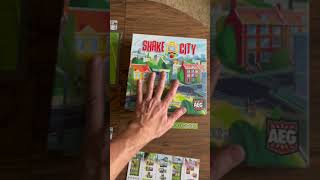
- Clear, step-by-step setup and playthrough in the video.
- Illustrates color drafting and orientation-based cube placement in an approachable way.
- Demonstrates how adjacency and edge connectivity contribute to scoring.
- Compact game concept that fits a 3x3 grid and simple components.
- Limited clarity on some edge cases from a short excerpt.
- Potential ambiguity about how some scoring rules are applied in complex positions.
- May rely heavily on visual aids to fully grasp orientation matching.
- Urban development and color strategy with adjacency-driven scoring
- A compact 3x3 grid city-building exercise where players draft colors and place cubes to create a connected urban layout.
- Instructional demonstration with explicit setup and scoring explanations
Mechanics (from transcript analysis)
- Adjacency Scoring — Points are awarded for roads, parks near homes, factories near roads and other factories, and shops connected to roads.
- Color selection / drafting — The active player selects a color (e.g., blue) and the corresponding three cubes of that color must be placed; other players may choose from remaining colors, leading to strategic color control.
- Constraint-driven placement — Only the active color can be placed by the chosen color; other players cannot place the active color during that moment, creating tension and planning considerations.
- Edge connectivity scoring — Placed roads that reach the edge of the grid contribute to final scoring, incentivizing perimeter expansion.
- grid-based placement — Players place three cubes on a 3x3 grid in an arrangement that matches the orientation of the placed cubes.
Video topics + discussion points
Quotes (from this video)
- shape of a three by three grid
- you gotta take three because there's three
- it's orientation as those cubes
- score points for having your roads connected
- factories next to roads and other factories
- edges of the build
References (from this video)
- Family weight and approachable for casual players
- Cube Shaker adds tactile, unpredictable fun
- Engaging tile-placement puzzle with strategic depth
- Good replayability due to random shaker outcomes and tile distribution
- Beautiful thematic city visuals
- Unpredictability of the cube shaker can limit planning precision
- Not all tiles can be scored every game; luck influences outcomes
- Scoring rules can be complex for new players
- Endgame and round structure differences (rounds 13-15) can be surprising
- Urban development, tile placement, scenic city-building
- A stylized modern city-building scenario where players place tiles on a shared grid to develop their own cities.
- Abstract/infrastructural
- Tiny Towns
Mechanics (from transcript analysis)
- Cube shaker randomness — A cube Shaker provides a 3x3 pattern of colors each round, determining available colors for placement.
- End Game Bonuses — Bonus tiles provide end-game scoring opportunities based on completing specific conditions.
- End-game scoring by tiles and city layout — Players score roads, parks, factories, shops, and homes with adjacency and pattern considerations.
- Pattern Building — Tiles must be placed following a precise color pattern and orientation as shown by cubes.
- pattern matching — Tiles must be placed following a precise color pattern and orientation as shown by cubes.
- Scoring via bonus tiles — Bonus tiles provide end-game scoring opportunities based on completing specific conditions.
- Set Collection — Active player selects a color; other players must choose from remaining colors.
- Set collection / color picking — Active player selects a color; other players must choose from remaining colors.
- Tile Placement — Players place tiles on their personal boards in patterns dictated by the chosen color and configuration.
Video topics + discussion points
Quotes (from this video)
- this is probably one of the coolest things about this game
- the cube Shaker itself will be proud of
- Shake That City ... build your city
- don't rush take your time in building
- you will have a high probability to win the game
- we're gonna be playing with it my family have had a great time playing it
References (from this video)

- Unique physical gameplay mechanic (shaking cubes)
- Town/city building theme
- Engaging kinetic element
- urban development
- city building
- physical play
Mechanics (from transcript analysis)
Video topics + discussion points
Quotes (from this video)
References (from this video)
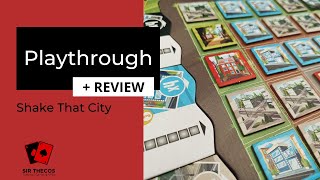
- Unique shaker gadget that is more than a gimmick
- Colorful components and durable production
- Accessible rules with a satisfying puzzle
- Multiple play modes including family variant and solo variant
- Replayability potential with expansions
- Setup time is longer due to sorting and baggies
- Rule complexity for casual players may be high (five tile types scoring)
- Replayability may benefit from expansions
- Print crooked components (noted by the reviewer) and potential production variance
- City planning and density scoring
- Urban city-building with parks, factories, shops, and roads
- Puzzle/strategy with clear scoring rules; modular board
Mechanics (from transcript analysis)
- Adjacency Scoring — Parks and factories score based on adjacency to other tiles.
- Column/Row completion scoring — Complete a full row/column to trigger extra points.
- Construction tiles (solo variant) — Optional construction tiles that modify setup and scoring.
- Edge-connectivity scoring — Shops score if connected to the board edge via roads.
- Shaker gadget — A built-in mechanism that reveals a 3x3 grid of tiles after a push.
- Tile Placement — Place colored building tiles on a grid in your city board.
Video topics + discussion points
Quotes (from this video)
- it's a really cool Gadget
- not it's not just a gimmick
- it's really simple really simple to play
- it's fun to shake that and press on here
- the setup time is a little bit longer than I would think
- I really like this game
- it's very cool
- I want to use expansions to keep it alive
References (from this video)

- Shaker games
- Bingo-like mechanisms
Mechanics (from transcript analysis)
Video topics + discussion points
Quotes (from this video)
- spreading the gospel of board games
- it's a must-have
- don't sleep on this
- we love talking about gateway games
- we're taking the game out to people
References (from this video)

- Bright, appealing art and chunky components
- Fast rounds with meaningful decisions
- Great for streaming because of clarity and pace
- Scoring can be intricate and eye-crossing live
- Board can become visually busy
- urban planning and zoning
- city-building with roads, parks, factories, and various buildings
- light, family-friendly, tongue-in-cheek city creation
- Carcassonne
- Cities: Skyline
Mechanics (from transcript analysis)
- Bonus tiles and end-game scoring — certain rows/columns with complete sets unlock bonuses and flips for additional scoring opportunities.
- Scoring from zones and bonuses — points come from road networks, park/housing distributions, and bonus tiles.
- Tile placement and zoning — players place tiles to build roads, parks, shops, houses, etc., scoring based on adjacency and border connections.
Video topics + discussion points
Quotes (from this video)
- We are going to do a prediction and this time we are going to offer a buy option.
- This is Call of Duty the board game we’re demoing, sponsored by Arcane Wonders.
- Fiction is a Wordle-inspired, traitor-filled word game.
- Mind Space is a thoughtful polyamino game with a clever dice-driven draw system.
- Shake That City is a bright city-building card game on a small footprint.