















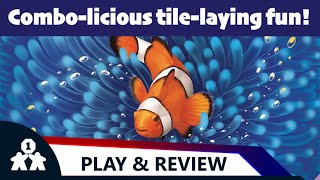

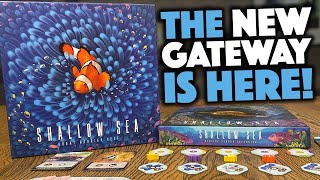




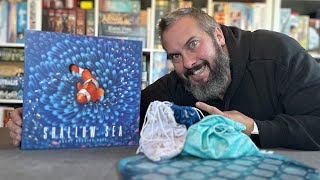

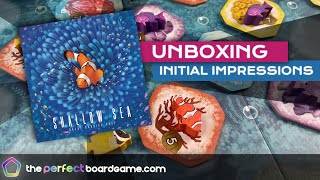




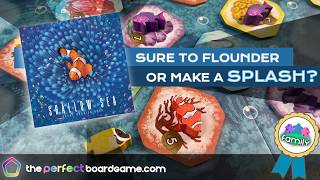






Dive into the vibrant world of Shallow Sea, a puzzle board game inspired by the breathtaking beauty of the Great Barrier Reef. In Shallow Sea, players will create their very own vivid ocean landscapes by strategically arranging an array of marine life, colorful fish, and corals.
What makes Shallow Sea truly unique is its fresh take on a multi-layered puzzle system. Unlike typical puzzle games where pieces merely stack up, the elements in Shallow Sea can activate, deactivate, and even move, creating exciting combos and thought-provoking dilemmas that keep you on your toes.
Easy to learn yet challenging to master, you’ll find yourself returning to its depths time and time again. Dive in and discover the wonders of Shallow Sea today!
- The goal of the Shallow Sea is to be the player with the highest points at the end of the game.
- On your turn, choose a combination of Fish and Coral or Sealife tile and place them in an empty space on your ocean board.
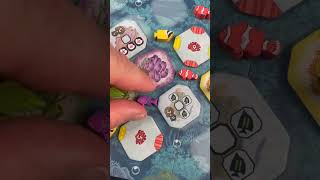
- When fish in the matching color gather around a Coral tile, the coral is completed. Flip the completed tile over! Completed Coral becomes a home for fish. Choose carefully which fish will inhabit the coral, keeping the puzzle and ecosystem cards in mind.
- By strategically arranging corals to fit the color puzzle, you can complete multiple coral tiles with fewer fish.
- Use Seashells to lure fish and move them around! Create amazing combos by completing multiple tiles in a single turn.
- Each Sealife Tile requires specific patterns of fish or coral. Invite a variety of creatures to enrich your ocean!
- Customize your ocean to match the distinct scoring requirements of the Ecosystem cards.
- The game concludes as soon as there are only 4 empty spaces left on each player's Ocean. When the game ends, the player with the highest score wins.
Get into… Shallow sea
Live Play - Shallow Sea
- Strong tiling puzzle feel
- Engaging min-max decisions
- Can be dense for casual players
- Array
- Underwater
- Abstract
- Calico
- Cascadia
Mechanics (from transcript analysis)
- Compound Scoring — Scoring derives from how tiles align to form patterns across the board.
- Pattern scoring — Scoring derives from how tiles align to form patterns across the board.
- tile laying — Players place tiles to create patterns and scoring opportunities.
Video topics + discussion points
Quotes (from this video)
- I love Shallow Sea. I am really enjoying this one.
- I do not think it's forever game.
- There’s a fun little tension of laying cards down and trying to min-max where each card goes as it goes towards multiple scoring criteria.
- The Druids of Adora, I cannot wait to give you a review on this one, but I need more plays first.
- Onward is replacing Guards of Atlantis.
- Way Too Many Cats had way too many symbols and things going on to be able to at a glance understand what's happening.
References (from this video)
- calm, relaxing, cozy
- deep puzzle with many scoring opportunities
- beautiful components and physical quality
- variety of large fish tiles increases replayability
- strong for casual play with depth
- expansions optional; base game is complete
- potential for analysis paralysis due to many scoring options
- component weight and box size? Not heavy but aesthetic is premium
- tile-placement puzzle focused on scoring patterns
- Underwater coral reef habitat
- calm, puzzle-oriented
- Cascadia
Mechanics (from transcript analysis)
- color and type matching — score for matching colors and coral types on the board
- Compound Scoring — multiple scoring avenues including color, coral type, and tile adjacencies
- flip mechanics — flip tiles to reveal scoring opportunities and adapt strategies
- large fish tiles — large fish act as objectives or obstacles affecting placement and scoring
- pattern-focused scoring — multiple scoring avenues including color, coral type, and tile adjacencies
- Resource management — spend seashells to take a fish and a different coral
- resource spending — spend seashells to take a fish and a different coral
- tile placement — place coral and fish tiles on a shared board to grow your habitat and achieve scoring patterns
Video topics + discussion points
Quotes (from this video)
- It's a very calm, relaxing, cozy game.
- The combos, the thinking, the puzzle, the aesthetics, it all just seems to go seamlessly together and really really nice.
- I just absolutely love that this game comes with so many large fish tiles that you'll be able to play with different arrangements of tiles.
- This fits entirely in the base game box. This is an empty box for me.
- Genuinely love it and I think it might be my favorite of that style of game.
References (from this video)
- high variability due to many scoring tiles and optional turtle expansion
- clear core rules with deep optimization opportunities
- excellent components and physical quality
- engaging puzzle that scratches other puzzle lovers' itch (Cascadia/Calico comparison)
- strong solo play experience
- ecology, resource optimization, and spatial puzzle
- Underwater reef environment with coral and fish tiles; modular board-building and scoring
- abstract puzzle-driven
- Cascadia
- Calico
- Wondrous Creatures
- Life of the Amazonia
Mechanics (from transcript analysis)
- Compound Scoring — per-game public objectives and two ecosystem objectives guide scoring and add variability.
- End-game trigger — the round ends when players have four squares left; multiple rounds occur based on placement pace.
- Market Pricing/Manipulation — earn seashells by completing tiles; spend seashells to swap items, move fish, or sweep/refresh the market.
- public and ecosystem objectives — per-game public objectives and two ecosystem objectives guide scoring and add variability.
- resource currency and market manipulation — earn seashells by completing tiles; spend seashells to swap items, move fish, or sweep/refresh the market.
- set collection and scoring tiles — collect coral tiles and scoring objective tiles; each tile has color/value patterns that affect scoring.
- Solo play support — explicit solo play potential with a small card mechanic (lionfish) mentioned as enabling solo play.
- tile placement — place tiles near existing tiles; tiles can be rotated to fit as you build your reef.
- tile placement with adjacency and rotation — place tiles near existing tiles; tiles can be rotated to fit as you build your reef.
Video topics + discussion points
Quotes (from this video)
- If you are someone who enjoys the puzzle of like Cascadia or Calico but wants more, this is an excellent option.
- The components are really high quality.
- I adore it.
- The puzzle that you're trying to do to get everything to complete your scoring objectives to work on the group object or not group objectives but the two ecosystem objectives for that game to maximize how you're scoring your coral.
- I tickles that puzzle itch in my brain that I really love.
- I'm enjoying playing this.
- It plays fabulously solo.
- One to four players. I absolutely adore it.
References (from this video)
- Beautiful, functional components and production
- Tight, puzzly interaction between coral, sea life and fish
- Simple turn structure that hides deep strategic layers
- Two scoring objectives for replayability
- Excellent rulebook with clear scoring references
- Excellent solo mode and accessible for non-hardcore Euros
- The seashell economy keeps the game flowing and dynamic
- Strong theme integration with reef-building narrative
- Some downtime in multiplayer could slow turns for 3-4 players
- Lack of direct conflict may reduce tension for some players
- Component improvement: reminder on seashell use could be clearer on board
- May require longer setup/takedown in four-player games compared to 2-player
- No major unpredictability in base structure (only two objectives, not too many variations)
- Array
- Underwater coral reef
- Puzzle/abstract with thematic ocean setting
- Wondrous Creatures
- Splendor
- Brass Birmingham
Mechanics (from transcript analysis)
- end game bonuses — Endgame occurs when every player has exactly four empty spaces; points are tallied by coral and sea life completion and other scoring cards.
- Endgame scoring — Endgame occurs when every player has exactly four empty spaces; points are tallied by coral and sea life completion and other scoring cards.
- Fish Movement — Move fish between bubbles on your board to fulfill coral/sea life requirements.
- Pattern Building — Complete coral and sea life to earn points; coral requires matching fish colors around it; sea life has additional placement requirements.
- Pattern/Set Completion — Complete coral and sea life to earn points; coral requires matching fish colors around it; sea life has additional placement requirements.
- Sea Shell Currency — Sea shells act as currency to pay for actions (move fish, replace rows, etc.) and are earned by flipping tiles.
- solo mode — A solo variant with a simple mechanism and no Atama/bot; you play against a single card that tracks seashells.
- tile placement — Take a tile from the top (coral) or bottom (sea life) and place it on your board adjacent to existing tiles; tiles can be rotated.
- Tile rotation — Tiles can be rotated in any direction after placement to fit gaps.
Video topics + discussion points
Quotes (from this video)
- This is one of the most well-designed Euros I've played in a very, very long time.
- Shallow Sea has some of the most functional and beautiful components I've ever seen in a board game.
- 10 out of 10. It's a masterpiece.
- There are no wasted actions in 1v1.
References (from this video)
- Drafting incentives that reward long-term planning
- High-scoring combo potential with clear visual cues
- Nice integration of sea-life coral tokens into scoring
- Immediate feedback from tile and fish interactions reinforces strategic decisions
- Abstract theme may not appeal to all players
- Scoring can become intricate for new players
- Potential for analysis paralysis in late-game drafting decisions
- Coral reef drafting and tile placement with sea-life theming
- Underwater coral reef environment
- Abstract strategy with visual cues (fish, coral tokens)
Mechanics (from transcript analysis)
- chain/scoring combos — Completing multiple adjacent tiles or collecting different coral increases points in a single move.
- Compound Scoring — Completing multiple adjacent tiles or collecting different coral increases points in a single move.
- tile drafting — On your turn you select one fish and one tile to place on your board.
- tile placement — Placed tiles interact with adjacent tiles via corner matches to trigger scoring.
Video topics + discussion points
Quotes (from this video)
- I'll take this tile and this clownish placing this clownish completes all three adjacent tiles because each tile has a matching fish on its Corners
- this one scores seven points and I'll mark it with the purple fish
- the same thing happens with the tile on the left
- then finally I score nine points for the tile above marked by my original clownish
- I've collected three different Coral I also complete this sea life tile for seven more points
- in this way shallow sea rewards clever Drafting and thoughtful planning with exciting high-scoring combos
- the real excitement comes from how fish are placed between tiles allowing you to chain multiple tile completions in a single move
- Shallow C is a tile placing game for one to four players
- Drafting and careful planning seem to drive the scoring explosions in this title
References (from this video)
- Deep, puzzle-like scoring with multiple routes to victory
- Strong solo play experience with a clear end condition
- Flexible setup including expansion modules and scenario mode
- Rich tactile feel with color and pattern matching
- Steep learning curve due to layered scoring and many rules
- Rules heavy for new players, especially with the expansion
- Potential analysis paralysis on late-game optimal moves
- Ecology-driven tile drafting and scoring
- Underwater reef ecosystem inspired by the Great Barrier Reef
- Puzzle-like solo objective with scenario-based goals
- Shallow Sea (base game)
- Nesting Seasons expansion
Mechanics (from transcript analysis)
- completing_coral_tiles — Complete coral tiles by surrounding them with specific colors; flipped tiles grant points and may trigger bonuses.
- ecosystem_card — An ecosystem card provides end-game bonuses based on completed corals with certain fish colors.
- end_game_trigger — The game ends when there are four empty spaces left on the board.
- mismatched_color_bonus — Completing corals with mismatched colored fish grants end-of-game bonus points.
- sea_life_tiles_and_scoring — Ten sea life tiles each offer unique scoring conditions, including diversity and color-difference bonuses.
- sea_shells_as_resource — Sea shells can spin or refresh pools, or move already-placed fish to new locations; unlimited capacity up to five per player.
- tile placement — Place coral tiles adjacent to existing tiles to score points and unlock sea life tiles.
- tile_and_fish_drafting — Draft a coral tile and an associated fish from the drafting pools; both must be placed with adjacency constraints.
- tile_placement — Place coral tiles adjacent to existing tiles to score points and unlock sea life tiles.
Video topics + discussion points
Quotes (from this video)
- End when there are four empty spaces on our board.
- You can spend two seashells in order to move a fish that you've already placed out to a different location.
- Done: we completed four different colors of coral in a line—this flips over and grants major points.
References (from this video)
- Beautiful theme
- High replayability
- Accessible to beginners
- ocean exploration and gentle puzzle-solving
- Underwater/oceanic environment with cozy puzzle vibes
- calm, contemplative, personal recommendation
Mechanics (from transcript analysis)
- Puzzle/logic — Cozy, brain-teasing challenges with high replayability
- tile placement — Board-tuning or layout-based interaction that drives play
- Tile/area arrangement — Board-tuning or layout-based interaction that drives play
Video topics + discussion points
Quotes (from this video)
- The perfect board game collection doesn't exist until now.
- This game's got a ton of replayability as well because every single time you play, you're going to set up a different module and it's going to change how you play.
- And remember, corporai never dies.
- Code Names. You can play this game wherever, whenever, with whoever.
- Spirit Island is the greatest cooperative game ever made.
References (from this video)
- engaging tiling puzzle
- replayable and approachable
- satisfying scoring decisions
- not a highly thematic experience for all players
- tile-based scoring optimization in a coral ecosystem
- Underwater sea environment with coral and sea life
- puzzle-focused abstract strategy
Mechanics (from transcript analysis)
- area/positioning optimization — maximize points by optimizing placement across a limited board space
- tiling — tile placement and scoring based on coral/sea life positioning
Video topics + discussion points
Quotes (from this video)
- It's one of those lovely puzzle games and I always find myself coming back to it.
- The board is so small, you feel an intense pressure come on top of you and it's on straight away.
- I'm the biggest Teenage Mutant Ninja Turtles fanboy of all time.
- Turtle Power.
- Easily the best co-op game of the year for me.
- The amount of replayability from the start is insane.
References (from this video)
- great puzzle feel
- high replayability
- may be expensive for some
- pattern-building with tile placement
- ocean/reef ecosystem
- Harmonies
- Galactic Cruise
Mechanics (from transcript analysis)
- tile laying / pattern building — Place hex tiles and fish to fulfill color/adjacency requirements; end game based on open hex count.
Video topics + discussion points
Quotes (from this video)
- Shallow Sea is my king.
- The production is insane. It's very expensive and I don't think the bang for the buck is there.
- Bomb Busters is a deduction game where you and your fellow bomb busting experts are trying to snip wires on a bomb so you and your friends don't blow up.
- Ready Set Bet is another crazy racing game.
- Shackleton base is a space-based euro that has a ton of depth and replayability.
References (from this video)
- beautiful, family-friendly
- Cascadia-like
- slightly heavier than Cascadia
- Underwater patterns and depth
- Sea life / ocean
- Cascadia-like puzzle game
- Cascadia
Mechanics (from transcript analysis)
- Multi-layered depth / pattern scoring — Depth and pattern-building scoring system.
Video topics + discussion points
Quotes (from this video)
- We are talking about our holiday gift guide and we’ve got the Battle List.
- Two Amanda — Town 77.
- Is it Cake? we watched the Halloween one and the Christmas special.
- Is this the Christmas talk? Yes, we are talking about Christmas.
- We’re going to have a con in Omaha next year.
References (from this video)
- Calming undersea theme with varied fish artistry
- Engaging drafting and tile-placing decisions with meaningful endgame choices
- Seashell economy introduces meaningful decision points and potential for big swings
- Rule clarity can be challenging in a first-playthrough or playthrough video
- Color matching and placement constraints can lead to analysis paralysis
- Endgame scoring is complex and requires careful tracking
- marine life, coral reefs, and endgame scoring through patterning
- Underwater reef ecosystem with coral tiles and sea life
- light, instructional drafting with a laid-back, humorous host dynamic
Mechanics (from transcript analysis)
- drafting — each player selects one fish tile and one associated tile per turn (from a shared market)
- Endgame scoring — endgame tiles and pattern completions generate points; some tiles multiply points based on color/placement
- Resource management — seashells act as a currency to modify choices or move/influence tiles; shells are earned by completing tiles
- resource management (seashells) — seashells act as a currency to modify choices or move/influence tiles; shells are earned by completing tiles
- tile placement — tiles are placed on your personal board with adjacency rules to form scoring patterns
Video topics + discussion points
Quotes (from this video)
- This game is witchcraft.
- Undersea theme, so calming.
- Teamwork in a non-teamwork game, because let me tell you, if there's one thing I'm not going to do is team up with all y'all.
- These shells are a resource, and you earn more by completing tiles.
- Four purple fish, the big swing in endgame scoring.
References (from this video)
- Fast-paced two-player experience with tight, well-scoped decisions
- High replayability due to diverse scoring tiles and layout variability
- Accessible mechanics that are easy to teach but offer depth in optimization
- Charming marine theme with approachable abstract puzzle gameplay
- Short playtime makes it an ideal filler or introductory puzzle game
- Color matching and tile dependencies can feel unforgiving if tile draws converge poorly
- Limited player count (specifically designed around two players) may reduce suitability for larger groups
- Variability in scoring tiles can lead to planning complexity that might overwhelm casual players
- Pattern-building and resource management in a marine environment
- Underwater reef ecosystem focusing on shallow sea habitats with coral and fish
- Abstract, puzzle-focused with light thematic framing
Mechanics (from transcript analysis)
- color/pattern matching — Points are earned by aligning colors and patterns of corals and fish along specific scoring tiles, with variability in each tile type affecting strategy.
- drafting — Players draft fish and coral tiles from a shared area adjacent to the chosen tile, creating a selective pull where placement options depend on what is drafted.
- End-game trigger — The game ends when there are four spaces left on the board, at which point scoring is completed across all rows and scoring tiles.
- Refill and draw options — Players can wipe and redraw tiles or refill the pool to alter the available choices, adding a push-your-luck element to planning.
- Resource/marker movement (shells) — Special mechanics (e.g., shells) enable shifting tiles or fish to influence placement options, providing tactical flexibility.
- tile placement — Drafted tiles must be placed on the player’s board adjacent to existing tiles, building a connected layout and expanding scoring opportunities.
- Variable scoring tiles — A set of scoring tiles provides different scoring criteria; players choose and sequence their placement to optimize points, adding depth and variability.
Video topics + discussion points
Quotes (from this video)
- this is a puzzle a drafting game we want to draw these tiles
- it's about fish
- there's a lot of variability in these scoring tiles
- it's a fun little puzzle game
- very simple video with so few rules
References (from this video)
- Engaging spatial puzzle with color-matching and tile-completion decisions
- Multiple scoring avenues via coral and sea life tiles, plus public scoring cards
- Flexibility with seashells to manipulate draws and reposition pieces
- Endgame and scoring can be complex for new players
- Late-game analysis paralysis potential due to many scoring interdependencies
- reef-building with fish and coral tiles; color matching for scoring
- Underwater ecosystem around the Great Barrier Reef
- abstract strategic puzzle
Mechanics (from transcript analysis)
- refill and end condition — After each turn, the display is refilled; in two-player mode, endgame triggers when each player has four empty spaces.
- sea life tiles and end-game scoring — Sea life tiles have end-game scoring conditions, with potential multipliers if not fully completed.
- sea shells resource — Seashells are earned and spent to flush the display, move fish, or break basic tile-drawing rules.
- tile drafting and pairing — On your turn, you pick a pair from the middle display consisting of a fish and a coral/sea life tile, then place them adjacent to existing tiles.
- tile flipping scoring — When a coral tile's scoring criteria are met (surrounded by required colors), it flips to its scoring side.
- tile placement and adjacency — Tiles must be placed on spaces adjacent to existing tiles; coral tiles require matching fish colors on top.
Video topics + discussion points
Quotes (from this video)
- this game is designed by yam CW and published by bad comet
- it's an abstract strategy game
- we are going to be building up our oceans by placing Coral tiles as well as fish into the Great Barrier Reef
- the game is prototype copy and things are subject to change in the future
References (from this video)
- Engaging entwined drafting with a calm yet deep puzzle
- Bright components and approachable yet crunchy
- Aquatic ecosystems and fish scoring
- Underwater world
- Cascadia
- Calico
Mechanics (from transcript analysis)
Video topics + discussion points
Quotes (from this video)
- The rules are very simple, but it is crunchy and a lot of fun
- Coordination between players in this game goes so far above and beyond what you normally see in this style of co-op game
- Two-player only and absolutely fantastic
- The conveyor belt action is fantastic. Rondell gameplay is big and crunchy here
- This is the hidden gem of the show for many folks
References (from this video)
- Dynamic movement conveyed in artwork
- Excellent color and composition
- Might be busy to some on a quick shelf glance
- Core Discovery
Mechanics (from transcript analysis)
Video topics + discussion points
Quotes (from this video)
- This is my favorite cover of the year.
- Echoes of Time will win because of that bold, cinematic look.
- Deep Regrets is definitely my call here.
- I hate that Star Wars Battle of Hoth cover.
References (from this video)
- Calming undersea theme with appealing art
- Accessible and family-friendly
- Lots of subtle strategic decisions in a breezy package
- Some players may find scoring fiddly if mismanaged
- Component quality expectations can be high for some
- Coral reefs, sea life, and reef ecosystem management
- Undersea reef ecosystem
- Calming, oceanic ambiance
Mechanics (from transcript analysis)
- placement with adjacency rules — Placed tiles interact with nearby tiles to unlock scoring bonuses.
- set collection / pattern scoring — Complete patterns and combinations for end-game scoring.
- tile drafting — Draft coral tiles and sea life tiles to place on your board.
Video topics + discussion points
Quotes (from this video)
- This is a roll and right or flipping right game.
- Energy bars let you duplicate actions.
- It's Christmas. This is Christmas.
- Chop chop till you drop.
- Undersea theme. Isn't it just calming?
- Orbit is a new Riner Knizia game.
- Azul Duel is a really engaging version of Azul.
- Tag Team is almost like an auto battler, but you program the order.
References (from this video)
- gorgeous art and components
- compares nicely to Cascadia with a fresh spin
- accessible for families and hobbyists
- shares thematic space with popular patterns games
- rule depth could vary between players
- marine life and pattern-building
- ocean ecosystem
- casual, Cascadia-inspired with a twist
- Cascadia
Mechanics (from transcript analysis)
- pattern placement — place chosen tiles to optimize points
- set collection — pick fish and coral to fill your ocean board
Video topics + discussion points
Quotes (from this video)
- I am so excited about that
- I love that world
- it's a small box game
- Point Galaxy is the next iteration of Point Salad
- the world of The Great Gatsby
- Layer is two-player with dungeon-building
References (from this video)
- beautiful components
- strong aesthetic
- availability may vary
- marine life conservation
- oceanic ecosystem, sea turtles
- elegant, nature-forward
- Oceanos
Mechanics (from transcript analysis)
- pattern-building — pattern-based placement and scoring
- tile placement — organize sea habitats on modular board
Video topics + discussion points
Quotes (from this video)
- Step into Kenfire Council, a cutthroat contest of strategy and politics.
- This is a big boy.
- 18 cards.
- It's a different type of train game.