/pic3336315.jpg)





























Shogun Deep Dive
What the Community Thinks About Shogun
Shogun stands as a thematic wargame that captures the feudal struggle of Japan's Sengoku Period with both mechanical elegance and visceral excitement. Reviewers consistently highlight the game's ability to blend thematic immersion with innovative mechanics, creating experiences that feel both strategic and unpredictable. The game's integration of theme and mechanics resonates particularly strongly with players who appreciate historical settings combined with substantial gameplay depth.
Core Mechanics That Define Shogun
The Cube Tower Battle System
The centerpiece of Shogun's combat resolution is the cube tower, a physical mechanism that simultaneously serves as both a gameplay tool and a focal point of player interaction. When daimyo clash over provincial control, both attacking and defending forces contribute their colored cubes to the tower. The unpredictable cascade of cubes falling from the bottom becomes the sole arbiter of combat outcomes. This mechanic brilliantly captures the chaos of real warfare: even an overwhelming military force can suffer unexpected defeats when cubes fail to emerge in favorable combinations. Green cubes, representing peasant militias and neutral forces, add additional volatility to every engagement. Players find themselves hovering over the tower in anticipation, since throwing their cubes represents commitment without certainty of victory. The randomness operates within a structured framework, making combat feel both exciting and strategically meaningful.
Programming Actions and Seasonal Planning
Shogun employs a sophisticated action selection system where players program their moves in secret before they resolve. Each round divides into a planning phase where daimyo assign province cards to specific action slots on their personal board. The system reveals hidden information gradually: the first five actions appear face-up during planning, but the final five remain concealed until execution. This creates fascinating decision tension around timing. A player might plan to harvest rice from a specific province expecting to perform that action early, only to watch it queue up among the hidden actions. By that time, an opponent may have conquered that very province through combat, rendering the action impossible. The seasonal structure (spring, summer, autumn, and winter rounds) punctuates play with administrative phases where provinces must be fed and scored, forcing players to balance expansion against sustainability.
The Shogun Experience
Table Presence and Component Design
The visual and physical design of Shogun commands attention whenever it appears on the table. The double-sided board displays distinct regions representing feudal Japan's provinces, each with designated building spaces and strategic positions. The three building types, castles, temples, and theaters, translate into distinct physical shapes that create a layered landscape as the game progresses. The cube tower itself functions as theatrical game element, its transparent frame allowing players to watch cubes tumble and settle before the victor emerges. Colored cubes representing armies immediately communicate power concentrations across the map. This component-rich presentation transforms what could be an abstract economic game into a representation of territorial conquest and cultural dominance. Players frequently find themselves drawn to adjusting the map layout or simply appreciating how the physical board evolves across two game years.
Strategic Depth Across Building and Control
Beyond combat, Shogun rewards players who think deeply about provincial development. Building castles costs three treasures and generates three points from regional majority, while temples demand two treasures and award two points, and theaters require one treasure for one point. This scaling system demands calculation about which building investments yield returns. Experienced players recognize that securing majority in even one region across the five scoring areas can generate substantial victory margins. Confiscating rice or treasure from provinces produces revolts, requiring players to manage peasant unrest alongside external threats. Some provinces generate better resources than others, creating territorial priorities that extend beyond immediate military advantage. The game rewards comprehensive regional control, not merely numerical dominance in one area. Players who balance expansion, building investment, and defensive preparations create engines of victory that sustain through both years of play.
What Makes Shogun Stand Out
Thematic Authenticity Through Mechanical Integration
Shogun achieves rare thematic resonance by making its mechanics reinforce historical flavor. The programming system mirrors the delays inherent in pre-modern military planning. Revolts mechanically embody the resistance of occupied populations. Seasonal cycles enforce the agricultural realities of historical daimyo who must feed their armies. Battle outcomes depend on village militia and unpredictable fortune, echoing real history where terrain, morale, and chance determined outcomes despite numerical advantage. The victory point structure, where cultural and military supremacy both matter, reflects how feudal power consolidated through both sword and ceremony. Few games achieve this alignment of mechanics and theme so cleanly; most games either sacrifice theme for mechanical clarity or create thematic chrome that obscures underlying systems. Shogun demonstrates that elegant systems and immersive theme need not conflict.
Escalating Complexity and Player Interaction
Shogun presents itself as an easy-to-learn game with exceptional strategic depth. The core actions are straightforward: move, build, harvest, or confiscate. Yet the interaction points between players multiply across multiple domains. Choosing which provinces to contest forces other players to either accept losses or commit resources to defense. Bidding for turn order creates kingmaker scenarios where seemingly weaker players determine who acts first. Provinces seized from other players can be immediately developed or left fallow, carrying political weight beyond pure point calculation. The tension between short-term opportunistic attacks and long-term territorial building creates constant negotiation around acceptable aggression levels. Every decision generates ripples: depleting a province of rice triggers revolts that destabilize the entire region; constructing a castle signals future intentions and invites preemptive strikes. This web of interdependencies keeps experienced players engaged while remaining accessible to newcomers.
Potential Drawbacks
Cube Tower Variance and Game Balance
The cube tower's inherent randomness generates moments of dramatic reversal that excite some players and frustrate others. A vastly superior military force can lose an engagement if green cubes dominate the tower's output. While reviewers praise this chaos as thematic authenticity, players seeking tighter mechanical control may resent outcomes where overwhelming preparation yields to luck. The variance compounds across a two-year campaign; early defeats from unfortunate tower draws can disadvantage players for the entire game. Experienced players develop strategies to mitigate this risk, avoiding overcommitment in single battles, maintaining flexible military positioning, but newer players may feel their strategic decisions matter less than the tower's whims. The game explicitly accepts this variance as core identity rather than an unintended consequence, which aligns with thematic goals but limits its appeal to players prioritizing pure skill determination.
Moderate Pacing and Planning Overhead
Shogun demands sustained engagement across a three-hour playtime, with the planning phase requiring synchronous secret decision-making from all players. The need to simultaneously program actions while calculating uncertain futures creates analysis paralysis opportunities, particularly among optimization-focused groups. Provinces with multiple building locations, resource tracks, and revolt marker states generate substantial bookkeeping complexity despite elegant underlying rules. The bidding system for turn order adds another decision point whose ramifications unfold gradually. For players accustomed to fast-paced tactical games, Shogun's emphasis on methodical planning and long-range positioning feels measured. The two-year structure, while providing campaign narrative, extends game length considerably. Groups prioritizing rapid plays may find the investment required for Shogun's payoff excessive, particularly since earlier rounds feel less decided than later ones when advantages compound.
If You Enjoy Shogun
Players drawn to Shogun typically appreciate games where territorial control intertwines with economic development and where player interaction shapes every decision. Games like Carcassonne and Medina offer similar landscape-building satisfaction with less military focus. Kemet provides comparable cube tower excitement with more direct player conflict. For those captivated by Shogun's planning mechanics, games like Twilight Struggle and Food Chain Magnate reward meticulous forward calculation. Players who love the historical wargame feel might explore specialist designs like GMT Games titles that emphasize more granular military simulation. Those seeking Shogun's table presence appeal should investigate more recent designs like Scythe or Brass, which pair visual impact with economic strategy. The core audience, players who value thematic authenticity, appreciate cube-driven chaos, and embrace multi-year campaign structures, finds relatively few modern alternatives that capture all these elements simultaneously.
What Reviewers Are Saying
"Combat you can have an overwhelming force and you throw your cubes in and then at the bottom a bunch of greens come out and maybe not all the ones you threw come out and you wind up losing it is representative I think of real combat in the real world that you're never sure if you're gonna win or not."
— The Secret Cabal Gaming Podcast
"It looks beautiful it looks like a load of sweets on the board and it's a really fun game... the most recent edition from fox mind they are very colorful translucent pieces which means it all looks very tropical."
— Adam in Wales - Board Game Design
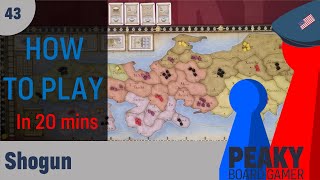
"Players will be defending their provinces and also they will be attacking to gain more of them they will also be constructing buildings in the provinces that will give them a lot of victory points players will also face riots as they will be taxing the provinces."
— Peaky Boardgamer