/pic5396946.png)
Skytear is a competitive card-driven miniatures game inspired by MOBA video games (like League of Legends) featuring 32 heroes from an original fantasy universe.
Using a draft system that supplements regular deckbuilding, players pick heroes from four factions in order to flexibly respond to their opponent's selections. Then, using these heroes, players compete to take control of the lanes and lead the minions there to assault the enemies' towers, or enter the dome to take control of the outsider there. In doing so, they will win one of the three victory conditions selected at the start of the game, allowing for potential bluffing or feints by switching objective.
Skytear is diceless, instead revolving around modifiers printed on each power card. This duality of effect means deckbuilding is a nuanced issue: cards that are most beneficial when played (and likely will) come with a negative modifier, reducing the effectiveness of most attacks. At the same time, drafting a particular hero provides you with their associated cards, meaning flexibility can be integrated into your hero selections.
With two maps, 32 heroes, and over 65 power cards at launch, Skytear is an extremely replayable tactical experience.


- Strategic card distribution mechanic makes the game shine
- Small footprint, only cards on the table
- Enjoyable gameplay using resources
- Strategy comes into play with dividing cards
- Great filler game, quick to play
- Scales up nicely, especially with 2-3 players
- Quick to teach
- Nice mechanic for discarding cards to get cogs (wild resources)
- Will click after multiple plays due to learning card combos
- Four players might make the game drag due to AP when dividing cards
- The Rookery card's balance is questionable as it's a single card in the deck and may not show up.
- building a city in the sky
Mechanics (from transcript analysis)
- Card Drafting — Players get cards with resources, action cards, or building cards. The person who deals the cards divides them into stacks, and players choose stacks in order.
- Hand Management — Players manage cards in their hand, making choices about which to play for building or to discard to gain cogs (wild resources).
- Negative Interaction — Pigeon cards can be thrown into stacks, and when acquired, they immediately go into play and are worth minus points unless the Rookery building is in play.
- Set Collection — Players collect resource cards to play building cards into their city, aiming for combinations that score victory points.
- Variable player powers — Factions in the game have different types of strategies and cards that synergize with one another, suggesting some form of asymmetric abilities.
Video topics + discussion points
Quotes (from this video)
- Wow this episode is packed I better get started
- Hey everybody guess what Gen Con is coming up soon Oh more stress more stress I don't need stress in my life
- I'm a loner come on people people like underdogs I'm the underdog here not that it matters because it's not like I'm on Twitter and I
- Basically take two dead of winters and you got two clans that kind of warned against each other
- Timothy Meier and Kobe took me on this project and they did a phenomenal job of really trying to create this awesome experience or 10 up to 10 players can go ahead and play around with these epic battle in which they're they're constantly trying to vie for power and win the game of surviving through the apocalypse and there's lots of fun stuff going on there there's even a timer that people have to worry a go on turns fast so it doesn't it doesn't drag
- Crossfire what's really neat about crossfire is that it phase in three minutes so it's super major quick
- That really creates a lot of interesting chaos and a lot of fun during that three minute time period
- The game actually turned out super beautiful we had an artist named Jen Z and she's actually well known for doing video games like transistor and bashing and she's doing a lot of cool stuff so to have her work with us on that project is an absolute blast
- This game is a race up the mountain where you are trying to we played it now competitively yes there are actually two modes that to most of this game there's competitive and co-op in the the co-op actually has a solo player mode so there's actually three modes to this game solo co-op competitive but we all said yeah we're going to do some little bit of backstabbing we decide to play competitive tonight and with this crew it's a good thing that we did
- My favorite mechanic definitely is the player board and and what that does that tracks your food your oxygen your weight and your health and ultimately your speed
- The flavor texture is really good yeah takes on the Karma card my favorite my favorite was there was a card called cheat codes yeah or gave you a bunch of stuff in the flavor text at the bottom was the cheat code for the contra which is a be a no be a oh
- If he hits $100,000 he has promised after one year of badgering and pestering he will do a Star Wars rebellion how to play video
References (from this video)
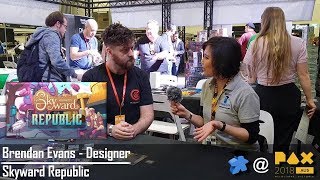
- original game was popular
- expansion introduces new cards and mechanics
- expansion allows buildings to be built taller
- expansion features multi-faction buildings
- expansion includes new critters causing havoc
- city building
- Avalon city of Skyward
Mechanics (from transcript analysis)
- Card Drafting — The game involves drafting cards that make up the city. Cards are split into two piles, players choose one, and the other pile is for the other player. This is described using a cake analogy where a cake is cut, a slice is chosen, and the remaining is for the other person.
- city building — Players compete to build the nicest city.
Video topics + discussion points
Quotes (from this video)
- hi I'm here with Brendan Evans D creator of sky wards there was outs about two years ago and it was really popular
- so when I use it going to do next okay we have a brand new set of cards and that brand new set of cards contains brand new mechanics so we've never seen before
- soon we will be up on Kickstarter really really soon
- check us out on Kickstarter soon
References (from this video)

Mechanics (from transcript analysis)
Video topics + discussion points
Quotes (from this video)
- Duck & Cover is a fantastic filler family game.
- Pentago is one of the best abstract games of all time.
- What is this in the middle of all the board games on BoardGameGeek?
- This game truly is mid.
References (from this video)

- beautiful production and components
- rules are clear and approachable
- satisfying strategic choices in how to allocate resources
- two-player mode described as more of a filler
- box is notably large for what it is
- the game length can feel longer in larger player counts
- city-building with resource acquisition
- floating cities in the sky
- engine-building with card-driven actions
- New York Slice
Mechanics (from transcript analysis)
- Engine Building — buildings provide powers that can reduce costs or enable future builds
- engine-building elements — buildings provide powers that can reduce costs or enable future builds
- I Cut, You Choose — the player who splits the selection creates piles; others choose piles in turn, last picker gets advantages
- Set collection and resource management — resources are required to build structures, with a wild resource mechanic to mitigate shortage
- split-pile drafting / eye-split mechanism — the player who splits the selection creates piles; others choose piles in turn, last picker gets advantages
Video topics + discussion points
Quotes (from this video)
- the crypto absolutely gets actual love
- it's probably going to be the best party game of 2018
- I think the crypto is a flawless game
- it's this perfect little box of what I think party games should be in 2018
- I absolutely love New York Slice