














Skytear Horde Deep Dive
What the Community Thinks About Skytear Horde
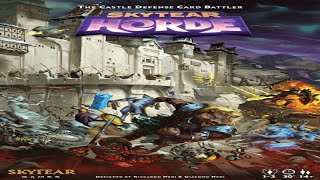
Skytear Horde, first published in 2023, is a lane-based card battler in which a game-controlled horde pushes toward the world of Skytear while heroes from four realms hold the line. Reviewers who cover solo games treat it as one of the stronger entries in that space. The consensus is that the core loop is satisfying even when the surrounding package draws criticism. Board Games UnLocked says the game plays very well solo and that the Monolith expansion makes it better by layering in more cards and variety. Foster the Meeple also frames it primarily as a solo experience and recommends the Deluxe version with its playmat, which helps keep the six lanes organized.
Agreement is strongest on gameplay and weakest on theme. Beyond Solitaire praised the lanes, the minions, and the portal, but said the setting feels very generic and that players who want a fantasy world they care about may not find it here. Shelfside was more enthusiastic about production and card design, though it also described the rulebook as confusing in places. The disagreements mostly concern difficulty and the campaign, with several reviewers saying the campaign is the weakest part of the box.
Core Mechanics That Define Skytear Horde
Lane Defense and Positioning
The battlefield is divided into six lanes. Players place ally cards into lanes to meet the monsters the horde deck produces, and the minion cards that accumulate in those lanes also demand attention. Monsters that get past your defenders deal damage to the portal or the castle, and losing the castle ends the game. Beyond Solitaire singled out the ability to rearrange the cards in your lanes as a key pleasure, because it lets you build a defense tailored to whatever the horde sends next. Shelfside noted that the horde flips a treachery card before combat, so the usual approach is to wait and react to those flips rather than commit everything early.
Pillage and Draw-on-Defeat
Minions pillage the deck, which means the draw pile doubles as the defender's life force. Beyond Solitaire explained that the game has no automatic draw: you draw a card only when you defeat a monster or minion, so deck attrition becomes the central pressure. Foster the Meeple described the same dynamic as a race against your own deck with very limited card draw, where each round's pillage shrinks the pool you have to work with. Shelfside pointed out that decking out is a loss condition, which turns a bad run into a steady spiral. Deck construction rules add a planning layer on top of this, since the cards you bring to the table determine how resilient your deck is to pillage.
The Skytear Horde Experience
Tense Pressure From the Pillage Clock
Reviewers describe a steady, uncomfortable tension. Each round the horde keeps arriving, and each pillage phase eats into the deck whether your draws have been kind or not. The mood is more severe than playful: Foster the Meeple said the one thing they wished was that the game were cuter, which suggests the tone leans toward grim rather than lighthearted. Because cards drawn are scarce, players must weigh every card they commit to a lane against the risk of running out of cards to draw.
Satisfying Tactical Puzzles
The counterweight to that pressure is the puzzle-solving. One Stop Co-op Shop described the game as a tactical puzzle of playing your cards and moving your units around, and said that puzzle is more engaging than the one in Ashes Reborn, though both are enjoyable. Board Games UnLocked described the solo flow as smooth because there are no teammates getting in each other's way, and called solo the easiest and best way to play. The payoff builds through card chaining, where a well-timed sequence of abilities can turn a losing lane into a clean defense. Players who enjoy working through a crowded board one decision at a time tend to describe this as the most rewarding part of the game.
What Makes Skytear Horde Stand Out
Asymmetric Alliance and Horde Decks
Shelfside praised the card abilities as the true heart of the game. The box includes three unique alliance decks and three horde decks, and the abilities on those cards are what makes the play feel layered. Reviewers pointed to familiar keywords such as trample, which lets damage carry past a defender, and armor, which lets a unit absorb hits. Shelfside compared the card play to Netrunner and to Magic: The Gathering Commander, but said the combination of asymmetric decks gives Skytear Horde a distinct identity. Because each horde deck has its own boss and behavior, replaying with a different pairing feels meaningfully different.
The Monolith Expansion and Solo Depth
Board Games UnLocked credited the Monolith expansion with making the game better. The expansion was released as a standalone product, but when players combine it with the base game, the number of cards and options grows considerably. That reviewer also said the deck-building side and the monolith content give the solo experience enough variety to keep returning. Foster the Meeple said the game is primarily a solo experience, which makes the expansion's added depth especially welcome for players who rarely have a group to play with.
Potential Drawbacks
Generic Lore and Presentation Issues
Beyond Solitaire said the game feels very generic, and Shelfside found the small text and the minion cards a chore to track during play. Board Games UnLocked also noted that the acrylic tokens in the deluxe edition carry symbols that do not match the printed icons on the cards, which is an odd inconsistency for a premium component set. Reviewers who value a rich fantasy setting may find the world thin compared with the mechanics.
Campaign Mode and Rulebook Clarity
Several reviewers said the campaign is the weakest part of the package. Board Games UnLocked said they had not really touched it and did not expect to return to it, and Shelfside said the rules for the Outsider are unclear and that the bosses feel generic. Beyond Solitaire also flagged rulebook ambiguities and early printing errata, and noted that the deck-death spiral from not drawing can feel punishing. Newer players should expect to lean on online rulings or community resources while learning the rules.
If You Enjoy Skytear Horde
Players who enjoy the lane positioning and reactive defense will find similar satisfaction in Kingdom Rush, where the satisfaction of placing defenders against an incoming wave carries over directly. Players who like the portal and pillage tension, with a shared pool of cards that can be drained by the opponent, will recognize the feel of Netrunner, which Board Games UnLocked and Foster the Meeple both used as a reference point. Players who value the chaining of abilities and the asymmetric decks will find related satisfaction in Magic: The Gathering and Hearthstone, while those who want a faster, more streamlined card battle may enjoy Marvel Snap or Radlands. For players who want the same tactical puzzle of playing cards and moving units, Ashes Reborn is the natural companion that One Stop Co-op Shop placed just behind Skytear Horde.
What Reviewers Are Saying
"I think the lanes are really interesting, I think the minions are really interesting. I really enjoy having to bounce your deck as resources and I like being able to rearrange the cards that are in my lanes in order to mount a defense that's a little bit more tailor-made to respond to whatever's coming out of the horde deck."
— Beyond Solitaire
"What really makes this game come together are the card abilities which are the meat of this game with three unique decks for the alliance and three horde decks and there's just so much to unpack here."
— Shelfside
"I think the game is done, which is always a nice thing when a game actually has all the content and you can buy it and you're good. You don't have to wait for more and more to come out."
— One Stop Co-op Shop