


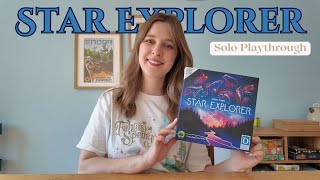

Star Explorer Deep Dive
What the Community Thinks About Star Explorer
Reviewers agree on the central appeal of Star Explorer: it is a light, pleasant drawing game that looks lovely on the table and takes very little time to learn. Crimsonboardgames described being "honestly quite blown away" by the beauty of the game on a first encounter at a convention, and later called it a great, chill solo experience. Sir Thecos placed it among favorite flip and write games and argued it was under the radar, noting that the original Polish release, then called Night Sky Explorers, deserved far more attention than it received. Queen Games' re-release under the Star Explorer name made the game easier to find in English.
Opinions diverge on depth. BoardGameCo's Alex Radcliff called Star Explorer "not like an amazing game" but a good, fun experience that works across a range of player counts. Tabletop Tokki was more critical, saying the game did not offer anything significantly exceptional in mechanics or strategy, so the decision to buy it comes down to whether a reader wants a lighter roll and write game with this theme and presentation. Reviewers generally agree that the game succeeds as a relaxed social or solo activity rather than as a deep strategy title.
Core Mechanics That Define Star Explorer
Pattern Building
The heart of Star Explorer is pattern building. Each round, a constellation is revealed, and players must reproduce its shape on their personal sky map using stars of specific colors. Crimsonboardgames noted that the constellation can be rotated freely but not mirrored, which forces players to fit the shape into the space left by earlier rounds. Scoring rewards connections: pink stars score for themselves, yellow stars score for themselves, and pink stars linked to yellow stars add a combined bonus. The pattern itself is the puzzle, and the scoring rules encourage players to route their constellations toward valuable clusters. Crimsonboardgames reported that a well-chosen placement could score far better than expected, which made the drawing feel rewarding.
Flip and Write
Star Explorer belongs to the flip and write family, a label Sir Thecos used, while Tabletop Tokki called it a flip and fill game. A tile is flipped each round to reveal the constellation that every player must draw on their own board, so the shared input is the same for everyone while the results diverge. Crimsonboardgames noted that when playing with others, nobody waits for a turn, because everyone draws the same constellation at once. The starting player also rotates through a simple rule: the player with the lowest score in the previous round leads the next one, which Crimsonboardgames called an interesting way to avoid a fixed turn order. Designed by Łukasz Szopka and published by Queen Games, the game uses this simultaneous structure to keep the table moving.
The Star Explorer Experience
A Calm, Cozy Creative Rhythm
Reviewers repeatedly describe Star Explorer as relaxing. Crimsonboardgames called it a very chill solo game in which you are simply drawing, and emphasized how cute the constellation artwork is. Tabletop Tokki described it as fun and satisfying, with the rotating board and drawing creating a gentle, hands-on rhythm. The feeling is closer to a sketchbook session than a competitive contest, and reviewers tend to describe the pleasure as the act of making something pretty while scoring points.
Tense Last-Round Scrambles
Beneath the calm surface, the game creates real pressure near the end. Crimsonboardgames described a final round in which the constellation required a difficult shape, and the reviewer had to accept a placement that was far from ideal. Such moments, where a single unlucky reveal forces compromises on the board, give the game a sharp edge that contrasts with its soft presentation. Players who expect a purely relaxing experience may be surprised by how tightly the final constraints can squeeze a sky map.
What Makes Star Explorer Stand Out
Artwork and Table Presence
The most consistent praise concerns the art and production. Crimsonboardgames singled out the constellation illustrations as very pretty and treated the physical presentation as a highlight. Tabletop Tokki similarly said that the overall visual impact of the game and the materials chosen by the publisher were really nice, even while the mechanics of the drawing process felt less satisfying. For many reviewers, the look of the finished sky map is a major reason to keep the game on the shelf.
Simultaneous Play and Quick Setup
Crimsonboardgames highlighted the solo setup as especially easy, since the components come ready to go and the reviewer only needed to grab a few tiles before starting. In group play, Crimsonboardgames valued that everyone draws at once, so no player sits idle while others take a long turn. BoardGameCo added that the game works well across a variety of player counts, and that drawing constellations is fun regardless of group size. The combination makes Star Explorer a practical filler or family option that does not demand a large time commitment.
Potential Drawbacks
Friction in Drawing, Rotating, and Erasing
The most direct criticism concerns the physical act of play. Tabletop Tokki stated that the implementation of rotating the board, drawing on it, erasing, and checking previously placed components was not the most satisfying part of the experience. Crimsonboardgames likewise described a process of drawing, erasing, and rethinking placements that could feel fiddly. Reviewers who prize a smooth, tactile interface may find this friction a meaningful drawback, even when they enjoy the overall theme.
Modest Depth and the Luck of the Draw
Several reviewers felt the game has a ceiling on strategic depth. Tabletop Tokki argued that the title is less about exceptional mechanics and more about whether the reader likes the roll and write format and theme. Crimsonboardgames also noted that the random order of constellations can strongly shape a session, recalling a run where the shuffle gave no red stars to work with at the start. Because the constellation drawn each round is partly random, a strong result depends on the luck of the reveal as much as planning.
If You Enjoy Star Explorer
Cities is the comparison title associated with Star Explorer, and reviewers' descriptions of it help explain the connection. Crimsonboardgames played Cities at the same convention and called it very simple but still very satisfying, which mirrors how reviewers describe the easygoing satisfaction of Star Explorer. Readers who enjoy the act of building a pleasing shape on a board, and who want a short, low-pressure game for a mixed group, are the audience most likely to enjoy both. Readers who want more strategic weight may find that neither title fully meets that need, and should look elsewhere for a deeper roll and write or pattern game.
For readers interested in the earlier version of the game, Sir Thecos noted that the original Night Sky Explorers included scoring for crossing a central line and that a Polish-language expansion added satellites, pulsars, and variable condition cards. Reviewers suggested that the expansion was not yet available in English at the time of their videos, so buyers should check availability before planning around it.
What Reviewers Are Saying
"Honestly, I think this is a great game. Very chill solo game. You're just like drawing. It's so cute. I love all the artwork of the constellations."
— Crimsonboardgames
"The actual physical implementation of rotating your board, drawing on it, erasing, seeing where your previously placed components were wasn't the most satisfying if I'm being honest, but I think that the overall visual impact of how it played out and the materials that they chose was really nice."
— Tabletop Tokki
"Star Explorers is very fun. It's not like an amazing game, but it's a good fun experience. I like it at a variety of player counts, and it's just fun to draw your star constellations."
— Alex Radcliff, BoardGameCo