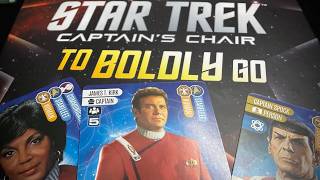


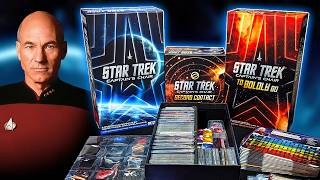








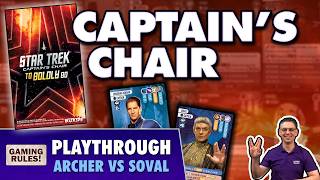








In Star Trek: Captain's Chair, you will go head-to-head with an opponent, each stepping into the shoes of an iconic captain from across Star Trek's galaxy and history. Command ships, crew, and away teams while you manage resources and alliances!
Each of the six captains comes with a unique, asymmetric deck of cards themed to that captain's personality strategies, allies, and assets. Each deck creates different strategic directions based on which common cards are available and what strategy your opponent deploys. The captains to choose from are:
Jean-Luc Picard
Benjamin Sisko
Michael Burnham
Koloth, The Dahar Master
Sela
Thy'lek Shran
True to Star Trek, antagonism will not win every game. You will need to pursue diplomacy, exploration, and science, with different captains excelling at different paths. With hundreds of unique, deeply thematic cards, you'll want to explore the galaxy again and again! The chair is yours, Captain!
—description from the publisher
- Deep strategic depth and high replayability
- Clear identity around Riker-driven play and synergy with Picard bot
- Many interesting engine-interaction moments and decisions
- Steep learning curve and terminology can be dense
- Engine optimization requires practice and familiarity with many card interactions
- Setup and deck management can be fiddly and busy
- Array
- Space
- Playthrough and analysis
- Second Contact
- To Boldly Go
- Box One
Mechanics (from transcript analysis)
- Actions and Free Actions — Turns consist of a number of actions (two main actions per turn, plus possible free actions) to activate cards, move agents, and trigger effects.
- Area Control — Sending away teams to locations and controlling locations to enable better execution of abilities.
- Deck building — Players manage a personal deck, drawing, discarding, and reshuffling, to fuel actions and triggers.
- deck manipulation — Lower Deck cards provide play and support operations; duty officers unlock additional actions and card interactions.
- Direct Card Interactions and Recursion — Interactions include recalling or duplicating plays, logging top cards, returning incidents, and reshuffling for engine building.
- Duty Officer / Lower Deck Mechanics — Lower Deck cards provide play and support operations; duty officers unlock additional actions and card interactions.
- end game bonuses — Glory counters and endgame scoring determine final victory; players weigh glory as a scoring resource.
- Endgame Scoring and Glory — Glory counters and endgame scoring determine final victory; players weigh glory as a scoring resource.
- Location Control and Away Teams — Sending away teams to locations and controlling locations to enable better execution of abilities.
- Resource management — Currencies such as dilithium, latinum, and dithium are spent to perform actions, upgrade cards, and trigger effects.
Video topics + discussion points
Quotes (from this video)
- Riker deck can do epic turns.
- This is why I was thinking I don't want to exhaust the Titan when I take control of Starbase 25.
- I think that's what I'm going to do.
- Riker maneuver is very powerful.
- The holo deck is a powerful way to draw three cards.
References (from this video)
- Rich, variable solo puzzle with meaningful decisions every turn
- Clear visual tableau of ships, crews, and abilities
- Tight integration of action economy, ship deployment, and neutral-location control
- Mission-based objective adds a tangible route to high endgame scoring
- Rules-heavy and timing-sensitive, which may be intimidating for new players
- Board state and iconography can be dense and require careful setup to avoid mistakes
- Incident deck management is critical; mistakes can lead to early loss in solo mode
- diplomacy, exploration, and tactical card-driven competition for control and points
- Star Trek universe; Enterprise-D era; near-future space exploration with neutral planets and encounters
- deck-building strategic skirmishes with a solo-opponent engine and mission-focused scoring
- Imperium Classics
- Imperium Legends
- Imperium Horizons
Mechanics (from transcript analysis)
- Action point allocation — Each turn provides a fixed number of action points used to play cards from hand; some plays are free, others cost AP.
- Action points — Each turn provides a fixed number of action points used to play cards from hand; some plays are free, others cost AP.
- Compound Scoring — Certain cards must be logged under a captain, and glory/shifts in score are tracked via star-date/logged assets; endgame scoring uses multiple tracked multipliers and mission completions.
- control of neutral locations — To control a neutral location, you must have sufficient tokens (ships and/or away teams) and maintain a token lead over the opponent.
- Deck building — Players curate and manage a personal deck/tableau of crew, ships, and events to activate actions and trigger effects.
- deck-building — Players curate and manage a personal deck/tableau of crew, ships, and events to activate actions and trigger effects.
- incident and encounter decks — The incident deck drives risk: drawing and discarding incidents affects your resources; encounter cards provide events and rewards; mishandling can cause loss or boost the opponent.
- log and score mechanics — Certain cards must be logged under a captain, and glory/shifts in score are tracked via star-date/logged assets; endgame scoring uses multiple tracked multipliers and mission completions.
- ship deployment and beaconing (beam/warp) — Ships can be deployed from the staging area and moved (warp) to various locations; cards can be beamed to ships to relocate or upgrade them.
Video topics + discussion points
Quotes (from this video)
- Incident cards are bad because if that incident deck ever runs out in the solo game, that's just an automatic loss.
- This is basically the timer for the game.
- solo playthrough of Star Trek Captain's Chair
References (from this video)
- familiar Imperium-style engine with Star Trek theming
- captain and fleet progression feels thematic
- two-player cap noted as a potential limitation
- not universally loved by non-Trek fans
- deck-building and strategic cycling of captain-specific powers
- Star Trek universe with ship captains and fleets
- Imperium Classics
- Imperium: Legends Horizons
Mechanics (from transcript analysis)
- card drafting — players draft cards from a shared market to improve their fleets
- deck-building with captain-specific powers — each captain provides unique abilities and progression
- indirect conflict via influence and market manipulation — players influence others rather than direct combat
- market card drafting — players draft cards from a shared market to improve their fleets
Video topics + discussion points
Quotes (from this video)
- We’re obsessed with board games.
- I freaking love Unstoppable.
- This game is great because there’s also it's a very open game where when a threat is out there, you can know what's on the other side of that.
- You can see from the other side like what is on the other side.
- Terra Mystica is getting a giant crazy big box version.
References (from this video)
- Ambitious scope with excellent iconography and art
- Robust track-based theme for deck-building fans
- Setup is a beast and can be overwhelming
- Two-player play can lead to downtime
- deck-building, exploration, and crew management
- Star Trek universe
- ambitious but dense with many moving parts
- DC Comics Deck-Building Game
- Legendary Marvel
Mechanics (from transcript analysis)
- area control and resource management — explore planets, manage ships and away teams
- Deck building — players gain cards and upgrade their decks to advance
- deck-building — players gain cards and upgrade their decks to advance
- isolinear chips and advancement — chips and development decks enable permanent abilities
Video topics + discussion points
Quotes (from this video)
- I'm Rob from just the road.com and these are my top 10 debt building games.
- Let's redo the countdown with a wider definition and some new discoveries from the last 5 years.
- Fingers crossed for a 15th anniversary big box in 2027.
- In Trains, you take the classic deck building formula and drop it onto a map of Japan.
- Undaunted Stalingrad is a two-player storydriven campaign game that blends tactical combat with smart debt building.
References (from this video)
- deep strategic depth and clever card interactions
- thematic integration; cards reflect Star Trek characters and settings
- asymmetric captain choices lead to varied play styles
- streamlined relative to Imperium; more focused
- enjoyable two-player competitive experience
- solo cadet mode as an approachable entry point
- long play time and potential analysis paralysis
- rulebook issues and learning curve; not casual-friendly
- solo modes may be heavier than some players prefer
- absence of Kirk in base game (addressed by future expansion)
- interaction can feel limited outside planetary/market actions
- fleet command, diplomacy, exploration, and resource management
- Star Trek universe; captain navigating a fleet through space and planetary control
- asymmetric captain-based campaign with evolving goals
- Imperium
Mechanics (from transcript analysis)
- Action tiles — three action tiles per captain that determine available actions with varying costs
- asymmetric captain abilities — each captain has a unique path and goals affecting strategy
- asymmetric player powers — each captain has a unique path and goals affecting strategy
- Deck building — build and upgrade a captain-specific deck using market and captain cards
- deck-building — build and upgrade a captain-specific deck using market and captain cards
- head-to-head competition on planets — two-player battler for control of planets with scoring tracks
- market drafting — acquire cards from a central market to improve your deck
- Resource management — manage multiple resources to activate cards and buy from the market
Video topics + discussion points
Quotes (from this video)
- this game is a very deep and strategic game very similar to the depth mechanical depth as seen in Imperium
- Star Trek captain's chair I feel like is more streamlined and focused
- not one that I would come back to a lot because it is long to play
- I think Kirk will be coming to this game including all the characters from the original Star Trek
References (from this video)
- Based on enjoyable Imperium system
- Potential to streamline complex mechanics
- No UK availability
- Hype train concerns
- No critic feedback received
- Star Trek
- Science fiction
- Imperium
Mechanics (from transcript analysis)
Video topics + discussion points
Quotes (from this video)
- I'm not as much of a completionist as I used to be
- I've got so much content in there already that probably still isn't played
- I've just kind of given up on Kickstarter
- Board game geek is kind of guilty for that
- I'm playing games to enjoy them and yes I play to win but I play to win in the spirit of the game
- Why am I spending this much money on a gamble it's not worth it
- These are the ones I like or these are Trends I don't like these are mechanics I don't like
References (from this video)
- distinct captain identities with strong Star Trek flavor
- deep strategic feel and strong thematic integration
- very solid two-player or solo play
- theme-heavy for some players
- may require a couple of plays to unlock full potential
- Star Trek immersion, crew-based strategic play
- Star Trek-inspired space captain simulation with multiple canonical captains.
- episode-like, captain-centric play sessions
- Star Trek-themed deck-builders
- Star Wars deck builders
Mechanics (from transcript analysis)
- asymmetric roles — Each captain feels distinct with unique synergies.
- asymmetric teams — Each captain feels distinct with unique synergies.
- Deck building — Build and optimize a deck of captain actions and crew abilities.
- deck-building — Build and optimize a deck of captain actions and crew abilities.
- engine building — Create a coherent strategy by combining cards for powerful turns.
- engine-building — Create a coherent strategy by combining cards for powerful turns.
Video topics + discussion points
Quotes (from this video)
- This is Spooktacular. Definitely check it out.
- It's so asymmetric and the fact these monsters also have different difficulty.
- Origin Story really is one of the more thematic trick-taking games that I've ever played.
- This is a fantastic deck building game.
- There’s so many captains that you play in it feel so distinct. It really nails the Star Trek theme.
- Pandora's box. Oh, so fun.
References (from this video)
- Star Trek theme
- Like the Imperium system
- Imperium system very complicated
- Complicated deck builder
- Long setup time
- Dense rulebook
- Complex cards with lots of text
- Star Trek
- Imperium
Mechanics (from transcript analysis)
Video topics + discussion points
Quotes (from this video)
- it's only a game
- Matt Leacock will you grow another thread of innovation in your skull and do something else
- we're done with pandemic
- I would rather be pessimistic and then pleasantly surprised then optimistic and then constantly disappointed
- I could rank something like Alice's garden a 9 10 out of 10 for how perfect a game for its genre it is but that doesn't mean I want to play it game after game
- this theme is going to speak to me heavily from a Nostalgia perspective
- you're not as good as you used to be mate
- this is why you've got to get your demos right
- head cubes on tracks is that really what I'm supposed to get excited for
- this one I think is the game that void fall should have been
References (from this video)
- strong IP appeal
- engaging crew-based decisions
- dependent on scenario quality
- average solo depth
- cooperative crew scenarios and mission execution
- Starfleet exploration and mission management within the Star Trek universe
- scenario-driven with starship crew dynamics
- Gloomhaven
- Hadrian's Wall
Mechanics (from transcript analysis)
- Cooperative teamwork — players coordinate to achieve mission objectives
- Scenario / Mission / Campaign Game — play unfolds across predefined mission steps
- scenario-based play — play unfolds across predefined mission steps
Video topics + discussion points
Quotes (from this video)
- I want to show you how the game plays and not to sell you the game.
- I’m one of the more genuine content creators.
- Mage Knight is the best game ever.
- Gaia Project beats Age of Innovation for me.
- I don’t like the idea of being a used car salesman.
- Star Trek: Captain’s Chair is an exciting licensed approach with lots of thematic promise.