/pic2537618.jpg)











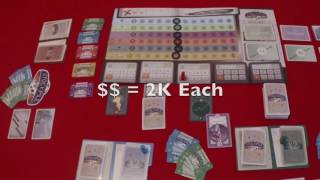











Stockpile Deep Dive
What the Community Thinks About Stockpile
Stockpile stands out among modern board games as a masterclass in bluffing and player interaction. Channels like Getting Games, Actualol, and Watch It Played consistently praise it as an exemplary design that delivers genuine tension through incomplete information, where every action at the table becomes a potential signal to opponents about hidden knowledge. The game transforms the stock-market theme into a framework where reading opponents matters as much as reading the board, creating memorable moments of strategic deception.
Core Mechanics That Define Stockpile
Insider Information and Hidden Knowledge
At the heart of Stockpile lies a deceptively simple asymmetry: each player privately sees a hint about how one company's stock will move while remaining uncertain about the others. This fragment of secret information cascades through every decision. When bidding on stock piles, players must constantly ask whether an aggressive bid signals genuine insider knowledge or elaborate misdirection. The simultaneous revelation of movement cards at round's end transforms all previous assumptions, making Stockpile a game where information advantage matters more than raw economic calculation.
The Supply Phase and Card-Placement Puzzle
During the supply phase, players simultaneously place cards into public stock piles, some face-down and some face-up. This simple action contains profound decision-making. Placing a card face-down lets you hide good cards or lure opponents into bidding on piles containing hidden liabilities. Placing a card face-up might signal weakness or deception, depending on context. The tension comes from knowing that opponents will scrutinize these choices, trying to extract meaning from incomplete signals. This mechanism creates a bluffing atmosphere where players are not only managing resources but actively performing for the table.
The Stockpile Experience
The Auction and Economic Tension
Stockpile's auction system forces genuine financial jeopardy. Players bid actual currency, which equals final victory points, to acquire stock piles. Unlike auctions that convert bids through abstract ratios, Stockpile makes the cost explicit and visceral: money spent now is money you will not count at the end. This creates natural deliberation as players weigh whether a pile is worth the price, whether they hold enough insider information to justify an aggressive bid, and whether caution will leave them too poor to seize a better opportunity later. The phase becomes a high-stakes negotiation with the game state itself.
Reading the Table and Narrative Drama
Stockpile excels at generating table narrative. When a player bids aggressively on a pile containing a company others were planning to avoid, it plants suspicion. When someone sells shares before a market revelation, opponents scramble to interpret the signal: did they know something bad was coming, or were they just raising cash for the next auction? These moments of interpretation create the game's most memorable interactions, turning the selling phase into theater where careful observation can yield as much advantage as any card drawn.
What Makes Stockpile Stand Out
Gateway Game with Strategic Depth
Stockpile bridges approachable and engaging with rare balance. The rules, while covering several distinct phases, resolve intuitively once players understand the flow. There is no hidden subsystem or counter-intuitive interaction, yet the emergent complexity from bluffing, information asymmetry, and auction timing creates substantial replayability. This makes Stockpile an excellent introduction to modern economic games while remaining satisfying for experienced players seeking genuine decisions.
Two Complete Games in One Box
The dual board design, standard on one side and advanced on the other, offers surprising flexibility. The standard side features symmetric stock tracks, while the advanced side introduces asymmetric volatility: some stocks climb easily but crash quickly, others move sluggishly but pay dividends. This design choice grants the box genuine replayability without requiring expansions, and players can choose their preferred complexity level without feeling compromised.
Potential Drawbacks
Perceived Complexity and Rules Overhead
Stockpile presents several distinct phases per round, and their order matters. New players often experience cognitive overload during the first teach, even though the rules themselves are straightforward. Reviewers recommend teaching the game while playing the first round, explaining each phase as it occurs, rather than delivering a rules dump up front. Once players internalize the sequence, teaching time becomes minimal, but the upfront barrier can discourage casual tables.
Analysis Paralysis in the Auction Phase
The auction's stakes can trigger extended deliberation, particularly among optimizers. Since bids directly convert to final money, players naturally calculate whether a pile justifies its cost, and some struggle to calibrate spending without complete information about hidden cards. This can extend the auction significantly, though experienced groups develop faster instincts. Optional asymmetric investor powers can compound this by creating wildly different starting positions, and their balance remains debated among the community.
If You Enjoy Stockpile
Players drawn to Stockpile often gravitate toward games combining asymmetric information with economic themes. Colorado shares Stockpile's clever card-placement mechanic and auction tension, though with less emphasis on market manipulation. High Society strips auctions to their essence: pure bidding tension with hand management and cards that punish overspending. For deeper market simulation, Brass: Birmingham offers richer economic interplay through network-building, though with greater rules complexity. And Coup delivers rapid-fire bluffing and hidden information without the economic layer, for groups who love the deception more than the math.
What Reviewers Are Saying
"The supply phase of the game is an excellent incentivization mechanic, because you have the usual things you have to think of, and it's not new in this game, Colorado uses it as well, where you are trying to put bad cards into stacks that already look good, or face down, so that someone takes the pile not knowing what it's going to be."
— Getting Games
"This is one of the best examples of how great modern board games are. You're trying to make the most money off the stock market, but the great twist is that you have information about how the stock market is going to move. You're making decisions based on what you know, but also based on how you think the other players are acting."
— Actualol
"Stockpile is all about trying to get a bargain and riding the wave of the market. It's so much fun gambling on a cheap industry and then seeing it skyrocket, and the secret insider info adds an exciting air of mystery, having you watch everyone like a hawk."
— Actualol