










Stupor Mundi Deep Dive
What the Community Thinks About Stupor Mundi
Reviewers describe Stupor Mundi as a smooth, mediumweight Euro that rewards planning over explosive turns. Designed by Nestore Mangone and published by Quined Games, it casts players as vassals of Holy Roman Emperor Frederick II, summoning allies around the Mediterranean and building a castle that the whole table shares. Phil, The Board Gaming Doctor tested the game on Board Game Arena during its digital development, and they praised the publisher and designer for using that format to find bugs in both the interface and the rules. Before You Play and Getting Games both teach the game from a prototype, which makes clear that costs and components are still being tuned.
Where reviewers agree is on flow. The game plays cleanly, the rules are approachable for experienced Euro players, and the interlocking systems reward a player who thinks several turns ahead. Where they diverge is on taste. Phil found the deck building less exciting than they hoped and does not enjoy scoring largely through track advancement. They were clear that this is a matter of personal preference, not a flaw in the design, and they still counted the game among the solid Euros they enjoy, even if they doubt they will return to it often.
Core Mechanics That Define Stupor Mundi
Deck Building
Every player starts with a small personal deck, and most of the cards are shared. As Before You Play explains, the decks are mostly the same, with mainly resource cards and cards that turn resources into money, and only two cards per player differ. Each turn you play one card from your hand, either face up for its printed reward or face down to take one of the two actions pointed to by the spears on your player board. Purchased cards enter your hand immediately and activate on the spot, so a well-timed purchase can be used again in the same round. Getting Games shows that buying a card often means trashing one from your hand or discard pile, a cost that thins your deck and makes each purchase a real choice. This is the system Phil found less engaging, though they noted that the trade-offs between buying, building, and trading are where the decisions live.
Track Advancement
Specialists move along three rows representing the countryside, villages, and cities. Each tile on the way offers an ongoing benefit as long as a specialist sits in that section, such as a bigger hand or extra money when you build a wall. Moving a specialist further often costs grain, and the first specialist to reach a city claims that city's immediate reward. Phil identified this as the main way players build their score, and they noted that the available tracks change from game to game, which keeps the layout fresh. Getting Games highlights how the same tracks also drive edicts, since a specialist landing on a marked space triggers a change to Frederick's castle.
The Stupor Mundi Experience
Tension Over Frederick's Castle
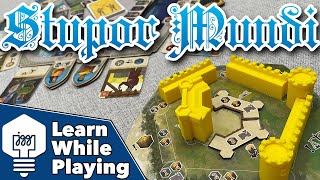
Much of the game's emotional charge comes from the shared castle. Each edict tile forces a player to add or remove pieces from Frederick's castle, and you must always carry out the edict even when it hurts you. Getting Games made this vivid when a player chose an edict that stripped the king's walls and allies, explaining the choice as a way to deny opponents their bonus points. The result is a table where every player keeps one eye on what the others are building and another on what the king will need to score.
A Smooth, Interlocking Euro Flow
Reviewers describe turns that feel quick to set up but satisfying to resolve. Phil called the game "very smooth," and the tutorial from Getting Games shows how a single structure, like a keep, can unlock a sixth card slot, extra hand size, or the ability to take both actions on a face-down card. Those small unlocks compound, so a turn that looks modest at first can set up a much bigger one later in the round.
What Makes Stupor Mundi Stand Out
Edicts That Reshape a Shared Castle
Reviewers consistently point to the edict system as the game's most distinctive feature. Phil said the edicts with Frederick's castle are "unique in a sense," and they valued having real say over what gets built and how scoring shifts for everyone. The edicts tie into the ally system as well. Loyalist allies want the king to thrive, while Independent allies reward you for outpacing him, so every edict can help one player and hurt another. That interplay is what makes the table feel interactive without turning it into direct conflict.
Digital Development on Board Game Arena
Phil spent months playing the game on Board Game Arena, watching its components and rules change from alpha through to later versions. They saw the digital testing as a real advantage for players who want to try the game before buying, and they suggested that Mangone fans in particular should seek it out. Before You Play also used the game's prototype state as a reason to explain changing values, which shows the design is still being refined in public.
Potential Drawbacks
Many Small Actions, Few Big Payoffs
Phil relayed concerns that players sometimes feel they are doing many small things that do not add up to a large combo or a satisfying payout. Some reviewers also felt the engine building was limited. Phil agreed that the deck building did not excite them and that scoring through tracks is not their favorite approach, so the criticism reads less as a flaw in execution and more as a question of whether the game's rhythm suits a given player.
Clogged Card Slots and Shifting Prototype Values
Before You Play noted that the board can get clogged, forcing a player to take a less efficient play simply because the other options are unavailable. The number of card slots is also limited, so late turns can be tight. Both Before You Play and Getting Games stress that costs, rewards, and some card effects were still being adjusted in the prototype, including a keep whose printed cost was corrected during play. Readers should expect the final numbers to differ from what these videos show.
If You Enjoy Stupor Mundi
Players who enjoy Stupor Mundi's track advancement will find satisfaction in other Euro games where moving pieces along rows unlocks ongoing benefits, because the appeal lies in planning which tracks to advance and when. Readers who value the shared-castle edicts should look for games where the board belongs to everyone and every player's actions change it, since that tension is what gives the table its shape. Those who enjoy the card economy will appreciate games where purchased cards activate immediately and can be reused in the same round, which is the quick-turn satisfaction Phil and the Before You Play host both describe.
What Reviewers Are Saying
"In addition you can take advantage of what other players are doing to score points for yourself once again through Frederick's Castle or through those promotion tracks so the game feels like everyone's actions and intentions are intertwined."
— Phil, The Board Gaming Doctor
"If all five of the walls were on here, we would be forced to remove them. You must always perform an edict, even if it makes you do something you don't want to happen."
— Getting Games
"On the other hand, Independents want you to individually thrive, and so all of their criteria are going to want you to have more of something than King Frederick."
— Before You Play