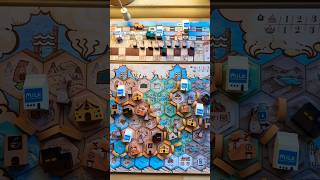


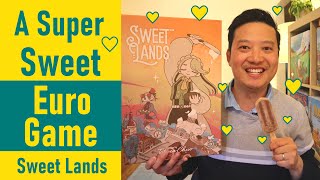



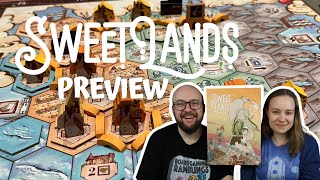



























Sweet Lands box art

Sweet Lands

Game ID: GID0311171
Collection Status
Description

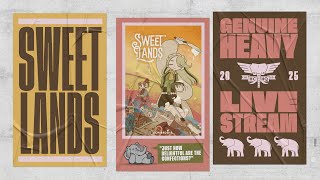
Welcome to “Sweet Lands”, the kingdom of delightful confections! The former king has succumbed to his gluttonous love for sweets, leaving behind a final decree. Summoned by this royal edict, you and your fellow players are challenged to build the most magnificent city — and if you succeed, you will ascend as the new ruler of Sweet Lands. Gather the support of various townsfolk and navigate through fierce competition to create the richest and most prosperous city of sweets!

Sweet Lands is a heavyweight Euro-style game with over 200 cards, 14 unique characters, and 449 wooden tokens, offering an unprecedented gaming experience. This game captures the essence of traditional Euro-style games while introducing fresh and innovative mechanisms. Come and experience our biggest masterpiece!

—description from the publisher

Year Published
2025
Transcript Analysis
Browse transcript mentions, sentiments, pros/cons, mechanics, topics, quotes, and references.
Total mentions: 12
This page: 12
Sentiment: pos 12 · mix 0 · neu 0 · neg 0
Mentions per page
Top
Showing 1–12 of 12
Video yaYk0_Fzh9E Unknown Channel game_review at 0:00 sentiment: positive
video_pk 61404 · mention_pk 154080
Unknown Channel - Sweet Lands video thumbnail
Click to watch at 0:00 · YouTube ↗
Overall sentiment (raw)
positive
Pros
  • Accessible and quick to learn
  • Hidden-card twist adds strategic depth
  • Works well with 3-5 players
  • Affordable and well-made packaging (not a flimsy tuck box)
Cons
none
Thematic elements
  • Color-coded suits, scoring via hidden, revealed and face-down cards.
  • Abstract color-based trick-taking game with hidden information (six suits; each player has nine cards and three face-down cards).
  • Analytical and enthusiastic overview of gameplay.
Comparison games
none
Mechanics (from transcript analysis)
  • End-of-trick mitigation with face-downs — Face-down cards can be used strategically; once exhausted, choices are limited.
  • Hidden Cards — Each player has three face-down cards unknown to opponents.
  • Must-follow color — If you have the color led, you must play it.
  • Scoring of cards — Face-up cards score by their value; face-down cards are worth 1 point.
  • Trick-taking — Players compete to win tricks; must follow the leading color if possible.
  • Turn order and start of trick — The winner of a trick usually starts the next trick; the game allows a house rule where the last winner starts.
  • Two-number cards with scoring — Cards show a main rank and a tiny score value; higher main rank corresponds to a lower tiny score.
  • Variable suits — Number of suits depends on player count (up to six).
Video topics + discussion points
No key topics recorded for this video.
Quotes (from this video)
  • This is Sweet Takes.
  • I think it's a great trick taking game.
  • I love that multiple people can take cards at the, you know, on each turn.
  • the big trick to this game is you have the three face down cards
  • This is a great trick taking game. I taught it to my nephew who had never really done trick taking and he caught on like that.
  • It's not in a tuck box like an Uno game that's just going to fall apart.
References (from this video)
No references stored for this video.
Video TqmCph6_-HM Unknown Channel general_discussion at 0:00 sentiment: positive
video_pk 59619 · mention_pk 152152
Unknown Channel - Sweet Lands video thumbnail
Click to watch at 0:00 · YouTube ↗
Overall sentiment (raw)
positive
Pros
  • The action economy cascades: most actions lead to multiple downstream benefits, creating a satisfying sense of chained progress.
  • Asymmetric player setups and maps promote varied gameplay experiences and diversification between sessions.
  • Endgame scoring rewards a broad portfolio of activities, reducing the risk of stalling on a single path and encouraging exploration.
  • Solo play is solid and enjoyable, offering a relaxing engine-building experience without heavy AI management.
Cons
  • Iconography can be clunky and hard to parse, especially in the iconography-heavy cards and rulebook; deciphering card effects often requires rulebook consultation.
  • Citizen deck is large (around 200 cards) and some cards feel opaque, leading to impression of Dead Space and occasional confusion about interactions.
  • Backtracking or changing planned actions can be awkward and cognitively intensive, which may slow down or frustrate players who like to adjust plans on the fly.
  • Resource tokens are tactile but could be more distinctive; deluxe resource sets with uniquely shaped tokens could elevate immersion and tactile satisfaction.
Thematic elements
  • Resource generation, city-building, and trade in a candy-coated setting; progression through tracks and asymmetric development create a narrative of growth and official prosperity within a playful dessert universe.
  • A whimsical confectionery-themed kingdom-building world where players expand a sweet realm by placing terrain tiles, building properties, and trading through ports to grow a diversified economy.
  • Light, thematic, and approachable; the theme serves as a vivid backdrop to engine-building and strategic placement rather than a heavy narrative drive.
Comparison games
  • Lisboa
  • Nucleum
  • Brass Birmingham
Mechanics (from transcript analysis)
  • Asymmetric player boards and character abilities — Each player has a unique character board with a one-time per-round ability and a personalized map board, producing early-game divergence and varied strategic options across play sessions.
  • asymmetric player powers — Each player has a unique character board with a one-time per-round ability and a personalized map board, producing early-game divergence and varied strategic options across play sessions.
  • Cards and automation engine — Citizen cards provide diverse effects that influence phase actions and resource flows. Automation cards, once activated, grant ongoing bonuses and must be slotted under the appropriate color area to continuously empower a player’s engine.
  • Compound Scoring — Final scoring blends scores from the prosperity track, city development, industry progression, and bonuses for roads, cookies, and other town features, creating a dense, multi-faceted endgame where every choice contributes to the final total.
  • Multi-track scoring and final tally — Final scoring blends scores from the prosperity track, city development, industry progression, and bonuses for roads, cookies, and other town features, creating a dense, multi-faceted endgame where every choice contributes to the final total.
  • Resource generation and track-based income — Income is produced via multiple sources: round support tiles, character-driven income, and a left-hand track on the player board. Resources are represented by differently sized cubes (e.g., 10s, 5s, 1s) to indicate value, and the generation rules emphasize planning and efficiency rather than brute accumulation.
  • Resource management — Resources are represented by tactile tokens (wood, wheat, ore, gold, diamonds) that players physically manipulate during play; while functional, the reviewer notes a desire for more tactile differentiation and potential deluxe upgrades to enhance immersion.
  • Resource tokens and tactile components — Resources are represented by tactile tokens (wood, wheat, ore, gold, diamonds) that players physically manipulate during play; while functional, the reviewer notes a desire for more tactile differentiation and potential deluxe upgrades to enhance immersion.
  • Skill tiles and endgame scoring — Skill tiles offer high-value scoring opportunities and are typically unlocked as milestones are reached along-progress on the map, providing powerful late-game levers and defining end-game scoring potential.
  • Tile-based map expansion and city-building — Players acquire terrain tiles and place them on their map to expand their kingdom. Building properties (such as tents and factories) yields bonuses and enables the creation of cities when three properties are connected, which serves as a key engine for point generation.
  • Trading and ports for draw power — Ports on the map create triggers for trade and draw power. Trading basic resources for terrain tiles and leveraging port locations are central to growing throughput and enabling more lucrative actions later in the game.
  • Worker placement discipline with action discs — Players place one action disc per turn onto designated action spots on a central board. Each spot requires paying a card cost or other resources to perform the action, and the availability of stronger actions grows as the start and income phases advance. This creates a cascading sequence of choices where every placement can unlock additional benefits.
Video topics + discussion points
No key topics recorded for this video.
Quotes (from this video)
  • the actions cascade and it feels so satisfying when you chain them together
  • you're rewarded for all the little things you do and for building out your sweet Kingdom
  • it's heavier than I expected but still approachable and fun
  • the theme is refreshing and not dry or dreary
  • this is a fantastic solo engine-builder and it fits a mellow evening session with friends
  • I'm backing it 100% and I think the gameplay justifies backing despite it being a prototype
  • the ports and draw power mechanic make exploration feel meaningful rather than arbitrary
  • the endgame scoring ties together so many different threads that you feel rewarded for your whole playstyle
  • iconography aside, the game sings when you start to chain actions and unlock engine bonuses
  • building out your city and watching bonuses cascade is incredibly satisfying
References (from this video)
No references stored for this video.
Video LPmiMzlCPjI Tabletop Toki playthrough at 0:05 sentiment: positive
video_pk 59683 · mention_pk 152206
Tabletop Toki - Sweet Lands video thumbnail
Click to watch at 0:05 · YouTube ↗
Overall sentiment (raw)
positive
Pros
  • Vibrant, unique art and presentation
  • Deep engine-building with multiple tracks and synergistic card interactions
  • Engaging solo gameplay with clear progression and end-game push opportunities
  • Potential for powerful late-game combos via skill tiles, bridges, and city expansion
  • Thematic cohesion around sweets and cookie rabbits enhances immersion
Cons
  • Prototype components and rules may differ from final production
  • Rule complexity can be high; initial learning may be intimidating
  • Solo rules diverge from multiplayer patterns; balance may depend on final rule set
Thematic elements
  • Prosperity through urban development and strategic resource management in a whimsical sugar-laden setting.
  • A confectionery-themed land-building world with territories connected by bridges and harbors, featuring cookie rabbits and baked goods as central motifs.
  • Narrated as a solo game playthrough with occasional humorous commentary; emphasis on world-building and track progression.
Comparison games
  • Aqua Garden
Mechanics (from transcript analysis)
  • Action discs on boards — Discs representing actions are placed on a board to activate multiple actions in sequence and manage efficiency.
  • Automation and tuck mechanics — Some cards allow automation of tokens and tucking of cards for points or bonuses.
  • card drafting — Draw five citizen cards, choose which to keep, and leverage discounts, bonuses, and unique abilities.
  • Card drafting from citizen deck — Draw five citizen cards, choose which to keep, and leverage discounts, bonuses, and unique abilities.
  • end game bonuses — Rounds progress with end-of-round bookkeeping; solo variant omits certain mid-game objectives found in multiplayer.
  • End-game scoring from multiple tracks — End-game scoring factors include prosperity, cities, tucked cards, and cookie rabbits, with late-game synergies.
  • End-of-round and end-of-game flow — Rounds progress with end-of-round bookkeeping; solo variant omits certain mid-game objectives found in multiplayer.
  • Resource management — Citizens produce resources that are spent to perform actions, buy cards, and advance tracks.
  • tile placement — Place terrain tiles to expand your city's landscape, with bridges unlocking production bonuses when tiles touch.
Video topics + discussion points
No key topics recorded for this video.
Quotes (from this video)
  • this is a pre-production copy so just do be aware that the final components rules Etc may be different from what you see here
  • the art is from tasuki ano super cool
  • this game deserves all the hype it can get
  • I will be releasing a very in-depth review of this prototype hobby
  • the top is just so delicious in theme and presentation as well
References (from this video)
No references stored for this video.
Video uCUM1sTp3rQ Tabletop Toy game_review at 0:21 sentiment: positive
video_pk 59682 · mention_pk 152205
Tabletop Toy - Sweet Lands video thumbnail
Click to watch at 0:21 · YouTube ↗
Overall sentiment (raw)
positive
Pros
  • Elegant cube-based resources that simplify counting and enable smooth resource exchanges
  • Beautiful screen-printed wood tokens and well-designed components
  • Dual-layer, double-sided player boards with unique pass abilities and building options
  • Strong flow from turn to round with momentum-building engine-building
  • Solid solo mode and scalable player count
Cons
  • Prototype-specific scoring track is fiddly due to a small track and three point tokens
  • Citizen card rule requiring one card to be kept in hand each round can feel limiting
  • Long playtime may not fit all collections or players, especially with heavier expectations
Thematic elements
  • Candy-themed Euro game focusing on engine-building, city-building, and resource management.
  • A whimsical confectionery land where players expand territory, build terrain, and attract cookie rabbits over five rounds.
  • Economy and development driven with light thematic flavor; not strongly narrative.
Comparison games
none
Mechanics (from transcript analysis)
  • Card-based triggers — Card play enables combos and triggers on the main board and prosperity tracks.
  • engine building — Combine citizen cards, skill tiles, and buildings to trigger chains of bonuses.
  • engine-building — Combine citizen cards, skill tiles, and buildings to trigger chains of bonuses.
  • Multi-use cards — Citizen cards can be used for multiple purposes and must be managed across rounds.
  • Resource management — Use cubes representing resources (wood, stone, coins, etc.) on a compact, numeric track to optimize actions.
  • tile placement — Place terrain tiles to expand your land and gain bonuses.
  • Worker/turn-based action economy — Take actions by placing citizens or paying money to employ citizens; action costs increase with use.
Video topics + discussion points
No key topics recorded for this video.
Quotes (from this video)
  • oh my gosh honestly y'all it blew me out of the water you can just stop the video right now and just go make sure you get a copy
  • the resources are actually just a series of Cubes
  • this is just a pre-production copy
  • I would absolutely recommend checking out Sweet Lands
  • wow number two criteria of it better do it better than anything else I own or anything else currently on the market that I have access to
  • the solo play is so great at least in this iteration of the rules and with the sample copy it just comes in two decks where you flip over two cards and then those actions are blocked out from the beginning of the round
  • being able to hold on to one card from round to round really can give you a boost on long-term planning
  • you absolutely need to keep an eye out and grab a copy of Sweet Lands as soon as you can
References (from this video)
No references stored for this video.
Video arGIXWqWDRY Unknown Channel game_review at 0:20 sentiment: positive
video_pk 59461 · mention_pk 152015
Unknown Channel - Sweet Lands video thumbnail
Click to watch at 0:20 · YouTube ↗
Overall sentiment (raw)
positive
Pros
  • Card-driven engine with multi-use cards and sweet tags
  • Deep, crunchy decisions with multiple interaction layers
  • Strong thematic integration with Candy Lands and town-building
  • High variability and potential for powerful combos
  • Rich production and component feel (noted by the speaker)
Cons
  • AP-prone; can be overwhelming and slow to optimize
  • Very table-hogging with multiple boards and components
  • Early card costs and resource constraints can hinder starts; potential for unplayable hands
  • No in-game hand limit may cause awkward discard decisions unless house rules are applied
Thematic elements
  • Sweet treats, candy-based economy, and city construction with resource production
  • Candy Land-themed city-building on a hex grid with a king candy ruler
  • Flavor-forward, heavy crunch and multi-layer decision-making with automation and tags
Comparison games
  • Castles of Burgundy
  • Gaia Project
  • Underwater Cities
  • Earth
  • Creature Caravan
  • Wondrous Creatures
  • Aqua Garden
Mechanics (from transcript analysis)
  • Automation / multi-use cards — Some cards can be automated by spending diamonds, triggering effects from tucked cards.
  • card drafting — Draw five cards per turn; play or activate actions from cards; some cards grant bonuses.
  • card drafting/hand management — Draw five cards per turn; play or activate actions from cards; some cards grant bonuses.
  • Multi-use cards — Some cards can be automated by spending diamonds, triggering effects from tucked cards.
  • Prosperity/Industry tracks and endgame scoring — Progress on terrain-based prosperity tracks and industry tracks affects end-game points.
  • Public/shared action board — A central board provides actions that players can take by paying costs with strategic timing.
  • Resource management — Track iron, wood, wheat, water, gold, and other resources to pay costs and activate actions.
  • Round structure with pass and round aid tokens — Five rounds with pass mechanics that grant bonuses or priority via round aid tokens.
  • Sweet tags / synergies — Tags on cards interact to discount costs or multiply effects based on tag counts.
  • Tags — Tags on cards interact to discount costs or multiply effects based on tag counts.
  • Tile placement / hex grid city-building — Place hex tiles on a personal map to build routes and districts; flips tiles to activate production.
  • Track advancement — Progress on terrain-based prosperity tracks and industry tracks affects end-game points.
Video topics + discussion points
No key topics recorded for this video.
Quotes (from this video)
  • the cards everything you do in this game revolves around cards
  • it's a point salad
  • this game is right up my alley
  • not sponsored not paid whatsoever
  • it's insane table hog
References (from this video)
No references stored for this video.
Video IazUNw2N3QU Unknown Channel game_discussion at 0:00 sentiment: positive
video_pk 50913 · mention_pk 151200
Unknown Channel - Sweet Lands video thumbnail
Click to watch at 0:00 · YouTube ↗
Overall sentiment (raw)
positive
Pros
  • Lush track-based economy with satisfying growth opportunities
  • Engages players in building an economic engine
  • Table presence provides a strong tactile experience
Cons
  • High complexity and significant table space requirements
  • Potentially long playtime and setup
Thematic elements
  • economic engine building, prosperity, urban development
  • Industrial city-building economy on a modular, tabletop board
  • abstract economic simulation with track-based progression
Comparison games
none
Mechanics (from transcript analysis)
  • Building construction and engine — Places/buildings create an engine that generates benefits and options.
  • Citizen card actions — Citizens are used to take actions that drive the economy and building phase.
  • Economy engine management — Players optimize sequences of actions to pull buildings and move up tracks.
  • engine building — Places/buildings create an engine that generates benefits and options.
  • Multi-use cards — Citizens are used to take actions that drive the economy and building phase.
  • Track advancement — Prosperity and Industry tracks advance to unlock actions and build opportunities.
  • Track progression — Prosperity and Industry tracks advance to unlock actions and build opportunities.
Video topics + discussion points
No key topics recorded for this video.
Quotes (from this video)
  • this is a golden crunchy Euro game that redefines the word sweet
  • oh my goodness
References (from this video)
No references stored for this video.
Video gwepGUzhiII Board Gaming Doctor game_review at 0:10 sentiment: positive
video_pk 38947 · mention_pk 117417
Board Gaming Doctor - Sweet Lands video thumbnail
Click to watch at 0:10 · YouTube ↗
Overall sentiment (raw)
positive
Pros
  • Strong asymmetry with multiple character powers and personal boards.
  • Robust card-driven engine with high card variability and multi-use utility.
  • High replayability due to a large pool of cards and asymmetric plans.
  • Engaging solo mode that both teaches the game and provides replayability.
  • Satisfying track system that complements tableau-building without overwhelming players.
Cons
  • Downtime potential at four players due to heavy optimization and planning per turn.
  • Rulebook accessibility concerns in non-English digital versions; English rules are available on BGG.
  • Overall complexity may be a barrier for lighter-weight or gateway players.
Thematic elements
  • Economic tableau-building with asymmetric powers and a confectionery theme.
  • A whimsical confectionery kingdom focused on building a sweet fantasy realm and infrastructure to attract residents (bunnies).
  • Abstract, puzzle-driven with minimal storytelling; thematic flavor through sweets and kingdom-building.
Comparison games
  • Terramystica
  • Age of Innovation
  • Castles of Burgundy
  • Gricola
  • Agricola
  • Ark Nova
  • Russian Railroads
  • Clans of Caledonia
Mechanics (from transcript analysis)
  • card drafting and multi-use cards — Each card can be played for its effect or tucked under the player board for ongoing benefits; can discard for actions.
  • Resource conversion economy — Converts basic resources (e.g., wheat, wood, stone) into actions and abilities; money is central to many transactions.
  • Resource management — Converts basic resources (e.g., wheat, wood, stone) into actions and abilities; money is central to many transactions.
  • Solo mode with AI blocking — Solo variant uses AI tiles that block spaces; players choose a column of benefits each round to shape strategy.
  • tableau building — Each player has an asymmetric board and eight character powers; builds tracks and structures to progress.
  • Tableau building with asymmetry — Each player has an asymmetric board and eight character powers; builds tracks and structures to progress.
  • Terrain/road building and tile placement — Place terrain tiles to enable road-building and unlock actions; roads and buildings interact with the tableau.
  • tile placement — Place terrain tiles to enable road-building and unlock actions; roads and buildings interact with the tableau.
  • Track advancement — Multiple shared tracks provide VP and income; milestones set end-game or scoring goals.
  • Track advancement and milestones — Multiple shared tracks provide VP and income; milestones set end-game or scoring goals.
  • worker placement — Use cards or discard cards to take actions on a worker placement board; blocking or competing for spaces.
Video topics + discussion points
No key topics recorded for this video.
Quotes (from this video)
  • But I think the most unique things about this game first of all are the cards/worker placement system.
  • I would give this an 8 out of 10.
  • the solo mode is really good.
  • this is a very very fun game.
References (from this video)
No references stored for this video.
Video S3Uvp1o0sx4 FRL game_review at 0:05 sentiment: positive
video_pk 34765 · mention_pk 103642
FRL - Sweet Lands video thumbnail
Click to watch at 0:05 · YouTube ↗
Overall sentiment (raw)
positive
Pros
  • Rich, crunchy decisions with many viable options
  • Engaging action selection and card economy
  • Strong asymmetry and variety from citizen cards
  • Beautiful production and the 3D kingdom visual payoff
  • High replayability due to multiple tracks and strategies
  • Whimsical theme with humorous card names
Cons
  • Prototype balance concerns (some citizen cards over/underpowered)
  • Harbors mechanic feels idiosyncratic and can penalize players
  • High complexity and long first plays; requires rulebook familiarity
  • Need for player aids in final product; order of income timing matters
  • Rule friction: certain constraints (e.g., always keeping a citizen card) may be unnecessary
Thematic elements
  • Economic development through track and building expansion in a candy-themed world
  • Whimsical candy kingdom with tracks, trains, and city-building
  • Playful, humorous with whimsical character cards
Comparison games
none
Mechanics (from transcript analysis)
  • Action selection with card economy — You hold Candy Citizen cards; you can play them for their action on the card or spend them to take actions on the main board; actions become more expensive as cards are reused.
  • Asymmetry via citizen cards — Citizen cards provide varying benefits and can be attached to a player board to trigger payouts.
  • City-building with group bonuses — Aim to form distinct cities with groups of three unique buildings for scoring.
  • Compound Scoring — Prosperity tracks determine scoring from tiles, roads, buildings, etc.
  • end game bonuses — End scoring across many categories with a visually impressive 3D kingdom display.
  • End-game payoff and 3D kingdom — End scoring across many categories with a visually impressive 3D kingdom display.
  • Resource management — Manage resources to perform actions; income increases via tracks and citizen cards.
  • Resource management and income — Manage resources to perform actions; income increases via tracks and citizen cards.
  • tile placement — Place train tiles, then roads; once flipped, buildings can be added.
  • Tile placement and track expansion — Place train tiles, then roads; once flipped, buildings can be added.
  • Track-based scoring — Prosperity tracks determine scoring from tiles, roads, buildings, etc.
  • worker placement — Card-driven actions function like worker placement on the main board.
  • Worker-placement-like actions — Card-driven actions function like worker placement on the main board.
Video topics + discussion points
No key topics recorded for this video.
Quotes (from this video)
  • this game is absolutely brilliant
  • one of the best gaming experiences this year
  • the core action selection system is very interesting
  • the joy of it is just playing it and working your way through all of its bells and whistles
  • you want to keep coming back to it
  • it's just so addictive to play again and again
References (from this video)
No references stored for this video.
Video _M8cZZ9TdVA Watch It Played / Board Game Review Channel top_10_list at 5:23 sentiment: positive
video_pk 10684 · mention_pk 94155
Watch It Played / Board Game Review Channel - Sweet Lands video thumbnail
Click to watch at 5:23 · YouTube ↗
Overall sentiment (raw)
positive
Pros
  • Highly rated game with many nines, tens, and eights from players
  • Beautiful visual presentation with great components
  • Heavy Euro game with substantial depth
Cons
  • Very heavy game - weight does not match the sweet theme
  • Cover art deceptive for game complexity
Thematic elements
  • Building and managing a sweet industry
  • Sweet/candy industry
  • Economic simulation
Comparison games
none
Mechanics (from transcript analysis)
  • action drafting — Limited spots for actions mean players must prioritize carefully
  • Action Priority — Limited spots for actions mean players must prioritize carefully
  • Area Building — Build roads, buildings, and production facilities on your board
  • disc placement — Place discs on player board to take actions, with first-come-first-serve action spots
  • Resource management — Manage production and resources to build industry
  • tile placement — Place discs on player board to take actions, with first-come-first-serve action spots
Video topics + discussion points
No key topics recorded for this video.
Quotes (from this video)
  • It's a boss fighting game with QR codes. In this game, you're going to get pick one of four heroes and then mix it with one of the four classes
  • Every other page in the rule book has this info about how the mechanisms in the game relate to real life
  • It's a dice placement game by Stefan Feld. What else do you need to know?
  • It's basically trick taking game with a lot of things around it
  • If you lose an auction, you also get some rewards
  • Let us know which ones are you most excited to try down in the comments
References (from this video)
No references stored for this video.
Video e3j50weF_uM Boardgame Geek Podcast top_5_list at 14:59 sentiment: positive
video_pk 9058 · mention_pk 26715
Boardgame Geek Podcast - Sweet Lands video thumbnail
Click to watch at 14:59 · YouTube ↗
Overall sentiment (raw)
positive
Pros
  • high-production feel with cute, detailed art
  • strong weight and depth for a heavy Euro experience
  • clear progression and satisfying scoring
Cons
  • noted as heavy; balancing and setup considerations discussed
Thematic elements
  • kingdom management with candy and pastry motifs
  • A candy- and architecture-themed kingdom on a Mars-like world
  • whimsical, humorous
Comparison games
none
Mechanics (from transcript analysis)
  • engine_building — players develop their own score engine via buildings and districts.
  • polyomino-like_placing — placing shapes to complete lines and score.
  • tile_placement — placing hex or hex-like tiles to form districts and unlock bonuses.
Video topics + discussion points
No key topics recorded for this video.
Quotes (from this video)
  • The art is off the chain.
  • I'm a big Sudoku fan. I play Sudoku almost every day.
  • The memory board is a fantastic idea; it mirrors real memory of trips.
  • This is one of the best gaming experiences I've had all year.
  • The Kickstarter fulfillment milestone is humbling.
  • If you are messaging Bezier on social, it's probably Jay answering.
  • Game Makers on a pallet forklift at Gen Con was incredible.
References (from this video)
No references stored for this video.
Video xtAbGekJTbw The Dice Tower top_10_list at 11:06 sentiment: positive
video_pk 6902 · mention_pk 103386
The Dice Tower - Sweet Lands video thumbnail
Click to watch at 11:06 · YouTube ↗
Overall sentiment (raw)
positive
Pros
  • cozy but crunchy engine-building with familiar heavy-game vibes
  • strong interlocking systems that reward planning
  • beautiful thematic integration and approachable depth
Cons
  • complexity can push away newcomers
  • the depth may feel repetitive if played frequently
Thematic elements
  • city-building and tile/track-based expansion
  • cozy, terraforming-like world with diverse tracks and tracks-driven end-game scoring
  • engine-focused, with aesthetic warmth and approachable rules
Comparison games
  • Terraforming Mars (engine-building scale)
  • Terra Mystica (track-driven choices)
Mechanics (from transcript analysis)
  • card-driven actions and discounts — cards enable or discount actions; synergy multiplies when plans align.
  • Multi-track scoring — various tracks influence end-game scoring; advancing on tracks multiplies effects.
  • worker placement — spots can be used by up to three players but require cards to place, creating a shared economy.
  • worker placement with shared spots — spots can be used by up to three players but require cards to place, creating a shared economy.
Video topics + discussion points
No key topics recorded for this video.
Quotes (from this video)
  • the map has all these different ways, and where they're located is very deduction-based
  • this is a nice marriage of the two—cooperative play and deduction
  • I love the pieces on this
  • it's a good heavy euro where you have action bidding; you don't just place out a worker
  • the interaction of the player spaces and the gears that you put out that allow you to basically pick from adjacent action spaces
  • everything in this game is so logical and cohesive
References (from this video)
No references stored for this video.
Video OOKz8HkGI8o Unknown Channel top_10_list at 7:01 sentiment: positive
video_pk 3783 · mention_pk 98763
Unknown Channel - Sweet Lands video thumbnail
Click to watch at 7:01 · YouTube ↗
Overall sentiment (raw)
positive
Pros
  • dense, visually appealing infrastructure
  • intriguing blend of production chain and territory ideas
Cons
  • heavy for a candy/production-theme game
  • could be overhead for casual players
Thematic elements
  • factory building and distribution network for sweets
  • industrial candy/food production empire
  • economic/engine-building with colorful components
Comparison games
Mechanics (from transcript analysis)
  • Resource management — Use discs to activate actions and manage production output
  • resource_and_discs_management — Use discs to activate actions and manage production output
  • worker placement — Place workers on actions to build factories and fulfill production needs
  • worker_placement — Place workers on actions to build factories and fulfill production needs
Video topics + discussion points
No key topics recorded for this video.
Quotes (from this video)
  • The coldest hot board game out there right now is Ory. So, Orly is actually a quite heavy Euro game from the looks of it alone, right?
  • Decorus is the new cooperative and hot board game from Pegasus.
  • The looks are not that great. Yeah, it it looks unique, but it's a really tough and heavy cooperative board game about hacking.
  • The Hobbit? Then you know what's coming.
  • This is a deck building game.
  • The board is actually very clean, yet at the same time detailed.
  • The pieces pop. I love the contrast of black and white background and then having colorful pieces.
  • First and hottest game this month is Vampire Lords, which is right now on Game Found.
  • Second hottest board game out there right now is The Old King's Crown.
  • Number three in our hotness list is Tigris and Euphrates.
  • Fourth hottest board game right now is Covenant.
  • Fifth hottest game on our list is Terramystica.
  • Number seven on the hottest games of the month is Tag Team.
References (from this video)
No references stored for this video.
Transcript Navigation
Top
Showing 1–12 of 12
View on BoardGameGeek