












Switch & Signal Deep Dive
What the Community Thinks About Switch & Signal
Reviewers describe Switch & Signal as a cooperative puzzle that rewards careful planning. Its theme is familiar, with goods moving from city to city by rail, but the game turns that theme into a tightly constrained problem that the whole table has to solve together. Channels that cover it often note how little it resembles other cooperative titles, and that distinctiveness is a large part of why people who discuss it keep returning to it.
Opinions diverge mostly on how the game works with a group compared with playing alone. Some reviewers find the experience strongest when players talk through their moves and anticipate what their teammates plan to do. Others feel the best moves are often obvious enough that the cooperative version becomes several people working through the same solo puzzle. Almost everyone agrees the design is smart and satisfying, and the discussion centers on whether its replay value and social dynamics match the quality of that design.
Core Mechanics That Define Switch & Signal
Card-Driven Track and Signal Control
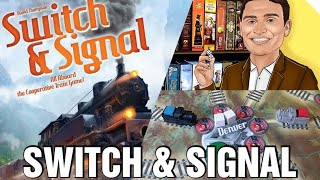
The main tool available to the team is the hand of cards. Reviewers describe playing cards to move switches so that routes line up for the trains, and to change signals so that trains can enter a city or pass through safely. The number of switches and signals that can be adjusted is limited, so every card matters and the team must decide which track changes are worth spending a turn on. Beyond Solitaire highlighted this constraint as the core of the challenge, since the group cannot adjust every route it might want.
Automatic Train Movement and Collision Avoidance
Trains move on their own at the end of each turn, and reviewers note that they travel at different speeds. This means the team cannot always know how far a train will go or when it will arrive. Keeping trains from colliding, avoiding dead ends, and keeping goods moving toward their destinations occupies most of the effort. The Chairman of the Board channel framed the goal as keeping trains flowing efficiently and safely without wasting movement, while Totally Tabled described the unknown train movement as the source of the tension.
Cooperative Pick-Up and Delivery
Goods must be collected at their origin cities and carried to their destinations, and the rail network is shared by every player. Reviewers treat deliveries as the objective and track and signal management as the means of achieving it. Beyond Solitaire described the goal as delivering goods and then returning the trains to the main station, which adds a second leg to each route and gives the team another logistical problem to solve.
The Switch & Signal Experience
Nerve-Wracking Uncertainty
Much of the game's tension comes from not knowing what the trains will do next. Totally Tabled called the experience really nerve-wracking because players cannot predict exactly how far or when the trains will move. Beyond Solitaire noted that a small timing error or a train that moves farther than expected can quickly turn the network into a mess. The Chairman of the Board channel also pointed to the constant pressure of deposits that must be completed before time runs out, which keeps the table focused on every turn.
Satisfying Puzzle Solving
Many reviewers describe the game as a puzzle first, with the satisfaction coming from finding a configuration in which every train arrives safely at its destination. Echos and the Solo Send Off series both called it an amazing or very cool puzzle, and the Chairman of the Board channel described it as an efficiency puzzle that is genuinely enjoyable to solve. Players who enjoy puzzle-style games seem to find it the most rewarding, and those who prefer looser, more social play tend to feel the experience is less compelling.
What Makes Switch & Signal Stand Out
A Cooperative Twist on Pick-Up and Delivery
Totally Tabled usually finds pick-up and delivery games unappealing and compared Switch & Signal directly with Star Wars: Outer Rim. The host explained that the game keeps the structure they dislike but adds cooperation, which transforms the routine into an interesting puzzle that works for them. The Chairman of the Board channel made a similar point, saying the genre works especially well in a cooperative setting. This shift from competitive logistics to shared problem solving is the element reviewers most often cite when explaining why the game feels different from others in its category.
Design Pedigree and Approachable Rules
Reviewers point to the designer, David Thompson, as a reason to take the game seriously. Totally Tabled said the design background shows once the game is being played. Beyond Solitaire described the game as not hard to teach or learn, while still being challenging and frustrating in the right ways. The host of that channel also suggested it would be a good choice for introducing a relative who loves trains, which points to its potential as an accessible entry in the genre.
Potential Drawbacks
Limited Replayability and Few Maps
The most common criticism is that the game does not offer enough variety to sustain repeated play. The Chairman of the Board channel said the game lacked a little in replayability and expressed a wish for more maps and expansion content, since the base game offers only two boards. The Solo Send Off host said that each game felt very similar, which led them to decide to part with their copy. Echos observed that once a layout has been worked out, the puzzle may become more predictable with repeated play, and Totally Tabled added that the presentation may not look especially appealing even though the design underneath is strong.
Cooperative Play Divides Opinion
Reviewers are split on whether the game works best with a full table. Some describe the solo version as the most satisfying way to play, and the Solo Send Off host said they would not play it with other people and considered it a pure solo experience. Echos was less enthusiastic about the cooperative mode, arguing that a group mostly solves the same puzzle separately and has little to discuss. Players who value conversation and debate at the table may find this approach less appealing than those who want a focused puzzle to work through.
If You Enjoy Switch & Signal
Readers who enjoy cooperative puzzles, tight logistics, and planning around uncertainty are likely to find the most appeal here. Reviewers who compare the game to other titles point to Star Wars: Outer Rim as the pick-up-and-delivery game it most resembles, while Beyond Solitaire contrasted it with Ticket to Ride, a familiar choice for introducing new players to train games. Those who enjoy Switch & Signal tend to appreciate the way its puzzles reward careful thought, and the reviewers featured here generally agree it is most rewarding when players can plan together and adapt as the trains move.
What Reviewers Are Saying
"the trick is you just don't know how far the trains are going to move or when so it's really nerve-wracking"
— Totally Tabled
"it's really challenging because you have very limited like switches and signals that you can use to open up and adjust routes so the trains take the right pathways to where they're supposed to go"
— Beyond Solitaire
"except that it is cooperative and it sort of turns everything into this really interesting puzzle that just works for me"
— Totally Tabled