





















Tacta Deep Dive
What the Community Thinks About Tacta
Reviewers consistently praise Tacta as a deceptively deep abstract puzzle that delivers surprising strategic richness in a compact package. What starts as a simple card-placement concept transforms into an engaging mental duel where players balance covering opponents' scoring potential with protecting their own visible dots. The game has resonated with audiences seeking lightweight titles that don't sacrifice decision-making or table presence.
Core Mechanics That Define Tacta
Tile Placement with Matching Constraints
Each turn, players draw from either end of their color-coded deck and place a card onto the shared table, but only where it aligns perfectly with existing shapes. This constraint forces spatial reasoning at every moment. You cannot arbitrarily position your cards; the geometric lines must match, creating a shared puzzle that grows more complex with each play. The limitation of choosing from only two deck positions, top or bottom, keeps turns brisk and eliminates decision paralysis.
Scoring Through Dot Visibility
Visible dots equal victory points, and herein lies the game's heart: every card you play is both offensive and defensive. You want your dots exposed while aggressively covering your opponents' scoring potential. This dual mandate creates tactical tension. Some cards force difficult choices between securing your own points or denying opponents theirs, and late-game positioning becomes critical as open spaces vanish and the board calcifies.
The Tacta Experience
Vibrant and Tactile
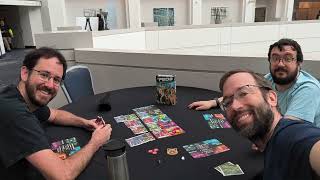
Reviewers rave about the visual payoff. By game's end, the table displays a colorful mosaic of overlapping cards with neon-bright lines forming an almost abstract art piece. The saturated colors, orange, blue, green, purple, pink, yellow, jump off the table and draw spectators' attention. Players describe the finished board as photogenic enough to photograph for social media, and the physical handling of cards feels satisfying as you rotate and flip each one before placing it.
Quick and Breezy
Games finish in 15-20 minutes, even with higher player counts. The rapid turn structure keeps energy high. Because you're only choosing between two cards, you move fast. There's no waiting for one player to contemplate fifteen different placement options. This speed works in Tacta's favor at game nights where you want multiple plays in one session or where you need a warm-up before diving into heavier titles.
What Makes Tacta Stand Out
Gateway-Accessible Rules with Surprising Depth
New players grasp the core concept immediately: match the shapes and score your dots. Within five minutes, anyone can play. Yet beneath this simplicity lurks genuine strategy. You begin to scan for spaces where your opponents cannot legally block you, you hold certain high-value cards for the endgame, and you track which colors dominate which regions of the board. Reviewers note that novice and experienced players can compete on relatively equal footing, making it ideal for mixed-skill tables.
Compact Design, Big Table Presence
Tacta comes in a tiny box that fits into a backpack without complaint, yet it spreads across a large table. This paradox appeals to travelers and players with limited shelf space. The small footprint belies the expansive play area the game demands, particularly at higher player counts with six players competing for table real estate.
Potential Drawbacks
Rules Interpretations Can Spark Debate
The rulebook permits cards to have "light overlap" with non-matching cards beneath them, but this terminology invites disagreement. Particular players who demand pixel-perfect card placement may find themselves in rules negotiations mid-game. Having a table agreement upfront about what "light" means prevents friction later.
Replayability Tied More to Player Interaction Than Game Variation
Because the game uses identical decks shuffled differently each round, the core puzzle and positioning options remain consistent. Freshness comes primarily from the people at the table and their competitive or collaborative energy, not from new rules, cards, or scenarios. If you play the same opponents repeatedly, the game's strategic landscape may feel familiar sooner than it would with games offering variable powers, asymmetric roles, or expanding modules.
If You Enjoy Tacta
Fans of spatial abstract games like King Domino, Patchwork, and Azul will find Tacta a natural fit. All three share the same DNA: intuitive rules that reveal strategic depth, beautiful geometric patterns, and tile-or-card placement that rewards forward planning. Tacta also appeals to players who loved the chaos and speed of real-time games but prefer turn-based mechanics, since it offers both play modes. Those seeking colorful, Instagram-ready games with fast play times and minimal rules overhead should add Tacta to their wishlist.
What Reviewers Are Saying
"It's a battle of dots. You've got them, you want to keep them, and your opponents keep trying to take them away."
— Watch It Played
"When it comes to real-time gaming, I'm always looking for great and simple options where you've got fun choices and a bit of panic, but the rules are simple enough that you can easily play it. Tacta definitely hits that in real time."
— Meeple University
"It's a tiny box that doesn't sacrifice decision-making or replay-ability. Each time you shuffle, the game unfolds differently. You never get stuck in decision paralysis, you just play and it moves fast."
— Let's Table It