/pic4092498.jpg)
Northwest India at the beginning of the 18th century. The rule of the Grand Moguls is waning, and the Maharishis and princes seize the opportunity to take control of the region. By influencing the prominent forces, building magnificent palaces, and ensuring a steady supply of commodities, the princes increase their power until the most successful has won.
The goal of the game is to gain the most influence points. These can be obtained by building palaces and by acquiring commodities. A palace can be built after securing the support of the Vizier, the General, the Monk, the Princess, or the Grand Mogul. Commodities are gained by seizing control of a region or by retrieving them on a space where a palace has just been built.
There are twelve turns with an auction for the region control and the support of the Vizier, General, Monk, Princess, and Grand Mogul, each represented by a different symbol. Players use cards in four colors to bid for the various prizes, and each player may only play one color in any given turn. During your turn you can either increase your bid by playing more cards or withdraw. When you do, you gain the reward for every symbol you have the majority of. You place palaces, gain region tiles, and increase your score accordingly. There are bonus points for connecting palaces over several regions on the map.After the final area on the board is auctioned, the player with the highest point total wins the game.
This game is #3 in the Alea big box series.
Note: the 2018 edition from Fantasy Flight Games includes rules for 2 players. You use only the cards included in the game, so no additional components are required. Anyone could use these rules with any version of the game.
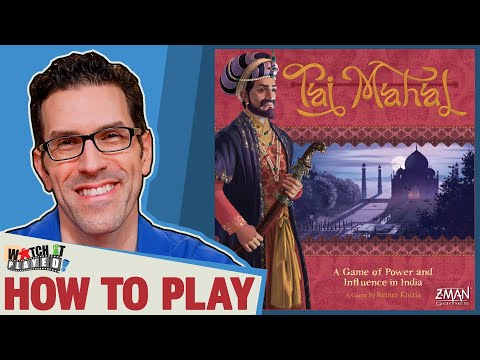
Taj Mahal - How To Play
- Enjoyed the bidding mechanism.
- Appreciated the old-school Euro feel.
- Strategic card play and hand management are key.
- Has depth beyond simple rules.
- Considered a good choice for a Euro classic.
- Can be 'brutal' and punishing if wrong decisions are made.
- The reviewer initially underestimated its complexity, calling it a 'brain burner'.
- Bidding for influence and placing Taj Mahals
- Provinces
Mechanics (from transcript analysis)
- Area Majority — Players compete for majority influence in provinces to place Taj Mahals and gain points.
- bidding — A core mechanic where players bid on influence over provinces by playing cards of a certain color.
- Hand Management — Players manage a hand of cards used for bidding and must strategically decide when to play them and when to withdraw.
- Set Collection — Collecting resources and special tokens like elephants or crowns.
- Variable player powers — Special council member abilities and bonus tiles provide different advantages.
Video topics + discussion points
Quotes (from this video)
- I'm gonna throw him under the bus
- You know I don't know if that bits getting old
- The game is phenomenal and it's built in such a way that it's just one of the most addictive video game experiences I've had in a long time
- that trailer came out and it spoke to me in the most perfect of ways
- I don't own the show so I thought I was gonna be up first
- You got to get your people to get in touch with his people
References (from this video)

Mechanics (from transcript analysis)
Video topics + discussion points
Quotes (from this video)
- Movie Tricks is really good. Movie Tricks is from Chitty Fox Games. It's a trick taker, but it's got a bit of a kick and I really like that.
- Severton is a game from Vlades Shaattle. You may have heard of Vlad Shaattle, but he's got a new game this year called Severton. It's the first time he's had a new game published for about 10 years. And a little bit like Dutch Resistance: Orange Shall Overcome, it's a cooperative game where you're trying to complete missions. And it's really, really good. And not many people are talking about it.
- The new version for me is an improved version of the game. So, if you like Ingenious or Genal, whatever you want to call it, then have a look at the 3D version. That was really good.
- we played this game called drop alter and I absolutely blitzed it. I mean I think I won I think I won six of five of the six rounds that we played or something like that.
- In general, I don't play abstract games. But there are certain ones which I do play and I do like.
- Project L is another really really good game and I really like Project L and uh and that is a completely abstract game.
- I dread the day when I have to play on Mars again because I don't have the time, mental energy, everything else to go back and relearn on Mars.
- Talisman. 34 year gap between playing it.
- as much as A Trespass Odyssey was the most complicated game that I've ever played and some of the rules were extremely confusing and we weren't sure of some of the rules after 25 games, that game had things in it which I have never had that experience from any other game ever.
- And I've heard that Kingdoms for Lawn offers a similar experience.
- But when I'm playing it solo, if I'm not live streaming it, my brain because of the weird memory issues that I have, literally gets to a point and I go up and it just stops and my short-term memory disappears and I'm like, I have no idea not only what I was doing, but where we are, what phase we're on, or anything like that.
- live streaming it and talking to the audience and keeping things going is the only way that I can actually get my brain to, you know, work and be able to cope with playing the actual game itself.
References (from this video)
- 15-year gap between plays
Mechanics (from transcript analysis)
Video topics + discussion points
Quotes (from this video)
- Movie Tricks is really good. Movie Tricks is from Chitty Fox Games. It's a trick taker, but it's got a bit of a kick and I really like that.
- Severton is a game from Vlades Shaattle. You may have heard of Vlad Shaattle, but he's got a new game this year called Severton. It's the first time he's had a new game published for about 10 years. And a little bit like Dutch Resistance: Orange Shall Overcome, it's a cooperative game where you're trying to complete missions. And it's really, really good. And not many people are talking about it.
- The new version for me is an improved version of the game. So, if you like Ingenious or Genal, whatever you want to call it, then have a look at the 3D version. That was really good.
- we played this game called drop alter and I absolutely blitzed it. I mean I think I won I think I won six of five of the six rounds that we played or something like that.
- In general, I don't play abstract games. But there are certain ones which I do play and I do like.
- Project L is another really really good game and I really like Project L and uh and that is a completely abstract game.
- I dread the day when I have to play on Mars again because I don't have the time, mental energy, everything else to go back and relearn on Mars.
- Talisman. 34 year gap between playing it.
- as much as A Trespass Odyssey was the most complicated game that I've ever played and some of the rules were extremely confusing and we weren't sure of some of the rules after 25 games, that game had things in it which I have never had that experience from any other game ever.
- And I've heard that Kingdoms for Lawn offers a similar experience.
- But when I'm playing it solo, if I'm not live streaming it, my brain because of the weird memory issues that I have, literally gets to a point and I go up and it just stops and my short-term memory disappears and I'm like, I have no idea not only what I was doing, but where we are, what phase we're on, or anything like that.
- live streaming it and talking to the audience and keeping things going is the only way that I can actually get my brain to, you know, work and be able to cope with playing the actual game itself.
References (from this video)

- Simple and straightforward mechanics
- Moves at a good pace
- Compounding scoring potential
- Strategic depth
- Tight endgame
- Good player interaction and blocking opportunities
- Evergreen game
- Aesthetically pleasing board and components
- Can take a few rounds to 'click'
- Potential for early game mistakes to be costly
- Some graphic design elements on cards could be smaller or clearer
- Building influence and trade routes in Mughal India
- India during the Mughal Empire
- Modern Art
- Ra
- Medici
- Castells
Mechanics (from transcript analysis)
- area control/influence — Players place palaces in provinces to gain influence and connect areas.
- auction/bidding — The game features 12 auctions where players compete for various rewards.
- Hand Management — Players manage a hand of cards used for playing in auctions.
- network and route building — Connecting palaces across provinces forms networks for scoring.
- Set Collection — Players collect sets of commodity tiles and advisor tokens for points.
Video topics + discussion points
Quotes (from this video)
- This is Taj Mahal.
- The object of the game is to score points and the main way to score points uh are twofold you're going to get a lot of points from connecting your palaces across this map and you're going to get a lot of points from collecting um these symbols here.
- Spite is is a good currency in this game.
- It is a lost almost a lost Gem of of his.
- This is an evergreen game for me this is never leaving my collection.
- If I were designing a game and trying to come up with a theme I would stay the hell away from actual historical settings I would I would invent a setting like you know aliens in space.
References (from this video)

- Can score points by connecting palaces across the map.
- Can score points by collecting symbols.
- Can score points from picking up tiles.
- Can score points from playing specific cards.
- Points are awarded for having the most of certain symbols when cashing out.
- Bonus tokens can provide additional benefits like drawing cards or straight points.
- Cards can be acquired by collecting two of a given advisor token.
- End-game scoring rewards players for the most colors of cards in their hand.
- White cards can only be played with another card of the same color.
- White cards cannot be played by themselves.
- Ties for having the most of a symbol do not grant the award.
- The crown mechanic is described as tricky and involves a palace on stilts that does not pick up bonus tokens.
- Auctions and connecting palaces
Mechanics (from transcript analysis)
- Area Control — Placing palaces on the board to claim provinces and potentially connect them.
- Auctions — There are 12 auctions over the course of the game, where players bid for province tokens.
- Card Drafting — Players can take two cards from a market after withdrawing.
- Hand Management — Players manage a hand of cards that are used for playing in auctions and for end-game scoring.
- Set Collection — Collecting multiple symbols to gain points.
Video topics + discussion points
Quotes (from this video)
- I need to be able to see otherwise I don't exist if I can't see myself.
- This is Taj Mahal. This is this is from the the golden age of uh circa 2000.
- The object of the game is to score points.
- Spite is is a good currency in this game.
- Very minimal endame scoring.
References (from this video)

Mechanics (from transcript analysis)
Video topics + discussion points
Quotes (from this video)
References (from this video)

Mechanics (from transcript analysis)
Video topics + discussion points
Quotes (from this video)
- the only constant is change
- jungkus games is my full-time career
- i want to make this digest of all games i've talked about on the site
References (from this video)

- grueling, strategic auctions
- varied routes and scoring options
- classic Knizia design with strong player interaction
- long play time (roughly 60-90 minutes); can linger
- some criticism of tile/icon differentiation
- trade, influence, and regional control
- India; auction and route-building game
- strategic bidding with long-term route planning
- Lost Cities
- Orango
Mechanics (from transcript analysis)
- Auction / Bidding — value and bid on areas around the table, with majority-based benefits
- auction bidding — value and bid on areas around the table, with majority-based benefits
- card-driven route advancement — cards and icons determine rewards as you push routes across provinces
- pass mechanics — passing yields different bonuses and dictates how auctions resolve
Video topics + discussion points
Quotes (from this video)
- it's a dig in for me
- the tactical decision space is really interesting
- this is going to be one of my go-to filler games
- the tipping point for every row and column is the funnest thing
- the dice are great
- this is a behemoth