












































Take Time Deep Dive
What the Community Thinks About Take Time
Take Time landed on multiple reviewers' year-end top-ten lists in 2025, a rare feat for a small cooperative card game with no theme and no miniatures. The Dice Tower's Camila and Z rated it 8.5 and 8 out of 10 respectively, with Camila calling it "such a great refreshing addition to the category" and Z declaring it "probably my favorite" limited-communication game. Tantrum House had three of their five panelists independently rank it their number-two game of the year. Board Stupid called it "really fun" after discovering it on a train ride, noting they play it at the end of every game day.
The consistent point across all channels: Take Time takes the meditative telepathy of The Mind and layers in structured puzzles similar to The Crew, making it more replayable and satisfying than either. A recurring warning accompanies that praise: the game's success depends entirely on group fit. The Dice Tower noted that players who struggled with Hanabi may face the same friction here, and Tantrum House observed that some groups sync up beautifully while others never quite click.
Core Mechanics That Define Take Time
Limited Communication and the Pre-Play Discussion Window
The core tension in Take Time lives in the gap between what players know and what they can say. Before anyone looks at their cards, the table has a free discussion phase: "whoever has the highest card should play here," or "let's aim for nines and tens in this segment." Once cards are in hand, all conversation stops. Players place numbered cards one at a time, face down, around a clock face divided into segments, trying to ensure that each segment's total is equal to or higher than the one before it.
Tantrum House noted that players with a trick-taking background bring useful instincts here: the thought process of anticipating what others hold, reading when to play high versus low, and deciding when to share information maps directly onto the game's demands. Players can also spend limited "gear tokens" to flip a card face-up, giving everyone a real data point at the cost of a finite resource.
Scenario and Campaign Structure
Take Time ships with ten envelopes, each containing four clock puzzles, for roughly 40 distinct challenges. Each envelope introduces new placement rules through a small rules sheet: a segment that must contain exactly one day card, a total that must land between 8 and 12, a prohibition on playing ones twos or threes anywhere. These constraints are revealed only after you open the envelope, so each session presents a genuinely new puzzle before cards are even dealt.
The Dice Tower's Z highlighted how this structure keeps players "excited to continue through the campaign." Tantrum House's Kevin noted that with 40 unique puzzles, "the difficulty seems to be getting harder and harder" as envelopes progress. Failed puzzles go into an "envelope of shame" to be revisited later, which means no puzzle is ever truly skipped, only deferred.
The Take Time Experience
Tense Then Euphoric
The emotional arc of a Take Time round is distinctly bimodal. The placement phase is quiet and personal: each player sits with their own uncertainty, committing cards without knowing whether their read of the table is accurate. The Dice Tower's Camila described feeling "that personal tension" of committing to a spot and not being able to take it back. Then cards are flipped one by one, and the room shifts entirely. The Dice Tower's Camila called these "high highs and low lows." The revelation that everything fell into place, or spectacularly did not, arrives fast and hits hard.
Breezy and Scalable
A single clock puzzle plays in roughly five to ten minutes. The Dice Tower's Z called it "the ultimate filler," noting that a determined group can play a single challenge in six minutes. This speed creates a particular kind of table energy: there is no downtime to lose focus, and a failed attempt can be reshuffled and replayed immediately. Tantrum House observed that players have run it as a quick opener for game nights, a family activity with rotating participants at a holiday gathering, and a late-night palate cleanser after heavier games. The brevity is a feature that makes the game fit almost anywhere.
What Makes Take Time Stand Out
Production That Elevates an Abstract Game
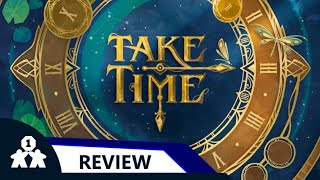
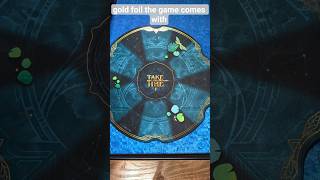
Take Time has no theme. The Dice Tower's Z acknowledged this directly: "there is no theme here," just a single opening line about clocks and then mechanics. Yet nearly every reviewer praised the physical game. Camila called the cover "gorgeous" and noted the publisher "went a little over the top with the gold foilings." Z agreed the production "goes a long way toward making it beautiful," especially valuable for a themeless abstract. Board Stupid's Wayne noted the game could easily have looked like a deck of Uno cards but instead looks elegant. That care in presentation signals, before a card is placed, that something worthwhile is inside.
Rewarding Mastery Without Replacing Luck
Take Time does not solve itself through repetition. The Dice Tower's Camila observed that "you feel yourself getting better at it as you play with the same group," but the game always retains a luck component because only half the deck is dealt each round, and which cards appear is never predictable. Tantrum House's Will noted that "the gameplay experience, regardless of what the outcome is, is interesting every single time." Playing the same clock repeatedly never feels like repetition because the challenge is always reconstituted from a fresh deal.
Potential Drawbacks
Group Dependency Can Break the Experience
Multiple reviewers flagged this as the game's most significant limitation. The Dice Tower's Z drew a direct comparison to Hanabi: "if Hanabi is a game that didn't quite work for you or someone in your game group didn't get it, you might have the same issue here." Tantrum House's Ryan noted playing with some groups where the team synced up beautifully and with others where they "had never won a game" regardless of how carefully everyone tried. When one player reads the table very differently from the rest, the puzzle breaks down in ways that no rule change or strategy session can fully prevent.
The Placement Phase Can Feel Passive
The Dice Tower's Z raised a structural critique: after your own turn in a round, there is no way to engage with what other players are doing. "There's no interaction with us two," Z said, until the reveal. The internal tension of your own hand is real, but watching a teammate place a card while being unable to respond can feel inert rather than suspenseful. Camila pushed back, arguing that the reveal phase delivers a satisfying climax precisely because of that silence, but Z's point stands for players who prefer cooperative games where every turn carries shared stakes visible in real time.
If You Enjoy Take Time
Players who love Take Time frequently mention The Mind as the closest relative, though most reviewers agree Take Time offers more structure and variety. The Crew: The Quest for Planet Nine came up repeatedly as a tonal companion, especially for players who enjoy cooperative card games with mission-based progression. Hanabi was also cited multiple times as a game occupying the same design space. For players drawn to the limited communication angle specifically, The Gang, a cooperative Texas Hold'em variant, was recommended by Board Stupid as a game using a similar mechanic in a poker wrapper. Tantrum House noted that players with trick-taking experience tend to adapt quickly, making games like The Fellowship of the Ring Trick-Taking Game natural companions for the same audience.
What Reviewers Are Saying
"It feels like a gamified version of The Mind. It's like they took that game and, but here's some rules and some form to it, which I really appreciated. It takes it above and beyond and gives that little bit more placement rules, a little bit more variation in the game."
— The Dice Tower
"The gameplay experience, regardless of what the outcome is, is interesting every single time, which is pretty cool. I also like that you can spend a little bit of time, play a couple chapters, or you can spend an evening if you want to."
— Tantrum House
"We keep playing it. Every time after a game day we always try to fit in a game of Take Time because we really love it. And it was a big, big one for us. Around 23 to 24 pounds MSRP, great value for 40 scenarios."
— Board Stupid